Chris Hall
Personal Trainer and Founder of Hall Personal Training
Exercise
November 18, 2026
The best gym routine for beginners is a full-body workout three times a week, such as Monday, Wednesday and Friday. Alternate between two simple workouts of five exercises each, do two or three sets of eight to 12 reps, and add weight when the last few reps start to feel easy. That is genuinely all you need to make good progress for your first few months.
Below you will find the full plan, how heavy to lift, when to move the weights up and the mistakes we see most often from people starting out.
Walking into a gym full of machines, racks and mirrors can feel overwhelming. The good news is that you can ignore most of it. As a beginner, your time is best spent on a handful of movements that work lots of muscle at once:
Add some walking or cycling on the days in between and you are already meeting the NHS physical activity guidelines, which recommend 150 minutes of moderate activity a week plus strength work for all the major muscle groups on at least two days.
Many popular plans split the body into chest day, back day and leg day. That can work for experienced lifters who train five or six times a week, but for beginners a full-body routine is the better choice.
A review of training frequency research found that training each muscle group at least twice a week gives better results for muscle growth than once a week. With a split routine of three days, each muscle only gets worked once. With three full-body sessions, every muscle gets worked three times, and you practise the key movements far more often, which is exactly what beginners need.
Three days a week is the ideal starting point, with a rest day between each session. That gives your muscles time to recover while keeping the habit going. If three is too many to fit around work and family, two sessions a week still works well. It just takes a little longer.
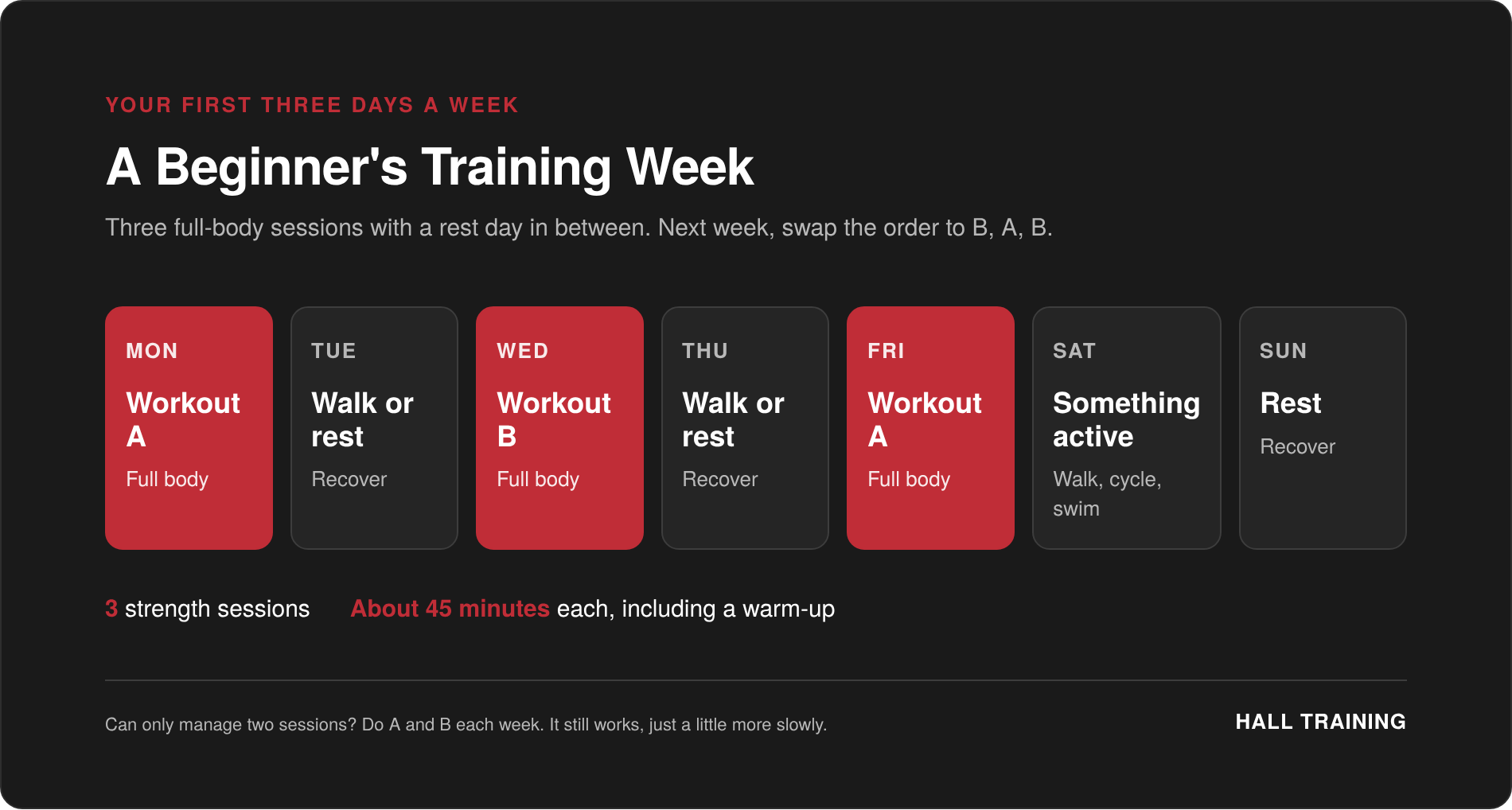
Alternate between Workout A and Workout B. In week one you do A, B, A. In week two you do B, A, B, and so on.
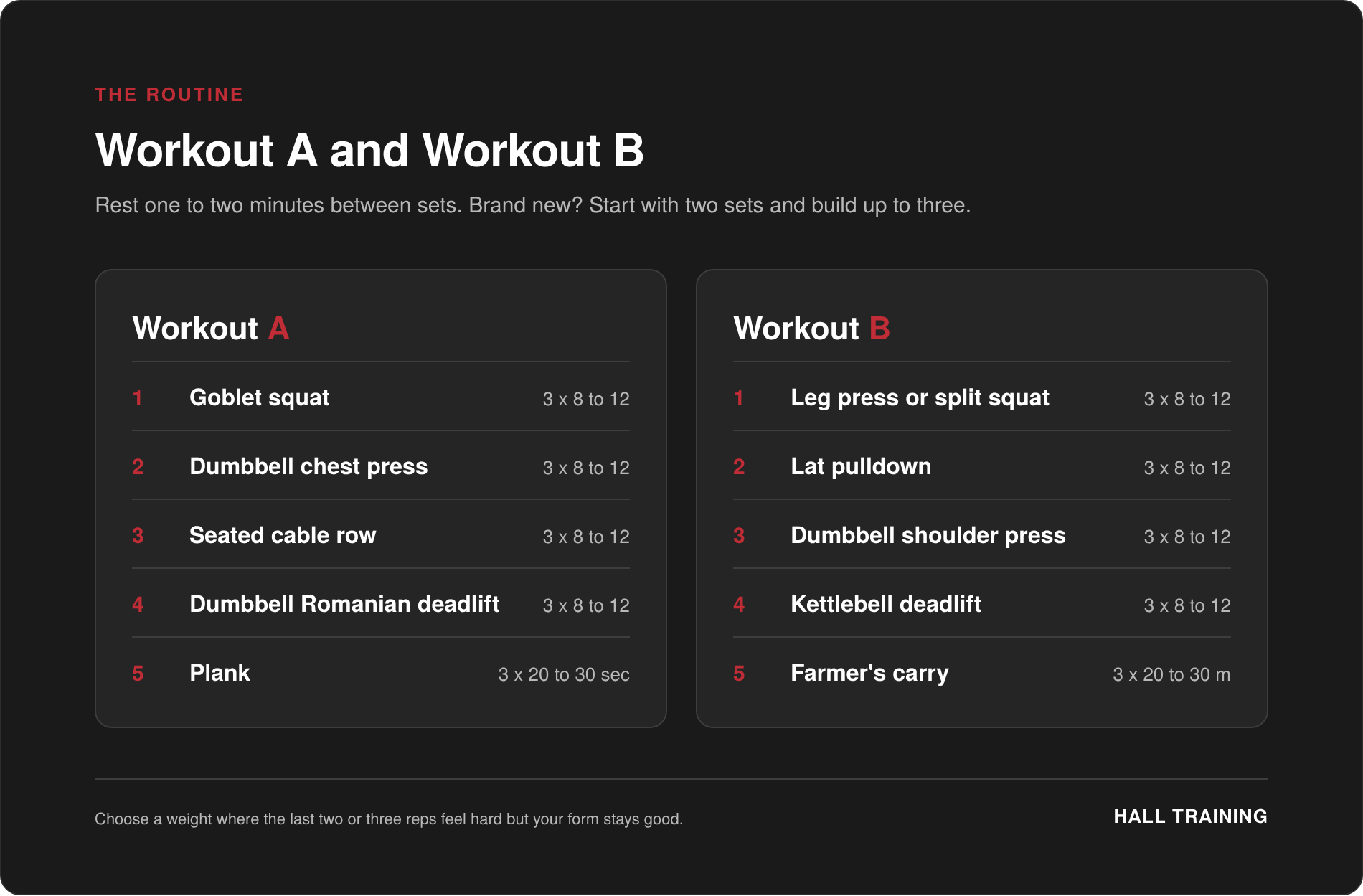
Rest for around one to two minutes between sets. Each session should take about 45 minutes including a warm-up. If you are brand new, start with two sets of each and build up to three over the first couple of weeks.
If your gym is short on kettlebells, swap them for dumbbells. A kettlebell workout for beginners uses the same movement patterns, so you can mix and match.
Heavy enough that the last two or three reps of each set feel hard, but you could still manage one or two more with good form. If you could keep going for another five or six reps, it is too light.
Most beginners err on the light side. In a study of novice lifters, people choosing their own weights picked loads of only 42 to 57% of their maximum, which the researchers concluded wasn’t enough to build muscle. That is completely understandable when everything feels new, but it is worth knowing that a little more challenge is usually needed.
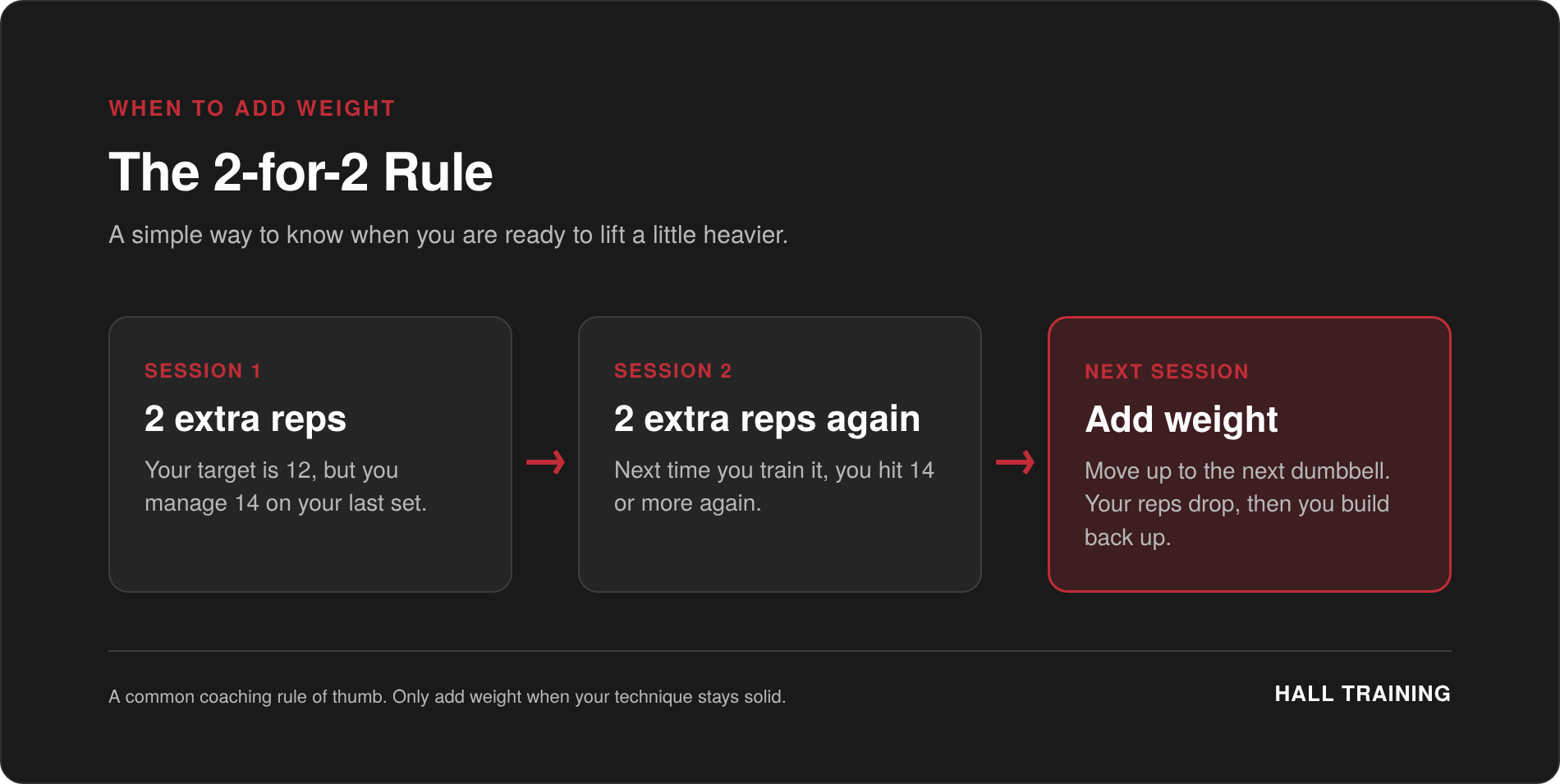
A simple rule that coaches often use is the 2-for-2 rule. If you can do two more reps than your target on the last set of an exercise, and you manage that in two sessions in a row, it is time to increase the weight.
For example, if your target is 12 reps and you hit 14 on your final set two workouts running, move up to the next dumbbell or add a small plate. Your reps will drop back down, and you start building up again from there.
Spend five minutes on a bike or rower to get warm, then do one or two lighter sets of your first exercise before the real thing. Afterwards, a few minutes of easy walking and gentle stretches for anything that feels tight is plenty.
On that last point, our post on whether muscle soreness means a good workout explains why aching isn’t a reliable guide to progress.
You can absolutely follow this routine on your own. But a coach speeds things up, especially in the first few months when you are learning the movements.
A 12-week study on supervised training found that people coached through every session lifted heavier weights, increased them faster and ended up stronger on the squat and bench press than people following the same plan alone. A coach also spots technique problems before they turn into aches or injuries. Strength training done well is protective in its own right, with a review of 25 trials finding that it cut sports injuries to less than a third.
If you would rather train at home, our guide to writing the best home training programme covers how to build a plan around the space and kit you have.
At our Deddington and Kidlington studios, you train in small groups of no more than six, each following your own programme. Your coach writes the plan, shows you every exercise, sets the right weights and tells you when it is time to move up, so you get all the benefits of a routine like this without the guesswork or the gym floor nerves.
If you would like a coach to build your first routine with you, book a call with our team and we will talk through where you are starting from and what you want to achieve.
Chris Hall
Personal Trainer and Founder of Hall Personal Training
you may also enjoy...
Exercise for Men over 40: How to Get Stronger without Getting Injured
The best exercise for men over 40, how often to lift and how to avoid injury when returning to training. Practical advice from our Oxfordshire coaches.
Body Recomposition: Can You Lose Fat and Build Muscle at the Same Time?
Can you lose fat and build muscle at the same time? Yes. Our coaches explain body recomposition, who it suits and how to track progress beyond the scales.
How Many Hours Per Week Should You Exercise? The Science-Backed Answer
We break down exactly how to split your time between strength and cardio for maximum health, longevity, and results.

How Many Steps Should I Actually Walk a Day?

The Post-Plunge Protocol: Why Temperature Is the Missing Key to Red Light Therapy Success
Clear answers
Better training
Around 45 minutes, including a warm-up, is plenty. Longer isn’t better when you are starting out. Consistency matters far more.
Both have a place. Machines are a good way to learn how an exercise should feel, while free weights like dumbbells and kettlebells train your balance and coordination too. This routine uses a mix of both.
Most beginners feel stronger within two to four weeks. Visible changes usually take two to three months of consistent training.
Most of it, yes, with a pair of adjustable dumbbells or a kettlebell. Swap the cable row and lat pulldown for dumbbell rows, and the leg press for split squats.