Chris Hall
Personal Trainer and Founder of Hall Personal Training

Exercise Wellness
July 3, 2026
“Just tell me how much exercise I actually need.”
If there’s one fitness question we get asked more than any other at Hall Training, it’s this. It’s a fair question, too. Most people who walk through our doors already know exercise is good for them. What has held them back up until this point isn’t a lack of motivation – it’s confusion.
Some have never exercised consistently before but know it’s time to start. Others used to be fit, but years of work, raising a family, and life’s endless commitments have gradually pushed exercise down the priority list.
Eventually, they reach a point where they decide:
“Right… it’s time to get back into it.”
And then the questions begin:
If you’ve ever asked yourself any of those questions, you’re certainly not alone.
The problem is that everyone seems to have a different answer. One expert tells you to walk 10,000 steps a day. Another says lifting weights is all you need. Someone else insists HIIT is the secret to longevity.
Then you have the official NHS and UK Government guidelines recommending:
These guidelines are an excellent starting point, but they still leave most people wondering: If I only have a few hours each week, how should I spend them?
Because let’s be honest… Time is arguably our most valuable commodity. Most of us aren’t deciding between exercising or sitting on the sofa. We’re deciding between exercising or spending time with our kids, our partner, getting through the housework, life admin, or simply catching our breath after a busy day at work.
If you’re going to invest your time into exercise, you want to know you’re getting the biggest return possible. Fortunately, thanks to one of the largest studies ever conducted into exercise and longevity, we now have a much clearer answer.
Talking of time, if you are reading this on your lunch break and just want the golden nuggets of information, here’s exactly what the latest science says you should be doing:
But if you have 5 minutes and want to know the “why” behind these numbers? Let’s dive into the data – the stuff I love!
In 2026, researchers from Harvard published one of the largest studies ever, looking at resistance training and long-term health.
Over 147,000 adults were followed for almost 30 years. Every two years researchers recorded how much strength training participants completed before tracking deaths from cardiovascular disease, cancer, dementia, respiratory disease, and other causes. Unlike many studies that simply ask whether lifting weights is good for you, this study asked a far more useful question: How much strength training gives us the biggest health benefit?
The answer was remarkably consistent. Across almost every major health outcome, the sweet spot landed between 90 and 120 minutes of resistance training per week. Not three hours. Not five. Just an hour and a half to two hours each week. For most people, that’s simply two or three gym sessions lasting around 30 to 45 minutes.
They found that the biggest health benefits from strength training alone peaked between 90 and 120 minutes per week. Here is exactly how that lifting time impacts your body and health:
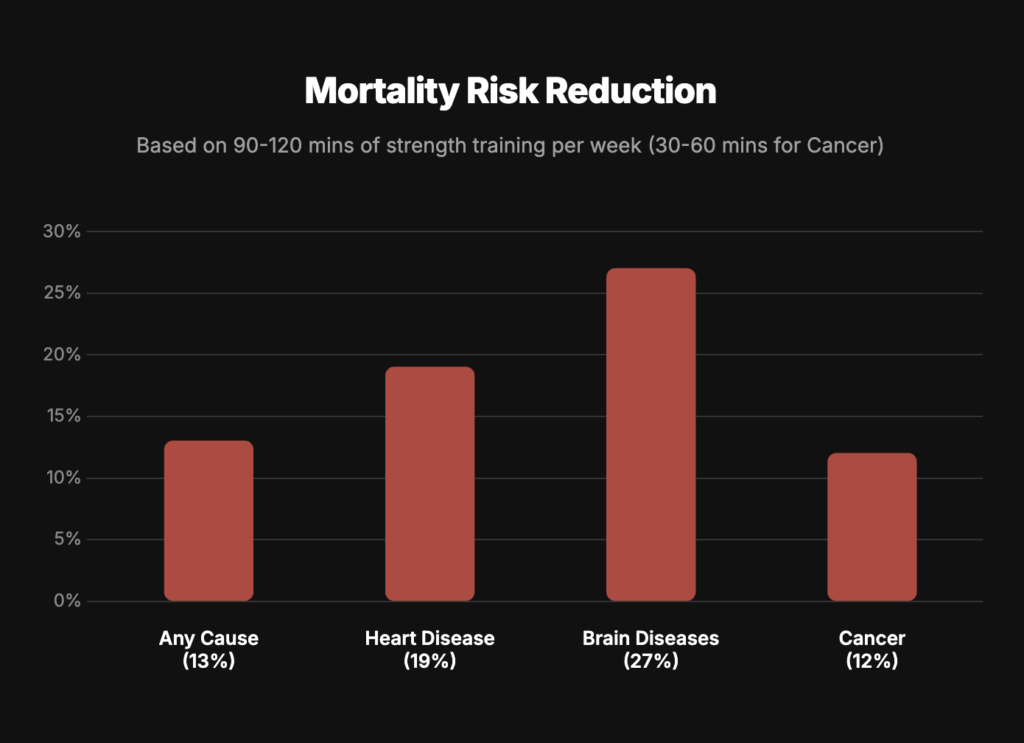
These are some impressive numbers, but they become even more meaningful when you understand why.
This effect was highly significant and one of the strongest findings related to brain health. Participants completing around two hours of strength training each week had a 27% lower risk of dying from neurological diseases, including Alzheimer’s disease and dementia. With Alzheimer’s currently standing as one of the UK’s leading killers, anything that reduces this risk is a huge win. Scientists believe resistance training actively causes structural changes in the brain that slow disease progression.
The same 90 – 120 minute window was linked to a 19% lower risk of dying from heart disease. Perhaps even more interestingly, this benefit remained even after researchers accounted for aerobic exercise. The lifting itself delivered the benefit, independent of cardio. And unlike overall mortality – where the benefits drop off going beyond two hours per week – the data suggests the heart benefits keep climbing at higher volumes rather than diminishing.
If you’re terrified of cancer but hate lifting, there is good news. The sweet spot here is actually much lower and in fact produced the most surprising result… You don’t need much resistance training. Just 30-60 minutes per week reduced cancer mortality by around 12%. Interestingly, those benefits appeared to plateau and eventually decline at around 150+ minutes. Researchers suggested this may relate to increased levels of IGF-1 (Insulin-like Growth Factor-1), a hormone linked to elevated cancer risks in older adults, although more research is needed before drawing firm conclusions.
Overall, lifting weights for 90 to 120 minutes a week leads to a 13% lower risk of dying from any cause compared to people who never lift.
This is where many people get caught out. We’ve almost been conditioned to believe that if some exercise is good, then more must automatically be better.
The Harvard study suggests that isn’t necessarily true. For general health and longevity, the majority of the benefits level off once you reach around 120 minutes of resistance training each week. That doesn’t mean lifting more is harmful. It simply means you aren’t gaining substantially greater health benefits from adding more hours in the gym.
Of course, if your goal is bodybuilding, powerlifting, or packing on serious muscle, this rule changes. You will almost certainly need double this amount of training. But that’s another conversation, as this study wasn’t measuring who had the biggest biceps or strongest deadlift – it was measuring who lived the longest.
There’s a huge difference between training for performance and training for health.
If strength training is the foundation of healthy ageing… cardio is the engine that drives longevity.
This was arguably the biggest takeaway from the research. When researchers compared aerobic exercise with resistance training alone, they found people who achieved sufficient cardio reduced their mortality risk by between 26% and 43%. By comparison, strength training alone reduced mortality by around 7 – 11%.
But here’s the really exciting part.
The people who combined both strength training and cardio had the greatest health outcomes of all. They experienced around a 45% lower risk of dying from any cause compared to people doing neither.
In other words… Don’t think of strength and cardio as competing with each other. Think of them as teammates.
Absolutely. Walking is still one of the best forms of exercise available.
It’s free. Accessible. Gentle on the joints. Easy to recover from. And, as I discussed in our article on How Many Steps Should I Actually Walk a Day?, you don’t need to hit 10,000 steps before you start seeing meaningful health benefits.
The catch? Walking simply requires more time, and here’s where it gets really interesting: not all cardio is created equal.
If you’re short on time, exercise intensity becomes incredibly important.
If you look at the data comparing minutes of activity for equivalent cancer reduction, you’ll see a stark contrast. Gentle walking requires roughly 150 minutes to achieve the same risk reduction that you can get from just a few minutes of Vigorous Intensity Exercise (VIE).
Research comparing different forms of activity found you need approximately:
…to achieve similar reductions in cancer risk.
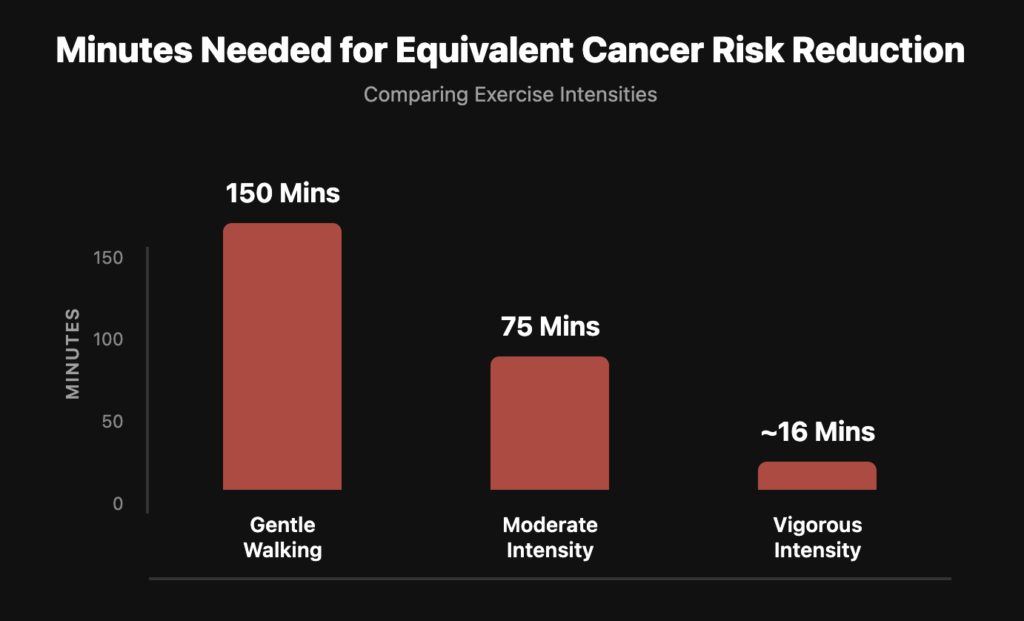
Walking absolutely works. Moderate exercise works too. But if your diary is already bursting at the seams, vigorous exercise is exponentially more efficient for disease reduction, making it the ultimate “longevity drug” and offering an incredible return on your investment.
Many longevity researchers now describe improving your VO₂ Max as the closest thing we currently have to a longevity drug. VO₂ Max measures how efficiently your body delivers and uses oxygen during exercise. The fitter your cardiovascular system becomes, the lower your risk of heart disease, diabetes, dementia, and premature death.
One of the reasons vigorous exercise is so effective is because it dramatically improves cardiorespiratory fitness in a relatively short amount of time. But that’s only part of the story.
During vigorous exercise your muscles produce lactate. For years lactate was wrongly blamed for causing muscle soreness and burnout, which we now know isn’t the case as something far more interesting is occurring…
Lactate acts as a signalling molecule. It crosses the blood-brain barrier and stimulates the release of Brain-Derived Neurotrophic Factor (BDNF), often referred to as fertiliser for the brain. BDNF encourages new brain cell growth, strengthens neural connections, and supports memory and learning.
One fascinating study even showed older adults increasing the size of their hippocampus – the brain’s memory centre – by around 10% after a year of regular exercise.
As we age, our heart naturally becomes smaller and stiffer. Remarkably, one study found previously sedentary 50-year-olds who completed two years of vigorous interval training developed hearts structurally resembling those of people around 20 years younger. That’s an extraordinary reminder that many aspects of ageing are more reversible than we once believed, which is exactly why it is never too late to start.
When people hear “vigorous exercise”, they often imagine exhausting gym sessions or needing to be an athlete, but the reality is far simpler. Here is how to get your vigorous cardio in:
Rather than asking yourself, “How many days should I exercise?” You should instead ask yourself two simple questions:
I believe five hours a week is the gold standard target. It maximises the benefits without making you a slave to exercise. But if you have less time, here is how you should split it up:
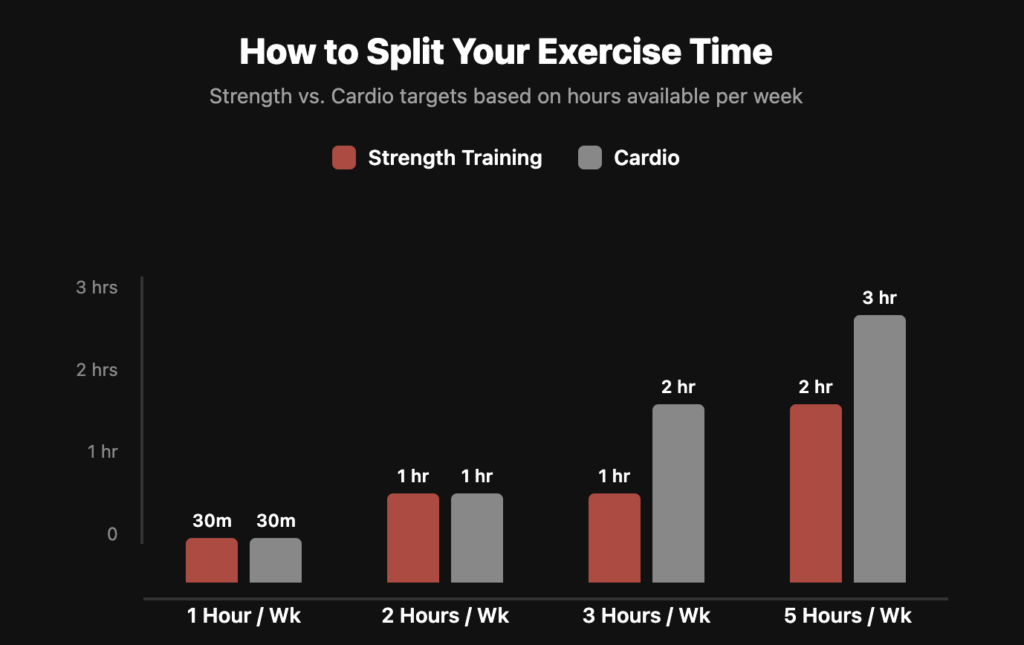
💡 Hall Training Tip: If finding a full hour feels impossible, split it up. Two 30-minute strength sessions often produce better consistency than trying to squeeze in one long workout.
Remember…
The study found that even people completing less than one hour of strength training each week still reduced their risk of dying compared with people who did nothing at all.
Something will always beat nothing.
Exercise doesn’t have to be confusing. If you’re looking for the biggest return on your investment of time, the latest evidence is refreshingly simple.
Aim for:
✅ 90-120 minutes of strength training each week
✅ Three to four hours of cardio
✅ Include some vigorous exercise where appropriate
✅ Walk as much as you reasonably can – check out my blog on the exact number of steps you should aim for (spoiler! it’s not 10,000)
From there, just look for creative ways to add more daily movement that doesn’t drain your schedule.
Could you do more? Of course. But unless you’re training for a marathon, bodybuilding competition, or another performance goal, you probably don’t need to.
At Hall Training, we’ve always believed exercise should fit around your life – not become your life, and our members live by this, with the vast majority seeing great results from just two sessions per week. After all, the best programme isn’t the one that’s scientifically perfect. It’s the one you’ll still be following five, ten, and twenty years from now.

Chris Hall
Personal Trainer and Founder of Hall Personal Training
you may also enjoy...

Why Most People Never Start Exercising (Even When They Really Want To)

How Many Steps Should I Actually Walk a Day?

Why Women Should Cold Plunge – and the Benefits You’ll See
is cold exposure safe for women?

Vitamin D in Winter: Why Your Levels Drop and How to Optimise
beyond just sun and supplements
-200x300.png)
Garlic vs Vampires: The 2025 Scientific Update
Big Garlic doesn’t want you to know this vampire secret