Chris Hall
Personal Trainer and Founder of Hall Personal Training
Exercise
November 4, 2026
Yes, you can. Body recomposition means losing fat and building muscle over the same period, so your shape changes even if your weight barely moves. It works best for beginners, people returning to training and anyone with a bit more fat to lose, and it comes down to three things: regular strength training, enough protein and a sensible approach to food.
For most people who walk through our doors, recomposition is a far more realistic goal than chasing a number on the scales. Here is how it works, who it suits and how to tell whether it is happening.
Most traditional advice splits the year into two phases. You either eat more to build muscle (often called bulking) or eat less to lose fat (cutting). Body recomposition, or body recomp for short, does both at once.
Because you are adding muscle while losing fat, your overall weight may change slowly or hardly at all. What does change is what that weight is made of. Clothes fit differently, your waist gets smaller and you get noticeably stronger.
It used to be seen as something only complete beginners could manage. The research says otherwise. A 2020 review in the Strength and Conditioning Journal found that recomposition has been shown in a wide range of people, including those who already lift weights, as long as they combine progressive strength training with good nutrition.
One of the clearest examples comes from a 2016 study at McMaster University. Forty young men ate well below their energy needs for four weeks while training hard six days a week. The group eating more protein gained an average of 1.2 kg of lean mass and lost 4.8 kg of fat. The group eating less protein lost 3.5 kg of fat but gained almost no lean mass.
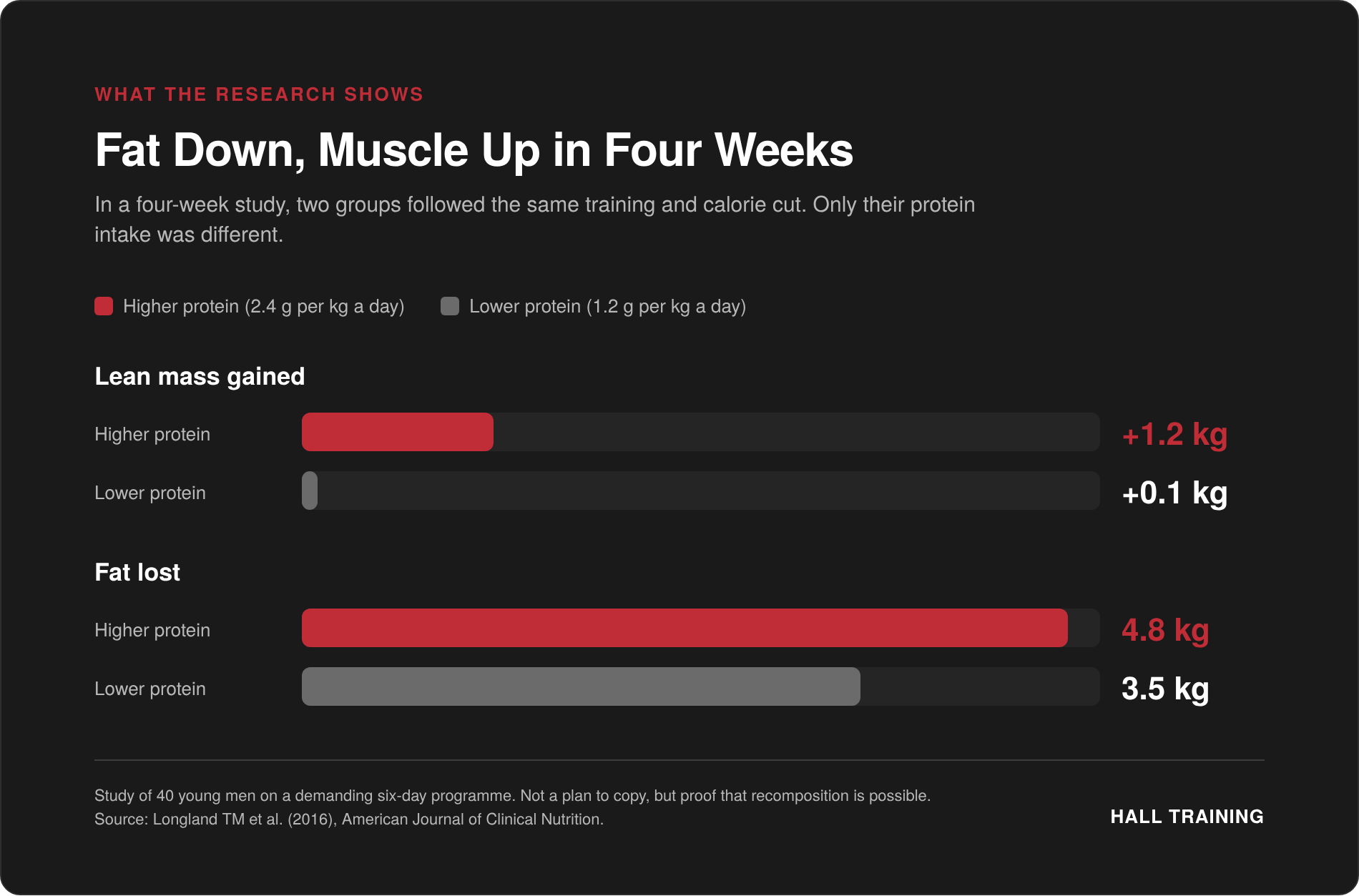
That study used a very demanding programme and a big calorie cut, so it isn’t a plan we would ever suggest copying. What it does show is that muscle can grow while fat comes off, and that protein makes a real difference to the result.
Almost anyone can improve their body composition, but some people will see it happen faster and more clearly than others.
If you have never followed a proper strength programme, your body responds quickly to the new challenge. This is the group most likely to see muscle go on and fat come off at the same time, often within the first few months.
If you lifted weights years ago and stopped, strength tends to come back faster than it took to build the first time. We see this regularly with members who used to play sport or train in their twenties and thirties.
Having more stored energy to draw on makes it easier for the body to fuel muscle growth while eating a little less. Progress on the scales may look slow, but the tape measure often tells a different story.
If you have trained consistently for years and are already fairly lean, recomposition is still possible, but it is slower and needs a more precise approach to training and food.
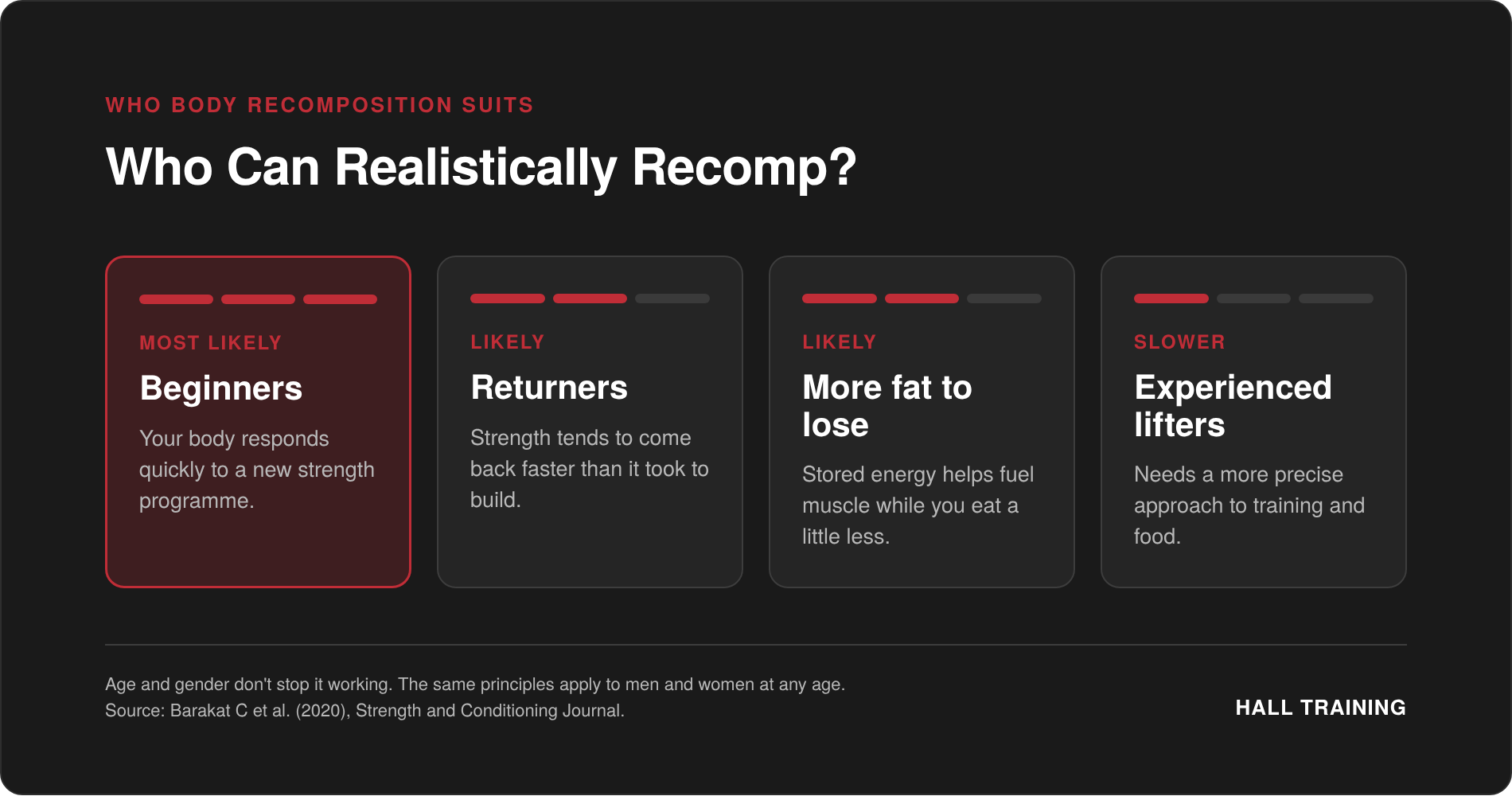
Yes. The principles are exactly the same for men and women, and age doesn’t stop it working. A review of 49 studies on adults over 50 found that people who followed regular strength training for around 20 weeks gained an average of about 1.1 kg of lean mass. That matters because we all lose muscle as we get older unless we give it a reason to stay.
This is one of the main reasons we focus on strength rather than weight loss alone. Our members range from 40 to 78, and for many of them, keeping or rebuilding muscle while losing a little fat is exactly the change they need. For women going through perimenopause or menopause, protecting muscle becomes even more important as hormones change.
Strength training is the part that tells your body to build and keep muscle. Without it, eating less tends to take muscle away along with fat. A good recomp programme usually includes:
A review of training frequency research found that working each muscle group at least twice a week gives better results for muscle growth than once a week. The NHS physical activity guidelines also recommend strength work on at least two days a week, alongside 150 minutes of moderate activity.
Endless cardio isn’t required. It has its place, but if it leaves you too tired to lift well, it can hold back the muscle side of the equation.
Protein is what your body uses to repair and build muscle, and it helps you feel full when you are eating a little less. A major review of 49 trials found that the benefit of extra protein on muscle levelled off at around 1.6 g per kilogram of body weight per day.
For a 70 kg person, that is roughly 112 g a day, spread across three or four meals. Our guide to how much protein you need shows you how to work out your own target and simple ways to hit it.
A small calorie deficit, or eating roughly what your body needs, tends to work best. Cut too hard and you will feel tired, train poorly and risk losing muscle. Eat too much and fat loss stalls.
You don’t need to weigh every meal. Building each plate around a good source of protein, adding plenty of vegetables and cutting back on the snacks and drinks that add up without filling you up is a good place to start. Sleep matters too. Recovery happens overnight, and our post on why sleep matters explains why it is easy to overlook.
During recomposition, losing a kilo of fat and gaining half a kilo of muscle shows up as only half a kilo on the scales. Over a few weeks, it can look like nothing is happening, even when your body is changing well. Water, salt and the time of day can also shift your weight by a kilo or more.
That is why we encourage members to track progress in a few different ways:
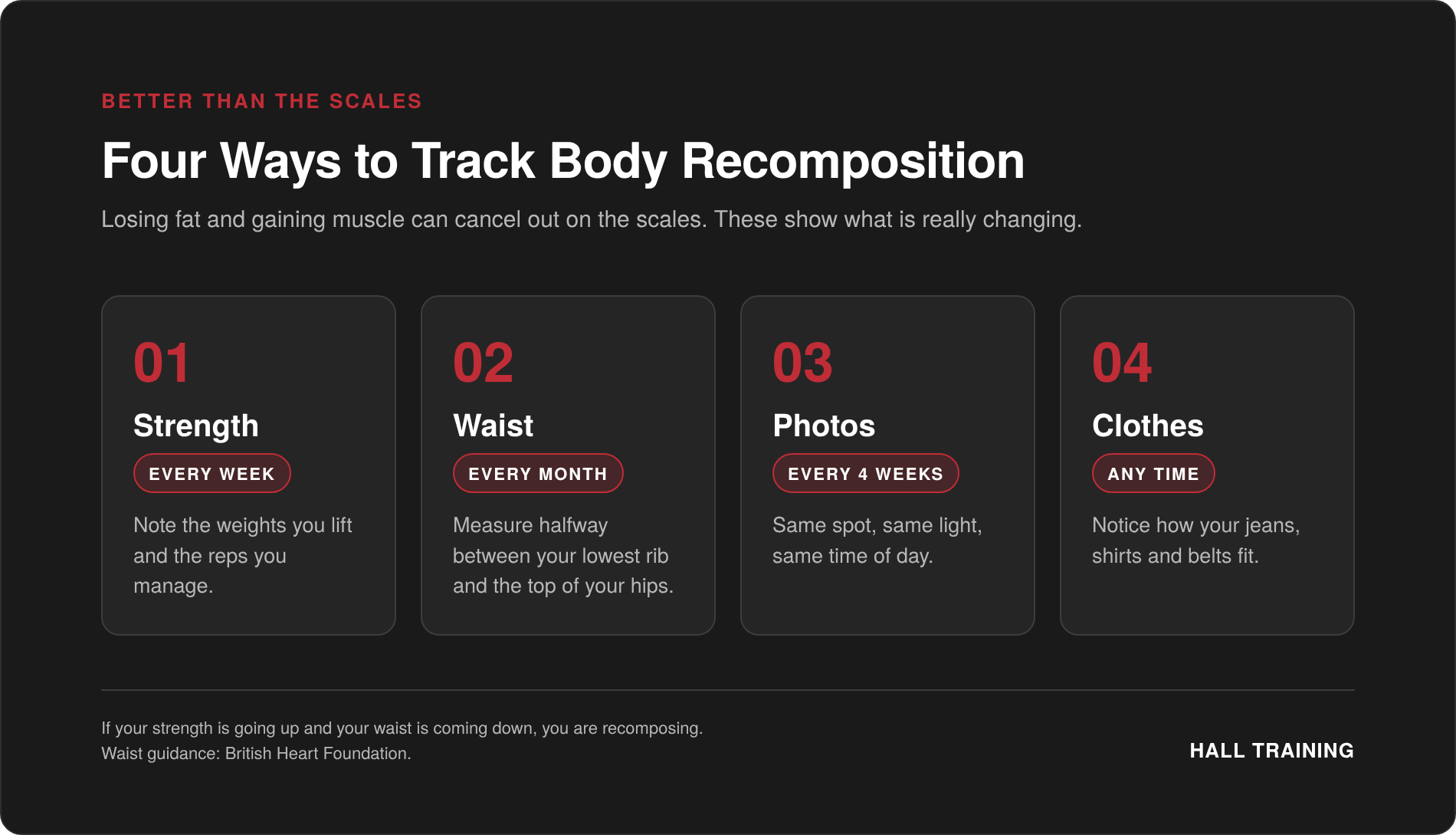
If your strength is going up and your waist is coming down, you are recomposing, whatever the scales say.
Most people notice they are getting stronger within a few weeks. Changes in how clothes fit usually follow over the next two to three months, and bigger visible changes build over six months to a year. Everyone is different, so treat that as a guide rather than a promise. The people who see the best results are almost always the ones who keep turning up week after week.
At our Deddington and Kidlington studios, you train in small groups of no more than six people, each following your own programme. Your coach plans every session, checks your technique and increases the challenge when you are ready, so the strength side of recomposition is taken care of. We also help you set realistic protein targets and track the measures that actually show progress.
If you would like to lose fat and get stronger without obsessing over the scales, book a call with our team. We will talk through where you are now and build a plan that fits your week.

Chris Hall
Personal Trainer and Founder of Hall Personal Training
you may also enjoy...
How Many Hours Per Week Should You Exercise? The Science-Backed Answer
We break down exactly how to split your time between strength and cardio for maximum health, longevity, and results.

How Many Steps Should I Actually Walk a Day?

The Post-Plunge Protocol: Why Temperature Is the Missing Key to Red Light Therapy Success
How Much Is Personal Training at Hall Training? The Complete Cost & Value Guide
why we’re comfortable being the premium choice for personal training in Oxfordshire

The Ultimate Guide to Ice Bath Timing: When Cold Therapy Actually Works (Science-Backed)
why the “before vs. after” debate misses the point – and how to time your cold exposure for maximum results
Clear answers
Better training
For most beginners and people returning to training, yes. It protects your muscle and avoids the low energy that comes with strict dieting. Cutting can make sense for experienced lifters who want to lose fat quickly, but it is harder to sustain.
Absolutely. Women respond to strength training and protein in the same way as men. Lifting weights won’t make you bulky. It helps you build a stronger, leaner shape.
Look for rising strength, a smaller waist measurement and clothes fitting differently, even if your weight stays about the same.
Not necessarily. Many people make good progress by focusing on protein, eating mostly whole foods and keeping portions sensible. Tracking for a few weeks can help if progress stalls.