Chris Hall
Personal Trainer and Founder of Hall Personal Training
Exercise Mindset Wellness
July 30, 2017
Following on from his last blog post on Hypertrophy mistakes everyone makes and how to avoid them, our personal trainer George looks at five key factors for exercise selection. A warning, this one is pretty in-depth, but will be perfect for anyone looking to improve their anatomy or hypertrophy knowledge. If it goes over your head, don’t panic! It’s up to your personal trainer to have this knowledge and make it work for you.
You’ve all heard of programme design, but how about exercise design? It’s probably not something you’ve come across, but hopefully come the end of this blog post you’ll have a few more tools in your belt to start tinkering with some of your favourite exercises. Heck, you might even need to throw some out completely!
Just to be clear before we begin, using only one or two of the following factors to explain something is likely going to get you into trouble, the key is to understand all pieces of the pie. After all, if all you have is a hammer, everything looks like a nail.
Most of these topics aren’t mainstream and they’re pretty ‘un-Instagramable’ – so, settle down, buckle up and prepare to have your mind-blown!
I’ve popped in a couple questions just to lighten things up – you’ll find the answers at the very end.
Joint Mechanics
Understanding joint mechanics gives you an indication of where an exercise increases and decreases in perceived weight throughout a movement.
It’s important to know the distance of the load from the axis, in our case, the joint; the further the weight is from the joint, the heavier the load ultimately becomes, so more force has to be imparted by that muscle. This is effectively what moment arms are.
A note on cables; cables create a constantly changing force angle on the lever (arm). That is, the load will appear to be heaviest when the cable is at 90o to the arm – play around with this yourself and let me know what you find.
Example: A dumbbell fly is fundamentally the same as a dumbbell press but with the lower arm extended, increasing the moment arm and making the load ‘heavier’.
Question 1: Which creates more torque at the joint; 5kg held horizontally at 0.5m or 5kg held horizontally at 1m?
(hold that thought, answers can be found below)
Muscle Mechanics
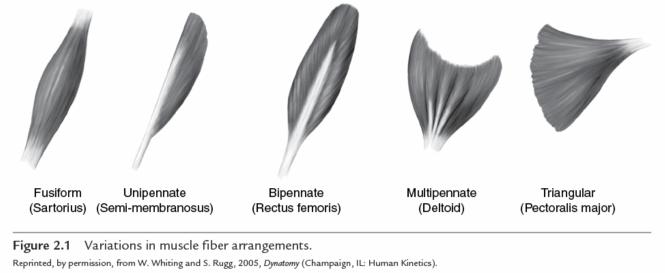
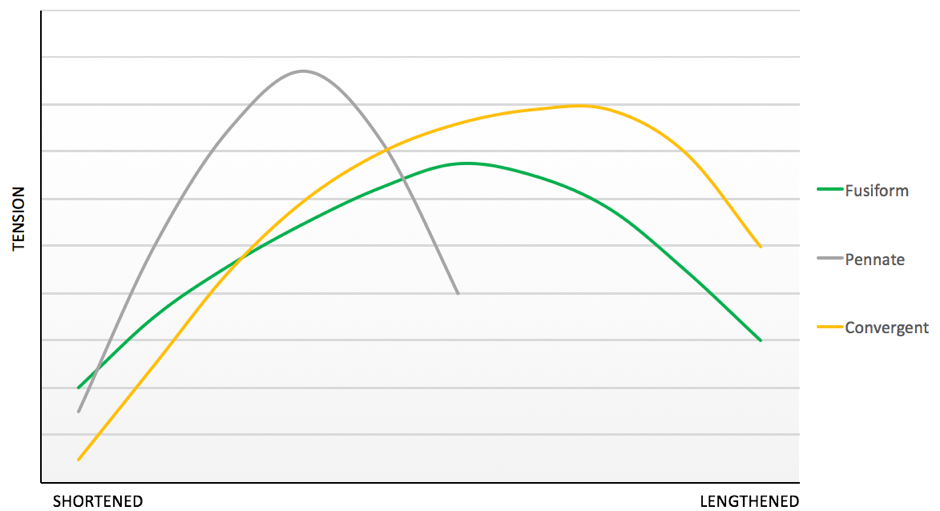
A muscle is not a muscle! Throughout the body, we have a number of different muscle types, and I’m not talking fast twitch vs. slow twitch here. Muscle fibres only pull in the direction in which they run, due to fibre direction and insertion points, each type differs in where its max strength lies.
Fusiform – e.g. Biceps
Pennate – e.g. Quadriceps, Hamstrings, Triceps, Deltoids
Convergent – e.g. Pectorals, Latissimus Dorsi
Resistance Profiles
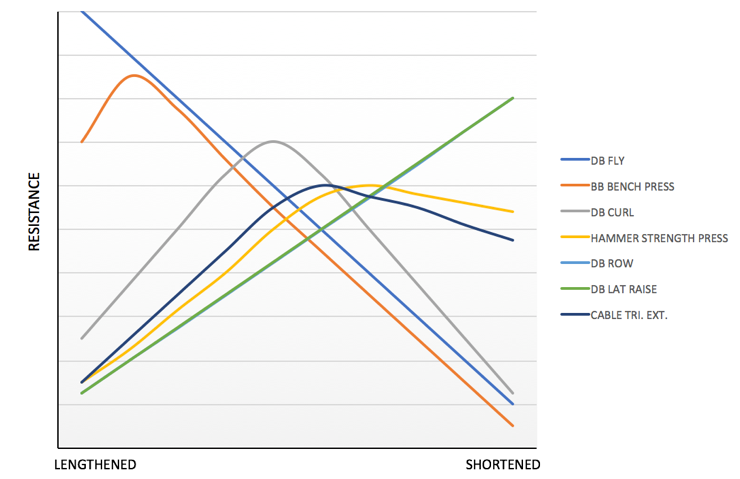
Resistance profiles shows how tension/force changes in the muscle throughout the range of motion of a particular exercise in isolation.
Going back to our above example, a dumbbell fly is increasingly heavier the further the load (weight) gets from the joint, and lighter the closer it becomes.
Strength Curves
The typical bell curve we all associate with strength curves is correct, well 80% correct. However, the muscle mechanics we spoke about earlier have the ability to shift our strength curve more toward an extreme range advantage, shortening the curve entirely or increasing the total peak tension.
Question 3: How does the strength curve for a pennate muscle differ from the others?
Neuromechanics
What you intend to do with the weight is vital to where tension is placed! A steady and controlled movement of an object has a constant mass throughout, whereas acceleration causes something to feel heavy from the start and lighter as it begins to move.
In order to overcome some gaps caused by all four of the previous factors, we can add in the use of momentum and design a more effective exercise. Just to add; ‘explosive’ and ‘accelerating’ do not mean throw!
Example: Dumbbell lateral raises are ridiculously hard at the top. We can accelerate the weight through to the top, where it naturally gets harder.
Information Overload? Where Do I Start?
I know, I get it – it may take a couple of reads and a few weeks of mulling over (it will, trust me). But truly understanding each of these areas and being able to instinctually integrate them into your programming is THE ultimate skill! Giving you the principles behind these five factors and how to use them is far more beneficial than giving you specific ‘to-dos’.
Going back to our original statement; “The most effective exercise for a given muscle is one that has the ability to perfectly match the output capability of that muscle throughout its entire range of motion.” – as I briefly explained in my last blog.
Maximally efficient exercises and ultimately, workouts, can be achieved by understanding how each of these factors interact with one another, and then making adjustments accordingly to match output capability.
Here are some examples to get you started…
Example 1: If an exercise is hardest where a muscle is mechanically weaker, it might be beneficial to decrease the difficulty there OR increase the difficulty where the exercise is easiest to balance things out.
Example 2: If a muscle is drastically stronger in a more lengthened position, it might pay to spend more time there with some partial reps.
There we have it – I did say only understanding one or two of these would get you in trouble, didn’t I?
“The more I learn, the more I realise how much I don’t know.”- Albert Einstein
Answers
Q1: 5kg held horizontally at 1m
Q2: Both pennate and convergent
Q3: More force created but over a shorter range of motion

Chris Hall
Personal Trainer and Founder of Hall Personal Training
you may also enjoy...

How Many Hours Per Week Should You Exercise? The Science-Backed Answer
We break down exactly how to split your time between strength and cardio for maximum health, longevity, and results.

Why Most People Never Start Exercising (Even When They Really Want To)

How Many Steps Should I Actually Walk a Day?

We’re Not for Everyone
Not for quick fixes, short-term chasers, or solo lifters

Why Women Should Cold Plunge – and the Benefits You’ll See
is cold exposure safe for women?