Chris Hall
Personal Trainer and Founder of Hall Personal Training
-1024x678.jpg)
Exercise Mindset Wellness
May 11, 2025
If you’re someone who often finds themselves saying, “I just don’t have the time to exercise,” I ask you to invest five minutes of your time today — because this blog post might just change your life.
Location, budget, and time are the three main factors that determine whether someone succeeds or fails with a fitness routine. But unlike location or budget, which are flexible, time is fixed.
It doesn’t matter whether you’re the world’s richest CEO with a net worth of $209.5 billion like Jeff Bezos, or you live humbly with only the clothes on your back — we all have the same ‘time budget’: 24 hours a day, 168 hours a week. Time is one of the few commodities that does not discriminate.
So, why is it that your friends and colleagues seem to find time to exercise, while you feel like it’s an impossible feat because “I’m just too busy…”?
The answer?
Here’s the truth: anyone who says they “just don’t have time” usually doesn’t have control of their time.
But I’ll assume that if you’ve read this far, you’re not the kind of person who enjoys being busy for the sake of it. Instead, you take your health seriously. You want to feel better, get fitter, and take back control — you just don’t know how to make time for it all.
Let’s change that!
Every government in the world recommends at least 150 minutes (2.5 hours) of moderate or 75 minutes of vigorous physical activity per week. Why? Because this small investment in time offers massive health benefits – based on extensive evidence demonstrating the significant health benefits of physical activity, including reducing the risk of chronic diseases, improving mental health, and extending lifespan.
In fact, the NHS has shown that 2.5 hours of activity per week can lower your risk of early death by up to 30%.
If you want to live a long, healthy life and be around to watch your grandkids grow up, then finding time to exercise isn’t optional – it’s essential. So, let’s help you find a few hours in your week…
When someone tells me, “I don’t have time to work out,” I walk them through a Time Audit. Nine times out of ten, we find 10–30 hours of unused or misused time each week.
Remember, you only need 2.5 hours — that’s less than 2% of your week.
If, after completing this audit, you still choose not to use your available time to improve your health, that’s your choice, and perfectly fine by me. But it’s no longer fair to say that ‘time is the issue’ or ‘lack thereof’, because it’s not – it’s something else.
…is a popular quote that states something can only be properly managed if it’s first measured. It’s true; you can only determine whether something’s successful if you know where you started from and track its progress.
When we measure, we often identify silly things we do that interfere with what we want to improve, so we naturally start doing something smarter instead. And it works in many areas of life. For example, research has discovered:
However, when was the last time you measured your time – your most important commodity?
You can’t declare that you don’t have time for something if you don’t actually know how you spend that time – and knowing comes through measurement.
The largest measurement of time comes from data gathered by the OECD Time Use Survey, gathering information across seven years for people between 15 and 64.
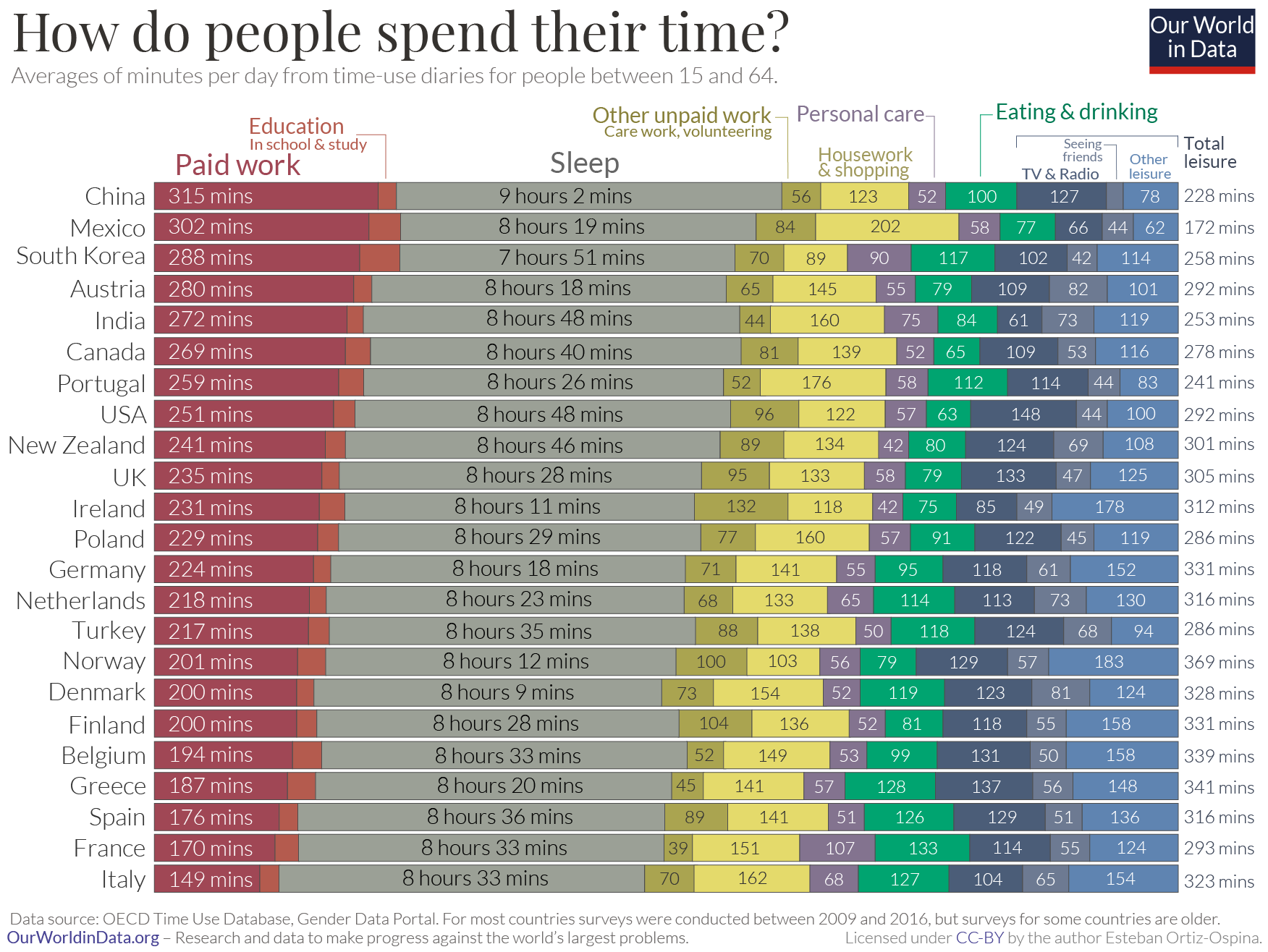
The first thing that jumps out from this chart is that there are indeed many similarities across countries.
This is not surprising — most of us try to split our days into “work, rest, and fun”, and so there are some predictable patterns. We spend the most time working and sleeping, but as evident from this, people in the UK spend a total of 305 mins/5 hrs per day enjoying leisurely activities – watching TV, listening to the radio, catching up with friends, reading, and of course exercising.
In fact, even after time spent on socialising and TV, the average person still has 2 hours a day available.
But okay — those people aren’t you. You’re busier. So let’s turn to you and start measuring your time with a personalised audit.
Work and sleep take up most of our time, so let’s start here:
Currently, work, sleep, and travel take up 110 hours of your 168-hour week. You still have 58 hours available, but wait, there’s more…
Now, before we go any further, let’s look at where your time currently goes:
Work – 50 hours
Sleep – 56 hours
Commute – 5 hours
Household chores & life admin – 10.5 hours
Shopping, cooking & eating – 17.5 hours
Socialising with friends and family – 7 hours
TV and downtime – 10 hours
You now have twelve hours of free time at your disposal! Even if we attribute 50% of these to ‘wasted time,’ you’re still left with 6 free hours a week! Can you honestly say to yourself: “I don’t have the time to exercise?”
We’ve just found at least 6 hours of available time in your week. All you need is 2.5–3 hours of that to completely change your health, fitness, and future.
Time is no longer the barrier. The choice is yours: Do you want to keep making excuses, or start making progress?
Let those 6 newly discovered hours each week be your gift to your future self. Use them to move, to sweat, to grow stronger. You deserve it – and your future self will thank you.

Chris Hall
Personal Trainer and Founder of Hall Personal Training
you may also enjoy...

How Many Hours Per Week Should You Exercise? The Science-Backed Answer
We break down exactly how to split your time between strength and cardio for maximum health, longevity, and results.
Why Most People Never Start Exercising (Even When They Really Want To)

How Many Steps Should I Actually Walk a Day?

We’re Not for Everyone
Not for quick fixes, short-term chasers, or solo lifters

Why Women Should Cold Plunge – and the Benefits You’ll See
is cold exposure safe for women?