Introducing Avanto° – Oxfordshire’s New Hub for Recovery, Resilience & Longevity
The Science of Cold, Heat & Light: Why We’re Launching Avanto° in Deddington
At Hall Personal Training, we’ve always been about performance and progression. But thriving isn’t just about reps and routines, it’s about building resilience at the cellular level. That’s why we’re launching Avanto°, a cutting-edge wellness & recovery space in Deddington, opening 12th August, and open to everyone – not just Hall Training members.
Avanto° brings together the power of cold plunge, infrared sauna, and red light therapy, three proven tools designed to improve your physical and mental well‑being via contrast therapy and hormesis.
Why Avanto°? The Power of Hormesis
Our modern environment has become too comfortable – heated homes, climate control, convenience. But the human body adapts best when challenged. The practices we offer at Avanto° are based on the concept of hormesis – the idea that small, manageable stressors can make you more resilient over time.
Think of it like a workout for your nervous system and cells. When done safely and consistently, exposure to cold, heat, or light creates a hormetic effect that:
- Triggers powerful healing responses
- Improves mitochondrial function
- Regulates stress hormones
- Builds tolerance to discomfort and emotional stress
It’s not just about short-term recovery, it’s about long-term adaptation.
“Hormesis is a fundamental biological principle where what doesn’t kill you – in the right dose – makes you stronger.”
– Mattson, M.P. (2008).
1. Infrared Sauna
What is it?
Infrared saunas use light to heat your body directly (rather than heating the air like traditional saunas), allowing for a more tolerable and deeper sweat at lower temperatures.
How it works:
Infrared waves penetrate the skin, increasing core body temperature and stimulating circulation, detoxification, and cellular repair. It also activates heat shock proteins, known to support longevity and immune health.
Science-backed benefits:
-
Multiple studies now show a 25–50% reduction in cardiovascular mortality for those using saunas 4‑7 times/week. Compared to once per week: hazard ratio for fatal CVD events drops to ≈0.23–0.37.
- Improved Cardiovascular Health & Longevity: Regular sessions increase circulation, lower blood pressure, and improve heart function and artieral stiffness – mimicking the effects of moderate exercise. Even in individuals with high inflammation markers (hsCRP) – regular sauna mitigates that risk. (Tanjaniina Laukkanen, et al. 2018)
- Reduced Pain & Inflammation: Infrared heat can ease joint and muscle pain by increasing cytokine Interferon. Infrared has also been shown to activate heme oxygenase-1, an enzyme that produces antioxidants – making it popular for arthritis, pain management and recovery. (Lin CC, Liu XM. et al. 2008)
-
Improve Cognitive Health: Studies show consistent sauna use is linked to reduced risk of dementia, cardiovascular disease, and all-cause mortality. (Laukkanen et al. 2015)
Common myth:
“Infrared saunas are unsafe and cook you from the inside”
Yes; infrared and micro-wavelengths are neighbours on the electromagnetic spectrum but they’re totally different!
Microwaves heat food by agitating water molecules at very high frequencies, causing friction.
Infrared saunas use gentle, naturally occurring light waves – like sunlight without the UV – that safely warm the body from within . The heat is soothing, not aggressive, and doesn’t “cook” you.
It’s more like basking in the warmth of the sun on your skin – not being reheated like leftovers
2. Cold Plunge Therapy
What is it?
Cold water immersion involves submerging your body in water below 12-15°C for a short period, typically 1 to 5 minutes.
How it works:
Cold exposure activates your sympathetic nervous system, spikes norepinephrine, reduces inflammation, and improves vascular tone. It also triggers brown adipose tissue, which helps regulate metabolism and heat production.
Science-backed benefits:
- Boosts mental performace & clarity: Cold exposure triggers the release of powerful neurochemicals like norepinephrine, epinephrine, and dopamine, which can increase by 250 – 530% during and after immersion. These catecholamines enhance focus, alertness, and mood, making you feel sharper, more energised, and mentally resilient. (L. Jansky et al. 1996)
- Improves metabolic health & metabolism: Regular cold water immersion stimulates brown fat – a type of fat that helps increase energy production and stimulates UCP-1 that turns excess energy into heat, increasing metablic rate by 350%. (P Srámek et al. 2000)
- Improves physical performance & recovery: Cold water immersion has been shown to support faster recovery following high-intensity or endurance exercise. Short immersions (<5 minutes) can improve muscle power, reduce soreness, and lower levels of circulating creatine kinase – a marker of muscle damage – making it a powerful tool for physical recovery. (Moore et al. 2022)
Common myth:
“Women shouldn’t do cold exposure”
It’s a physiological fact, women do feel cold more intensely than men. They begin shivering at higher temperatures, their skin cools faster and report discomfort quicker. But this heightened sensitivity doesn’t mean weakness. Instead, it reflects a fundamentally different physiological response to cold. In fact, once ‘cold adapted’ women are better at maintaining the cold benefits with less physiological stress compared to me. (Kaikaew et al. 2018)
3. Red Light Therapy (Photobiomodulation)
What is it?
Red light therapy (RLT), also known as photobiomodulation (PBM) or low-level light therapy (LLLT), uses specific wavelengths of red and near-infrared light (600–1200nm) to stimulate beneficial biological processes – especially in the mitochondria, the powerhouse of your cells.
How it works:
Red and NIR light target three key mechanisms:
- Red and NIR light helps to “unblock” cytochrome c oxidase – a key enzyme in energy production – by displacing nitric oxide and enhancing ATP (energy) production by up to 70%. (De Freitas and Hamblin 2023)
- It activates a growth factor known as, Transforming Growth Factor Beta-1 (TGF-β1), crucial for healing and regeneration. A Journal study of Clinical Laser Medicine & Surgery found that red light therapy accelerated wound healing by an average of 36% compared to controls within 30 days.
- Red and NIR stimulate non-visual pain receptors – like TRPV1- to reduce pain and inflammation. (Gupta et al. 2013)
These primary mechanisms of action trigger a cascade of other downstream cellular and systemic benefits.
Science-backed benefits:
- Reduces Pain: Red light therapy can modulate cytokine activity, decrease pro-inflammatory markers and promote the expression of anti-inflammatory markers, which helps alleviate pain associated with inflammatio. A review published in Pain Research and Management, red light therapy was reported to provide significant pain relief ranging from 20% to 70% in various conditions, such as musculoskeletal disorders, joint pain, and chronic low back pain. (Gupta et al. 2013)
- Improves ATP Production and Cellular Energy: Red and NIR light stimulates Cytochrome C Oxidase (CCO) a main mitochondrial target for light therapy. Illuminating it with red/NIR light can enhance cellular respiration and energy production, mainly by freeing CCO from NO inhibition, which can increase ATP production by up to 70% in certain cell types. (De Freitas and Hamblin 2023)
- Improves cognnitive function: Red and NIR light can influence cognitive function, mood, and even neuroprotection. When applied to the head, RLT can improve focus, memory & reaction time. Reduce symptoms of depression & anxiety and increase cerebral blood flow.This is likely due to enhanced mitochondrial activity in neurons and increased nitric oxide release, which boosts brain energy and oxygenation. (Cassano et al. 2016)
Common myths:
“Red light damages your eyes.”
False – research shows the opposite. A 3-minute exposure to 670nm red light has been shown to restore mitochondrial function in the aging retina and improve colour contrast vision for up to a week. (Shinhmar et al., 2021)
“It works better in the sauna or while exercising.”
Actually, combining RLT with heat reduces its effectiveness. Heat and sweat interfere with light absorption and disrupt the cellular pathways RLT is meant to activate (Hamblin & Arany). For best results, it should be used when the body is cool and dry.
The Avanto° Experience
At Avanto°, we combine cold, heat, and light into a personalised experience. Whether you’re popping in for a quick plunge, layering light with sauna for recovery, or coming for a thirty or 60-minute contrast session, our space is calm, private, and designed to help you feel calm through contrast.
We’re excited to open Avanto° to the entire Oxfordshire and Cotsworld community, not just Hall Training members. You don’t need a gym membership – you just need the intention to feel better (and get out of your comfort zone a little).
If you would like to be among the first to experience it, and receive 50% off your first two sessions, join our Avanto° Heimo (tribe) newsletter and be the first in-line when we go live!
You can also follow us on Instagram @Avanto.Wellness for updates, education, and launch news.
The Truth About Habits: Why Routines Win
Why You’re Struggling to Build Habits (And What to Do Instead)
5:45 am: I wake up, head downstairs, and reach for a hydrogen tablet with half a litre of water. I empty last night’s dishwasher, sterilise baby bottles, and add 15 drops of methylene blue into another half litre of water.
Then I brave a 3½‑minute cold plunge. While I’m in there, I soak two mugs in hot water. Once out, I spend 8 minutes under red light therapy. After that, I make coffee for me and my wife and take it back upstairs. By 6:25 am, we’re sipping in bed—and by 7:00 am, the kids burst in and our day begins.
When I tell people about my morning routine, the response is almost always something like:
“You do that every day? I wish I could get into the habit of waking up early… or doing ice baths…”
Or:
“You drink a litre of water first thing? I keep meaning to drink more water, but I always forget…”
Sound familiar?
When people set out to get fitter, eat better, or feel more in control of their day, they often say things like:
- “I just need to get into the habit of exercising…”
- “I want to build the habit of eating more protein…”
- “If I could just remember to drink more water…”
But here’s the catch: trying to build a habit for something that requires effort, intention, or discomfort often sets you up for disappointment.
The truth is, I haven’t developed a habit of waking up early or doing cold plunges. What I’ve built is a routine – and that’s a big difference.
Habits vs. Routines
We often use the words interchangeably, but there’s a crucial distinction.
A habit is a behaviour done with little or no conciuos thought.
A routine is a series of behaviours that are intentional and repeated with effort.
This is backed up by experts like Nir Eyal, author of Indistractable, who warns that many people fail to make lasting change because they try to form habits before building routines.
Routines are what come first – the deliberate, structured behaviours we repeat. Over time, and only sometimes, they might evolve into habits. But not always, and that’s okay.
Trying to shortcut this process leads to frustration. We blame ourselves, thinking we lack discipline, when in fact, all we were doing is following flawed advice.
Why Routines Require Effort
Getting out of bed before sunrise, jumping into a cold plunge, cooking a protein-rich breakfast – these all take conscious thought. Even if they get easier with time, they rarely become truly effortless.
Routines, unlike habits, are often uncomfortable. They all involve a level of discomfort. They go against the grain of what your body wants in the moment – we like being comfortable. They require conscious thought, deliberate effort, and a degree of internal friction.
Compare that to brushing your teeth or making your morning coffee – things that feel strange not to do. Those are habits. But anything that offers delayed gratification – exercise, healthy eating, mindfulness – likely won’t ever feel that automatic.
That’s why chasing the idea of building a habit before building a routine is often setting yourself up to fail.
So How Do You Build a Routine That Sticks?
According to behavioural research and neuroscience, including insights from Harvard Business School, there are three key strategies:
- Set Rules, Not Just Intentions We’re often told to “set clear intentions.” But the problem with intentions is they’re vague, flexible, and easy to ignore. They leave too much room for negotiation — both from others and yourself.Instead, set rules.
Rules carry more weight. They feel firmer, more established – and we tend to obey them. While some might argue that rules sound restrictive, the truth is: people respect rules. They don’t respect vague intentions.
For example, don’t just say:
“I want to drink more water.”
Say:
“I drink 500ml of water as soon as I wake up.”
Likewise, don’t intend to go to the gym three times a week – make it a rule!
“I go to the gym three times a week. No matter what.”
Rules create clarity. They eliminate grey areas. They’re easier to follow, harder to argue with, and far more likely to be respected – by yourself and by others.
For example, I’ve walked at least 10,000 steps a day for over 380 days — through birthdays, Christmas, holidays, and even the birth of my son. Why? Because I made it a rule for myself: walk 10,000 steps every day. No excuses.
Be specific about what you’re doing, when you’re doing it, and why.
Reflect on your deeper reason. As Ximena Vengoechea suggests, ask yourself: “Why does this matter to me?” Knowing your why will help you push through inevitable resistance.
Charles Duhigg, author of The Power of Habit, also reminds us: “”There’s no such thing as 21 days to a habit.” Some behaviours might take weeks, others months, some never. Be patient.
- Prepare for RoadblocksThink ahead: What typically stops you? Lack of time? Distractions? Mental fatigue?If you’ve failed before, learn from it. Anticipate obstacles and put systems or rules in place. Block out time in your calendar to make it a priority, and reduce decision-making, get accountability from a friend, partner or coach – Accountability is one of the biggest reasons our members keep showing up — and seeing results.
The more friction you remove in advance, the easier it becomes to follow through when energy or motivation is low.
- Use Nudges and Microhabits A nudge is a small environmental cue or behaviour that supports the action you want to take.For example:
• Place a full water bottle beside your bed as a reminder to hydrate first thing.
• Lay out your gym clothes the night before.
• Set a daily reminder to book your training session.
You can also try temptation bundling – linking something you want to do with something you should do. Listen to a podcast only while walking. Have a coffee only after a cold plunge.
These small adjustments make routines feel more sustainable, and even enjoyable.
Final Thoughts
If you’re trying to adopt healthier behaviours, don’t wait for them to become automatic. Don’t wait for motivation. And don’t beat yourself up when it doesn’t feel effortless.
Instead, design a routine – one that’s built around clear intentions, realistic expectations, and small supportive nudges.
Because real change comes not from what we do on autopilot, but from the conscious actions we show up for, day in, day out.
That’s where the transformation lives.
Time, Attention, and the Cost of Comfort: How to Reclaim What Matters Most
The Real Reason You’re Always Distracted (And What to Do About It)
I had the pleasure of speaking at the Network & Natter conference at Bloxham Mill this week, where I gave a presentation on one of the most important topics we rarely stop to think about: Time, Attention, and how we can reclaim both to live more intentionally.
You can download the full presentation here. Since the talk, the feedback has been incredible. I’ve been genuinely surprised by just how much it resonated with people.
So, I thought I’d pull together the key points and turn them into an easy-to-digest and actionable blog post. If you couldn’t attend – or you just want to refresh the message – I hope this gives you something to reflect on and put into practice
Attention, Time & Money: Why Discomfort Might Be the Key to Your Happiness
In today’s world, we idolise those who work 60+ hour weeks, live in giant homes, and drive around in £100,000 sportscars. It’s easy to assume that if we simnply work harder and hustle longer, we’ll reach that same level of success – and happiness will follow.
Our education system reinforces this. From a young age, we’re told: work hard, get good grades, earn more money, and everything else will take care of itself.
But there’s one problem: it isn’t true!
The Money-Happiness Illusion
Studies suggest that once your basic needs are met – food, shelter, security – additional income has minimal impact on your happiness. The “sweet spot” for life satisfaction is estimated at around £70,000 per year. Beyond that, more money tends to buy more things, not more joy.
What’s more, we’re trading something finite (our time) for something that we mistakenly treat as infinite (money). But only time can offer the most meaningful rewards: presence, relationships, growth, and purpose.
“All my possessions for one moment of time.” – Queen Elizabeth I
A stark reminder that time, not wealth, is our most precious commodity.
Comfort Creep: How Convenience Is Making Us Weaker
Over the past few decades, we’ve engineered a world that makes almost everything easier. While innovation has improved safety and efficiency, it’s also made our lives too comfortable—and that’s becoming a problem.
From lifts and escalators to Uber and food delivery apps, we’ve removed nearly all physical friction from our day-to-day routines.
The Escalator Study
A particularly telling example: in public places, studies show only around 8% of people choose stairs over escalators. That means 92% of us will actively avoid discomfort, even if it’s just walking up a flight of stairs.
It’s the same with prescription weight-loss drugs like Mounjaro, which bypass the discomfort of healthy eating and exercise. Technology has allowed us to escape the natural stressors that once kept us strong—now we’re losing resilience in the process.
We’ve built a life that protects us from the slightest inconvenience, and in doing so, we’ve created a culture of fragility.
Dopamine vs Anandamide: What Really Feels Good?
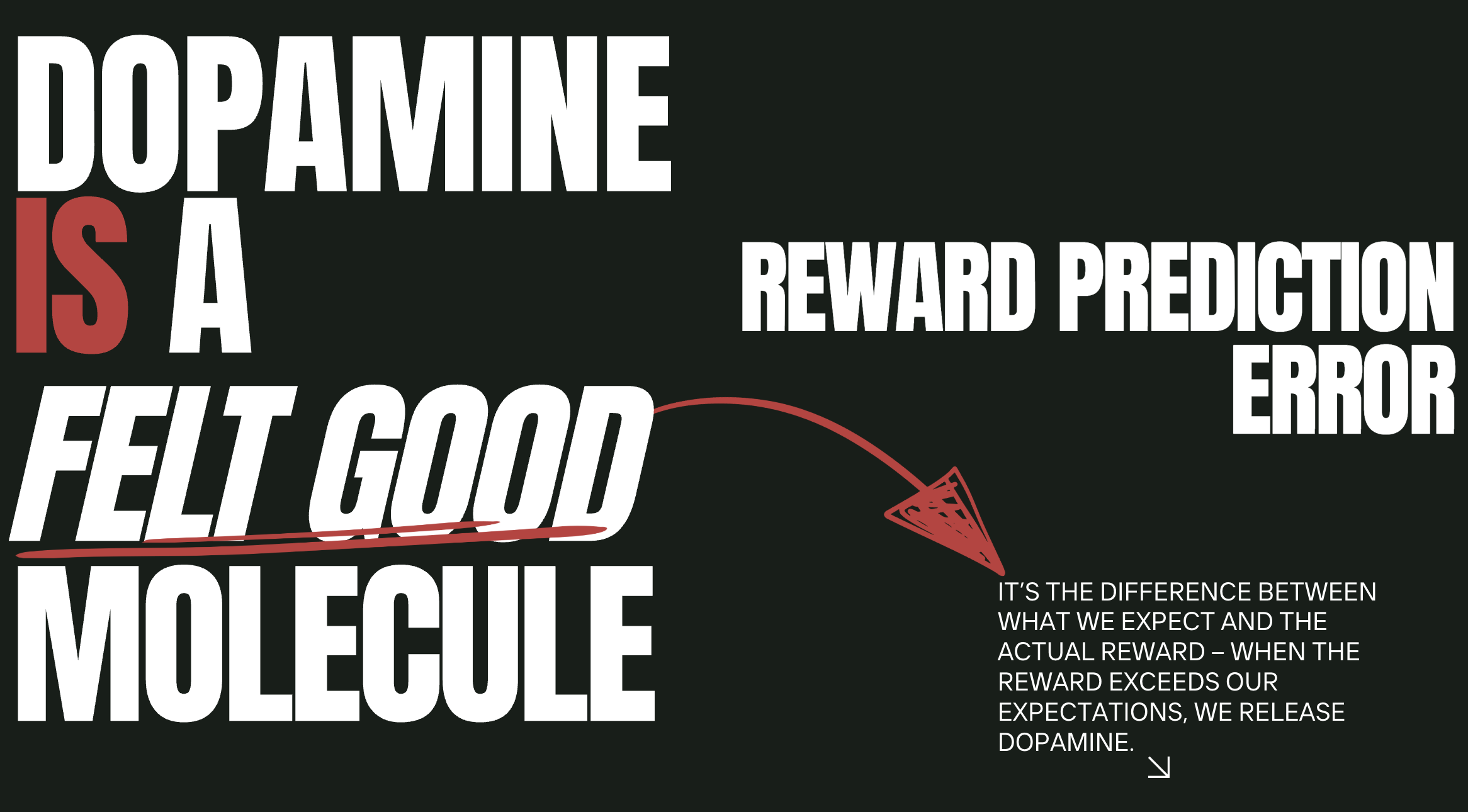
Let’s get something clear: dopamine is not the feel-good chemical. That role belongs to anandamide, a neurotransmitter responsible for true pleasure and bliss (the name itself comes from the Sanskrit word ananda, meaning joy).
The Role of Dopamine
Dopamine is the motivation molecule. It spikes when we experience something unexpectedly good—a “reward prediction error.” For example, if you didn’t expect to find a new coffee shop on your way to work, dopamine helps you remember that moment and associates it with pleasure.
But dopamine is fleeting. Despte popular belief dopamine’s role isn’t to make us feel good – it’s to teach us what felt good and drive us to seek it again.
Food, Exercise & Modern Dopamine Traps
Modern ultra-processed food is engineered to hijack our dopamine system: high fat, high sugar, salt, crunch, and reward. It overrides natural satiety signals and keeps us craving more. Exercise, on the other hand, triggers a slow release of dopamine and anandamide – especially after exertion – which is part of the famous “runner’s high.”
But when comfort creep and technology make it easier to avoid effort, we stop chasing these natural highs, and start relying on artificial ones – scrolling, snacking, bingeing. And we lose out on the real rewards.
Internal vs External Distractions: Why the Enemy Is Inside
It’s easy to blame our phones for stealing our attention. But surprisingly, only 10% of distractions come from external triggers. A full 90% are internal. They come from within: feelings of boredom, anxiety, restlessness, or dissatisfaction.
When those feelings arise, we grab our phones or check our email—not because we’re truly interested, but because we’re uncomfortable.
Our phones have become our modern “shock machines” In a 2014 study, 67% of men and 25% of women chose to administer electric shocks to themselves rather than sit quietly for 15 minutes. That’s how uncomfortable we’ve become with just being.
Habit Loops and Digital Dependency
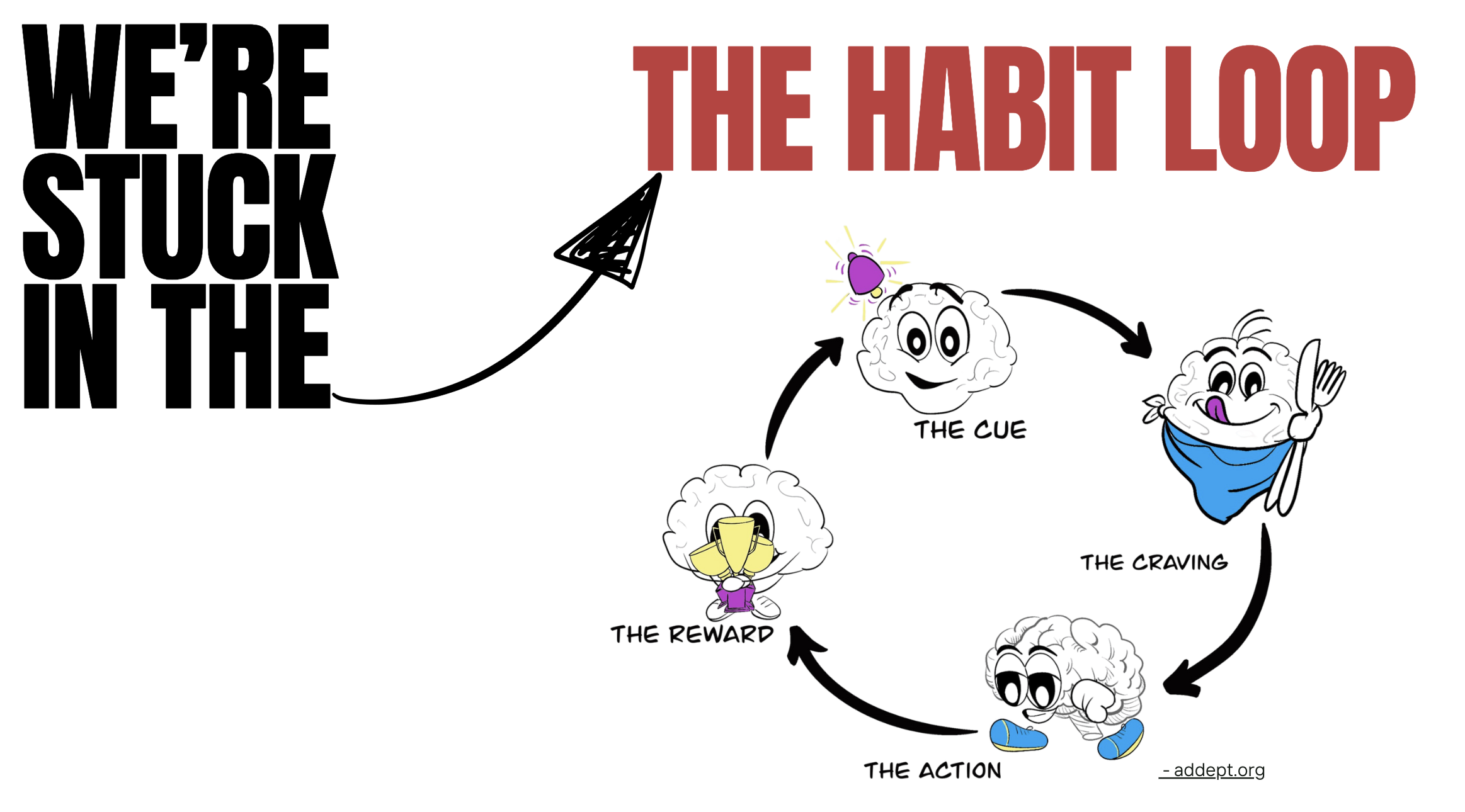
Charles Duhigg’s Habit Loop explains how behaviours form:
-
Cue: is a trigger, the habit e.g. the sight of your phone. It’s a prompt for your brain to move on to the next step – the craving.
-
Craving: is that delicious anticipation of the reward. It’s the motivational force behind each habit. We don’t crave the action; we crave the state/the reward that occurs after the action has been done. You don’t crave clicking on social media; you crave the relaxation and entertainment it offers your brain.
-
Action: is the behaviour itself – working out, drinking your coffee, taking a shower, scrolling on social media – the thing you need to do in order to answer that craving.
-
Reward: is what doing that action gives you – the dopamine hit! It’s the thing that satisfies the craving and makes you that much more likely to do it again.
This loop wires our brain for fast, repeatable behaviour. Every time you reach for your phone instead of sitting with discomfort, you reinforce the habit.
We’re not addicted to our phones. We’re addicted to relief from discomfort.
Building Resilience Through Hormesis
If comfort is killing our attention, motivation, and vitality—what’s the solution?
The answer lies in hormesis: the process by which small, manageable stressors make us stronger.
These “beneficial stressors” train the body and mind to tolerate discomfort and become more resilient over time.
-
Cold Exposure (Ice Baths)
• Triggers norepinephrine release and dopamine, boosting mood, alertness, and mindfulness.
• Regular exposure improves circulation, reduces inflammation, increases fat metabolism, and enhances stress tolerance.
-
Heat Exposure (Infrared Sauna)
• Increases blood flow and heart rate similar to cardio.
• Enhances heat-shock proteins that repair cellular damage.
• Reduces cortisol and promotes parasympathetic recovery.
-
Red Light Therapy
• Stimulates mitochondrial function, ATP production, and cellular repair.
• Reduces oxidative stress (ROS), improves skin appreance and wound heeling, speeds recovery, and balances hormones.
• Shown to positively impact sleep and circadian rhythm.
These aren’t gimmicks. They’re modern applications of ancient wisdom, now supported by clinical research and neuroscience. And they’re at the heart of Avanto Wellness, our new wellness hub (opening August 2025), designed to help you reclaim your energy, sharpen your mind, and build real-world resilience.
So What Can You Do?
You don’t need to throw away your phone or move to the mountains. But if you want to take back control of your time and attention, start with this:
-
Time block your day
Plan your tasks and stick to time-limited windows of work, movement, connection, and rest.
-
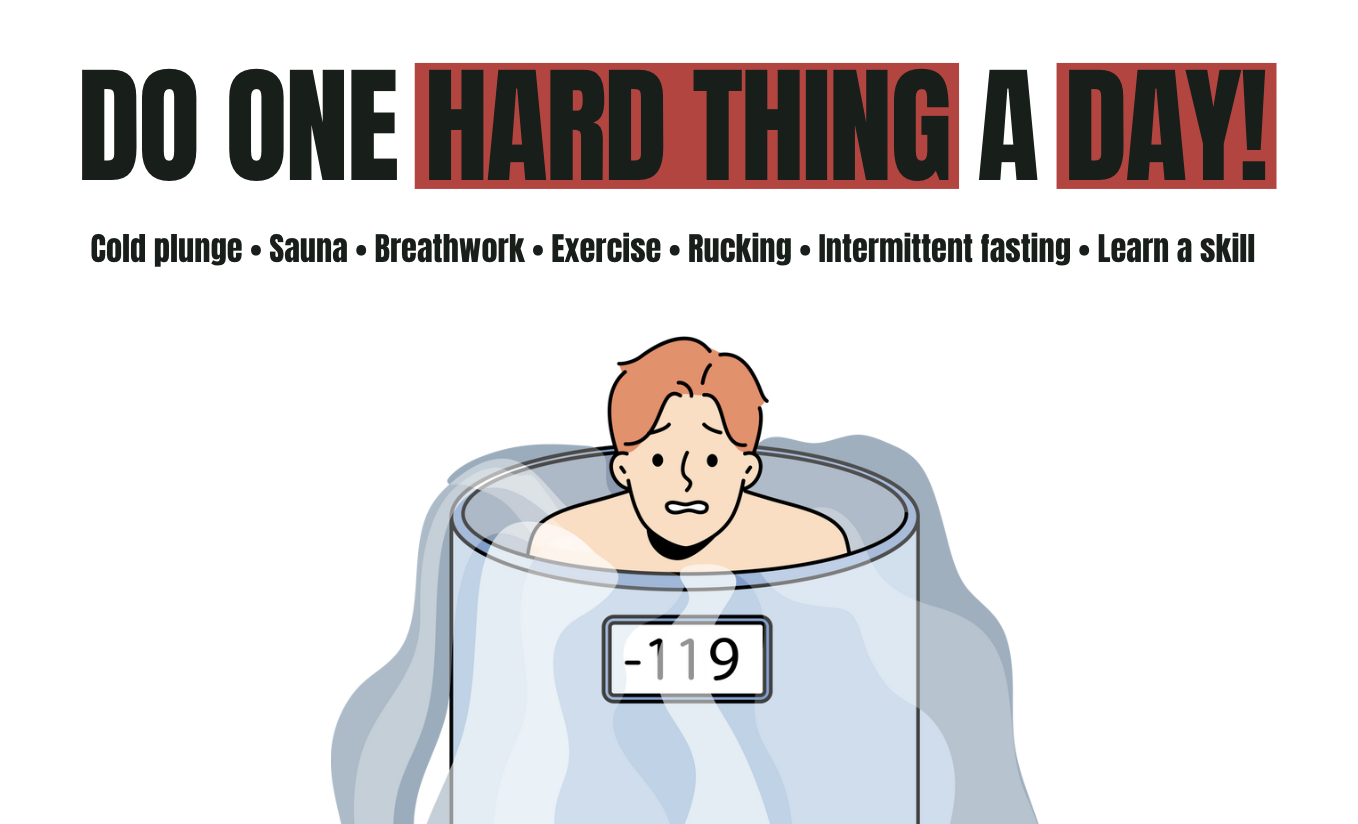
Do one hard thing a day
Train your tolerance. Become comfortable around the feeling of discomfort. It could be an ice bath, workout, sauna, or even fasting or learning a new skill.
Final Thought
Attention is time. Time is life.
If we can’t control where our attention goes, we can’t control how our life unfolds.
At Hall Personal Training and through Avanto, we’re here to help you slow down, build resilience, and reclaim the energy and presence you were designed to live with.
Ready to take back control of your time, energy, and focus?
Whether you’re looking to improve your resilience, build healthier habits, or simply feel more present in your day-to-day life—we’re here to help.
- Learn more about our coaching and our 30-day programme here at Hall Personal Training
- Discover our new wellness hub, Avanto Wellness – featuring an infrared sauna, cold pluge and red light therapy.
- Drop us a message or come visit, we’d love to help you find what works for you.
How to Finally Make Time for Exercise (Even With a Busy Life)
Why You Still Feel Like You Don’t Have Time to Exercise (Even When You Do)
You may have been someone who’s struggled to find the time to exercise – until you read our recent blog post, which helped people to discover 12 hidden hours in your week.
However, despite now being aware of this free time, you still feel like, “I just haven’t got time to exercise.” Even though you can clearly see you’ve got a whole day’s worth of free time available to you.
So why is that?
Why, even when you know you have the time, do you still feel like you don’t?
Here are the top three reasons people struggle to utilise their free time and ultimately, why you may feel unable to get started:
- Parkinson’s Law
- Perfection Over Progress
- Procrastination
1. Parkinson’s Law
Parkinson’s Law — coined by Cyril Northcote Parkinson — states that “work expands to fill the time available for its completion.” In other words, if you’re given more time to complete a task, it often takes longer, even if the task itself hasn’t changed.
Many of us can relate. Take someone who’s recently retired. When asked, “You must have so much free time now?” their reply is usually something like:
“You’d think that — but I’m busier than ever! I honestly don’t know how I managed to work and do everything else…”
A classic case of Parkinson’s Law. Despite freeing up 40+ hours a week by retiring, that time is now easily filled — often unintentionally — with less essential tasks.
Take myself, for example. I set a strict 3-hour deadline every Friday to write a blog post. If I gave myself all week, I’d fall victim to Parkinson’s Law and end up stealing time from more important tasks just to finish it.
So, if you’ve completed our Time Audit and discovered six hours of spare time in your week, yet still feel too busy to exercise – you’re likely falling into this trap. Like the retiree, your free time has been quietly filled with bits and pieces that feel urgent but aren’t important.
2. Perfection Over Progress
Perfectionism is hard-wired into many of us. It’s part of what’s helped humans evolve and innovate. But it often comes at a cost — and that cost is progress.
I speak with so many people who are unhappy in their skin, tired of how they feel, and desperate to make a change… yet refuse to start because they can’t train three times per week.
As mentioned in my previous blog: you don’t need to train three times a week to see results.
There’s a reason why most governments recommend just 150 minutes (2.5 hours) of moderate-intensity exercise per week – it’s been proven to reduce the risk of all-cause mortality and improve longevity.
Of course, training 3-4 times per week can lead to faster improvements, but if your goal is to feel fitter, become stronger, improve your body composition, and boost your general health – 2 sessions per week is plenty.
It’s absurd to say, “I won’t start until I can do three sessions a week,” because that day will likely never come.
I always explain to people: it’s better to start today – even if that’s just one hour a week – than to wait until ‘life calms down.’
(And if Parkinson’s Law has taught you anything – that day is a myth and will likely never arrive. Life is busy!)
Even if you begin with just an hour a week, you’ll soon find momentum builds. Before you know it, you’re able to commit to two, three, or even four sessions per week.
When you start something while busy, you overcome inertia. You put the wheels in motion – and an object in motion stays in motion. You also increase your capacity, and start finding natural solutions to the “I don’t have time” problem.
This is how people transition into progress-driven mindsets and, ironically, end up closer to perfection by no longer chasing it.
3. Procrastination
Procrastination is one of the biggest roadblocks between having an idea… and taking action.
Defined as the act of postponing or delaying something, the Ancient Greeks even had a word for it: akrasia – acting against your better judgment.
If you’re someone who says:
“I’ll do that tomorrow.”
“I’ll start next week.”
“Let me go away and think about it…”
Then you’re dealing with procrastination.
There are two popular schools of thought around why we procrastinate:
- Oliver Burkeman, author of Four Thousand Weeks and Meditations for Mortals, suggests we procrastinate on meaningful tasks because they force us to face uncomfortable truths, like fear of failure, inadequacy, or finality. It feels safer to delay than risk doing something imperfectly.
- Sahil Bloom, author of The 5 Types of Wealth, explains that procrastination is about offloading responsibility onto your future self. You push a task ‘down the road’ because it’s easier to delegate it to ‘later you’ than to do it now.
Unfortunately, procrastination is hardwired into us. Our brains value immediate pleasure and comfort, even when we know those aren’t best for us long term.
But here’s the truth: procrastination is a growth limiter.
If you want to fulfil your potential, you have to fight it.
So… What Can You Do About It?
Here are some simple, practical steps to stop procrastinating on exercise, eating well, and doing the things that’ll genuinely make you feel better:
1. Let Go of “All or Nothing” Thinking (inspired by Oliver Burkeman)
Many people put off healthy habits because they think it has to be perfect – a full gym session, flawless meal prep, no slip-ups. That’s just fear wearing a smart disguise.
Instead, ask yourself:
“What would this look like if I let it be easy?”
- A 10-minute walk is a win
- A decent lunch is enough
- One good session is better than zero
Perfection is the enemy of consistency.
2. Start Tiny and Make It Obvious
When life’s busy, your brain craves simplicity. So ditch vague goals like “get fit” or “eat clean.”
Instead:
- Book one session this week.
- Keep a protein bar or bag of nuts in your desk or bag.
- Set an hourly timer to stand and walk for 2 minutes – it genuinely boosts clarity.
Make the next step so small and obvious that it feels easier to do than to ignore.
3. Schedule It (Sahil Bloom’s style time-blocking)
Your calendar is already full. If your health isn’t on it, it won’t happen.
People who work out regularly don’t just find time – they make it!
Literally schedule your workouts, food shops, or walks. Treat them like a work meeting that’s non-negotiable.
At Hall Personal Training, we run sessions from 6:00am to 8:30pm, on the hour, every hour, which removes the “limited availability” excuse. Members have free rein to book sessions at times that work for them.
4. Close the Thinking-Doing Gap
Saying “I’ll go for a run later” or “I’ll prep something after work” leaves space for procrastination to sneak in.
Instead, pair intention with immediate action:
- Put your trainers by the door
- Chop veg while the kettle boils
- Book that PT session right now!
You don’t need motivation, you just need to start.
Any action, no matter how small, reduces mental resistance and builds momentum.
5. Stop Outsourcing It to “Future You”
The version of you getting home late tomorrow or travelling next week won’t suddenly feel more motivated. Respect that version of you by doing something today to help them out:
- Pack your gym kit tonight
- Plan tomorrow’s lunch
- Block 30 minutes for movement or going for a walk
Future you isn’t a superhero – it’s still you.
Set them up for success by acting in their best interest now!
Final Thought From Me…
Procrastinating around your health doesn’t make you lazy – it makes you human. But if you can notice it and still act, you’ll win.
You don’t need to feel ready, you just need to begin especially when you don’t feel like it. That’s where the real breakthroughs happen.
Ready to Stop Waiting and Start Moving?
The truth is, most people aren’t struggling because they don’t have time – they’re struggling because of how they’re using it. Between Parkinson’s Law, perfectionism, and procrastination, it’s no wonder getting started feels harder than it should. But the moment you take action — however small — everything begins to shift. You don’t need to be perfect. You don’t need the perfect week. You just need a starting point.
That’s exactly what our 30-Day Accelerator Programme is designed for — to help you break through inertia, build momentum, and prove to yourself what’s possible in just a few weeks. Whether it’s one, two or three sessions a week, we’ll meet you where you’re at and help you build up from there.
Get in touch today to learn more or secure your place – your future self will thank you for it.
Your 168-Hour Time Audit: The Simple Fix for “I Don’t Have Time”
“I Don’t Have Time to Exercise” – Let’s Prove That Wrong in 5 Minutes
If you’re someone who often finds themselves saying, “I just don’t have the time to exercise,” I ask you to invest five minutes of your time today — because this blog post might just change your life.
Location, budget, and time are the three main factors that determine whether someone succeeds or fails with a fitness routine. But unlike location or budget, which are flexible, time is fixed.
It doesn’t matter whether you’re the world’s richest CEO with a net worth of $209.5 billion like Jeff Bezos, or you live humbly with only the clothes on your back — we all have the same ‘time budget’: 24 hours a day, 168 hours a week. Time is one of the few commodities that does not discriminate.
So, why is it that your friends and colleagues seem to find time to exercise, while you feel like it’s an impossible feat because “I’m just too busy…”?
The answer?
- You haven’t been taught how to manage your 168 hours each week,
- Or, you like being busy and telling others just how busy you are, because it gives you a (false) sense of productivity — a feeling of accomplishment, even superiority, based on society’s flawed view that “busy people are important people.”
Here’s the truth: anyone who says they “just don’t have time” usually doesn’t have control of their time.
But I’ll assume that if you’ve read this far, you’re not the kind of person who enjoys being busy for the sake of it. Instead, you take your health seriously. You want to feel better, get fitter, and take back control — you just don’t know how to make time for it all.
Let’s change that!
How Much Time Do You Really Need?
Every government in the world recommends at least 150 minutes (2.5 hours) of moderate or 75 minutes of vigorous physical activity per week. Why? Because this small investment in time offers massive health benefits – based on extensive evidence demonstrating the significant health benefits of physical activity, including reducing the risk of chronic diseases, improving mental health, and extending lifespan.
In fact, the NHS has shown that 2.5 hours of activity per week can lower your risk of early death by up to 30%.
If you want to live a long, healthy life and be around to watch your grandkids grow up, then finding time to exercise isn’t optional – it’s essential. So, let’s help you find a few hours in your week…
Welcome to the Time Audit
When someone tells me, “I don’t have time to work out,” I walk them through a Time Audit. Nine times out of ten, we find 10–30 hours of unused or misused time each week.
Remember, you only need 2.5 hours — that’s less than 2% of your week.
If, after completing this audit, you still choose not to use your available time to improve your health, that’s your choice, and perfectly fine by me. But it’s no longer fair to say that ‘time is the issue’ or ‘lack thereof’, because it’s not – it’s something else.
“What gets measured gets managed”
…is a popular quote that states something can only be properly managed if it’s first measured. It’s true; you can only determine whether something’s successful if you know where you started from and track its progress.
When we measure, we often identify silly things we do that interfere with what we want to improve, so we naturally start doing something smarter instead. And it works in many areas of life. For example, research has discovered:
- People who track their food lose more weight, thanks to awareness from measurement (source)
- Analyzing drinking behavior reduced the amount of drinking among people who self-identified as over-drinkers (source)
- Students who recorded their study habits studied more deliberately and consistently and got better grades (source)
- People who monitor their behaviors typically have healthier habits (source)
However, when was the last time you measured your time – your most important commodity?
You can’t declare that you don’t have time for something if you don’t actually know how you spend that time – and knowing comes through measurement.
How the Average Person Spends Their Time
The largest measurement of time comes from data gathered by the OECD Time Use Survey, gathering information across seven years for people between 15 and 64.
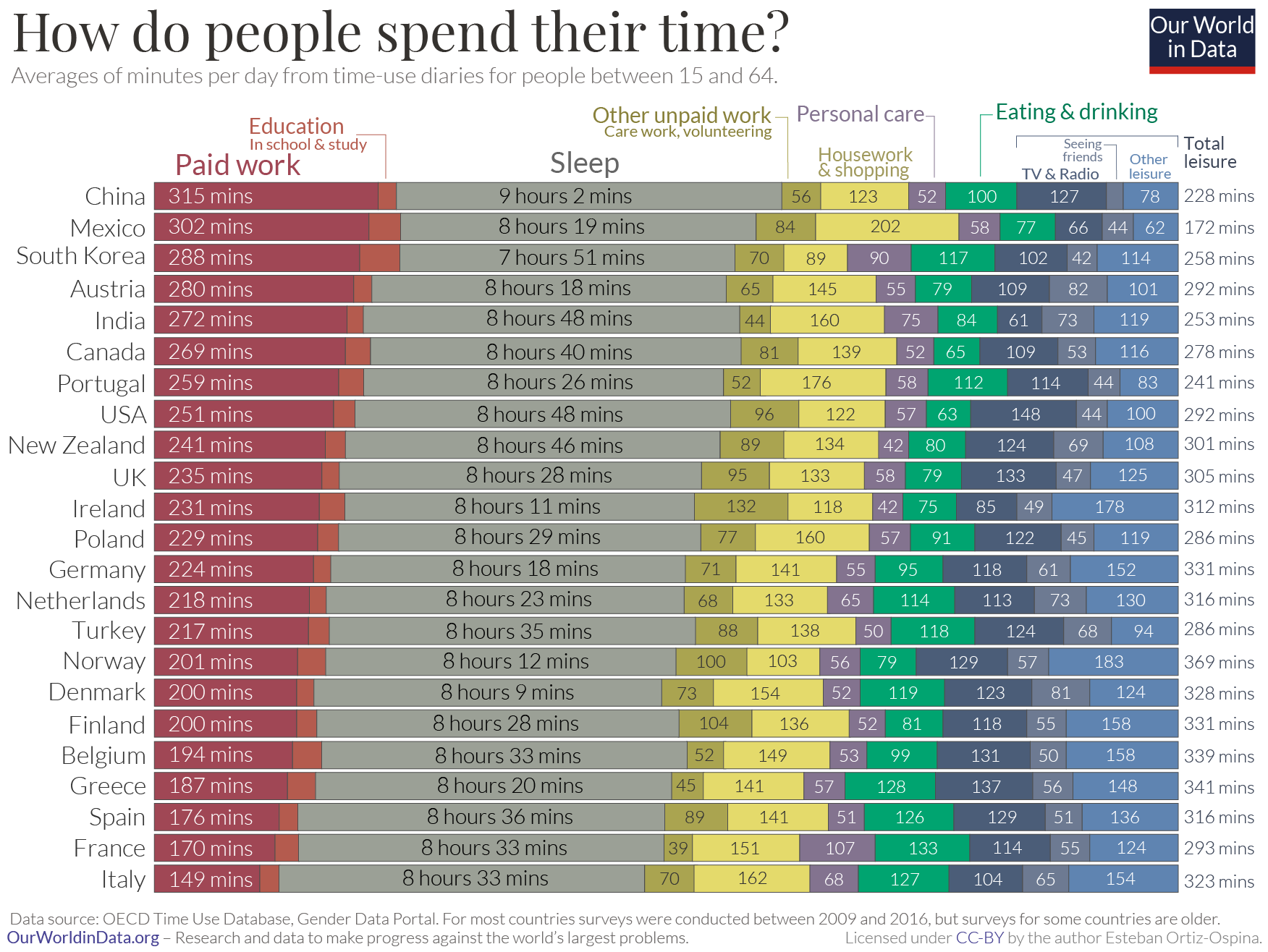
The first thing that jumps out from this chart is that there are indeed many similarities across countries.
This is not surprising — most of us try to split our days into “work, rest, and fun”, and so there are some predictable patterns. We spend the most time working and sleeping, but as evident from this, people in the UK spend a total of 305 mins/5 hrs per day enjoying leisurely activities – watching TV, listening to the radio, catching up with friends, reading, and of course exercising.
In fact, even after time spent on socialising and TV, the average person still has 2 hours a day available.
But okay — those people aren’t you. You’re busier. So let’s turn to you and start measuring your time with a personalised audit.
Your Time Audit
Work and sleep take up most of our time, so let’s start here:
- Work – A typical working week is around 37-40 hours per week, but let’s say you have a demanding job that requires 50 hours a week.
- Sleep – The average sleep duration in the UK is 6.2 – 6.9 hours per night, but let’s say you value your sleep and get a full eight hours – total sleep for the week: 56 hours.
- Commute time – You then need time to get to and from work. Since the pandemic, most of us work from home (at least a day or two in the week), but let’s presume you don’t, so I’ll give you 5 hours a week (an hour a day) of commute time.
Currently, work, sleep, and travel take up 110 hours of your 168-hour week. You still have 58 hours available, but wait, there’s more…
- Household chores & life admin – We need to make time to keep up with the day-to-day admin of life and maintenance of our home, so let’s set aside 10.5 hours a week, giving you 90 minutes a day.
- Supermarket shopping, cooking, and eating – You need to eat, right? In the above survey, people in the UK spend 79 minutes eating, drinking, and 29 minutes doing the food shop – 12.5 hours per week. However, let’s assume you really enjoy cooking and spending more time over meals; I’ll give you an extra 5 hours a week – a total time of 17.5 hours per week or 2.5 hours per day.
- Socialising with friends and family – Spending time with friends and loved ones is just as important as staying active, so let’s set aside 7 hours a week for this.
- Netflix and chill – We all need time to unwind; what better way than catching up on our favorite series? I’ll give you 10 hours a week for this.
Now, before we go any further, let’s look at where your time currently goes:
Work – 50 hours
Sleep – 56 hours
Commute – 5 hours
Household chores & life admin – 10.5 hours
Shopping, cooking & eating – 17.5 hours
Socialising with friends and family – 7 hours
TV and downtime – 10 hours
- Total allocated time: 50 (Work) + 56 (Sleep) + 5 (Commute) + 10.5 (Chores) + 17.5 (Meals) + 7 (Socialising) + 10 (TV) = 156 hours
- Total hours in a week: 168
- Remaining time: 168 – 156 = 12 hours
You now have twelve hours of free time at your disposal! Even if we attribute 50% of these to ‘wasted time,’ you’re still left with 6 free hours a week! Can you honestly say to yourself: “I don’t have the time to exercise?”
Still Think You Don’t Have Time?
We’ve just found at least 6 hours of available time in your week. All you need is 2.5–3 hours of that to completely change your health, fitness, and future.
Time is no longer the barrier. The choice is yours: Do you want to keep making excuses, or start making progress?
Let those 6 newly discovered hours each week be your gift to your future self. Use them to move, to sweat, to grow stronger. You deserve it – and your future self will thank you.
Complete your peronal time audit using our >> Time Audit Tool
Breaking Free from the Snacking Trap: Practical Solutions for Mindful Eating (Part 2)
Breaking Free from the Snacking Trap: Practical Solutions for Mindful Eating (Part 2)
In our previous blog we explored our habits around modern snacking, and uncovered some startling truths: the average person consumes 580 calories daily from snacks alone, while screen time increases our consumption by up to 25%. We learned how food companies engineer ‘hyper-palatable’ foods to hit the perfect ‘bliss point’ and how sophisticated marketing tactics trigger emotional eating. Armed with this knowledge of why we snack mindlessly, we can now focus on practical, evidence-based solutions to regain control over our snacking habits.
Practical Implementation Strategies: Combining Insights from Hillis and Moss
Understanding how food companies engineer snacks to be irresistible, as Michael Moss reveals in “Hooked,” helps us develop more effective counter-strategies. By combining Moss’s insights about food industry tactics with Hillis’s practical skills, we can create a more comprehensive approach to healthy snacking.
- Breaking the ‘Bliss Point’ Cycle: Moss explains that processed snacks are designed to hit a perfect ‘bliss point’ of salt, sugar, and fat that keeps us coming back for more. To counter this, we need to reset our taste buds and expectations. This doesn’t happen overnight, but through gradual, intentional changes. Start by choosing whole foods that offer natural sweetness and satisfaction. For example, instead of reaching for candy, try fresh fruit with a small handful of nuts. The fibre, protein, and natural sugars provide sustained energy without triggering the addictive cycle that processed snacks create.
- Creating Your Daily Framework: Both Hillis and Moss emphasise the importance of structure in overcoming problematic snacking. Your daily framework should acknowledge both physical hunger and the psychological triggers that food companies exploit. Here’s how to build it:
Start your morning by eating a satisfying breakfast that includes protein, fibre, and healthy fats. This stabilises blood sugar and prevents the mid-morning energy crashes that food companies count on to sell their products. Plan your breakfast, focusing on whole foods that don’t contain the manufactred flavours that are ultra-processsed, designed to override our natural satiety signals.
For example, a good breakfast might look like:
- Greek yogurt (we love Fage Total yogurt) with berries, oat bran and granola (providing protein, fibre and and natural sweetness)
- Two-three egg omlette w/avocado and side salad (offering protein, healthy fats and sustained energy)
- Porridge with cinnamon, fresh fruit and a protein shake (satisfying the desire for sweetness without added sugars)
3. Afternoon Energy Strategy: The afternoon represents a particularly vulnerable time for many of us. As Moss points out, food companies specifically target afternoon (and evening) slumps with their marketing. Combat this by:
- Having energy-sustaining snacks readily available during this time.
- Hide, or better yet, remove any ultra-procssed food(s) so you won’t be tempted.
- Understand that afternoon fatigue (or bordom) is likely to signal a ‘want’ to eat – go for a walk or occupy yourself to help distract you from the emotional itch that’s vying for your attention.
- Walk away and planning activities during typical craving times that don’t revolve around eating can help enormously.
The ‘Get Back on Track’ Protocol: A Compassionate Approach
Both Hillis and Moss acknowledge that occasional slips are normal, especially given how deliberately snack foods are engineered to be irresistible. From experience, we’ve found our members have the greatest success by having a strategy to recover quickly and learn from these moments.
When you find yourself overdoing it with snacks, resist the urge to label it as a failure. Instead, view it as valuable information about your triggers, your behaviour and patterns. Ask yourself:
- What was happening emotionally when I reached for the snack?
- Was I genuinely hungry, or responding to external cues?
- How did the environment influence my choice?
- What could I do differently next time?
Building Sustainable Habits: The Long Game
Understanding Marketing to Make Better Choices: Moss reveals how food companies use nostalgia and emotional connections to sell their products. Armed with this knowledge, we can:
- Recognise emotional marketing triggers and make conscious choices.
- Create new, positive associations with healthy foods.
- Develop personal rituals around snacking that don’t rely on processed foods.
Environmental Design – Beyond the Kitchen: Your environment extends beyond your immediate space. Consider:
- Alternative routes around the workplace that avoid trigger locations (like vending machines or the staff room – where we know there’s always someone who brings in cake.
- Social situations where snacking might be challenging.
- Stress management strategies that don’t involve food.
Special Considerations for Modern Life
Screen Time and Snacking: Given that screens are an unavoidable part of modern life, develop strategies that acknowledge this reality while minimising its impact on snacking:
Create designated “screen snacking” times if needed, but make them intentional and planned. Use a small plate or bowl rather than eating from packages, and portion out snacks before sitting down with screens. This maintains some control while acknowledging that completely eliminating screen-time snacking might not be realistic for everyone.
Social Navigation: Social situations often centre around food, and food companies know this. Their marketing often targets social gatherings and celebrations. Develop strategies for these situations:
- Eat a small, protein-rich snack before social events
- Bring healthy options to share that you genuinely enjoy
- Focus on social connections rather than food
- Position yourself away from snack tables during events
Looking Forward: Sustainable Success
The key to lasting change lies in understanding both the external forces working against us (as Moss reveals) and the internal skills we can develop (as Hillis teaches). By combining these insights, we can create personalised strategies that acknowledge the challenges of our food environment while building the skills needed to navigate it successfully.
Remember, the goal isn’t perfection but progress. Every small choice adds up to significant change over time. Start with one strategy that resonates with you, practice it until it becomes natural, then add another. This gradual approach leads to sustainable transformation in your relationship with food and snacking.
The Hidden Truth About Snacking: Understanding Our Modern Snacking Crisis (Part 1)
Snacking and the Modern Brain: Why We Eat More Than We Think
The average person now consumes approximately 580 calories daily from snacking – nearly a quarter of their recommended daily intake. In our fast-paced, screen-dominated world, snacking has evolved from an occasional indulgence into a constant habit that significantly impacts our health and weight. But what’s driving this behavior, and why is it so hard to stop?
Understanding Modern Snacking
- The Psychology Behind Our Snacking Habits: Most of us don’t reach for snacks due to genuine hunger. Research shows that our snacking behaviors are deeply influenced by psychological triggers – stress, boredom, and emotional needs take the driver’s seat when it comes to our snacking decisions. Josh Hillis, author of Lean and Strong, explains that excessive snacking often serves as an emotional coping mechanism, a way to self-soothe or distract ourselves from uncomfortable feelings.
- The Digital Dilemma – Screens and Snacking: Our screen-focused lifestyle has created a perfect storm for mindless eating. Recent studies involving nearly 2,000 adults revealed that watching screens while eating disrupts our natural ability to regulate food intake. When we eat while watching Netflix, scrolling through social media, or working on our laptops, we consume 20-25% more calories than we would without these digital distractions.
The impact becomes more severe with regular screen users. Adults spending more than three hours daily on screens consume 30% more energy-dense, nutrient-poor snacks compared to those with limited screen time. This isn’t just about immediate calories, Psychologist Suzanne Higgs has shown screen-based eating impairs our body’s natural satiety signals and food memory formation, creating a cascade effect where we’re more likely eat more (in the way of snacks) later in the day.
- The Engineering of Addiction: According to Michael Moss’s groundbreaking research in Hooked, food companies have mastered the art of creating “hyperpalatable” foods through sophisticated techniques that rival those of the tobacco industry. Food scientists and marketers work together to create what they call the “bliss point” – the perfect combination of sugar, salt, and fat that maximizes pleasure without completely satisfying hunger.
These products are specifically designed to trigger dopamine releases in our brains, creating reward patterns similar to those seen with addictive substances. The engineering goes beyond just taste—texture, mouth-feel, and even the speed at which foods dissolve are carefully calibrated to keep us coming back for more.
The Science Behind Snacking
- The Brain’s Reward System and Modern Snacks: What makes modern snack foods particularly compelling is their speed of reward. Companies engineer products to dissolve quickly in your mouth, creating what’s known as vanishing caloric density. When foods disappear quickly, your brain is tricked into thinking you’re consuming fewer calories than you actually are. This phenomenon, combined with carefully crafted textures and flavors, creates a perfect storm of craveability that keeps you reaching for more.
- The Marketing Manipulation: The manipulation doesn’t stop at the ingredient level. Food companies exploit emotional connections and memories, particularly those formed in childhood, to create lasting associations between their products and feelings of comfort or happiness. They ensure their products are cheap, convenient, and seemingly impossible to avoid, while using sophisticated marketing tactics to make us believe we’re making conscious choices about our snacking habits.
- Environmental Triggers and Accessibility: Your surroundings play a crucial role in snacking behavior. Companies ensure their products are:
• Prominently displayed at checkout counters
• Available in vending machines everywhere
• Advertised across all media platforms
• Priced affordably to encourage frequent purchases
Perhaps most concerning is how companies have begun marketing “healthier” versions of their addictive snacks. Adding protein, fiber, or removing small amounts of sugar doesn’t address the fundamental issue; these foods are still engineered to override our natural satiety signals and encourage overconsumption.
Understanding the Impact
The combination of psychological triggers, screen-time habits, engineered foods, and sophisticated marketing creates a perfect storm for overconsumption. The average person now consumes significantly more calories from snacks than they did just a few decades ago, contributing to rising obesity rates and related health issues.
Understanding these factors is the first step toward making more conscious choices about our snacking habits. While we can’t completely avoid the influence of food marketing or eliminate screens from our lives, we can approach our food choices with greater awareness and create strategies to protect ourselves from the industry’s most manipulative practices.
[In Part 2, we’ll explore practical strategies and solutions for breaking free from problematic snacking habits and establishing healthier relationships with food.]
Hop into Happiness: Guilt-Free Guide to Easter Chocolate.
Is Chocolate Actually Healthy? A Trainer’s Guide to Easter Treats
Easter is here, bringing with it a delightful dilemma: How can we fully enjoy all those chocolatey treats without feeling guilty? Fear not, fellow chocolate lovers! This isn’t just another blog post telling you to resist temptation. Instead, we’re diving deep into the actual health benefits of chocolate and showing you how to make smart choices this Easter. Get ready to indulge your sweet tooth and feel good about it!
Decoding the Cocoa Bean: A Chocolate Origin Story
Ever wonder where all that deliciousness comes from? It all starts with the cocoa bean, and there are three main players in the chocolate world:
- The Aristocrat: Criollo – This is the “diva” of cocoa beans, prized for its complex flavours and delicate aroma. Think of it as the gourmet ingredient that elevates chocolate to an art form.
- The Workhorse: Forastero – This bean is the backbone of the industry, making up 90% of the world’s chocolate supply. Reliable and robust, it provides that classic chocolate taste we all know and love.
- The Hybrid Hero: Trinitario – A clever blend of Criollo and Forastero, this bean combines the best of both worlds – rich flavor with dependable performance.
From Bean to Bliss: Unlocking the Chocolate-Making Magic
So, how does that humble bean transform into the Easter treats we crave? After harvesting, the beans undergo fermentation and roasting to unlock their flavours. The outer shell is then removed, revealing the precious nib. This is where the magic truly happens:
- Grinding the Nibs: The nibs are ground into a luscious, liquidy paste.
- Separating the Goodness: The process naturally separates the cocoa butter, a rich and flavourful fat.
- Crafting Chocolate: For dark chocolate, sugar is added to the paste. The higher the cocoa percentage, the bolder the flavour and the lower the sugar content – win-win!
Pro Tip: Always check the ingredient list! The best chocolates use cocoa butter, which melts luxuriously in your mouth. Some manufacturers substitute cheaper (and less healthy) vegetable oils, especially in warmer climates.
Top 5 Reasons to Celebrate Dark Chocolate (Besides the Taste!)
Forget the guilt – If you’re enjoying dark chocolate with at least 70% cocoa content, it’s okay to feel a little smug. Here are five surprising ways it can help you out:
- It Lifts Your Mood
Dark chocolate contains phenylethylamine (PEA) — the same chemical your brain makes when you’re falling in love. It boosts dopamine, helping you feel more positive and alert.
- It’s Full of Important Minerals
Chocolate is rich in magnesium, zinc, potassium, and iron. A 100g bar of dark chocolate can provide:
• 146mg of magnesium (great for energy and relaxation)
• Up to 76% of your daily zinc needs
Given how common deficiencies are, a little dark chocolate could help bridge the gap.
- It Improves Brain Function
Dark chocolate contains flavonols, which increase blood flow to the brain. One study showed people performed better on mental tasks after consuming cocoa — and even found it less tiring.
- It Supports Heart Health
The antioxidants in cocoa may help reduce the risk of stroke, lower cholesterol, and improve flexibility in the arteries — all great news for cardiovascular health.
- It Can Help Manage Cravings
According to neuroscientist Will Clower, melting a square of dark chocolate on your tongue 20 minutes before a meal can help activate the body’s satiety hormones, making you feel fuller and potentially reducing your overall calorie intake.
- Bonus Perk: As highlighted in our infographic, chocolate also has a brain-boosting power. Thanks to Brain-Derived Neurotrophic Factor (BDNF), dark chocolate can enhance memory and improve cognitive function.
Easter Chocolate Strategy: Smart Choices for a Guilt-Free Holiday
Ready to make the most of your Easter chocolate haul? Here’s your game plan:
- Go Dark: Choose dark chocolate with 70% cocoa or higher for maximum benefits and minimal sugar.
- Savour Every Bite: Practice mindful eating. Instead of mindlessly munching, savour each square and truly appreciate the flavor.
- Portion Patrol: A few squares can satisfy your craving without sabotaging your health goals.
- Label Detective: Become a savvy shopper and read those labels! Avoid chocolate with excessive sugar, unhealthy fats, and artificial additives – real chocolate doesn’t require any of it!
This Easter, Embrace the Joy of Chocolate – Responsibly!
This Easter, let’s ditch the guilt and embrace the pleasure of chocolate, armed with the knowledge to make smart choices. By choosing quality dark chocolate, practicing moderation, and savouring every bite, you can hop into happiness and celebrate a truly guilt-free holiday! Happy Easter!
Mastering Diet Adherence: How to Navigate and Overcome Lapses
Top 6 Strategies for Diet Adherence Backed by Behavioural Nutrition Research
For some, sticking to a calorie-controlled diet may feel straightforward. For most, however, it’s far more challenging – a process filled with setbacks, temptations, and emotional ups and downs. Yet long-term success doesn’t require perfection. It lies in recognising lapses, understanding their causes, and adapting strategies to overcome them.
The Science Behind Dietary Lapses
Dietary lapses are better understood when approached as predictable behavioural patterns, not personal failures. Research in behavioural nutrition has identified several consistent factors that contribute to diet lapses. A landmark study in the Annals of Behavioral Medicine found that:
-
Emotional States: Studies show we eat up to 40% more when stressed. Emotional eating research consistently shows that stress, boredom, and negative emotions activate reward centres in the brain, increasing cravings and potentially reinforcing unhealthy eating patterns.
Michael Easter’s “The Comfort Crisis” underscores that our modern environment, with its “hyper-convenient” availability of processed foods, amplifies these lapses. His research suggests that deliberate discomfort – whether through routine fasting, controlled indulgence, or mindful eating – is key to mental resilience and self-control.
Practical Strategies To Overcome Common Triggers (Backed by Science)
1. Control the Home Environment
Since most lapses occur at home, creating a supportive environment is essential. Research published in the Journal of Health Psychology shows that proximity to food strongly influences consumption – when tempting foods are readily visible, consumption increases by up to 70%.
-
Out of Sight, Out of Mind: Keep tempting snacks hidden or out of the house altogether. Stock up on healthier options like fruit, air-popped popcorn, or oatcakes.
Dr. Kashey suggests asking: “What problem am I trying to solve by eating this?” This helps identify if the craving is driven by hunger or an emotional trigger.
2. Address Emotional Eating with Self-Awareness
Studies show that individuals who practice emotional self-regulation are significantly less likely to resort to comfort eating.
3. Combat Evening Cravings
The circadian rhythm influences hunger hormones like ghrelin, making evenings particularly challenging for dieters.
4. Consume High-Satiety Foods
Research demonstrates that high-satiety foods can reduce overall caloric intake by up to 300 calories per day (Blundell et al., 2016). Try including more of the following foods in your diet:
-
Strategic Choices: Foods like oatmeal, potatoes, eggs, and watermelon score high on the satiety index.
5. Harness the Power of Tracking
Research consistently shows that tracking improves dietary adherence:
However, tracking shouldn’t become rigid or a stressful afair, as that defeats the point. As Trevor Kashey points out, “The goal isn’t perfection but progress toward a system that supports your success.” Over time, you can adapt your diet to rely on informed habits rather than detailed logging.
6. Make Smart Food Swaps
Research shows that simple food substitutions can reduce caloric intake by up to 350 calories per day, ‘sensible subsituations’ – as I coin – are easy ways to do this:
Embrace Progress Over Perfection
Research shows that flexible eating patterns lead to better long-term adherence than rigid approaches. Dr. Kashey argues that most diets fail because they aim for rigid perfection, leaving no room for natural setbacks. “Behaviour is measured over time, not in isolated moments.” he explains. A single lapse won’t derail your progress- as long as you don’t let it define your day.
Michael Easter reinforces this mindset: “Small discomforts build resilience. Lapses happen, but using them as opportunities to problem-solve rather than giving up enhances self-control and long-term success.”
By understanding triggers, building supportive habits, and treating lapses as learning moments, you create a foundation for sustainable diet adherence. Remember, success in weight management isn’t about being perfect—it’s about consistently showing up, learning, and adapting along the way.
Take the Next Step with Hall Training
Understanding the science of diet adherence is the easy part – putting it into practice however, can be far tricker. At Hall Training, we’re here to help you bridge that gap. Our comprehensive nutrition support programme provides:
Join our 6-week programme and transform your understanding of nutrition into lasting habits. We’ll support you through the challenges, celebrate your victories, and help you develop a sustainable approach around healthy eating that fits your lifestyle.
Ready to move beyond understanding to action? Contact us today to start your journey.
The Dieting Secret That Matters More Than Calories or Carbs
What’s the Best Diet? Science Says It’s the One You Can Stick To
With so much conflicting information available at our fingertips, many people struggle to know what to do when it comes to their diet and healthy eating. We often hear questions like:
- “What’s the most effective diet for weight loss?”
- “Should I eat low-carb or low-fat?”
- “Which foods will help me lose weight?”
Among our members, one of the most common questions remains: “What is the best diet?”
The question “what’s the best diet?” plagues many seeking weight management and struggling to lose weight. With obesity rates soaring – affecting approximately one-third of children and two-thirds of adults in England – and projections suggesting only 1 in 10 adults will be a healthy weight by 2050, finding a sustainable eating approach is crucial. The truth is, there’s no magic bullet. Numerous studies compare low-carb vs. high-carb, low-fat vs. high-fat, ketogenic vs. carbohydrate cycling, and various other approaches, but the results often highlight a surprising factor: adherence.
A meta-analysis of 11 well-known diets published in the Journal of the American Medical Association supports this. This study examined weight loss at 6 and 12 months across various diets (including Atkins and Ornish, which showed high initial success), revealing several key points:
- Any diet is better than no diet: Participants on any structured plan lost more weight than those with no dietary changes.
- Short-term vs. Long-term effects: While low-carb diets showed greater weight loss initially (8.73 kg at 6 months compared to 7.99 kg for low-fat), this difference diminished over time. After 12 months, low-carb and low-fat diets yielded nearly identical results (approximately 7.25 kg weight loss).
- Behavioral support and exercise matter: Behavioral support provided additional weight loss in the short term (3.23 kg at 6 months), but the effect of exercise became more prominent over the longer term (2.13 kg at 12 months), regardless of the specific diet followed.
- Adherence is key: The study concluded that the most effective diet is the one an individual can consistently maintain.
So, What Is the Best Diet?
The answer is simple: the best diet is the one you can adhere to consistently. Research indicates that adherence is a critical factor in weight loss success, regardless of the specific diet followed. Studies comparing various diets have found that while there may be differences in short-term weight loss, these differences often diminish over time. Adherence remains the primary factor associated with long-term weight loss.
Personal preferences play a significant role in diet adherence. If you enjoy carbohydrates and have an active lifestyle, a higher carbohydrate diet might be more suitable for you. Conversely, if you prefer fats and find it easier to limit carbs, a low-carb diet could be more appropriate. The key is to choose a diet that aligns with your preferences and lifestyle, making it easier to stick with in the long term.
Tips for Setting Up Your Ideal Dietary Plan:
At Hall Training we help each of our members build and create a personalised eating plan around them! There’s no secret in what we do, so let me share our framework with you:
- Prioritise Personal Preferences: Choose a plan that’s easy and convenient, whether it’s low-carb, calorie counting, or avoiding liquid calories.
- Tailor It to Your Goals and Lifestyle: Active individuals might benefit from higher carbohydrate intake, while those aiming for weight loss might focus on calorie reduction. A flexible approach may suit those with busy social lives.
- Address Medical Needs: Consider any allergies, intolerances, or conditions like hyperinsulinemia that might influence dietary choices.
- Balance and Moderation: Whether you’re eating for health, strength, performance or weight loss, moderation and balance is key.
- Prioritise Protein Intake: Higher protein intake is consistently linked to success in weight loss and muscle gain programmes – we see this all the time with our own members.
The Role of Calorie Balance
Regardless of the diet chosen, maintaining a calorie deficit is essential for weight loss. Studies have shown overconsumption and underreporting of calories are common factors in diet failure. While adherence is crucial, research has proved accurately tracking calorie intake is vital for effective weight management.
In Summary
Ultimately, the best diet is the one you can stick to over the long term. There’s no single perfect diet for everyone—success depends on sustainability, personal preferences, and lifestyle, enabling you to adhere to it consistently over time. Choosing an approach you enjoy and can maintain will always yield better results than jumping from one fab diet to another.
If you need help…
At Hall Personal Training, we help our clients build sustainable habits that support their health and fitness goals. If you’re unsure where to start or need guidance on finding the best approach for you, get in touch with our team today. Let’s create a plan that works for you and sets you up for long-term success!