Time, Attention, and the Cost of Comfort: How to Reclaim What Matters Most
The Real Reason You’re Always Distracted (And What to Do About It)
I had the pleasure of speaking at the Network & Natter conference at Bloxham Mill this week, where I gave a presentation on one of the most important topics we rarely stop to think about: Time, Attention, and how we can reclaim both to live more intentionally.
You can download the full presentation here. Since the talk, the feedback has been incredible. I’ve been genuinely surprised by just how much it resonated with people.
So, I thought I’d pull together the key points and turn them into an easy-to-digest and actionable blog post. If you couldn’t attend – or you just want to refresh the message – I hope this gives you something to reflect on and put into practice
Attention, Time & Money: Why Discomfort Might Be the Key to Your Happiness
In today’s world, we idolise those who work 60+ hour weeks, live in giant homes, and drive around in £100,000 sportscars. It’s easy to assume that if we simnply work harder and hustle longer, we’ll reach that same level of success – and happiness will follow.
Our education system reinforces this. From a young age, we’re told: work hard, get good grades, earn more money, and everything else will take care of itself.
But there’s one problem: it isn’t true!
The Money-Happiness Illusion
Studies suggest that once your basic needs are met – food, shelter, security – additional income has minimal impact on your happiness. The “sweet spot” for life satisfaction is estimated at around £70,000 per year. Beyond that, more money tends to buy more things, not more joy.
What’s more, we’re trading something finite (our time) for something that we mistakenly treat as infinite (money). But only time can offer the most meaningful rewards: presence, relationships, growth, and purpose.
“All my possessions for one moment of time.” – Queen Elizabeth I
A stark reminder that time, not wealth, is our most precious commodity.
Comfort Creep: How Convenience Is Making Us Weaker
Over the past few decades, we’ve engineered a world that makes almost everything easier. While innovation has improved safety and efficiency, it’s also made our lives too comfortable—and that’s becoming a problem.
From lifts and escalators to Uber and food delivery apps, we’ve removed nearly all physical friction from our day-to-day routines.
The Escalator Study
A particularly telling example: in public places, studies show only around 8% of people choose stairs over escalators. That means 92% of us will actively avoid discomfort, even if it’s just walking up a flight of stairs.
It’s the same with prescription weight-loss drugs like Mounjaro, which bypass the discomfort of healthy eating and exercise. Technology has allowed us to escape the natural stressors that once kept us strong—now we’re losing resilience in the process.
We’ve built a life that protects us from the slightest inconvenience, and in doing so, we’ve created a culture of fragility.
Dopamine vs Anandamide: What Really Feels Good?
Let’s get something clear: dopamine is not the feel-good chemical. That role belongs to anandamide, a neurotransmitter responsible for true pleasure and bliss (the name itself comes from the Sanskrit word ananda, meaning joy).
The Role of Dopamine
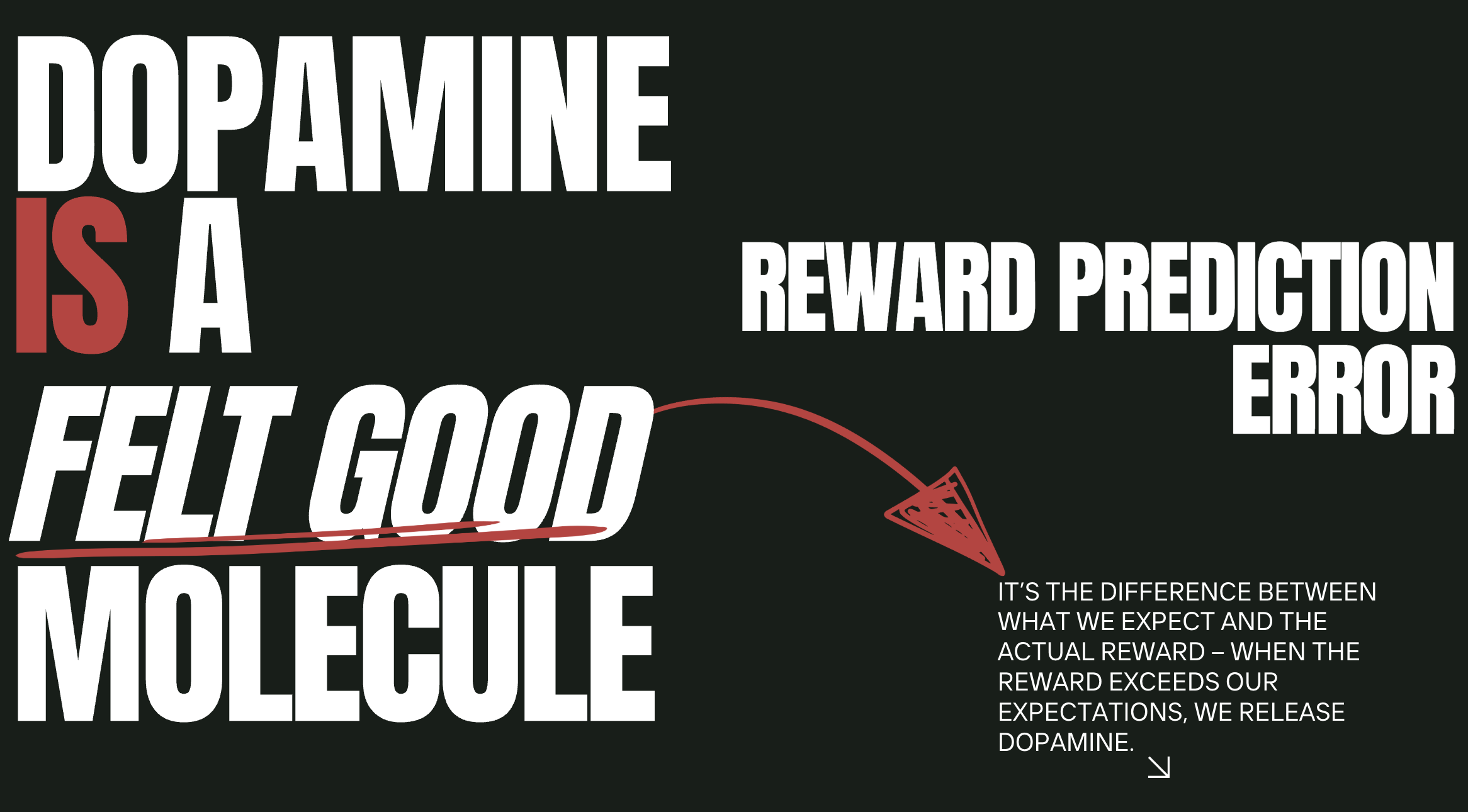
Dopamine is the motivation molecule. It spikes when we experience something unexpectedly good—a “reward prediction error.” For example, if you didn’t expect to find a new coffee shop on your way to work, dopamine helps you remember that moment and associates it with pleasure.
But dopamine is fleeting. Despte popular belief dopamine’s role isn’t to make us feel good – it’s to teach us what felt good and drive us to seek it again.
Food, Exercise & Modern Dopamine Traps
Modern ultra-processed food is engineered to hijack our dopamine system: high fat, high sugar, salt, crunch, and reward. It overrides natural satiety signals and keeps us craving more. Exercise, on the other hand, triggers a slow release of dopamine and anandamide – especially after exertion – which is part of the famous “runner’s high.”
But when comfort creep and technology make it easier to avoid effort, we stop chasing these natural highs, and start relying on artificial ones – scrolling, snacking, bingeing. And we lose out on the real rewards.
Internal vs External Distractions: Why the Enemy Is Inside
It’s easy to blame our phones for stealing our attention. But surprisingly, only 10% of distractions come from external triggers. A full 90% are internal. They come from within: feelings of boredom, anxiety, restlessness, or dissatisfaction.
When those feelings arise, we grab our phones or check our email—not because we’re truly interested, but because we’re uncomfortable.
Our phones have become our modern “shock machines” In a 2014 study, 67% of men and 25% of women chose to administer electric shocks to themselves rather than sit quietly for 15 minutes. That’s how uncomfortable we’ve become with just being.
Habit Loops and Digital Dependency
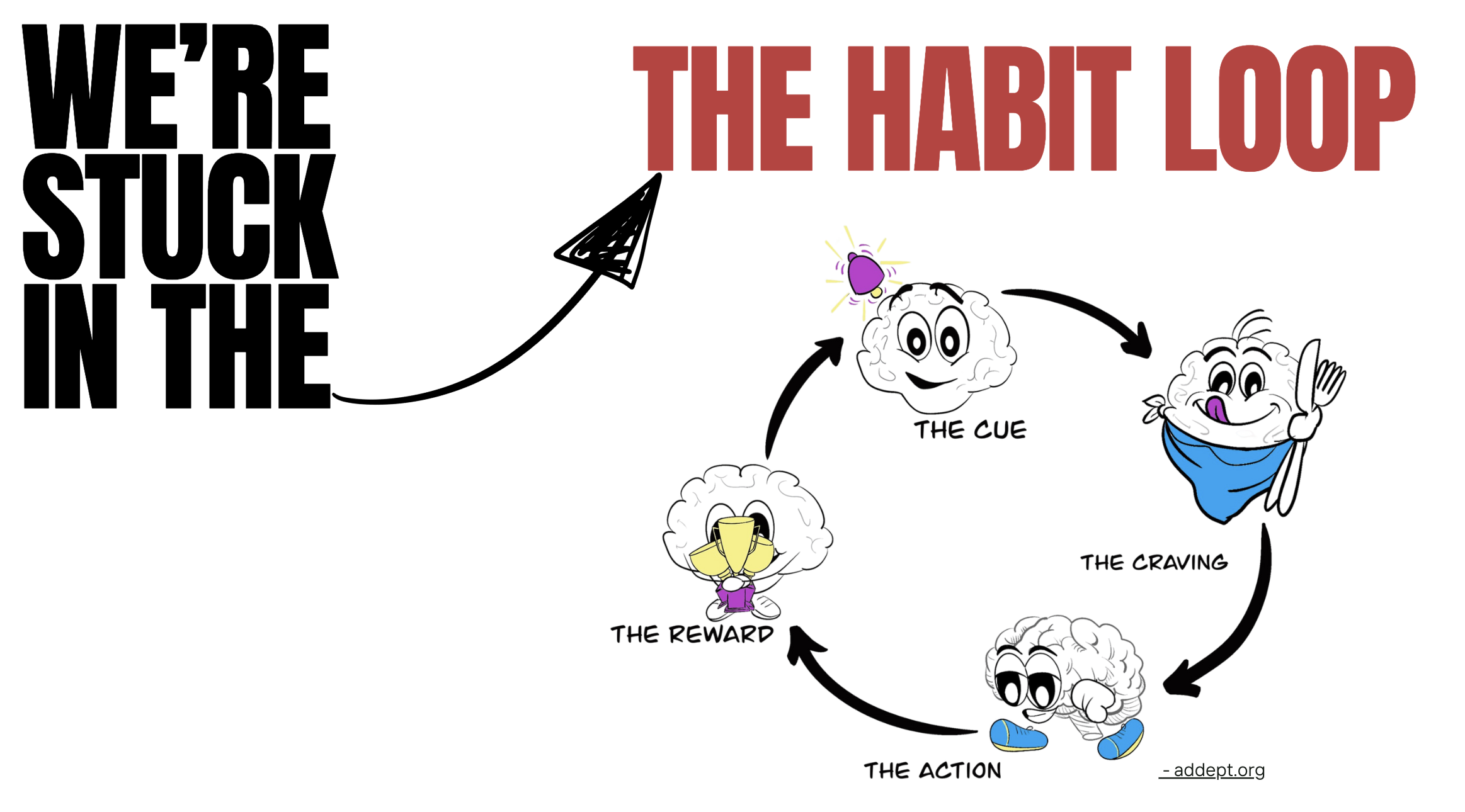
Charles Duhigg’s Habit Loop explains how behaviours form:
-
Cue: is a trigger, the habit e.g. the sight of your phone. It’s a prompt for your brain to move on to the next step – the craving.
-
Craving: is that delicious anticipation of the reward. It’s the motivational force behind each habit. We don’t crave the action; we crave the state/the reward that occurs after the action has been done. You don’t crave clicking on social media; you crave the relaxation and entertainment it offers your brain.
-
Action: is the behaviour itself – working out, drinking your coffee, taking a shower, scrolling on social media – the thing you need to do in order to answer that craving.
-
Reward: is what doing that action gives you – the dopamine hit! It’s the thing that satisfies the craving and makes you that much more likely to do it again.
This loop wires our brain for fast, repeatable behaviour. Every time you reach for your phone instead of sitting with discomfort, you reinforce the habit.
We’re not addicted to our phones. We’re addicted to relief from discomfort.
Building Resilience Through Hormesis
If comfort is killing our attention, motivation, and vitality—what’s the solution?
The answer lies in hormesis: the process by which small, manageable stressors make us stronger.
These “beneficial stressors” train the body and mind to tolerate discomfort and become more resilient over time.
-
Cold Exposure (Ice Baths)
• Triggers norepinephrine release and dopamine, boosting mood, alertness, and mindfulness.
• Regular exposure improves circulation, reduces inflammation, increases fat metabolism, and enhances stress tolerance.
-
Heat Exposure (Infrared Sauna)
• Increases blood flow and heart rate similar to cardio.
• Enhances heat-shock proteins that repair cellular damage.
• Reduces cortisol and promotes parasympathetic recovery.
-
Red Light Therapy
• Stimulates mitochondrial function, ATP production, and cellular repair.
• Reduces oxidative stress (ROS), improves skin appreance and wound heeling, speeds recovery, and balances hormones.
• Shown to positively impact sleep and circadian rhythm.
These aren’t gimmicks. They’re modern applications of ancient wisdom, now supported by clinical research and neuroscience. And they’re at the heart of Avanto Wellness, our new wellness hub (opening August 2025), designed to help you reclaim your energy, sharpen your mind, and build real-world resilience.
So What Can You Do?
You don’t need to throw away your phone or move to the mountains. But if you want to take back control of your time and attention, start with this:
-
Time block your day
Plan your tasks and stick to time-limited windows of work, movement, connection, and rest.
-
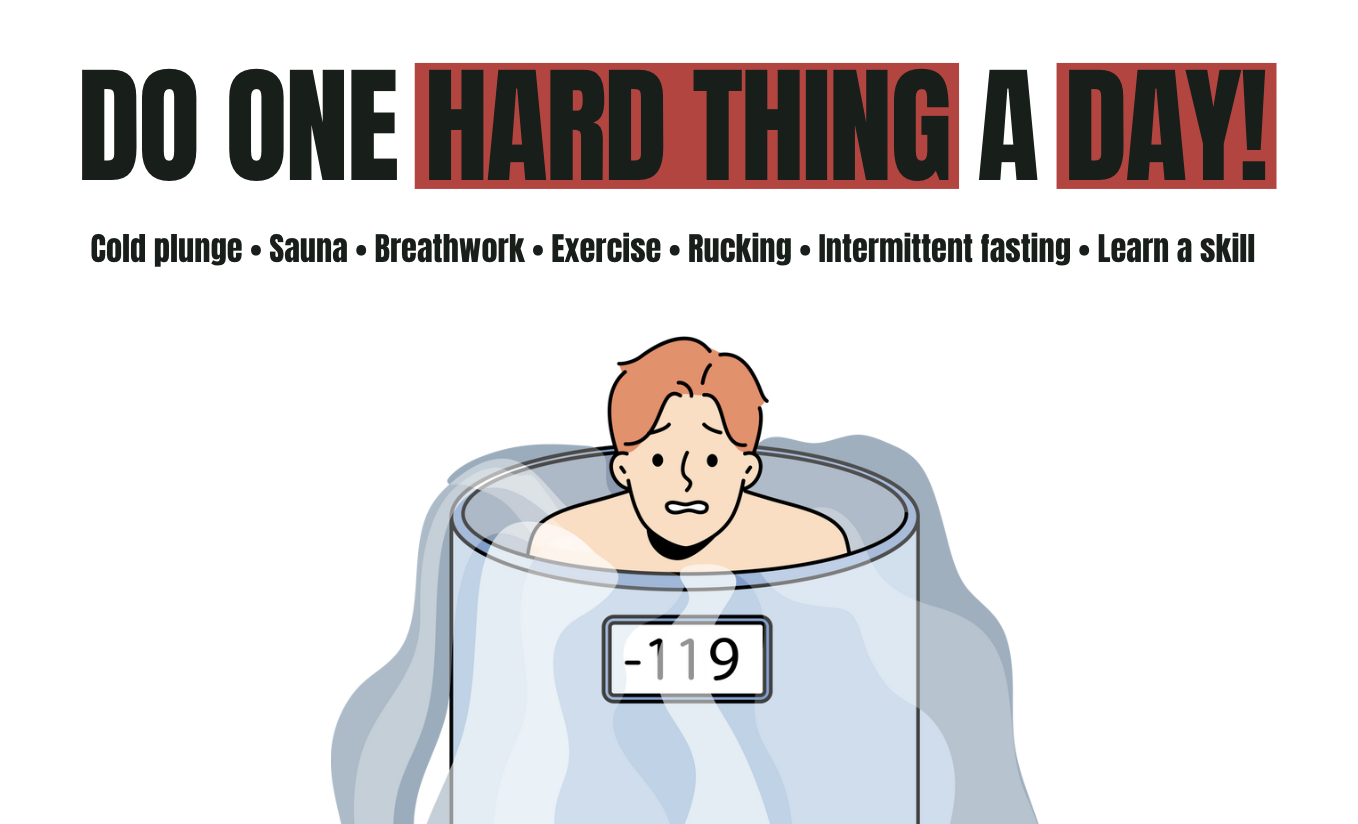
Do one hard thing a day
Train your tolerance. Become comfortable around the feeling of discomfort. It could be an ice bath, workout, sauna, or even fasting or learning a new skill.
Final Thought
Attention is time. Time is life.
If we can’t control where our attention goes, we can’t control how our life unfolds.
At Hall Personal Training and through Avanto, we’re here to help you slow down, build resilience, and reclaim the energy and presence you were designed to live with.
Ready to take back control of your time, energy, and focus?
Whether you’re looking to improve your resilience, build healthier habits, or simply feel more present in your day-to-day life—we’re here to help.
- Learn more about our coaching and our 30-day programme here at Hall Personal Training
- Discover our new wellness hub, Avanto Wellness – featuring an infrared sauna, cold pluge and red light therapy.
- Drop us a message or come visit, we’d love to help you find what works for you.
How to Finally Make Time for Exercise (Even With a Busy Life)
Why You Still Feel Like You Don’t Have Time to Exercise (Even When You Do)
You may have been someone who’s struggled to find the time to exercise – until you read our recent blog post, which helped people to discover 12 hidden hours in your week.
However, despite now being aware of this free time, you still feel like, “I just haven’t got time to exercise.” Even though you can clearly see you’ve got a whole day’s worth of free time available to you.
So why is that?
Why, even when you know you have the time, do you still feel like you don’t?
Here are the top three reasons people struggle to utilise their free time and ultimately, why you may feel unable to get started:
- Parkinson’s Law
- Perfection Over Progress
- Procrastination
1. Parkinson’s Law
Parkinson’s Law — coined by Cyril Northcote Parkinson — states that “work expands to fill the time available for its completion.” In other words, if you’re given more time to complete a task, it often takes longer, even if the task itself hasn’t changed.
Many of us can relate. Take someone who’s recently retired. When asked, “You must have so much free time now?” their reply is usually something like:
“You’d think that — but I’m busier than ever! I honestly don’t know how I managed to work and do everything else…”
A classic case of Parkinson’s Law. Despite freeing up 40+ hours a week by retiring, that time is now easily filled — often unintentionally — with less essential tasks.
Take myself, for example. I set a strict 3-hour deadline every Friday to write a blog post. If I gave myself all week, I’d fall victim to Parkinson’s Law and end up stealing time from more important tasks just to finish it.
So, if you’ve completed our Time Audit and discovered six hours of spare time in your week, yet still feel too busy to exercise – you’re likely falling into this trap. Like the retiree, your free time has been quietly filled with bits and pieces that feel urgent but aren’t important.
2. Perfection Over Progress
Perfectionism is hard-wired into many of us. It’s part of what’s helped humans evolve and innovate. But it often comes at a cost — and that cost is progress.
I speak with so many people who are unhappy in their skin, tired of how they feel, and desperate to make a change… yet refuse to start because they can’t train three times per week.
As mentioned in my previous blog: you don’t need to train three times a week to see results.
There’s a reason why most governments recommend just 150 minutes (2.5 hours) of moderate-intensity exercise per week – it’s been proven to reduce the risk of all-cause mortality and improve longevity.
Of course, training 3-4 times per week can lead to faster improvements, but if your goal is to feel fitter, become stronger, improve your body composition, and boost your general health – 2 sessions per week is plenty.
It’s absurd to say, “I won’t start until I can do three sessions a week,” because that day will likely never come.
I always explain to people: it’s better to start today – even if that’s just one hour a week – than to wait until ‘life calms down.’
(And if Parkinson’s Law has taught you anything – that day is a myth and will likely never arrive. Life is busy!)
Even if you begin with just an hour a week, you’ll soon find momentum builds. Before you know it, you’re able to commit to two, three, or even four sessions per week.
When you start something while busy, you overcome inertia. You put the wheels in motion – and an object in motion stays in motion. You also increase your capacity, and start finding natural solutions to the “I don’t have time” problem.
This is how people transition into progress-driven mindsets and, ironically, end up closer to perfection by no longer chasing it.
3. Procrastination
Procrastination is one of the biggest roadblocks between having an idea… and taking action.
Defined as the act of postponing or delaying something, the Ancient Greeks even had a word for it: akrasia – acting against your better judgment.
If you’re someone who says:
“I’ll do that tomorrow.”
“I’ll start next week.”
“Let me go away and think about it…”
Then you’re dealing with procrastination.
There are two popular schools of thought around why we procrastinate:
- Oliver Burkeman, author of Four Thousand Weeks and Meditations for Mortals, suggests we procrastinate on meaningful tasks because they force us to face uncomfortable truths, like fear of failure, inadequacy, or finality. It feels safer to delay than risk doing something imperfectly.
- Sahil Bloom, author of The 5 Types of Wealth, explains that procrastination is about offloading responsibility onto your future self. You push a task ‘down the road’ because it’s easier to delegate it to ‘later you’ than to do it now.
Unfortunately, procrastination is hardwired into us. Our brains value immediate pleasure and comfort, even when we know those aren’t best for us long term.
But here’s the truth: procrastination is a growth limiter.
If you want to fulfil your potential, you have to fight it.
So… What Can You Do About It?
Here are some simple, practical steps to stop procrastinating on exercise, eating well, and doing the things that’ll genuinely make you feel better:
1. Let Go of “All or Nothing” Thinking (inspired by Oliver Burkeman)
Many people put off healthy habits because they think it has to be perfect – a full gym session, flawless meal prep, no slip-ups. That’s just fear wearing a smart disguise.
Instead, ask yourself:
“What would this look like if I let it be easy?”
- A 10-minute walk is a win
- A decent lunch is enough
- One good session is better than zero
Perfection is the enemy of consistency.
2. Start Tiny and Make It Obvious
When life’s busy, your brain craves simplicity. So ditch vague goals like “get fit” or “eat clean.”
Instead:
- Book one session this week.
- Keep a protein bar or bag of nuts in your desk or bag.
- Set an hourly timer to stand and walk for 2 minutes – it genuinely boosts clarity.
Make the next step so small and obvious that it feels easier to do than to ignore.
3. Schedule It (Sahil Bloom’s style time-blocking)
Your calendar is already full. If your health isn’t on it, it won’t happen.
People who work out regularly don’t just find time – they make it!
Literally schedule your workouts, food shops, or walks. Treat them like a work meeting that’s non-negotiable.
At Hall Personal Training, we run sessions from 6:00am to 8:30pm, on the hour, every hour, which removes the “limited availability” excuse. Members have free rein to book sessions at times that work for them.
4. Close the Thinking-Doing Gap
Saying “I’ll go for a run later” or “I’ll prep something after work” leaves space for procrastination to sneak in.
Instead, pair intention with immediate action:
- Put your trainers by the door
- Chop veg while the kettle boils
- Book that PT session right now!
You don’t need motivation, you just need to start.
Any action, no matter how small, reduces mental resistance and builds momentum.
5. Stop Outsourcing It to “Future You”
The version of you getting home late tomorrow or travelling next week won’t suddenly feel more motivated. Respect that version of you by doing something today to help them out:
- Pack your gym kit tonight
- Plan tomorrow’s lunch
- Block 30 minutes for movement or going for a walk
Future you isn’t a superhero – it’s still you.
Set them up for success by acting in their best interest now!
Final Thought From Me…
Procrastinating around your health doesn’t make you lazy – it makes you human. But if you can notice it and still act, you’ll win.
You don’t need to feel ready, you just need to begin especially when you don’t feel like it. That’s where the real breakthroughs happen.
Ready to Stop Waiting and Start Moving?
The truth is, most people aren’t struggling because they don’t have time – they’re struggling because of how they’re using it. Between Parkinson’s Law, perfectionism, and procrastination, it’s no wonder getting started feels harder than it should. But the moment you take action — however small — everything begins to shift. You don’t need to be perfect. You don’t need the perfect week. You just need a starting point.
That’s exactly what our 30-Day Accelerator Programme is designed for — to help you break through inertia, build momentum, and prove to yourself what’s possible in just a few weeks. Whether it’s one, two or three sessions a week, we’ll meet you where you’re at and help you build up from there.
Get in touch today to learn more or secure your place – your future self will thank you for it.
Your 168-Hour Time Audit: The Simple Fix for “I Don’t Have Time”
“I Don’t Have Time to Exercise” – Let’s Prove That Wrong in 5 Minutes
If you’re someone who often finds themselves saying, “I just don’t have the time to exercise,” I ask you to invest five minutes of your time today — because this blog post might just change your life.
Location, budget, and time are the three main factors that determine whether someone succeeds or fails with a fitness routine. But unlike location or budget, which are flexible, time is fixed.
It doesn’t matter whether you’re the world’s richest CEO with a net worth of $209.5 billion like Jeff Bezos, or you live humbly with only the clothes on your back — we all have the same ‘time budget’: 24 hours a day, 168 hours a week. Time is one of the few commodities that does not discriminate.
So, why is it that your friends and colleagues seem to find time to exercise, while you feel like it’s an impossible feat because “I’m just too busy…”?
The answer?
- You haven’t been taught how to manage your 168 hours each week,
- Or, you like being busy and telling others just how busy you are, because it gives you a (false) sense of productivity — a feeling of accomplishment, even superiority, based on society’s flawed view that “busy people are important people.”
Here’s the truth: anyone who says they “just don’t have time” usually doesn’t have control of their time.
But I’ll assume that if you’ve read this far, you’re not the kind of person who enjoys being busy for the sake of it. Instead, you take your health seriously. You want to feel better, get fitter, and take back control — you just don’t know how to make time for it all.
Let’s change that!
How Much Time Do You Really Need?
Every government in the world recommends at least 150 minutes (2.5 hours) of moderate or 75 minutes of vigorous physical activity per week. Why? Because this small investment in time offers massive health benefits – based on extensive evidence demonstrating the significant health benefits of physical activity, including reducing the risk of chronic diseases, improving mental health, and extending lifespan.
In fact, the NHS has shown that 2.5 hours of activity per week can lower your risk of early death by up to 30%.
If you want to live a long, healthy life and be around to watch your grandkids grow up, then finding time to exercise isn’t optional – it’s essential. So, let’s help you find a few hours in your week…
Welcome to the Time Audit
When someone tells me, “I don’t have time to work out,” I walk them through a Time Audit. Nine times out of ten, we find 10–30 hours of unused or misused time each week.
Remember, you only need 2.5 hours — that’s less than 2% of your week.
If, after completing this audit, you still choose not to use your available time to improve your health, that’s your choice, and perfectly fine by me. But it’s no longer fair to say that ‘time is the issue’ or ‘lack thereof’, because it’s not – it’s something else.
“What gets measured gets managed”
…is a popular quote that states something can only be properly managed if it’s first measured. It’s true; you can only determine whether something’s successful if you know where you started from and track its progress.
When we measure, we often identify silly things we do that interfere with what we want to improve, so we naturally start doing something smarter instead. And it works in many areas of life. For example, research has discovered:
- People who track their food lose more weight, thanks to awareness from measurement (source)
- Analyzing drinking behavior reduced the amount of drinking among people who self-identified as over-drinkers (source)
- Students who recorded their study habits studied more deliberately and consistently and got better grades (source)
- People who monitor their behaviors typically have healthier habits (source)
However, when was the last time you measured your time – your most important commodity?
You can’t declare that you don’t have time for something if you don’t actually know how you spend that time – and knowing comes through measurement.
How the Average Person Spends Their Time
The largest measurement of time comes from data gathered by the OECD Time Use Survey, gathering information across seven years for people between 15 and 64.
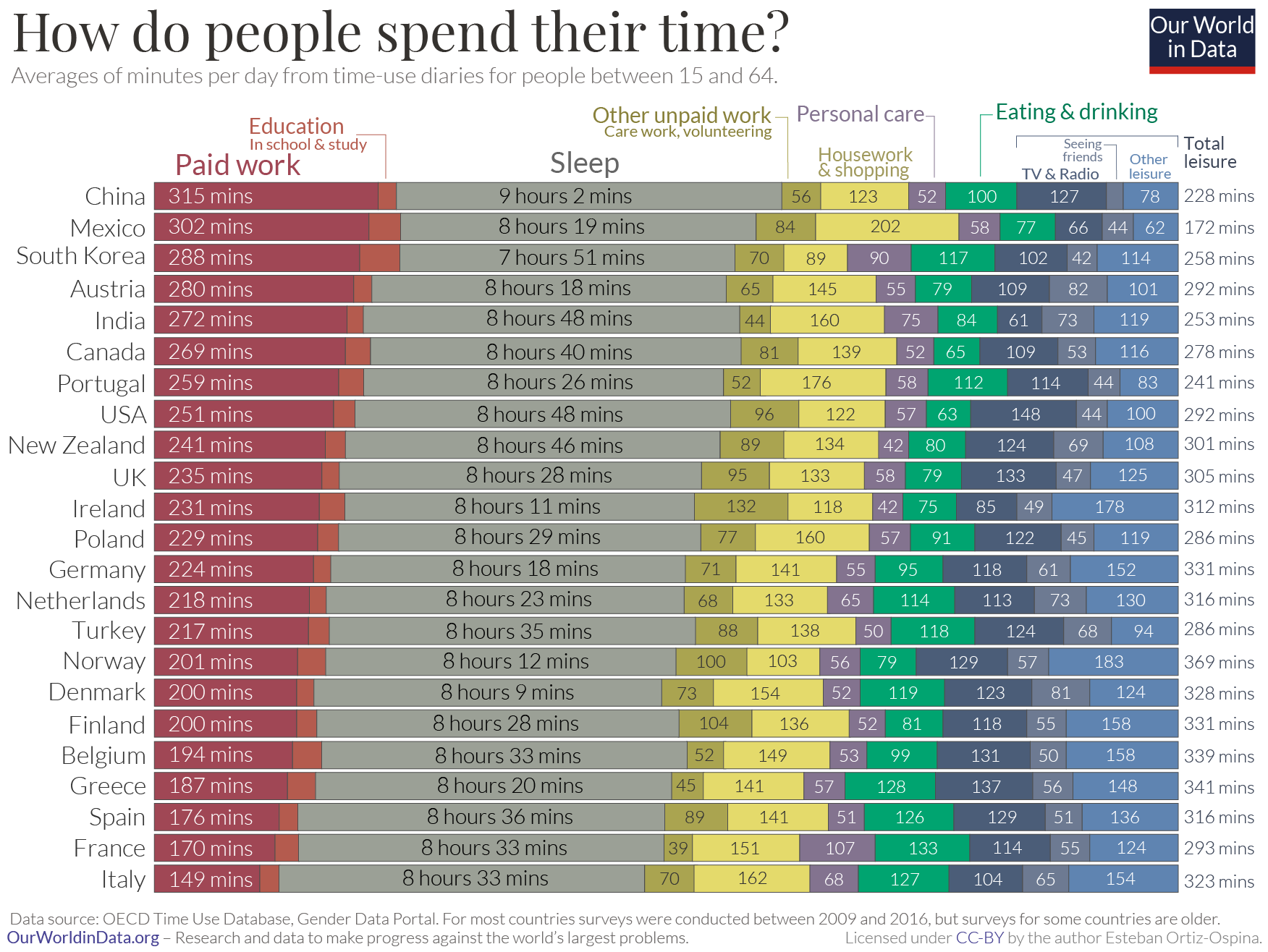
The first thing that jumps out from this chart is that there are indeed many similarities across countries.
This is not surprising — most of us try to split our days into “work, rest, and fun”, and so there are some predictable patterns. We spend the most time working and sleeping, but as evident from this, people in the UK spend a total of 305 mins/5 hrs per day enjoying leisurely activities – watching TV, listening to the radio, catching up with friends, reading, and of course exercising.
In fact, even after time spent on socialising and TV, the average person still has 2 hours a day available.
But okay — those people aren’t you. You’re busier. So let’s turn to you and start measuring your time with a personalised audit.
Your Time Audit
Work and sleep take up most of our time, so let’s start here:
- Work – A typical working week is around 37-40 hours per week, but let’s say you have a demanding job that requires 50 hours a week.
- Sleep – The average sleep duration in the UK is 6.2 – 6.9 hours per night, but let’s say you value your sleep and get a full eight hours – total sleep for the week: 56 hours.
- Commute time – You then need time to get to and from work. Since the pandemic, most of us work from home (at least a day or two in the week), but let’s presume you don’t, so I’ll give you 5 hours a week (an hour a day) of commute time.
Currently, work, sleep, and travel take up 110 hours of your 168-hour week. You still have 58 hours available, but wait, there’s more…
- Household chores & life admin – We need to make time to keep up with the day-to-day admin of life and maintenance of our home, so let’s set aside 10.5 hours a week, giving you 90 minutes a day.
- Supermarket shopping, cooking, and eating – You need to eat, right? In the above survey, people in the UK spend 79 minutes eating, drinking, and 29 minutes doing the food shop – 12.5 hours per week. However, let’s assume you really enjoy cooking and spending more time over meals; I’ll give you an extra 5 hours a week – a total time of 17.5 hours per week or 2.5 hours per day.
- Socialising with friends and family – Spending time with friends and loved ones is just as important as staying active, so let’s set aside 7 hours a week for this.
- Netflix and chill – We all need time to unwind; what better way than catching up on our favorite series? I’ll give you 10 hours a week for this.
Now, before we go any further, let’s look at where your time currently goes:
Work – 50 hours
Sleep – 56 hours
Commute – 5 hours
Household chores & life admin – 10.5 hours
Shopping, cooking & eating – 17.5 hours
Socialising with friends and family – 7 hours
TV and downtime – 10 hours
- Total allocated time: 50 (Work) + 56 (Sleep) + 5 (Commute) + 10.5 (Chores) + 17.5 (Meals) + 7 (Socialising) + 10 (TV) = 156 hours
- Total hours in a week: 168
- Remaining time: 168 – 156 = 12 hours
You now have twelve hours of free time at your disposal! Even if we attribute 50% of these to ‘wasted time,’ you’re still left with 6 free hours a week! Can you honestly say to yourself: “I don’t have the time to exercise?”
Still Think You Don’t Have Time?
We’ve just found at least 6 hours of available time in your week. All you need is 2.5–3 hours of that to completely change your health, fitness, and future.
Time is no longer the barrier. The choice is yours: Do you want to keep making excuses, or start making progress?
Let those 6 newly discovered hours each week be your gift to your future self. Use them to move, to sweat, to grow stronger. You deserve it – and your future self will thank you.
Complete your peronal time audit using our >> Time Audit Tool
Mastering Diet Adherence: How to Navigate and Overcome Lapses
Top 6 Strategies for Diet Adherence Backed by Behavioural Nutrition Research
For some, sticking to a calorie-controlled diet may feel straightforward. For most, however, it’s far more challenging – a process filled with setbacks, temptations, and emotional ups and downs. Yet long-term success doesn’t require perfection. It lies in recognising lapses, understanding their causes, and adapting strategies to overcome them.
The Science Behind Dietary Lapses
Dietary lapses are better understood when approached as predictable behavioural patterns, not personal failures. Research in behavioural nutrition has identified several consistent factors that contribute to diet lapses. A landmark study in the Annals of Behavioral Medicine found that:
-
Emotional States: Studies show we eat up to 40% more when stressed. Emotional eating research consistently shows that stress, boredom, and negative emotions activate reward centres in the brain, increasing cravings and potentially reinforcing unhealthy eating patterns.
Michael Easter’s “The Comfort Crisis” underscores that our modern environment, with its “hyper-convenient” availability of processed foods, amplifies these lapses. His research suggests that deliberate discomfort – whether through routine fasting, controlled indulgence, or mindful eating – is key to mental resilience and self-control.
Practical Strategies To Overcome Common Triggers (Backed by Science)
1. Control the Home Environment
Since most lapses occur at home, creating a supportive environment is essential. Research published in the Journal of Health Psychology shows that proximity to food strongly influences consumption – when tempting foods are readily visible, consumption increases by up to 70%.
-
Out of Sight, Out of Mind: Keep tempting snacks hidden or out of the house altogether. Stock up on healthier options like fruit, air-popped popcorn, or oatcakes.
Dr. Kashey suggests asking: “What problem am I trying to solve by eating this?” This helps identify if the craving is driven by hunger or an emotional trigger.
2. Address Emotional Eating with Self-Awareness
Studies show that individuals who practice emotional self-regulation are significantly less likely to resort to comfort eating.
3. Combat Evening Cravings
The circadian rhythm influences hunger hormones like ghrelin, making evenings particularly challenging for dieters.
4. Consume High-Satiety Foods
Research demonstrates that high-satiety foods can reduce overall caloric intake by up to 300 calories per day (Blundell et al., 2016). Try including more of the following foods in your diet:
-
Strategic Choices: Foods like oatmeal, potatoes, eggs, and watermelon score high on the satiety index.
5. Harness the Power of Tracking
Research consistently shows that tracking improves dietary adherence:
However, tracking shouldn’t become rigid or a stressful afair, as that defeats the point. As Trevor Kashey points out, “The goal isn’t perfection but progress toward a system that supports your success.” Over time, you can adapt your diet to rely on informed habits rather than detailed logging.
6. Make Smart Food Swaps
Research shows that simple food substitutions can reduce caloric intake by up to 350 calories per day, ‘sensible subsituations’ – as I coin – are easy ways to do this:
Embrace Progress Over Perfection
Research shows that flexible eating patterns lead to better long-term adherence than rigid approaches. Dr. Kashey argues that most diets fail because they aim for rigid perfection, leaving no room for natural setbacks. “Behaviour is measured over time, not in isolated moments.” he explains. A single lapse won’t derail your progress- as long as you don’t let it define your day.
Michael Easter reinforces this mindset: “Small discomforts build resilience. Lapses happen, but using them as opportunities to problem-solve rather than giving up enhances self-control and long-term success.”
By understanding triggers, building supportive habits, and treating lapses as learning moments, you create a foundation for sustainable diet adherence. Remember, success in weight management isn’t about being perfect—it’s about consistently showing up, learning, and adapting along the way.
Take the Next Step with Hall Training
Understanding the science of diet adherence is the easy part – putting it into practice however, can be far tricker. At Hall Training, we’re here to help you bridge that gap. Our comprehensive nutrition support programme provides:
Join our 6-week programme and transform your understanding of nutrition into lasting habits. We’ll support you through the challenges, celebrate your victories, and help you develop a sustainable approach around healthy eating that fits your lifestyle.
Ready to move beyond understanding to action? Contact us today to start your journey.
How Exercise Boosts Productivity: The Science & Our Exclusive Workspace Partnership
Boost Your Productivity with Exercise: Our New Partnership with Bloxham Mill
The start of a new year shouldn’t be just about setting yourself some fitness goals, but should also be a time for you to work on your performance and productivity too. At Hall Personal Training, we’re always looking for ways to help our members feel their best, both in and out of the gym. That’s why we’re excited to announce our new partnership with Bloxham Mill, a modern and flexible workspace just 10 minutes from our studio in Deddington and Banbury.
This collaboration isn’t just about offering our members exclusive perks at Bloxham Mill; it’s also about highlighting the powerful link between exercise and productivity. Moving regularly isn’t just great for your body; it’s a proven way to sharpen your mind, boost your energy levels, and improve overall work output.
How Exercise Enhances Productivity
If you’ve ever felt sluggish at your desk or struggled to focus on an important task, exercise could be the missing piece in your daily routine. Research consistently shows that being physically active can increase productivity, improve concentration, and enhance overall cognitive function. In fact, employees who exercise regularly report a 21% increase in productivity (Journal of Occupational and Environmental Medicine). Here’s why:
- Sharper Focus & Faster Thinking: A study published in the British Journal of Sports Medicine found that just 20 minutes of exercise can boost brain function and concentration for hours. Movement increases blood flow to the brain, helping you stay alert and make better decisions.
- Brain-Derived Neurotrophic Factor (BDNF) & Mental Performance: Exercise stimulates the release of BDNF. Higher BDNF levels are linked to better focus, problem-solving, and overall mental well-being, making regular physical activity a powerful tool for workplace success.
- Increased Energy Levels: It might seem counterintuitive, but using energy to exercise actually creates more energy. People who exercise regularly report feeling more refreshed and less fatigued during their workday.
- Reduced Stress & Improved Mood: Exercise is a powerful stress reliever, helping to reduce cortisol levels and release endorphins. A healthier mindset leads to better problem-solving and a more positive work environment.
- Enhanced Creativity: Research from Stanford University suggests that walking can increase creative output by up to 60%. If you’re struggling with a mental block, stepping away for a quick walk or workout could be just what you need to spark fresh ideas.
- Better Sleep for Higher Performance: Regular exercise promotes deeper, more restful sleep, which in turn leads to improved cognitive function, decision-making, and efficiency at work.
How Our Partnership with Bloxham Mill Can Help You
To support our members both physically and professionally, we’ve teamed up with Bloxham Mill, a leading flexible workspace offering premium coworking spaces, fully serviced offices, and high-tech meeting rooms. Whether you work remotely, run your own business, or just need a professional space to focus, this partnership provides fantastic benefits.
Exclusive Perks for Hall Personal Training Members:
>> A complimentary weekly pass to experience the Hive, Bloxham Mill’s stylish coworking space. Perfect for those who need a fresh, professional setting to work productively.
>> 20% off meeting room bookings – Ideal for key presentations, collaborative sessions, or client meetings in a fully serviced, high-tech space.
These perks are designed to help you create a balanced routine that supports both your health and your professional success.
How to Claim Your Exclusive Offer
If you’re a Hall Personal Training member and want to take advantage of these exclusive perks at Bloxham Mill, here’s how:
>> Get in touch with Louise at reception@bloxhammill.com to book a tour or learn more.
>> Quote WINTEROFFER when booking your space to claim your discount.
Start Moving & Working Smarter
The connection between exercise and productivity is clear: when you prioritise your health, your work performance naturally improves. By combining structured personal training with access to a dedicated professional workspace, you can take your focus, energy, and efficiency to new heights in 2025.
If you’re ready to move more, think better, and work smarter, get in touch to discover how personal training can help you stay accountable and build healthier habits – together, let’s make this year your most productive yet!