Chris Hall
Personal Trainer and Founder of Hall Personal Training
Exercise Mindset Wellness
July 5, 2017
Many personal trainers, coaches and gym-goers seem to think that if you a lift a weight from A-to-B, the muscles involved in that lift will be activated, while others (more sensible folk) believe a muscle is only really activated in a lift when you’re thinking about it – this is known as the mind-muscle connection.
So who’s right, and do we really need to be thinking about the muscle we’re trying to work, or can we afford to let our mind wander elsewhere?
Well, the research on this topic is limited and mostly anecdotal, however I’ve managed to dig up a few studies that can shine some light on the topic.
The largest study I found was by glute expert, Bret Contreras. He took a group of subjects and using EMG data, found whether the load, cadence, and form dictated muscle activation, or whether it’s possible to mentally steer muscle activation to individual muscles using the power of the mind.
It’s very important to note that the load, speed, grip-widths, stances, bar movements and joint ranges of motion were all kept constant between the two groups as otherwise these factors would ultimately sway the outcome.
The results are somewhat surprising! There’s certainly evidence to support that the mind-muscle connection does in fact exist, but only for certain muscles:
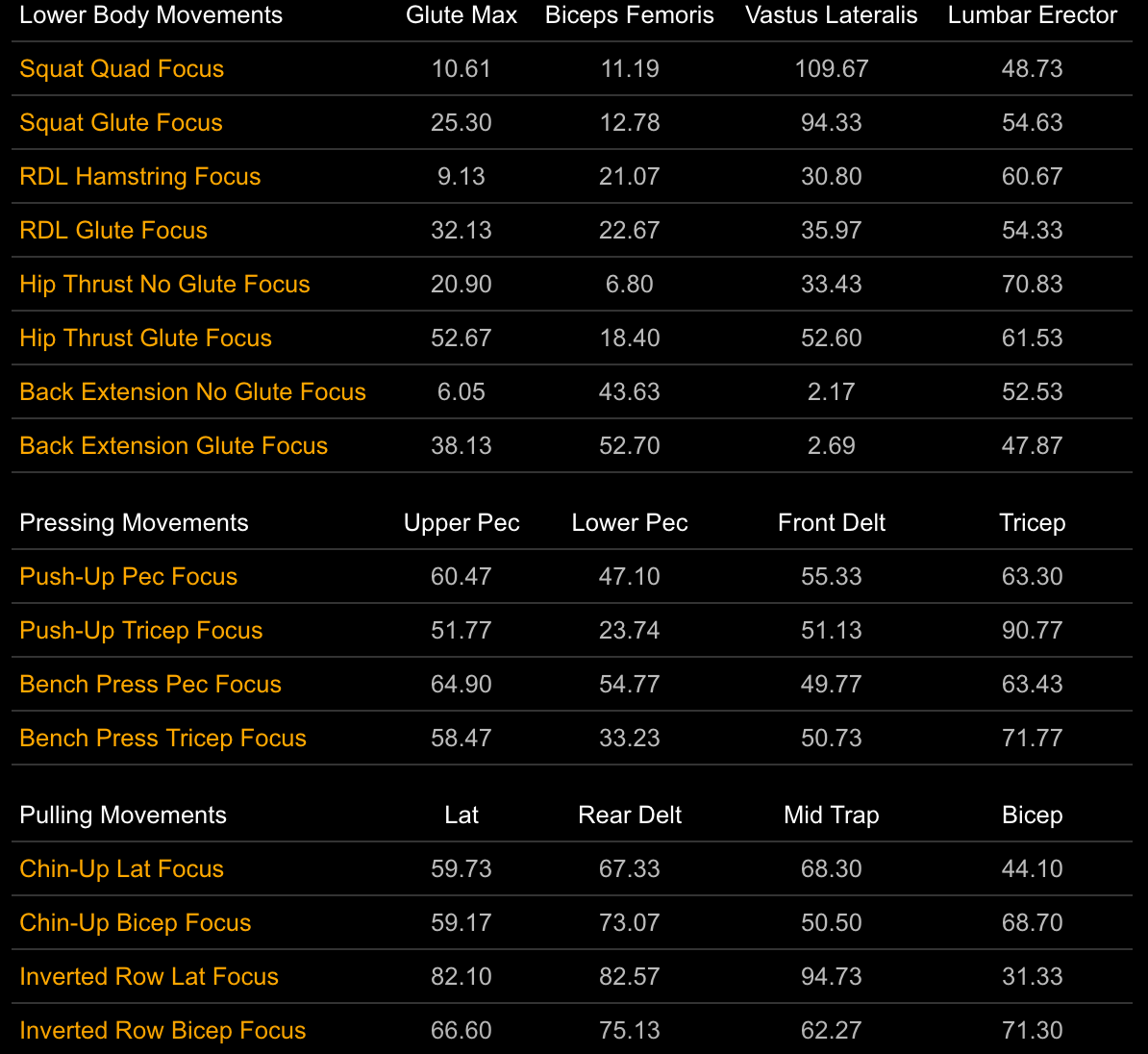
The glutes seem to have the greatest influence of recruitment, with a 32% difference in recruitment when thinking about them working to not working. During a back extension, muscle activation only reached 6% when subjects weren’t thinking about them compared to a staggering 38% when they were actively thinking about them. Overall, glute activation was a lot higher when subjects were really thinking about them working during hip extension exercises such as RDL’s hip thrusts, squats and back extensions.
Other muscles that were found to respond well to the mind-muscle link were the pecs and the triceps; focusing on the pecs while pressing limited the work the triceps had to do, placing more load through the pecs. This was easier to do when performing a push up rather than a bench press.
For puling muscles such as the back, mid-traps and the biceps it was really dependant on the movement being performed at the time. Lat activation didn’t change too much during a chin up, but they really came into play when thinking about them during an inverted row.
On the whole there is evidence to suggest there is a mind-muscle connection, and we should really think about muscles working if we want to improve the amount of work they’re contributing in a lift. However, there are a few other things to bear in mind:
So there you have, and I personally believe the mind-muscle connection does exist as we see it day in and day out with our clients too. A great way I explain this to clients is to look at the connection like revising for an exam:
When you revise for an exam, it’s one thing reading the information you need to learn, but just because you’ve quickly read it doesn’t necessarily mean you’ve understood it or will even able to recite it. However, if you think about what you’re reading and really visualise it, then you’ll have a much greater understanding and retention rate – muscles are no different. Think about the muscle you’re trying to work and really hone in on it. I guarantee it’ll add a whole new dimension on to your training.
Next week I’ll be talking about how you can create this link between mind and muscle.

Chris Hall
Personal Trainer and Founder of Hall Personal Training
you may also enjoy...

Why Most People Never Start Exercising (Even When They Really Want To)

How Many Steps Should I Actually Walk a Day?

We’re Not for Everyone
Not for quick fixes, short-term chasers, or solo lifters

Why Women Should Cold Plunge – and the Benefits You’ll See
is cold exposure safe for women?

Vitamin D in Winter: Why Your Levels Drop and How to Optimise
beyond just sun and supplements