As winter arrives and the cold weather sets in there’s only one type of food that helps to warm our bellies – carbohydrates. Today I want to talk about a group of carbohydrates known as ‘grains’.
Grains are any food made from wheat, rice, oats, cornmeal, barley or another cereal. Bread, pasta, oatmeal, breakfast cereals, tortillas, and grits are all examples of grain products.
Grains can be divided into 2 groups:
- Whole Grains – Whole grains are untouched and contain the entire grain kernel ― the bran, germ, and endosperm. Examples include wholewheat flour, bulgar wheat, oats and brown rice.
- Refined Grains – Refined grains are grains that have been milled, a process that removes the bran and germ. This is done to give grains a finer texture and improve their shelf life, removing a lot of the dietary fiber, iron, and some B vitamins. Examples are white flour, white bread, and white rice.
Most grains have been given a bad rap over the last few years with some ‘experts’ claiming that consuming them causes weight gain, abdominal bloating, cardiovascular disease and even cancer. Eating any foods in excess will inevitably cause weight gain and sometimes bloating, but to say grains are a danger to one’s health is completely absurd and certainly not true! If anything, I can only see grains being beneficial to health as they’re useful sources of minerals, antioxidants and fibre, which should all feature as part of a healthy diet, alongside lean proteins and healthy fats. So, to reap the benefits, I’ve made a guide to some great grains:
Amaranth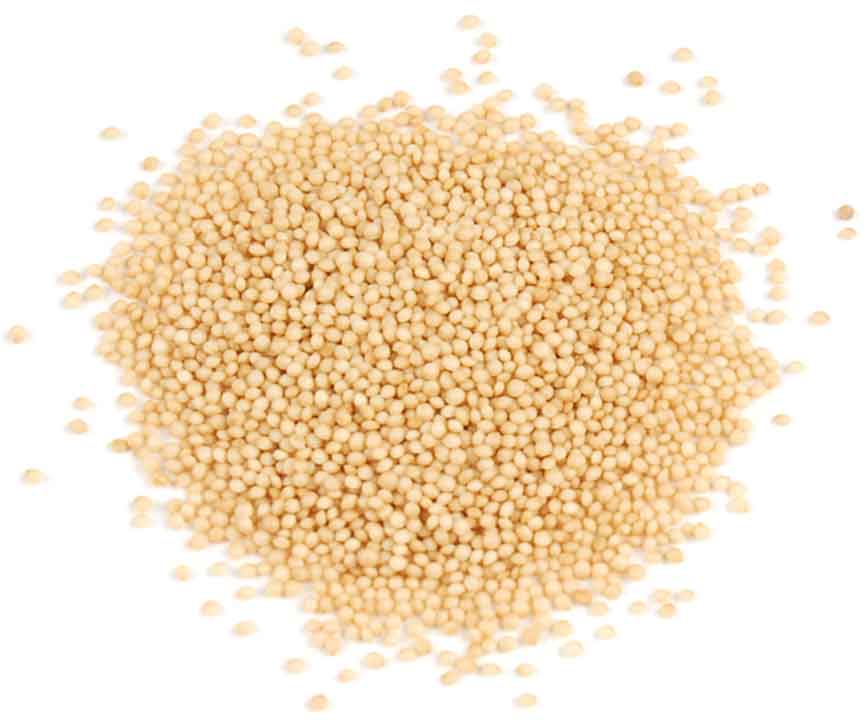
Amaranth is usually rich in magnesium, which is required for muscle relaxation and helping the body to manage stress; calcium, which helps to maintain bone density; iron which carries oxygen round the body, and lysine (some evidence suggests it helps counter the effects of cold sores but more importantly it helps to reduce calcium loss and therefore good for bone health).
Tip: It is in the same family as quinoa and beetroot and contains no gluten. In fact it’s technically not a grain at all but cooks like rice or can be used as a substitute to popcorn.
Barley
Keeping fit for students – our top tips
Balancing lectures, essays and socialising with your health and fitness is tough – there’s no two ways about it. But despite the copious alcohol on offer, and resulting late night trips to the kebab van, it is possible to stay in shape while you’re at university. Our trainer Pete has provided his top tips for busy students:
1. Buy a gym membership
This may sound obvious but it will give you some accountability. When I was a student money wasn’t exactly free flowing so, hopefully, if you are paying for a gym membership it will make you want to make the most of it and will keep you going. Luckily in Oxford there are cheap membership deals on offer. Whether you’re living in central Oxford, or based in Cowley, Pure Gym memberships often come in at under £20 per month, and lots of the Oxford colleges have their own offers or facilities you can take advantage of.
2. Schedule your gym trips
Although every thinks that when you are a student you have unlimited free time to spend watching Jeremy Kyle, this is not always the case. Workloads can be heavy and the stress can make you think you need to spend every waking minute in the library. YOU DON’T. Set yourself a time to go to the gym. I used to like going in the morning as it was a more exciting prospect to wake up to than going to sit at a computer all day. Making the gym part of your routine will also make the habit stick. Try to go to the gym at the same time, on the same days each week. Half way through term you won’t even notice that you’re making time for it anymore – it’ll be natural.
3. Plan a decent programme
The gym can be stressful if you don’t have plan. There is nothing worse than getting in, looking around and not knowing what you are going to do. Often, this leads to people doing the same thing every time, because they can’t think of what they should be doing. This can lead to you losing the enjoyment of going to the gym and it will also stop you making the progress you could be making. So try and plan what you are going to do, no matter how basic. If you struggle to do this or just don’t know how to then maybe go to some classes at the gym or think about getting a personal trainer.
4. Get a gym buddy
Going to the gym with a friend can help on a number of different levels. Firstly, making the gym more of a social event will continue to keep it more interesting, thus keeping you going. Secondly, it means that if you are having an off day and can’t be bothered to train, then hopefully your friend won’t be feeling the same and will encourage/force you to go to the gym and I guarantee you’ll thank them for it afterwards. Finally, if you are a super competitive person it will make you push harder when you work out.
5. Set a goal
You may have heard us bang on about goal setting before, that’s because its damn important! You wouldn’t do all your uni work if you didn’t know you were going to get a degree at the end of it, or if you didn’t want a degree. So why would you put in loads of work at the gym if you don’t know what you want the end result to be? Whatever it is, make sure you know what you want from your efforts and keep that in mind.
6. Do things you enjoy
Obviously, it’s nice to optimize what you do at the gym but if for some reason you can’t do that, don’t get disheartened and just remember that something is always better than nothing. You have still made the effort to go, you have still burned calories and stimulated your muscles, you will still get that self-righteous feeling and can brag about going to the gym. Finally, doing things you don’t like will nearly always lead to you stopping doing it. So do things you enjoy when you go the gym whether it’s a Zumba class or lifting ridiculously heavy weights.
So next time work feels overwhelming, take a break, plan your gym trips, and refocus on your health and fitness. By the end of term, you should definitely be seeing some results!
If you need a helping hand, check out our student training page to see how our tailored sessions could point you in the right direction, at a fraction of the cost of regular personal training sessions!
Poor posture? It could be Upper Cross Syndrome
For those of you who don’t already know, as well as being a personal trainer I am also a qualified sports therapist. A sports therapist works with musculoskeletal injuries such as muscle strains, ligament sprains and fractures, to name just a few. In my role as a sports therapist, I also analyse posture and any postural imbalances that a person may have. One of the most common types of posture issue I see is Upper Cross Syndrome (UCS).
Upper Cross Syndrome is a muscle imbalance which affects the upper body and to be more specific, the head and shoulder area. It is characterised by a rounding of the shoulders and an extended neck. If somebody is suffering from UCS, you will notice forward neck translation (forward told of the head), a hunched back, rounded shoulders, and pain and tightness in the upper back and neck.
Why does it happen?
Our bodies are fantastic at adapting to muscle imbalances, which sounds great but really it’s not. Adjusting for imbalances puts a lot more stress on other joints, which shouldn’t be loaded with the extra work. Due to the adaptation seen in UCS, muscles that tend to be relaxed when their buddies should be doing the work get loaded with extra responsibilities.
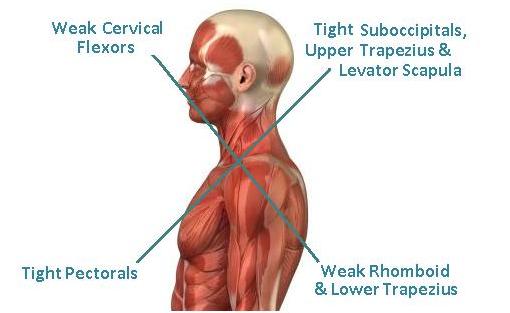
The main muscles which are affected by UCS are the pectorals, upper trapezius and levator scapulae, also weak rhomboids, lower trapezius and neck flexors. The image below describes which muscles are weak and which are tight in the condition.
 What are the causes?
A sedentary lifestyle is the main contributor to UCS. This can range from sitting on the sofa watching TV to being sat at a desk while working. Training patterns can also be a contributing factor, especially in men. When I walk around the gym, I see a lot of men in the free weights area with UCS. I ask them what they’re training and the normal response is chest. They don’t give any attention to their backs and this is why this posture is visibly noticeable. The pecs become tight and when back training is neglected, the lower traps, rhomboids and serratus anterior become weak, which causes the shoulders to round.
Using your smartphone or tablet can also cause the muscles at the back of your neck to become tight and the muscles at the front of your neck to become weak. A lot of us keep our phones at a distance, and its because of this that we over-extend our heads, causing that long neck look that you may see.
How can I fix it?
The first issue to address is strengthening the muscles that have become weak. Any exercise that strengthens the upper back will help, however I would strongly recommend the High Cable Lateral Extension and Seated Rows.
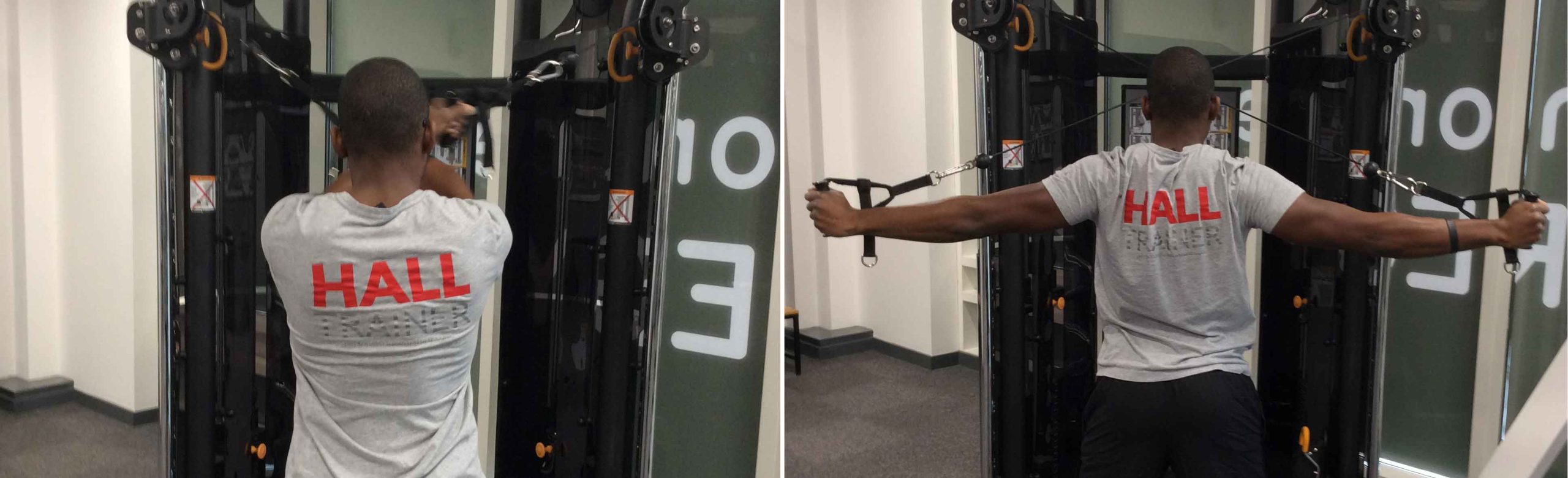
High Cable Lateral Extensions
Stand facing the cable machine and hold the left cable with the right arm and the right cable with the left arm as shown in the picture on the left. Next create the letter T with your arms as shown in the picture on the right. As you make the letter T, squeeze the shoulder blades together (a good cue for this is try to get your shoulder blades into your back pocket). Return back to the starting position. It’s best to work with light weights focusing on high repetitions. Three sets of 15 reps will do the trick.
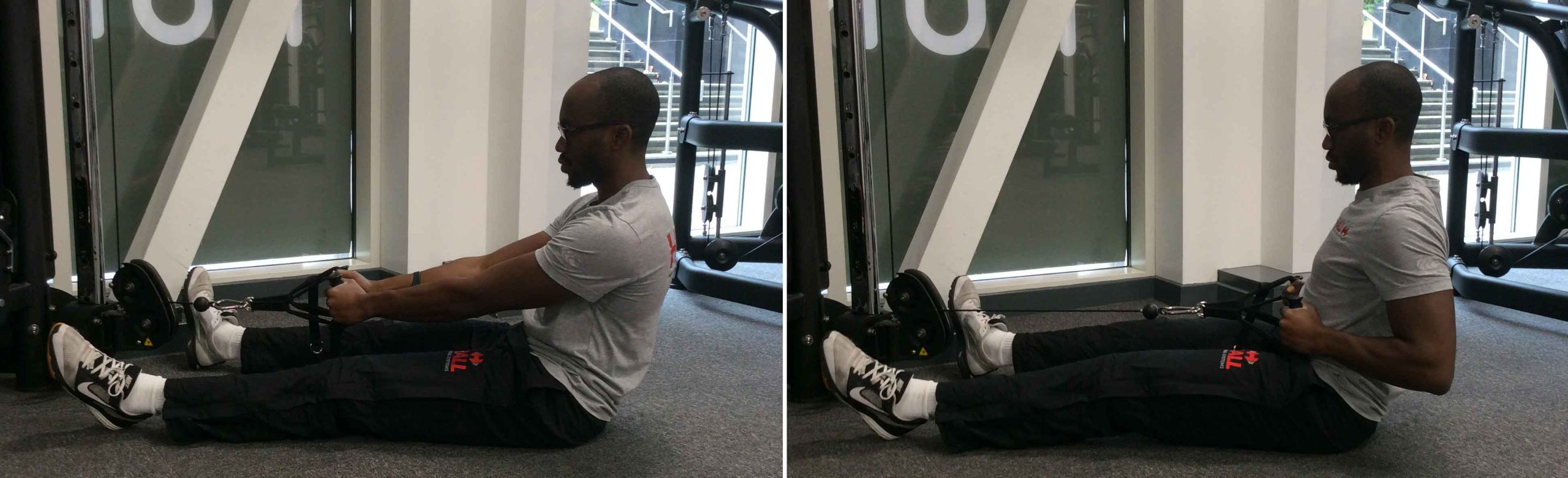
Seated Rows (Machine or Cable)
You can use either a cables machine or a fixed machine. What you want to do is pull either the cables/handles towards your chest and focus on squeezing the shoulder blades together. Again use the cue I mentioned above to help squeeze the shoulder blades together.
Upper Cross Syndrome is a relatively common condition, but by being more aware of your posture on a daily basis and working to strengthen your upper back, you can really make some ground in reducing the symptoms and improving your posture.
If you have any further questions or need more advice, drop me a line.
Want to get into running? Start with a 5k
Getting into running, especially joining running events, can be really daunting, but with a little bit of work and determination, everyone is capable of running a 5k.
Why run a 5k?
A 5k is the perfect starter distance. It is a challenging distance to all, not just new runners, but is also very achievable mentally and physically for beginners. Beginner runners should ideally start with shorter distances before moving to the longer, more endurance based events such as a 10k or a half marathon. This will help long term with speed when you progress to the longer distances. For example, running a 10k in under an hour is impossible until you can run a 5k in under 30 minutes. As you progress and look to join group events or races, speed will become key and building up to a 5k will really help you develop this.
What prerequisites should runners have before taking on this plan?
As this is a short distance there is no minimum fitness level required. If you can walk, you will soon run after following the programme below! This is aimed at beginner runners.
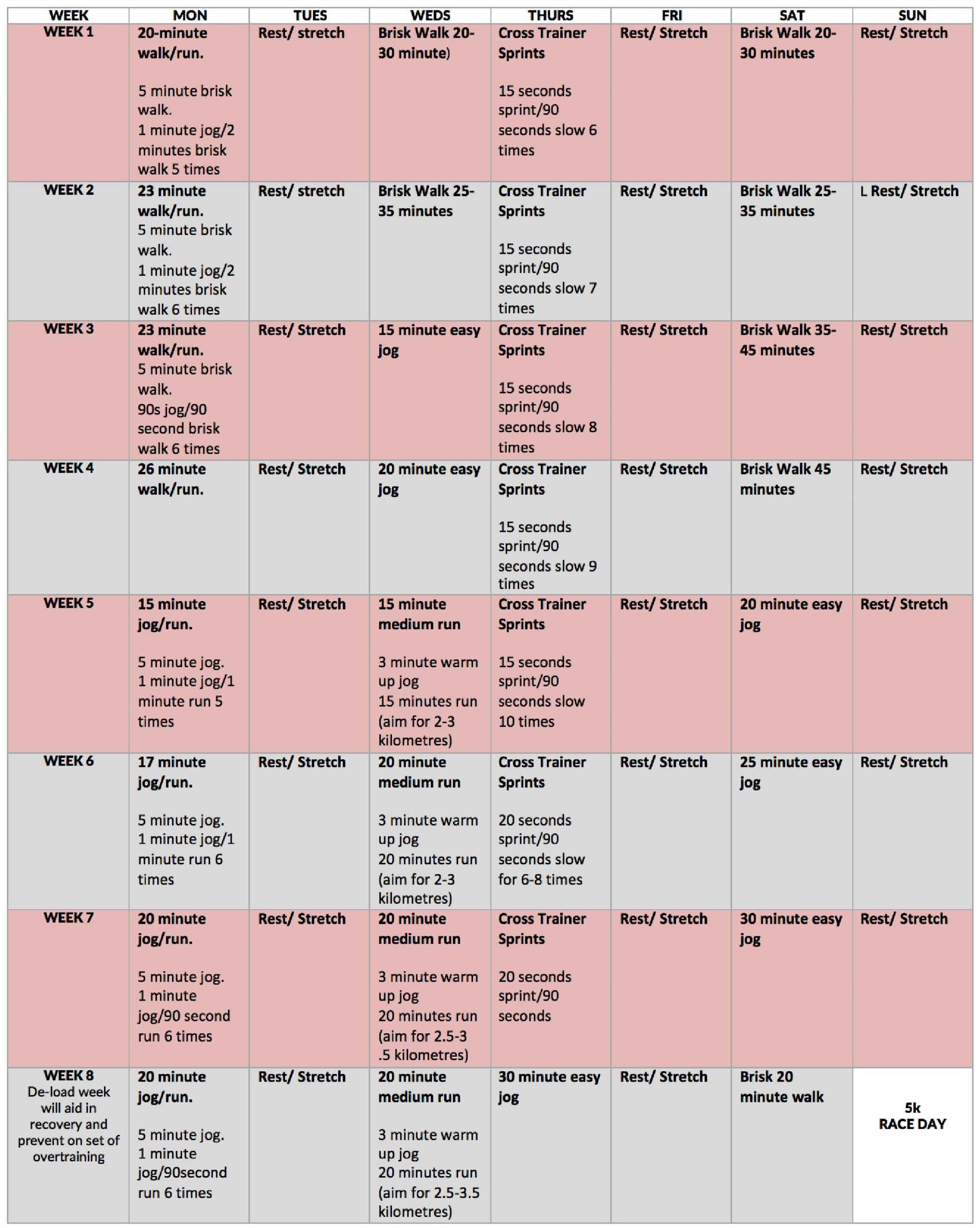
Understanding the programme
Walk/run
Treat the first 5 minutes as your warm up. You will find you have a better rhythm and breathing pattern in the main part of your session after a brisk walk or slow jog. After your warm up, complete 1 minute or 90 seconds jogging followed by 2 a minute brisk walk until the overall time is complete.
Jog/run
Again as above treat the first 5 minutes as a warm up. After your warm up complete 1 minute of slow jogging followed by 1 minute of a faster run. This is not a sprint but should be faster than your 5k pace.
Easy jog
This session is a continuous jog at a steady pace similar to your warm up pace. The aim is to run continuously without stopping. This should not be an overly strenuous session but aimed at building endurance and confidence.
Medium run
This session is aimed at building distance into your continuous run. Aim to maintain the same pace throughout the run while running the furthest you can in the allocated time. This is a harder run than the easy jog.
Cross Trainer sprints
Sprints can be completed on either a cross trainer or bike. Both of which are non-weight bearing which allows your joints to rest. Each 15-20second sprint must be at maximum speed followed by a 90 second slow recovery. The recovery should be approximately 40% of your maximum speed.
Week 8 – deload week
As you can see the volume is lower on week 8. This allows your body to rest in preparation for the 5k race. Keeping the volume high will deplete glycogen/energy levels in the lead up to the race. Taking active recovery the day before the race, such as a 20 minute brisk walk will keep you fresh and hungry for the race.
This programme should be achievable for anyone, no matter your fitness level – so why not give it a go? You’ll be joining your local park run in no time!
If you have any questions or need some further advice, just email me on becky@halltrainingsystems.com. I’d be happy to help!
5 Upper Body Exercises You Probably Never Knew Existed
The key to any successful fitness programme is variety. While all of the ‘standard’ exercises and lifts, such as the bench press and squat, are key, there are many more little-known exercises that could also help you achieve your goals.
To help with your workout inspiration, here are five upper body exercises you probably didn’t know existed, but should definitely include in your next workout!
1. Standing Cable Pallof Press
Origin: This exercise was introduced in 2006, and named after the Boston-based physical therapist, John Pallof.
Targets: It works the core’s ‘true’ fuction – stability over movement. It resists the trunk going into side flexion (bending to the side) and extension (bending backwards), working the core and abs hard! It also helps to bring the hips into a strong posterior pelvic tilt position (hips tucked underneath) along with keeping your abs braced.
Who can do it? It’s an exercise that can be both regressed and progressed for any level of ability. Standing (feet neutral) is probably the most basic version of this exercise. Once you’ve mastered this you can then play around with feet position (split stance) and then move into a kneeling position.
2. Z Press
Origin: This movement is named after strongman Zydrunas Savickas.
Targets: Core, shoulders – requires hip mobility, trunk strength, hamstring flexibility and lumber strength, as well as thoracic spine mobility.
Who can do it? This is a much harder exercise than your standard overhead press, and if you expect to lift an equal amount of weight as you would during your overhead press then you will be disappointed! It is best attempted by those familiar with weightlifting. Make sure you keep your heels and the back of the knees in contact with the floor and then perform the movement like a standard overhead press.
If you struggle to keep the legs straight and the lower back stiff, then try widening your foot position slightly, which will make room for your hips, or place a small step under your bum to reduce the degree of hip flexion. This exercise requires a huge amount of trunk stability and hip mobility, and if you find you’re lifting less than half the weight for your standing overhead press then you need to work on your truck stability and hip mobility before tackling it.
3. Kneeling Zottman Curl
Origin: Named after the 19th Century strongman, George Zottman.
Targets: all of the muscles that flex your elbow joint. The concentric portion (as you curl the dumbbells up) primarily targets the biceps, with them being in a mechanically strong position when your palms are facing upwards. At the top of the exercise, rotate the wrists, switching to a pronated grip (palms down). As we lower the weight, we readily engage the brachioradialis (a muscle which runs from the forearm to the upper arm) and brachialis (the muscle located beneath the biceps), effectively combining two exercises in one.
Who can do it? Anyone; those new to weightlifting should just start with a smaller weight! We find the Zottman curl has a strong carry over for chin up or pull up strength especially in females, due to the biomechanics of the lift.
Typically you’ll see people performing this in a standing position. Personally, I prefer a kneeling position as eliminates the ability to cheat or force the weight up by swinging from the back or using the legs. When in a kneeling position I find it places more emphasis on the core and glutes by holding a posterior pelvic tilt position.
4. California Press
Origin: Believed to have been named by members of Gold’s Gym in California back in the ‘70s.
Targets: It’s a hybrid exercise that’s a cross between the close-grip bench press and lying triceps extension. It’s a popular assistance exercise among the powerlifting community, particularly by lifters who need to increase the size of their triceps and strength to bring up their bench press weight.
A good starting weight for this exercise would be a halfway weight between what you would lift when you close-grip bench press and what you would use when performing lying triceps extensions. If you find yourself going too heavy too soon, you’ll more than likely compromise technique and it’ll revert back to being a close-grip bench press.
Who can do it? This is best practiced by somebody familiar with weightlifting, who has experience in both the close-drip bench press and lying triceps extension.
5. Pendlay Row
Origin: Named after former Junior World Champion in Powerlifting and Collegiate National Champion in Olympic Weightlifting, Glenn Pendlay.
Targets: Maximal back strength and explosiveness – great for improving deadlifts!
Who can do it? This exercise should only be attemped by those with a strong core and lower back. Starting and stopping each rep from the floor minimises the time the weight is suspended, allowing for a split second recovery and easing the burden on the lower back. This allows for a greater amount of weight to be lifted compared to the bent over row. However, due to the body’s position and pull from the ground, the body is having to resist the bar’s downward force meaning you’ll need a strong core and low back if you want to be pulling sufficient weight. It should be performed with lower reps (4-8) and an explosive manner.
Hopefully this post has given you a few ideas on how you can spice up your next programme. Watch this space for five lower body exercises you should be using too!
Common Fears for New Runners
With the sun finally making an appearance, new runners are beginning to take to the streets, fields and hills. I often find that people are nervous before they take up running, but there’s no need to be – running is an excellent way to improve your general fitness and also kick-start any weight loss you may be trying to achieve.
Here are a few of the most common worries I hear, and the reasons why they shouldn’t be anything to fear!
1. Will I cause damage to my joints (specifically knees) from excessive running?
There is no definitive answer to this as it depends on a number of factors such as age, fitness, strength and previous training history. The action of running should not cause damage to a healthy strong joint, especially if you are running correctly and factoring strength and mobility training into your routine. If you are particularly worried I would suggest getting a professional to run you through a movement screen to test whether the main muscles used for running (glutes, hamstrings, hip flexors and quads) are activating correctly and working together efficiently. If they are, then it is unlikely you will damage your joints.
2. What if I’m not the right build for running?
Women seem to struggle with this more than men. With differing body shapes and the constant image of the typical runner on billboards and in magazines this is a common worry. You may not be slight and light weight but that does not mean you cannot or should not run. The lighter you are the easier it may be to cover those long miles but the heavier you are the more power and strength you may have for the sprint finish and speed required while racing (if that added weight comes from muscle). It is no secret that the less body fat you have the easier you will find running but this shouldn’t prevent you from getting started, after all, running could help you lose some of this stubborn body fat. Compression clothing and tight sports bras can help keep those jiggly bits under wraps while covering you up and allowing you to not feel weighed down. Everyone can run, and the more they do, the easier it will become.
3. Am I running far enough?
Most people running for fitness will assume the more miles they cover the better, but this is not always the case. If you are new to running start short. I usually suggest 3k-5k continuous running. If you are a complete newbie to exercise, pick a time and run for that amount of time, for example 10 minutes. Increase this by 2-5 minutes or 0.5-1k once you are stronger at that particular distance or time. There is little benefit in jumping straight into a long run of 8-15k before you are fit as the work effort will plummet. Starting at the longer distance is like trying to lift 100kg with no previous strength training…it ain’t gonna happen. If you can’t run 5k in 25 minutes you will never run 10k in 50 minutes. Work your way up and once you reach the longer distances you will be much faster and stronger than if you had started with them.
4. I don’t know when to increase my distances.
Whether you are running for fitness or running to train for a particular distance you should always vary the distance and route. The body adapts to a stimulus if completed regularly over a short period of time. Once you have run 5k of the same route 5-10 times the body becomes more efficient at that distance. When once you found it almost impossible to maintain 5 minutes per kilometre you now will find it relatively comfortable. To see progress, you must overload the body and change the stimulus regularly. I suggest changing the route every 4-6 weeks and incorporating runs of different distances/speeds every week. Ideally, aim for 2-3 runs a week at varying intensities: for example a 5k fast run, 10k moderate run and one interval/speed session.
5. Should I use a treadmill or run outside? What is the difference?
There is a huge difference between running on a treadmill and taking to the streets or fields. Anyone who uses treadmills and runs outside regularly will most likely agree that you can run for longer without tiring as quickly on a treadmill; this is due to the difference in terrain such as the lack of hills, grass and gravel. The foot strikes the ground at the same angle continuously on a treadmill which can cause injury of a long period of time. The feet and ankles are designed to stabilize when traveling on uneven surfaces. The constant impact at the same angel can upset the joints, tendons and muscles all over the body. There is nothing wrong with using a treadmill occasionally as it may allow you to reach more distance, but I would suggest mixing it up and only using the treadmill when necessary. After all, it’s so much more interesting to run outside! If you plan to complete a race outside my advice would definitely be to train outside, to allow the body time to adapt.
6. I feel exhausted after 60 seconds, I can’t carry on.
I hear this a lot! Running is a weight bearing exercise, meaning you are carrying all your weight continuously unlike activities such as cycling or using the cross trainer. Due to this, larger runners may find it harder, but anyone who is new to running will struggle more in the first 5 minutes than after the first 15 minutes. Your body need time to adapt and start circulating oxygen. Running in the morning or after long periods of sitting can also make you feel breathless as this can cause blood pooling when the valves of veins in your legs do not work effectively, thereby making it difficult for blood to return to the heart. I suggest a 5-minute jog/walk to get the blood circulating and raise the heart rate, along with a 5-minute dynamic mobility session before running.
7. Are all the fancy gadget and monitors necessary?
If you are new to running then I always say you need the bare minimum: a suitable pair of trainers and comfortable lightweight clothes. Many runners get bogged down in timing their runs with GPS watches and measuring their heart rate per kilometre. This can be very helpful if you are a regular runner training for a race or, completing runs requiring a specific pace such as tempo runs and fartlek runs (runs with varying pace). For the average recreational runner, I do not believe these gadgets to be necessary. Just get running, build the distance/time running and increase your fitness. The beauty of running is in its simplicity.
Five things we learned about fitness in May
Another month has been and gone, and with it, the usual stream of brand new fitness research has appeared. But what does this new research say, and how can you use to benefit your training?
1. The kind of shoes you are wearing will affect your squat?
Ever wondered how your shoes can affect your squat? Well, wearing normal sports shoes could be hampering your progress, as it increases the amount of dorsiflexion at the ankle (when you point your toes up). When this is compared to performance in weightlifting shoes, the amount of ankle dorsiflexion is reduced, allowing your knees to travel further over your toes. This is particularly beneficial for people with limited mobility in the ankles. So if you enjoy squatting and find that you have limited mobility in the ankles, then give it a try using weightlifting shoes.
2. Focusing on external cues helps to increase maximal force.
What do you concentrate on when you’re lifting, your muscles (internal cues) or the impact you are having on your immediate environment (external cues)?
A study carried out by Halperin et al looked at the difference between focusing on internal and external cues during the mid-thigh pull. They found that focusing on external cues can improve maximal force production by 9 per cent, when compared to the 3 per cent improvement found when concentrating on internal cues.
The take-home message from this is that rather than focusing on what your body is doing, take into consideration the environment that you are in and use it to your advantage. For example, focus on pushing your feet firmly into the ground when you deadlift, and try and force the ground away from you, or trying to split the bar apart when you are doing a close-grip bench press.
3. Smoking will ruin your fitness efforts.
In the spirit of World No Tobacco Day, we thought we’d better look into the impacts smoking has on fitness. Even if you’re young and fit, and train often, it’s unlikely you’ll escape all the negative side effects of smoking. One study looked at the effects of smoking on physical fitness among 3,045 Navy personnel and found that smoking was associated with lower exercise levels and lower physical endurance, both cardio and muscular. Even after differences in the exercise levels of smokers and the non-smokers were taken into account, the smokers fared worse in the tests. If you’re looking to improve your general health and physical fitness, smoking should be one of the first things you drop.
4. Squatting can help increase your sprint performance.
The benefits of squatting seem to come up in all of our monthly posts, but if you’re still not convinced that squats are for you, did you know that they can even improve your sprint performance? That’s not to say you have to go and squat with heavy weights. A study by Custodio et al tested the effects of low and moderate load full squat training on changes in sprint running times over 10m, 20m and 10-20m split. What they noticed was that using low loads (40-60 per cent of 1RM) to improve 10-20 split and the 20m sprint was greater than using moderate load (65-80% of 1RM). So you don’t need to squat heavy to see an improvement in performance!
5. Losing weight will affect your appetite.
As we know, in order to achieve weight loss we must create an energy deficit by altering the amount of energy consumed versus the amount of energy we expend. This can be achieved through our diets, through exercise or a combination of both. However, once we’ve lost weight, it leads to a decrease in activity energy expenditure. NEAT (Non-exercise activity thermogenesis) or the activities of daily living, play a big role when you are trying to lose weight. Its importance is often underrated. A study found that activity energy expenditure decreased to 400kcal in people who had lost at least 10 per cent of their bodyweight compared to controls, even if you have kept the weight off for a year. So even once you’ve reached your target weight, it’s important to keep your NEAT/daily activity levels up.
Here are a few ways that you can increase your NEAT levels:
- Walk to work
- Walk during you lunch hour
- Take a family walk after dinner
- Set up a treadmill in front of the tv
- Cut the grass with push lawn mower
- Take the stairs
- Park further away
- Walk to a co-workers desk instead of emailing them
- Get off a bus stop early
- Walk a dog
- Buying a pedometer – conscious, consistent efforts to improve NEAT must be made to help with long-term fat loss success.
References:
1. Influence of footwear type on barbell back squat using 50, 70, and 90% of one repetition maximum: a biomechanical analysis, by Whitting, Meir, Crowley-McHattan, & Holding, in The Journal of Strength & Conditioning Research (2016)
2. The effects of attentional focusing instructions on force production during the isometric mid-thigh pull, by Halperin, Williams, Martin & Chapman, in The Journal of Strength & Conditioning Research (2016)
3. Conway TL, Cronan TA. Smoking, exercise, and physical fitness. Prev Med. (1992)
4. Effect of low- vs. moderate-load squat training on strength, jump and sprint performance in physically active women, by Mora-Custodio, Rodríguez-Rosell, Pareja-Blanco, Yañez-García & González-Badillo, in International Journal of Sports Medicine (2016)
5.Appetite and energy balancing by Rogers & Brunstrom in Physiology & Behaviour (2016)
How Will Smoking Affect My Fitness?
Last week saw World No Tobacco Day 2016, with its big push on plain-packaged cigarettes. The initiative is part of a global push to reduce smoking levels. But why are the authorities so concerned about smoking, and should you be too?
Let’s start with the obvious… smoking is bad for you! We all know it, it’s not a secret, yet every day I bet we all see people walking down the street with a cigarette. Unfortunately, for many people smoking is a very social activity and something it’s very difficult to stop.
In the spirit of No Tobacco Day, I want to throw out some information and ideas on the negative effects of tobacco and smoking in general, and also look at how it can impact your exercise – after all I am a personal trainer, and if you weren’t interested in fitness you probably wouldn’t be reading this blog post! I also want to look at what measures you can take to try and stop smoking, as well as what materials are available to help you tackle it.
Enough of the smoke and mirrors
I’ve never been one to “sugar coat” anything so let’s start by quickly highlighting the risk you are taking by choosing to smoke. The World Health Organisation (WHO) estimate that half of the people who use tobacco die as a result of this, which means tobacco could be causing around 5 million deaths each year, or around 10 per cent of world deaths. In addition, there are approximate 600,000 deaths of non-smokers due to second-hand smoke every year. Smoking also increases your risk of all kinds of cancer, including the lungs, mouth, larynx, pancreas, kidney, stomach and bladder, and also affects your fertility (Dechanet et al. 2011). In women, research shows that smoking is harmful to the ovaries, while for men it can cause importance due to the arterial narrowing it causes (Kenderci et al. 2005).
Overall, each cigarette you smoke could take 11 seconds of your life.
Impacts on fitness
Alright, so now you know about all the bad effects that smoking could have on your general health, but how will it affect all of your hard work in the gym . . . Well for one thing, smoking increases carbon dioxide levels in the blood, and reduces oxygen. Your body needs oxygen for your muscles to be able to grow, repair and absorb nutrients. This is a pretty fundamental part of recovery from a good training session. If your muscles can’t grow and repair properly, then you’re cheating yourself out of your hard work. As well as this, shortness of breath, increased phlegm, coughing, and the inability to cope with sudden exertion are all things that will make your journey into health and fitness much more difficult!
Even if you’re young and fit, and train often, it’s unlikely you’ll escape all the negative side effects of smoking. One study looked at the effects of physical fitness among 3,045 Navy personnel and found that smoking was associated with lower exercise levels and lower physical endurance, both cardio and muscular (Conway et. al.1992). Even after differences in the exercise levels of smokers and the non-smokers were taken into account, the smokers fared worse in the tests. If you’re looking to improve your general health and physical fitness, smoking should be one of the first things you drop.
Don’t drag it out
So now you know what you’re doing to yourself, what’s the best way to go about stopping? Going “cold turkey” is the most common choice for people who want to kick the habit. Decide you’ve had enough, throw away all your cigarettes, lighters and ashtrays. Tell your friends and your family as well, everything is easier with a bit of help!
Alternatively, you could look at nicotine replacement by using items such as patches, gum or inhalers. These will help you cope with the cravings. Maybe seek some professional advice to look into the reasons why you smoke. What triggers you to light up a cigarette? What can you do to limit these triggers.
Whatever you think will work for you, why not make a start this “World No Tobacco Day?” Remember that the first few days will be the toughest. Try to distract yourself as much as possible during this time, keep your hands busy and your mind occupied. When you get a craving, just think about delaying acting on it as the feeling will pass and reward yourself with the things you enjoy when you do manage to fight the cravings! It isn’t easy but it does get easier.
For more information on giving up smoking, visit the NHS Smokefree site.
References:
Conway TL, Cronan TA. Smoking, exercise, and physical fitness. Prev Med. 1992;21(6):723-34.
Is the sugar tax really going to halt child obesity?
With the release of last week’s budget, it seems everyone is talking about the sugar tax. Over the last few days I’ve read several opinions on whether this is a good idea and ultimately, whether it will help to halt the obesity crisis – the million-dollar question!
The Government’s new tax on sugary drinks will be split into two bands: the first for total sugar above 5g per 100ml, and the second for when total sugar exceeds 8g per 100ml. To give you some context, Coca Cola contains 10.6g of sugar per 100ml, while your typical orange juice has 8g.
The tax won’t be placed on pure fruit juices or milk based drinks. But in an effort to drive down childhood obesity, is this the right approach?
There’s no denying it: our consumption of sugar-sweetened beverages (SSBs) has risen in recent decades, and there is evidence to suggest that this increase is having an impact on obesity and the rising number of cases of type 2 diabetes (Hu. 2013). But sugary drinks alone are not the root of the problem.
The number of articles, statements and scientific studies linking sugary drinks to weight gain makes it easy to point the finger, and come to the conclusion that sugary drinks should be eliminated. In theory, this makes a lot of sense, but when you compare the theoretical data with the observed data, you can see that the actual weight gain associated with sugary drinks is in fact ten times less than was originally theorised, and actually, less than 2% of weight gain can be attributed to drinking sugary drinks (Kaiser 2013)!
It’s only in the last ten years or so that sugar has been demonised for our increasing waistlines. Interestingly, our total consumption of sugar in the UK has actually fallen by 20 per cent in the last 30 years (Barclay. 2011)! In fact, it is our eating patterns as a whole that are to blame. If you look at the most recent data on calorie consumption, we are both eating more (approximately 445 calories more) but also moving less than we were 40 years ago (Church TS, et al).
 Out of the additional 445 Kcals we’re now consuming only 10 percent are from caloric sweeteners
Interestingly out of the 445 extra calories we’re now consuming, less than 10 percent are from sweeteners/sugar; that’s only 45 calories! The remaining calories can be blamed on our increased consumption of refined grains such as french fries, potatoes, crisps and baked goods, along with fats and oils .
Now, placing a tax on sugary drinks does indicate that the Government are realising the extent of the obesity crisis and starting to do something about it. But let’s be honest, the price isn’t going to increase so dramatically that it will force those who buy them to find a healthier alternative. In fact, a lot of the ‘healthier’ alternatives are probably going to have just the same impact (if not worse!) than if you were to choose a sugary drink.
Milkshakes, flavoured waters and off-the-shelf cold coffees can contain nearly as much sugar, if not more, than your average can of soda and they tend to be higher in calories! In fact, if you compare a standard 471ml bottle of chocolate milkshake to a can of coke you’ll find the milkshake has an extra 203 calories. Yet these drinks are exempt from the tax!
If we are serious about tackling childhood obesity, then we must not be naive enough as to think that pushing up the cost of fizzy drinks is going to have a noticeable impact. It is more important to focus on the issue of over-eating in general, and reducing our consumption of delicious but unhealthy foods such as refined grains and fatty foods (Choo 2015). It’s also crucially important that we remain active and encourage our children to put the iPad down, get up off the sofa and out into the fresh air. Only then do I believe we’ll stand a fighting chance of tackling the obesity crisis.
A few possible solutions:
Drink sugar-free alternatives: Now I can understand your immediate reaction to this – “diet drinks cause cancer!” – Well, we now know from the science that unless you’re drinking close to 5 litres of diet soda a day or you’re born with a rare inherited disease (phenylketonuria) you needn’t worry. In fact, there’s emerging evidence to show diet drinks may actually reduce the risk of obesity and weight gain, increasing satiety and reducing food intake. You can read our blog post on sweeteners and diet soda here.
Reducing screen time: The amount of time kids (8-18 year olds) are exposed to electronic devices or lit screens has increased by almost 2 1/4 hours from its level 5 years ago, taking the average amount of time children are exposed to electronic devices to nearly 8 hours per day (Kaiser)! For at least some of that time, they could be being active.
Get kids moving more: The Department of Health recommends at least 1 hour of moderate to vigorous exercise per day, of which only 24 percent of girls and 32 percent of boys (among 2-15 year olds) in England are achieving. One benefit of taxing fizzy drinks is that the money raised will be going towards sports equipment for schools, which should help encourage kids to be more active on a daily basis.
Any move to tackle the obesity crisis must be praised, but the issue is much more deeply rooted in our lifestyles than what we drink. Any serious attempt to tackle the crisis must face up to this fact, and make real efforts to encourage change.
About Chris Hall
As the founder of Hall Training Systems, it is my mission to provide you with the very best personal training experience. I set up Hall Training Systems as Oxford’s leading personal training service in nutrition, performance and weight loss, ensuring I can deliver the very best in training techniques. You can find me on Facebook, Google+ or why not even give us a Tweet @Hall_Training
Run your next 10k in an hour!
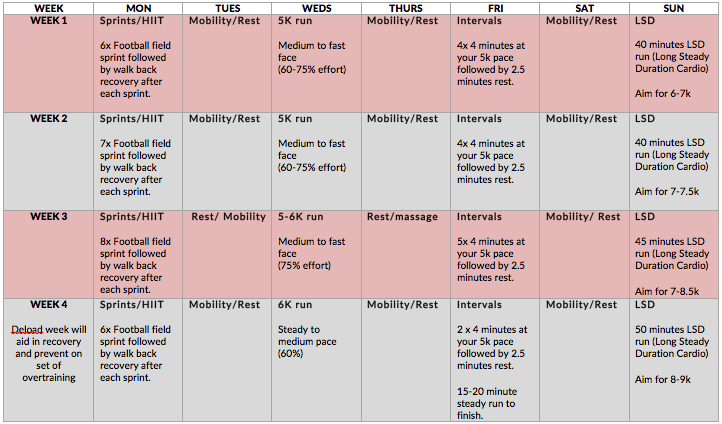
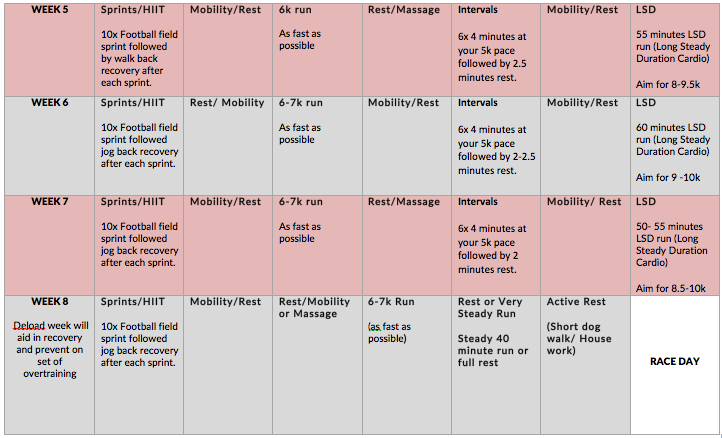
In preparation for this year’s Town and Gown 10k race I’ve put together an 8 week training plan that’s designed to get men completing the race in under 50 minutes, and most women within the hour. The plan is designed for someone with beginner’s running experience and can be done without needing to sign up to your local gym.
Understanding The Programme
Mobility – Use these sessions to do extra work on your flexibility/mobility. For example, static stretches or foam rolling. I would focus on the muscles used most during running e.g Hip flexors, quadriceps, calves, hamstrings and glutes. It may also be helpful to foam roll/stretch or massage the front of your shins to prevent the on-set of shin splints or to reduce the pain if you are unfortunate enough to suffer from them. Buying a good pair of running shoes tailored to your foot and gait would also be extremely useful and further prevent the risk of injury.
Deload: Weeks 4 & 8 – You may realise you are doing less during these weeks. This time will aid in your recovery and can be seen as ‘active rest’. You will still gain a lot from these weeks fitness wise, but try not to overdo it and add more in. Sometimes less is more and when it comes to 10k-training recovery is key!
Week 8 will be your taper week to allow for optimal recovery and get your body hungry for your 10k race.
Intervals – Intervals teach your body to run fast. This is where you get your speed in. Make sure your hard effort is faster than talking pace but sustainable. On weeks 6 and 7 the recovery gets shorter. This is to challenge your aerobic capacity more in the lead up to the race. Make sure you walk or if possible jog the recovery. This session should ideally be competed on a field so you can stay in the same area. This may also allow you to calculate the distance covered in each sprint bout/set.
Sprints/HITT- HIIT is a great way at working two different energy systems of the body. It’ll help improve and increase your fitness levels and ability to recover. It’s important that you put 100% of your effort into each and every set. Sprint the long length of a football pitch or similar distance, once complete walk back to your start position. Notice this changes in week 6 to a jog back recovery. You could also try this up a hill for approximately 70-100m.
Steady run– Steady runs are an incredibly important part of your active recovery. They help to get the blood flowing through your muscles, pushing out the waste products from the hard sessions. These should be a very steady talking pace. This is the time to really enjoy your running.
About Becky Hodgson
As a successful 800m runner for Oxfordshire Athletics I have a strong postion on evidence based training and application. Strength training is my passion, including passing my knoweldge of lifting on to help other women like myself to see both the physical and practical benefits that strength training has to offer.
You can find me on Facebook, or why not even give us a Tweet @Hall_Training