Five things we learned about fitness in September
As those of you who follow this blog series will know, we learn new things about fitness every month. As personal trainers its crucial we stay up to date with all of this research so we can keep making sure our clients are receiving the best possible support. So what have we learned from the latest research this month? Our fab trainer Elliot, a personal trainer at Trimnasium in Cheltenham, has trawled it all to bring you five gems.
1. Volume isn’t always king
Performing just about every exercise known to man during your session is common practice for many gym-goers, it almost seems like a good idea to exhaust a muscle of everything it has and to be limping out of the gym…
Although even though it seems the norm, is it really more productive to go above and beyond?
If you’re finding yourself particularly sore after training, feeling as if you’re not quite recovering and not able to really push hard, then the amount of work you’re doing in the gym may be doing more harm than good.
A recent study was done to compare the physiological response to a high volume workout to the response to a high intensity workout with lower volume.
What they found may have you re-thinking your next workout… Even after 72 hours, the power output of the athletes who trained with high volume hadn’t returned to their initial baseline, while the athletes who trained at high intensity had returned to that level. Not only that, but markers of muscle damage were significantly elevated following the high volume workout.
So rather that thinking about how much you can fit in during your workout window, strike a good balance between volume and intensity to ensure you’re at your peak whenever you get in the gym.
2. Low carb, high fat or low fat, high carb?
I personally feel as if this question has been asked for as long as I’ve been in the industry and I feel as if it always will be… We are all individuals and will all respond in different ways to different macronutrient ratios, so you’ll hear a lot of ‘this works for me!’ But what does the science really have to say about this…
In a study carried out on a number of overweight individuals, some were assigned to Low Carb, High Fat (LCHF) diets and others were assigned to High Carb, Low Fat (HCLF) diets. Both groups saw significant reductions in both body weight and waist circumference, however the LCHF group saw the greatest changes in both.
Does this give us a definitive answer on which is superior? Maybe, maybe not…
Unfortunately, the subjects were not monitored 24/7 and were not forced to specifically eat certain meals with certain calorie contents. So there are quite a few drawbacks to this study and the LCHF group may have just eaten less and done more activity, unfortunately we’ll never really know.
My opinion: find what suits you the best and stick to it; also understand that science suggests that the LCHF diet may be superior (and science never lies…)
3. Are knee sleeves worth the investment?
If you’ve watched any type of powerlifting competition, strong man event or even if you watch the guy who squats the most in your gym (certainly not me), then you’ll notice that they are probably wearing knee sleeves. What are they for you might be wondering? San they help me squat as much as those guys? And are they really worth the £50-60 pound some of the more reputable brands are selling them at?
The answer… Potentially, but not entirely…
When assessing the powerlifters using knee sleeves, researchers found that knee sleeves seem to improve balance and proprioception, increase knee flexion and reduce knee adduction.
If you’re a keen powerlifter who wants to get as strong as possible in the squat, then they may be worth the investment. Anything that helps increase stability, especially in such a demanding lift, will certainly be of benefit and even more so when handling such heavy loads.
But if you only visit the squat rack on the odd occasion and your main goal isn’t to be the strongest squatter in the gym, then you should be just fine without them.
4. To beet or not to beet?
If you know anything about me, you know I love a good health food fad. I’ll try anything once if it supposedly has a positive effect on your physical or mental wellbeing, my latest venture is apple cider vinegar but that’s another story for another day…
In this study, they tested something that I’ve heard great things about but have never personally tried – ‘beetroot juice.’ They simply wanted to see if it had any benefit over a generic energy drink when it comes to recovery.
The subjects were separated into different groups and consumed different drinks, they all had to participate in a workout specifically designed to produce exercise-induced muscle damage…
What they found was neither the beetroot juice nor the generic energy drink could reduce the loss in strength, however beetroot juice was effective for reducing PWO muscle soreness.
Maybe this will be next on my list!
And last but certainly not least…
5. How long does it take to recover from an intense contest prep diet?
As a physique competitor and someone with a great interest in the endocrine system and the effects it can have on our physical and mental health, it was inevitable that I would delve head first into this study. Most of us may never compete, but if you are dieting or are planning on getting into a very lean state this may also interest you. Considering that for the most part it’s usually anecdotal evidence we hear, it’s nice to see some research done on this topic.
You’ll quite often hear competitors say that the sport is not healthy, but how much does it really impact our hormones?
The study takes a look at a natural male athlete over the course of the 8 months during his competition preparation period. What they found was pretty notable; his testosterone had dropped by almost 70%, his thyroid hormones (T3,T4) were both significantly reduced and his cortisol (A.K.A ‘stress hormone’) was up.
So, as you can see the prep took a huge hit on this athlete, however they continued to monitor the athlete following his competition prep, and after five months of recovery the athlete was able to return to his baseline numbers.
So this is certainly something to bear in mind if you’re in the thick of an intense diet, especially considering not everyone will respond the same way and return to their previous baselines like this athlete did.
References:
1. Bartolomei, S., Sadres, E., Church, D. D., Arroyo, E., Gordon III, J. A., Varanoske, A. N., & Hoffman, J. R. (2017). Comparison of the recovery response from high-intensity and high-volume resistance exercise in trained men. European Journal of Applied Physiology, 1-12.
2. Zinn, C., McPhee, J., Harris, N. K., Williden, M., Prendergast, K., & Schofield, G. (2017). A 12-week low carbohydrate, high fat (LCHF) diet improves metabolic health outcomes over a control diet in a randomised controlled trial with overweight defence force personnel. Applied Physiology, Nutrition, and Metabolism.
3. Sharif, N. A. M., Li, G. S., Usman, J., & Safwani, W. K. Z. W (2017). Biomechanical and functional efficacy of knee sleeves: A literature review. Physical Therapy in Sport.
4. Clifford, T., Howatson, G., West, D. J., & Stevenson, E. J. (2017). Beetroot juice is more beneficial than sodium nitrate for attenuating muscle pain after strenuous eccentric-bias exercise. Applied Physiology, Nutrition, and Metabolism.
5. Pardue, A., Trexler, E. T., & Sprod, L. K. (2017). Case Study: Unfavorable But Transient Physiological Changes During Contest Preparation in a Drug-Free Male Bodybuilder. International Journal of Sport Nutrition and Exercise Metabolism, 1.
Why do I feel tried after training?
It’s the end of your session, you’ve had a great workout and feeling on top of the world; and then out of nowhere you suddenly feel as though you’re going to drop into a coma as all of your energy is being zapped from your body.
I’m probably guessing you’ve had some experience of this rather strange and unexplained drop in energy a few hours (or even munites) after training, something we refer too as, The Post Workout Slump (PWS).
Why does it occur?
There are many reasons why we can end up feeling tired and mentally fatiuged after training:
• Intensity of the session
• Sleep the night before
• Illness
• Blood sugar levels
• General mood
• Hormonal
These can all contribute to our energy levels during and after exercise however, these are most likely to effect our physical energy, and aren’t the main reason for why we can sometimes suddenly feel whacked mentally.
Tryptophan is probably the main cause for the sudden onset of tiredness as it has been shown to promote fatigue after exercise (Meeusen R. 1996).
Tryptophan is a protein – the precursor for the neurotransmitter called 5-hydroxytryptamine (5-HTP) which is involved in fatigue and sleep.
When we exercise we increase the amount of tryptophan in the bloodstream (Ishikura K. Et al. 2013) increasing it’s availability to the brain within as little as 30 minutes (Blomstrand. E 2005). Once we finish our session the circulating tryptophan is then taken up by the brain and converted to 5-hydroxytryptamine (5-HTP) – minutes later and 5-HTPs effects present themselves as we’re left feeling whacked.
So, is there a way to combat this?
Well I’m glad you asked, as yes there is! Branched Chain Amino Acids (BCAA’s) have been shown to combat tryptophan’s effects and prevent PWS (Blomstrand et al. 2006). They do this by competing with tryptophan in a race to see who can reach and be taken up by the brain first; and guess who wins… the amino acids!
These then force tryptophan to admit defat and reside back in muscle and other tissues. (Blomstrand et al. 1995, 1997).
So, if you’re a person who suffers from the Post Workout Slump after exercise try adding 5-10g of BCAA’s into your water to sip on while training, I guarantee it’ll help you!
You’ll also find sipping on 5-10g of a carbohydrate solution during training also helps to prevent tryptophan to exert it’s fatiguing effects (Davis JM 1995).
BCAA’s have also been show to be particularly beneficial in raising energy in people who are overly stressed or, who suffer from chronic fatigue syndrome (CFS) (Castell LM. et al. 1999).
So there you have it, if we can keep a lid on the amino acid tryptophan from coverting to 5-HTP we can reduce, or even eliminate the need for a nap post exercise. It is worth noting however, that 5-HTP isn’t all bad, and if you’re someone who struggles to curb their carvings for carbohyrdates when dieting then 5-HTP may just become your trusted ally.
Take a look at one of our past fun facts on Tryptophan – The secret to carb cravings!
I was in the gym the other day when I overhead a client complaining to her personal trainer that the reason she was unable to lose any weight is because she’s addicted to sugar. She continued to justify her addiction by saying how there’s one study showing sugar to be more addictive than cocaine!
Well, as you can imagine I wanted to share my two cents but decided to stay well out of the conversation. However, it has led me to answer the question about whether eating sugar really does make us gain more weight.
First, let me address the sugar/cocaine study. Yes, there is a study from back in 2007 that concluded sugar was more addictive than cocaine. The basic outline was that rats were given cocaine until they became dependent on it. Then, researchers provided them a choice where they could continue to have the cocaine or they could switch to sugar. Surprise, surprise, they (94%) chose to make the switch over to sugar – from this result the researchers concluded:
“that intense sweetness can surpass cocaine reward, even in drug-sensitized and -addicted individuals.”
And now everyone who’s campaigning against sugar seems to reference this study to back their argument up.
However, let’s just stop to think about this for a second… the rats were fed cocaine until they became dependent on it, which means this was their main source of ‘food.’ The researchers then introduced them to sugar to give them a choice between cocaine and sugar… of course they’re going to choose the sugar over cocaine, they’re rats and their first instinct is to survive!
Gosh, I bet if you gave them a choice between cocaine and blueberries, or cocaine and tuna, they would all turn to the blueberries and tuna, because it’s food! This doesn’t suddenly mean blueberries or tuna are more addictive than cocaine… our survival mechanisms will always make us choose the one that will keep us alive.
So really, this is a hugely flawed and unfair set of results and should be ignored when making an argument against sugar.
Other commonly cited studies among the ‘sugar haters’ are ones from 2004 and 2007, that show correlations between the populations’ rise in obesity and our consumption of sugar from the 1960s to early noughties.
If you were to just look at the data up until 2000, you could be fooled into thinking sugar intake was the cause for our rise in obesity. However, if you then look beyond 2000 and into more recent years, you’ll find this association disappears. In fact, from the early noughties right the way through to 2013, our intake of sugar falls while obesity rates continue to climb. [1]
.jpg)
Sugar isn’t inheritably fattening, but like any food can cause weight gain if you’re overfeeding (Te Morenga 2012). If you’re under eating and in a caloric deficit then it doesn’t matter whether you’re on a low fat, high sugar diet, a low fat, high carb diet, or even a high sugar diet where almost 50% of your calories are coming from sugar – there is no difference in weight loss or fat loss between either diets. (West & De Looy 2001) (Saris, et al. 2000) (Surwitt, et al 1997).
So, if our intake of sugar is declining why is obesity still on the rise? Well the fact of the matter is we’re eating more but moving less. Data shows we’re now eating around 500 calories more than we were in the 1960s, and that the energy we expend through moving around is 142 calories lower from what it once was (Church TS, et al. 2011).
Hence why we’re now recommended to reach 10,000 steps per day, enough to burn around 500 calories, the additional calories we’re now consuming.
The only problem I can see with sugar is how palatable it is – it tastes great and we all love it, hence why it’s used in a lot of foods. Sugar on its own isn’t ‘evil’, but a lot of foods that contain high amounts of sugar also contain high amounts of fat, as the two together make our taste buds dance like crazy! The problem is, these foods don’t seem to fill us up in the same way foods high in protein and fibre do, so we’re always left craving more…
Bonus note: as you’ve just learnt when it comes to adding sugar into your diet you have nothing to fear. However, things do become a little more complicated when looking at how sugar and glucose metabolism works in obese individuals – something I will cover in a future post.
References:
1. wholehealthsource.blogspot.co.uk/2015/11/carbohydrate-sugar-and-obesity-in.html
Are liquid calories ruining your diet?
If you’re struggling to lose weight despite feeling that you eat really healthily, then you may well find this insightful; “liquid calories” could be your stumbling block. If you want to lose weight, then it’s crucial that you become more mindful about what you’re drinking.
However, the difficulty we’re faced with is that liquid calories are also “hidden calories,” meaning that most people are completely unaware how many calories they’re consuming through their drinks. You see, an interesting thing about liquid calories is that they don’t appear to register with the brain in the same way calories from food do (Vartanian LR. 2007). In other words, drinks provide a sneaky way to consume extra energy and to pack on a few extra pounds (DiMeglio DP, Mattes RD. 2000).
I guess this is the reason doctors prescribe high-calorie drinks to both the elderly and those who are suffering from certain eating disorders, to help promote weight gain.
The average adult consumes a little over 500 calories per day from beverages alone, (Drewnowski A. 2013), with drinks being the largest source of added sugars in our diet (Huth PJ, Fulgoni VL, Keast DR et al 2013).
For example, a Starbucks Spiced Pumpkin Latte has recently gone on sale, personally I’m not fan, but I know a lot of you are and they’re all the rage around this time of year however, at whopping 380 calories and 50g sugar it literally takes the place of a small meal… and that’s for a medium cup!
If you stop to think about that for a second… 380 calories; for what’s essentially a fancy coffee, you’ll begin to realise how mad and easy it is to drink away your calories. I actually spoke to the Daily Mail about hidden calories in coffee-shop drinks a couple of years ago.
To put this figure into perspective, doctors, nutritionists and even our personal training team will likely recommend close to a 500-calorie deficit to help kick start weight loss. If you keep an eye on what you’re drinking, losing weight will often be as easy as a walk in the park, and even that’ll help too!
This is just one instance where liquid calories can slip under the radar.
The term liquid calories can umbrella a whole array of foods/beverages that you probably wouldn’t otherwise consider thinking twice about consuming, but all add up:
• cooking oils – average of 120 calories per serving
• fruit juices – average of 100 calories per 200ml
• milk – average of 50 calories per 50ml
• protein shakes – average of 200 calories per shake
• flavoured water – average of 50 calories per 500ml
• fizzy, sugary drinks – average of 150ml per can
• energy drinks – average of 100 calories per can
• pouring cream – average of 70 calories per 15ml – I’ll admit, I used to be a sucker for adding pouring cream to my coffee, but when I actually stopped to check how many calories I was drinking, which was in excess of 220Kcals from cream alone, I quickly stopped and started taking it black, or adding a dash of single cream.
Oh, and let us not forget alcohol. Yes sorry, it too falls under the liquid calorie umbrella, with an average glass of wine providing around 125Kcals – not too bad you say?… Sure, but let’s not kid ourselves as when do we ever have just the one glass…? More like half the bottle, which comes in at around 325 calories!
As you can see, the calories we consume in the form of liquids really can add up, and can begin to limit to your ability to lose weight.
Luckily, liquid calories are as easy to reduce as they are to consume. By being more aware of what you’re drinking and more importantly, how many calories you may just be pouring down your throat, it becomes easier to identify any extra calories you may be consuming.
Five things we learned about fitness in August
From debunking the myth behind BCAA supplementation on muscle growth, to foam rolling and shirt splitting arm science, August’s fitness research has covered it all. Our level 5 trainer Owen has sifted through it all to bring you some gems you can apply to your own training straight away – enjoy!
1. Branched-chain amino acids and muscle protein synthesis in humans: myth or reality?
If you’ve ever had a peek inside a sports nutrition shop, scrolled through a few health websites or simply seen one of the tens of thousand “ADD GENERICFITPROCOMPANY to get your X,Y,Z” on instagram, you’re more than likely familiar with the supplement BCAAs.
If you’re not, congratulations, you’ve probably saved yourself some cash.
Despite commonly held beliefs that these Branched Chain Amino Acids promote anabolism (the growth of tissue) and stave off catabolism (the breakdown of tissue), a recent review by Robert Wolfe (2017) suggests otherwise.
I’ll save you the in depth biochemical details (which are all examined here), and skip to the punch line.
In order to achieve sufficient MPS (muscle protein synthesis) to grow muscle tissue, all EAA (the 9 essential amino acids) are required. This means that the three isolated EAA’s found in BCAAs fall short of the ability to stimulate MPS to the extent of anabolism.
Further to this, the paper theorizes that due to the competition of leucine, iso-leucine and valine for transporters to the cell, MPS may actually be rate-limited by their co-ingestion. This explains why leucine in isolation has been shown to have positive effects on MPS, whilst BCAA’s tend to skew negatively.
Now if you managed to make it through all of those many acronyms, the important take homes are these:
BCAAs do not promote MPS in isolation, all of the amino acids that the body cannot produce are needed. Not only that, but due to the competition of transportation, BCAAs may actually limit MPS, and blunt anabolism.
All in all, this is perhaps the most damning review of BCAAs to date. The kind of stuff that sends a cold chill down the neck of supplement companies everywhere.
My advice?
Whey protein is cheaper, has a full amino acid profile, and has been shown to increase MPS in a peri-workout window.
When total protein is accounted for, there is no coherent reason to be using BCAAs.
Unless of course, you happen to like the taste of particularly expensive flavoured water.
2. The Real Secret to Shirt Splitting Arms (Click Bait Alert)
If you’ve ever meandered into the free weights section of the gym on a Friday night, you’ll be fully aware of the vast quantity of males gathering around the Preacher Curl machine.
Come 6:30pm, not a single EZ Bar nor 10kg dumbbell will be free for use. Not unlike a holy ritual, the clubbers and pubbers of the city amass to pay their respects to the iron.
As far as I’m aware, the practice of training biceps on a Friday evening has been around for as long as the working week has.
Yet when it comes to mastering the art of crafting biceps that render sleeves useless, should we be using heavier loads, or focusing on precise execution?
A recent study, freshly published in the Journal of Strength and Conditioning, sought to provide us with some clarity, comparing two groups using full ROM (range of motion) and partial ROM using 80% 1RM on unilateral elbow flexion on the Scott Bench.
Despite the peak torque, soreness from palpation and arm circumference being statistically similar between conditions, more expressive muscle damage was found in the full ROM (range of motion) group.
As muscle damage is a key pathway towards increasing hypertrophy in a given muscle, we can extrapolate from this study that full ROM exercises are more beneficial than partials for promoting tissue growth, despite the greater absolute load lifted under the partial ROM circumstances.
So if you ever find yourself in that 6:30pm Friday crowd, opt for tighter execution, and eek out as much ROM as you comfortably can.
You’ll be splitting shirts in no time.
Bonus tip:- Pre-shrink your shirt sleeves in the wash. It’s a thing. Unfortunately.
3. Leg Day, Is foam rolling worth our time?
If you’re a regular reader of our blog spot, you may have noticed that our main maestro Chris Hall recently dove into the depths of foam rolling, discussing what it actually does, the benefits and the potential pitfalls.
While I won’t be following Chris down that frightfully deep rabbit hole today, generally speaking the practice of SMR (self-myofascial release) can acutely increase flexibility and aid blood flow to the targeted area, making it a good option before partaking in physical activity.
Not only that, but foam rolling seems to trend towards a ‘cross-over flexibility’ effect, meaning that if you foam roll one area, a corresponding area may actually become more flexible. For instance, rolling out the bottom of the foot with a tennis ball may improve hamstring flexibility.
However, an interesting study published this month by Cavanaugh M.T (2017) found that this isn’t the case in all muscle groups.
The research team found that when SMR was performed on the quadricep muscles, subsequent activation of the bicep femoris (hamstring) decreased significantly. There was no such change in the quadriceps when the hamstrings were rolled.
What does this mean?
Although this is just one study out of many, and no firm conclusions can be drawn yet, it might be an idea to leave the quadriceps out of your next foam rolling routine, particularly if you have a hamstring-biased session.
I also do this because my quads always hurt so much I want to cry.
So much pain, many ouches.
4. The low down on low load training, can you still build muscle?
As personal trainers, I think it’s safe to say that we’re pretty obsessed with adding weight to the bar. In order to disrupt homeostasis and adapt our bodies, increasing levels of stimulus need to be accounted for over a long period of time.
Progressively loading more weight onto a bar continuously allows for appropriate stimulus of which to adapt, building larger, stronger muscles.
Yet while progressive overload is an incredibly (if not the most) important aspect of hypertrophy, is it possible to build muscle using lower relative loads?
There have actually been several studies that have previously shown this could be the case, yet no clear review to pool this data and come up with a conclusive answer.
Enter Schoenfeld B.J. et al. (2017)
This much needed systematic review observed data from 21 of available studies that met the requirement of:
– Using both >60% 1rm and <60%1rm loads.
– All sets in all training protocols reaching momentary muscular failure.
– At least one method of estimated/observing changes in muscle mass and/or dynamic, isometric or isokinetic strength.
– The training protocol lasted a minimum of 6 weeks
– No participants had pre-existing medical conditions that would disrupt potential results.
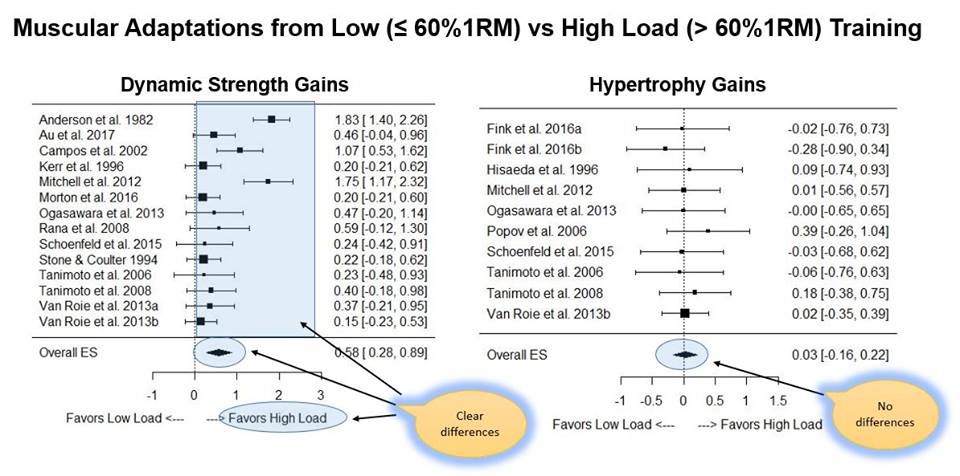
(image: Schoenfeld, B.J et, al. (2017). Strength and hypertrophy adaptations between low- versus high-load resistance training)
Interestingly enough, the data pool suggests that while it’s fundamentally clear that heavier loads are needed in order to increase strength gains, it’s entirely possible to create muscular hypertrophy adaptations in circumstances of low load training.
If we take a look at the above chart, all markers that fall to the right of the centre line, show that heavier loads hold a clear advantage, while everything falling to the left demonstrate low loads being advantageous.
The bottom line?
It’s entirely possible to build muscle whilst using loads lower than 60% of your 1rm. It’s easy to attach the principle of ‘progressive overload’ to simply adding more weight to the bar, while in reality there are many forms of the mechanism.
Decreasing rest times, increased frequency, increased volume, increasing time under tension, greater internal connections to contractions, velocity, loading through different ranges of motion, mechanical drop sets.
The list could go on.
The concept of ‘progressive overload’ in reality, is the ability to bring about increasing levels of stimulus of which to adapt. Do this over a long period of time, and you’ll be putting yourself in a good position to progress, extra load isn’t the only variable we can manipulate.
Oh, and if you want to get stronger, lift heavier.
5. Want to decrease your x-country time? Check this study out.
Coincidentally, prior to writing up this study I stumbled upon all of my old x-country medals/trophies/certificates/other causes of inflammatory hubris.
Turns out, I was quite the little runner in high school, unleashing those pale, peg-like legs and representing South Wales on the odd occasion.
As coincidence (or fate) would have it, an incredibly relevant study was accepted and published by the Journal of Strength & Conditioning research this August, examining high school x-country runners.
Naturally, my curiosity prevailed and I had to take a peek at the findings. After all, this new information might have been the missing link in my progression!
It’s theorised that a key reason for a decrease in running efficiency and therefore running economy is due to the fatigue of the muscles that stabilise the movement.
This study examined whether a protocol in pelvic and core stability strength training had any beneficial relevance to high school x-country runners across a six-week period.
Race times were measured at three and six week intervals, and interestingly enough, both the control group and the pelvic protocol group saw decreases in their race times.
What does this tell us?
Core stability work might help, or it might not. I know, great stuff.
We can however, further ascertain that the primary method to get better at running, is to run more. Time on your running feet is the primary mechanism to build greater running efficiency and economy, thereby decreasing your race time.
Run more, get better.
Looks like I was never destined for greatness, and didn’t miss a trick in my running days after all.
I’m not sure if that’s a comfort or not.
Anyhow, if your preparing for a marathon and still have some thrist left for knowledge, then you gather a few more helpful tips from a blog we contributed to for Ashbounre Health, check it out here.
References
1. Robert R. Wolfe. (2017). Branched-chain amino acids and muscle protein synthesis in humans: myth or reality?. Journal of the International Society of Sports Nutrition
2. Baroni, Bruno et al. (2017). Full Range of Motion Induces Greater Muscle Damage Than Partial Range of Motion in Elbow Flexion Exercise With Free Weights. Journal of Strength & Conditioning Research:. 31, 2223-2230.
3. Cavanaugh, Mark T et al. (2017). Foam Rolling of Quadriceps Decreases Biceps Femoris Activation. Journal of Strength & Conditioning Research:. 31 (.), 2238-2245.
4. Schoenfeld, Brad & Grgic, Jozo & Ogborn, Daniel & Krieger, James. (2017). Strength and hypertrophy adaptations between low- versus high-load resistance training: A systematic review and meta-analysis. Journal of strength and conditioning research. 10.1519/JSC.0000000000002200.
5 .Clark, Anne W et al. (2017). Effects of Pelvic and Core Strength Training on High School Cross-Country Race Times. Journal of Strength & Conditioning Research. 31 (.), 2289-2295
Caffeine addict or chronically stressed? You need Adaptogens.
So today’s Friday’s Fun Fact is a little different as in all honestly this week has been crazy, with no real time to come up for air.
Stress this week has certainly been my accompanying partner, after launching Cheltenham, the arrival of two new trainers and being asked to speak at a Virgin Sport event – we’ve not spread out the workload too well! The greatest stress is knowing things aren’t going to slow down, and I’ve been relying on caffeine and coffee to keep me going.
But is that a good idea? Probably not… if you’re a caffeine addict too, read on.
Let’s be clear about one thing, I like caffeine and I absolutely love coffee, I’m not arguing with that, but relying on caffeine or other stimulants as an energy boost for a long-term solution is a little like relying on petrol to start a campfire.
Your ability to produce energy is like a campfire. You look for good-sized logs that will burn for a long time, providing a consistent amount of heat. You can use the campfire for warmth, to cook and even for protection. The wood you gathered burns steadily and you have a good supply of additional wood to add to the fire when necessary.
Throwing petrol on your campfire may cause the fire to burn brighter and hotter (for a moment), but it’s not safe or well-controlled. It quickly burns up the logs used to make it, leaving you with a pile of burnt-out ashes before you even had time to gather up more fire wood – no amount of petrol is going to relight those ashes and fix the problem.
So, if we’re heading into stressful times we need to ditch the petrol canister and go out to find our supply of fuel, otherwise we’re likely to ‘burn-out the fire.’
But is there anything that can help to tackle the stress? Well, Adaptogens could be the answer.
What are adaptogens?
Adaptogens are plant or fungus compounds that can both support the body against the effect of stress, and also strengthen and rejuvenate the body after prolonged exposure to stress. Whether you’re in a state of high stress or low stress, adaptogens can help to restore balance. (Panossian A & Wikman G. 2010).
Western-style research into the compounds didn’t begin until 1947, when the Soviets were looking for compounds to strengthen and protect their soldiers (Brekhman, I.I Dardymov, I.V 1969).
They found that these compounds helped regardless of the source of the stress (chemicals, environment, stress from physical activity, psychological stress etc.). When adaptogens were used, they saw a decrease in illness, faster recovery from physical exertion, and an improved level of homeostasis and wellbeing.
As well as the above, adaptogens have also been shown to:
• increase mental performance and physical work capacity in sleep deprived people (Shevtsov VA. et al. 2003)
• reduce symptoms of both anxiety and depression (Andrade et al. 2000) with Ashwaganda showing up to a 56% reduction in symptoms in people with anxiety (Cooley K et al. 2009)
• help improve life and work-related stress (Edwards D, et al. 2012)
• Rhodiola Rosea has been shown to help people to improve performance on work-related tasks by about 20% (Darbinyan V, et al. 2000)
• What’s more is that adaptogens have been shown to take effect within as little as 30 minutes, with the benefits continuing for at least 4-6 hours (Panossian A. 2005)
If, like me, you’re reading this thinking they’re exactly the type of firewood I need to light my fire and they sound awesome, then here’s a list of your most popular adaptogens:
Asian ginseng*
Holy Basil
Ashwagandha*
Cordyceps
Schisandra
Siberian ginseng
Reishi
Shiitake
Rhodiola Rosea*
*most extensively studied adaptogens in the scientific literature.
Now, the next time you’re having to deal with choric periods of stress stop throwing the petrol over the fire by spending your time at the coffee machine, but rather gather up some fire wood and start taking one of these adaptogens.
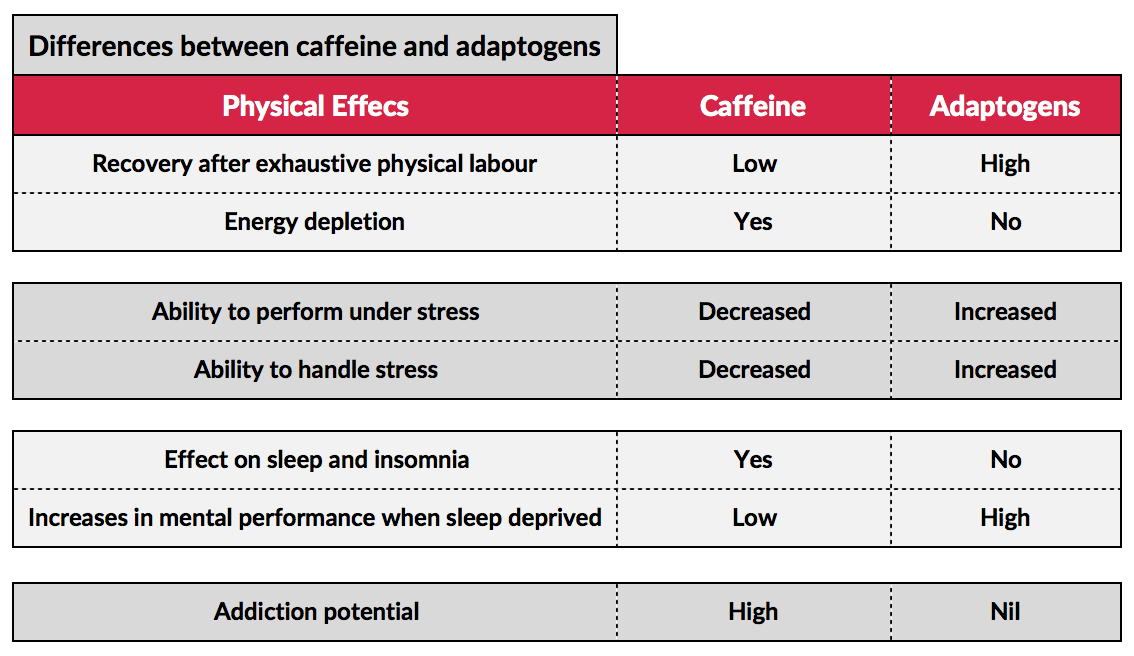
Here’s a brief list I’ve pieced together comparing the differences between caffiene and adaptogens based on the scientific evidence and work Alexander Panossian’s done over the years on adaptogens:
How many calories do we burn when weight training?
Today’s Friday Fun Fact is a question I’ve wanted to find an answer to for a while: just how many calories do we burn when weight training?
Heart rate monitors and fitness trackers can provide us with some basic numbers, and are great at determining how many calories we’re burning during some light to moderate cardio work, but when we do any strength training or perform high intensity interval work, they’re pretty useless!
You see, heart rate monitors estimate our energy expenditure through the linear relationship between power output (how much work you’re doing per unit of time) and the amount of oxygen consumed (which is equivalent to energy expenditure during aerobic exercise). Because the relationship between heart rate and oxygen consumption is linear, you can use your heart rate to estimate total energy expenditure.
However, this linear relationship crumbles under very high intensities, like when you’re sprinting or doing some resistance training, which is why they’re not reliable.
When it comes to measuring these kinds of activity, fitness trackers aren’t much better. Although they may sense movement, they have no way of determining how much load (weight) you’re lifting. For example, a Fitbit worn on the wrist will likely show the same number of calories burnt whether you perform a squat with ten kilos or a hundred kilos – not very rewarding for you.
So how can we estimate energy expenditure during resistance training?
Before answering the question it’s important we highlight the word “estimate,” or rather, replace it with the word “guesstimate.”
When it comes to weight training, variables such as gender, age, weight, loading parameters, programme design (traditional sets vs. supersets) load on the bar, range of motion etc. will all have an impact on the amount of energy used during a session. So, when we look at this we can only really guesstimate the number of calories based on the evidence that’s been documented in the literature.
When we look at the literature the number of repetitions performed is our best predictor at guesstimating energy expenditure in each session.
• A study by Kelleher et al, comparing supersets to traditional sets, found the total energy expenditure ranged from 260 to 279 calories across 240 reps – that’s about 1.1 calories per rep.
• A study published in the Journal of Strength and Conditioning Research looking at eight single set exercises found energy expenditure to range between 70 – 135 calories across 120 reps – that’s about 0.6 calories per rep.
• Hunter et al, took subjects through 8-10 exercises for two sets each (total of 160 reps), and found their average energy expenditure to be 113 calories – that’s 0.7 calories for each rep.
• Lastly, a study that looked at the relationship between rest intervals and total number of calories burnt on a leg press over five sets of 10 reps (50 reps) found an approximate energy expenditure of 90 calories – 1.8 calories per rep. However, when the same subjects then performed dumbbell chest flys for the same number of sets and reps, only 50 calories were burned – 1 calorie per rep (Farinatti, 2011).
As you can see there’s quite a range, with majority of the literature suggesting you burn between 0.5 and 1 calories per rep.
How do you know whether it’s really 0.5 or 1 calorie per rep?
To guesstimate the total number of calories you’ve used during a session I would hazard a guess using the following guidelines:
1 rep = 1 calorie when:
• Favouring super sets over tradition single sets
• As part of a circuit
• Compound exercises in favour of isolation exercises
• Larger muscles over smaller muscles
• Sufficient load is used i.e. nearing repetition maximums
• Rest intervals are incomplete
• Using stimulants pre-workout, such as caffeine before training
1 rep = 0.5 calories when:
• Single sets are performed
• Rest intervals are longer (+1 min)
• Smaller muscle groups are utilised
• Lighter loads are used
• The majority of your session is built around isolation work
The next time you’ve finished a workout and slumped over in a corner of the gym waiting to catch your breath, take a moment to tally up your reps, and match them against the points above to see how many calories you’ve burnt – it may just motivate you crank out a bonus 5 sets of 20 reps on the leg press as a finisher – after all, that’ll be 100 extra calories you’ve just used!
Five tips to increase diet adherence
For some people, sticking to a calorie controlled diet and losing weight can be an easy task, but for most of us (myself included) it can be a bumpy road with many setbacks along the way.
This is completely normal and you shouldn’t become disheartened if you fall off the band-wagon; the important thing is to recognise when you’ve fallen off, why you fell off and what you’re going to do to get back on it.
A study published this year in the The Society of Behavioural Medicine looked at the reasons people lapsed on a diet. I’m not going to bore you with the specifics as it’s the sexy stuff we’re really interested in.
So here we go; over a one year period it was found that:
• Unintentional food intake was the most common reason people lapsed i.e. the foods you know aren’t good for you but you love them anyway (pastries, cakes, ice cream, chocolate and crisps)
• Lapses were highest when at home – 46% of lapses occurred at home compared to at work or when eating out.
• The most common time for a lapse was in the evening – between 6:00pm and 9:00pm
• The risk of lapsing was higher at the weekends compared to weekdays
• Feelings of hunger and deprivation, and the availability of delicious foods were also associated with an increased risk of a lapse
The researchers also discovered that people who were stressed, angry, lonely, sad or bored lapsed more frequently than those who had a more rounded emotional state.
Now, if you’re anything like me then ninety percent of your lapses coincide with these findings.
Personally, I find it much harder to stick to my diet when I’m working from home and over the weekend than during the week. Come the evenings, it’ll be around 8:30/9:00pm when I start craving the chocolate and all things sweet. These cravings are then further exacerbated when I’m bored, stressed or when I know I have bar of Dairy Milk sat in the fridge door – it can be so hard sometimes!
So when it comes to diet lapses you have two options. The first is to adopt a mind-set of “oh well, science says I’m bound to fail, this is out of my control.” The second is to look at the strategies above, see which ones you identify with and then use this information to help prevent further lapses.
If you can build in a few strategies to help reduce or better yet, prevent a dietary lapse, then you’ll be onto a win and a far more successful weight loss journey.
Here are a few examples:
1. Access to delicious and highly desirable foods was the biggest cause for people to lapse. Find ways to control your access to these foods, simply by removing them from your cupboards and not letting them enter your home. Also try limiting your exposure and visibility to them through photos on social media, television ads and cooking programmes – programmes such as Bake Off really aren’t going to help supress your cravings for these types of foods!
2. People are most likely to lapse when at home – If home is the place where you find self-control difficult then ask yourself why? Why are you more tempted by foods when at home than anywhere else? Is it because of boredom, access to delicious foods, loneliness, habit, or lack of routine? If you’re able to find what pulls that trigger you can then think of ways to prevent it. Through working with clients I’ve found boredom, access to tempting foods and habit to be the main reasons they lapse when at home. Why not set yourself a new healthy habit. When you’ve got home and relaxed for a while, why not go for a daily 20-minute walk to increase your step count and prevent you eating?
3. The window between 6:00pm-9:00pm is the dangerous time for diets! This makes a lot of sense as most people will be returning home from work, often feeling stressed, hungry and tired, so will pop the kettle on for cup of tea, in which case biscuits are usually nearby, or they may pour themselves a glass of wine (or two, three, and four… oh God, I’ve drunk the bottle).
Habit plays a huge role here as there are many actions such as walking through the front door, popping the kettle on, sitting down to watch TV, that all spark an unconscious cue for self-reward. Being aware of these actions and the cues they spark can really help you to reduce the acts of self-reward, and therefore what’s being put in your mouth. – If you wish to know more on why habits exist and how they can be changed, I strongly recommend the book: The Power of Habit by Charles Duhigg.
4. Emotional state dictates whether a person is likely to lapse. If we’re bored, stressed, lonely or sad we tend to reach for the snack cupboard to help cheer ourselves up. Last week I talked about how tryptophan can help alleviate some of these emotional-based carvings.
Boredom and stress seem to be the biggest culprits for food cravings. Boredom often occurs in the evenings when we’re sat around with nothing really to distract us. Plan your evenings with activities such as going for a walk after dinner, attending a local book club, signing up to a team sport, or even going to the gym. These will help to provide structure and alleviate boredom, all while taking your mind off food.
5. The feelings of hunger and deprivation led to a greater lapse rate – Opt for higher satiety foods to help minimise the feelings of hunger and deprivation, which impact lapse risk. Meals that are high in protein and fibre will help to keep you feeing fuller for longer. Also, look at foods with a high-ranking Fullness Factors (FF); these are foods that are more likely to satisfy your hunger with fewer calories. Examples include potatoes, watermelon, beansprouts, eggs, popcorn, porridge and steak.
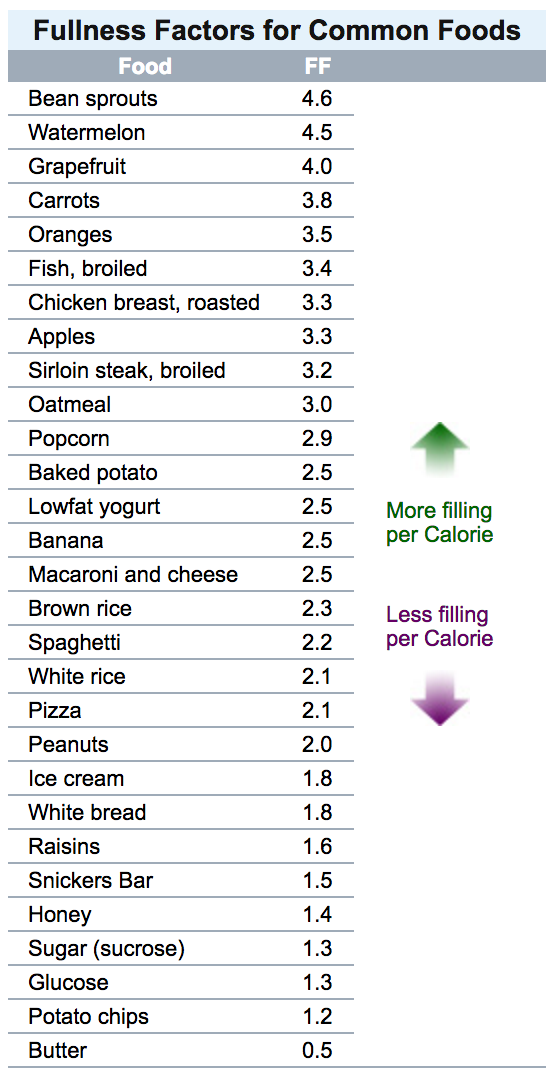
source: nutritiondata.self.com
These are just a few strategies you can put in place to help ensure you stay on track. Admittedly, it would be unrealistic to expect everyone who starts on a diet to adhere to it 100% of the time, we’re only human after all. So it’s important to be aware there will be times when you encounter a lapse, and although you may not be able to fight it you can reduce it. Swapping certain foods for others can help reduce the caloric intake of a lapse.
Here are some great food swaps that you can use:
• Ice cream swapped for Alpro ice cream
• Slice of cake swapped for a protein bar (try a Grenade bar)
• Crisps swapped for popcorn
• Glass of wine or beer swapped for gin and slim line tonic
• Sugary beverages swapped for diet versions
• Crackers or biscuits swapped for oatcakes or rice cakes
There you have it, a few stretgies that may just help prevent you from having a minor stumble off the band wangon.
References:
Forman, E.M., et al. Ecological momentary assessment of dietary lapses across behavioral weight loss treatment: characteristics, predictors, and relationships with weight change. Ann Behav Med. Mar 9, 2017 [Epub ahead of print]
Tryptophan – The secret to curbing carb cravings!
Do you crave carbohydrates when you’re dieting? Well, this could be why…
Tryptophan is an amino acid that is converted to 5-HTP, which in turn up-regulates the production of serotonin – the happy hormone of the brain!
Low levels of tryptophan will undoubtedly lower the uptake of serotonin, and expose you to:
• increased susceptibility to depression
• increased craving for sugary foods
• low mood
• increased aggression
• increased hunger – these symptoms seem to be a lot more magnified in women
Unfortunately, tryptophan does get depleted when dieting, by as much as 15-20% when calories are set at 1,200 or lower (Strasser. 2015). It’s a big reason why it becomes very difficult to actually stick to a diet and not be tempted to binge and overeat.
Why?
Well, it’s important to know that increases in glucose and insulin in response to a high carbohydrate consumption will trigger an increase in brain tryptophan and serotonin synthesis (Benton. 2002).
If you’re someone who experiences any of the above symptoms when on a calorie-controlled diet then it may well be worth increasing your consumption of tryptophan. Only recently, scientists from the University of Barcelona were able to show that treatment with tryptophan-rich protein foods improved emotional processing, mental energy levels and reaction time in middle-aged women.
Taken in dosages of 400-1,000mg/day, it has been shown to:
• reduce food intake (up to 18% more than placebo in a 1989 study w/ obese women | Ceci. 1989)
• increase weight loss – found in a 12-week study with obese women (Cangiano. 1992)
• reduce the food intake – specifically carbohydrate intake in both male and female with type II diabetics (Cangiano. 1998).
Where can I find Tyrptophan?
You can either choose to supplement tyrptophan in the form of 5-HTP (the easiest way) or to increase your intake of tryptophan rich foods for example:
• Elk
• Spinach
• Eggs
• Spirulina
• Soy protein
• Crab
• Halibut
A go-to supplement I recommend would be this one as it’s rather potent at 200mg per cap!
So, if you find yourself ‘pulling your hair’ out when dieting or dreaming about dancing doughnuts and prancing pretzels, it may be a sign that your serotonin levels are a little low and upping your tryptophan may not be a bad idea.
Five things we learned about fitness in July
This month our level 4 trainer, Pete reviews the latest fitness and nutrition research from July. This month, Pete looks into how much protein you need to build muscle strength and size – more isn’t necessarily better. Can caffeine actually make us stronger… and how a simple trick can increase the recruitment of your glutes in a squat.
So pop the kettle on, sit back and enjoy!
1. Periodising your training will make you stronger
OK, so here’s something some of you may have been wondering. Is it actually worth getting a proper periodised training programme from a personal trainer instead of just rocking up to the gym and doing a workout? Well, this month Williams et.al conducted a meta-analysis (a study which examines the results of lots of different studies) looking at whether periodised models elicited a greater increase in maximal strength as opposed to non-periodised methods. And the answer is . . . yes they do! The results of multiple studies corroborate the findings that periodisation of programming saw a greater benefit for maximal strength in upper body and lower body multi-joint movements.
I was very happy to read that all the time we spend writing out weeks of programme cycles for clients will be helping them to achieve their results faster.
2. Protein supplements will help your gains
The easiest way to think of this second study is as the daddy of studies into protein supplementation! It is another meta-analysis that took data from 49 studies and evaluated the results in order to ascertain the:
“effect of protein supplementation on resistance training-induced gains in muscle mass and strength in healthy adults”.
Clearly, with so many studies included in the analysis, there was a great deal of variation with regard to the subjects that were used; there were a few studies who used trained individuals but the majority of the interventions were carried out on un-trained subjects. All of the studies had the subjects training ≥ 2 times per week, and lasted for between 4-52 weeks. The majority of the studies supplemented with whey protein but soy, casein, pea, milk, whole foods and protein blends were also used. It is also important to note that although the protein intake was increased the total daily energy intake did not increase.
The meta-analysis revealed that:
“protein supplementation increased 1RM strength (by 2.49kg), fat-free mass (by 0.30kg), muscle fiber cross-sectional area (by 310μm2) and mid-thigh muscle cross-sectional area (by 7.2mm2).”
What these numbers show is that adding supplemental protein will aid with both size and strength.
The type of protein did not seem to have a significant effect on the results, and it’s also interesting to note that there did not appear to be any benefit of increasing protein above 1.6g per kg of bodyweight every day.
3. Will caffeine make me strong?
When you read this title I’m sure that many of you are thinking “please say yes!!”. Caffeine has been studied lots regarding endurance, but not as extensively when it comes to maximum strength. This month we had a study that looked into precisely that, and what’s even more exciting is that the subjects of the study were trained individuals (as often studies will be done with untrained individuals).
In summary, the results showed that ingesting caffeine had an acute impact on maximum lower body strength and on maximum upper body high-velocity strength. It was surprising that there appeared to be no reason as to why maximal lower body strength was increased but the same was not true about maximal upper body strength.
For those of you who are keen to pop this bit of info into practise, the numbers used in the study were 6mg of caffeine per kg bodyweight and it was ingested 1 hour prior to training.
4. Should we ban(d) squats to target the glutes?
Sorry for the teasing title and for getting a few hopes raised the research had shown that everybody should stop squatting immediately! Unfortunately not, this piece of research is actually about what we can do to get more bang for our buck from the squat. The aim was to find out whether popping a band around the upper thighs would increase glute activation, and to see if it would have any effect on the number of reps that could be performed at a given weight.
Interestingly, the only effect that was seen through adding a band was that EMG for the gluteus maximus and gluteus medius were increased for both the eccentric and concentric phases of the squat. EMG amplitudes for the bicep femoris and vastus lateralis were unchanged when the band was added. There was also no change in the amount of reps that could be performed at either 80% or 60% of 1 rep max.
All in all, if you have a resistance band and you’re looking to get a bit more glute work into your training, try popping it around your thighs when squatting and it will make the glutes work harder without negatively affecting other muscles.
5. Train quicker to get faster
Here’s an interesting one with slightly surprising results! This final piece of research was designed to compare the effects of different forms of hamstring training on strength, activation and sprint performance. Some of the subjects carried out low volume training with a heavy load but low velocity while others used a resistance band at high velocity. As you would expect, the heavy load training increased 1 rep max strength on the leg curl while there was no difference in the banded group. However, when sprint times were measured both from a static and a flying start, the banded group improved on both, while the subjects using the heavy load saw no improvement. High-velocity training seems to have a better transfer to high velocity athletic activity. If you want to be quick then train quick!
References
1. Williams, T. D., Tolusso, D. V., Fedewa, M. V., & Esco, M. R. (2017) Comparison of Periodized and Non-Periodized Resistance Training on Maximal Strength: A Meta-Analysis. Sports Medicine.
2. Morton, R. W., Murphy, K. T., McKellar, S. R., Schoenfeld, B. J., Henselmans, M., Helms, E., Aragon, A. A., Devries, M. C., Banfield, L., Krieger, J. W., & Phillips, S. M. (2017) A systematic review, meta-analysis and meta-regression of the effect of protein supplementation on resistance training- induced gains in muscle mass and strength in healthy adults. British Journal of Sports Medicine.
3. Grgic, J., & Mikulic, P. (2017) Caffeine ingestion acutely enhances muscular strength and power but not muscular endurance in resistance-trained men. European Journal of Sport Science, 1.
4. Spracklin, O. F., Button, D. C., & Halperin, I. (2017) Looped Band Placed Around Thighs Increases EMG of Gluteal Muscles Without Hindering Performance During Squatting. Journal of Performance Health Research.
5. Janusevicius, D., Snieckus, A., Skurvydas, A., Silinskas, V., Trinkunas, E., Cadefau, J. A., & Kamandulis, S. (2017). Effects of High Velocity Elastic Band versus Heavy Resistance Training on Hamstring Strength, Activation, and Sprint Running Performance. Journal of Sports Science and Medicine