Why Most People Never Start Exercising (Even When They Really Want To)
You Meant to Start… So Why Didn’t You? The Psychology Behind Fitness Inaction
Every week, people make the decision to get fitter.
It’s rarely a casual thought. More often, it’s prompted by something that feels meaningful at the time. A drop in energy. A moment of discomfort in their own body. A photo they don’t quite recognise themselves in. Sometimes it’s something more subtle – just a growing sense that things aren’t where they should be.
That moment leads somewhere. They look into options, explore personal training, maybe even reach out and make an enquiry. And when they do, they’re usually sincere. They mean it when they say they want to change something.
But here’s the part most people don’t see coming:
The majority of people who make that decision never actually start.
Not because they change their minds in any conscious way. More often, it’s because nothing happens quickly enough for the decision to take hold.
What the data quietly tells us
Across the fitness industry, there’s a consistent pattern. When someone enquires about joining a gym or working with a personal trainer, only around 20-40% go on to actually get started. That means the majority – around 60–80%– never take that next step to see a change.
At first glance, that might sound like a sales problem. But when you look more closely, it’s not really about persuasion or pricing. It’s about timing.
Most of the people who do start tend to do so quickly. Within a week of reaching out, sometimes even within 24–48 hours. There’s a natural momentum to their decision, and they move with it.
But when that momentum isn’t used, something else happens. Data from class-based training environments shows that if someone hasn’t attended a first session within roughly 10 to 14 days, the likelihood of them ever starting drops significantly <20%. By the time a month has passed, most of those initial intentions have faded entirely.
So the real question isn’t why people don’t want to start.
It’s why something that felt important just a couple of weeks ago can quietly disappear.
The gap between deciding and doing
In behavioural science, this is known as the intention–action gap; the space between what we say we want to do and what we actually follow through on.
It’s been studied across health behaviours for years, and the findings are remarkably consistent. Around half of people who intend to make a positive change to their health never act on it.
This isn’t about willpower in the way most people think of it. It’s not a question of discipline or character. It’s a reflection of how human behaviour actually works.
Making a decision is a psychological event. Acting on it requires navigating real life – with all its competing demands, distractions, and uncertainties.
And that’s where things begin to drift.
The moment that starts it all
Most decisions to get fit begin with a surge of clarity.
For a short period of time, things feel obvious. The reasons for starting are clear, the benefits feel important, and the barriers seem manageable. This is what psychologists often describe as a motivation spike – a temporary rise in the desire to change.
It’s in this window that people take their first step. They search, they read, they enquire.
But motivation of this kind is not designed to last. It’s a response to a moment, not a permanent state.
If nothing happens next, that clarity begins to soften. Not dramatically, but gradually. Other priorities reassert themselves. The urgency fades. The emotional weight behind their decision becomes less immediate.
Within a few days, the thought shifts from “I’m doing this” to “I’ll look at this later.”
Within a couple of weeks, it often becomes “I just need to find the right time.”
And eventually, it disappears into the background entirely.
Why starting feels harder than it should
So, if your desire is there, why don’t you take action?
Part of the answer lies in something simple: starting something new carries friction.
It requires stepping outside of your normal routine and experiencing a slight discomfort. It involves committing time in a busy schedule that already feels full. It often means entering an environment that feels unfamiliar, even if only briefly. There can be an underlying concern about fitness levels, confidence, or simply not knowing exactly what to expect.
None of these barriers are overwhelming on their own. But together, they create just enough resistance to delay action, and park it for “another time” – which ultimatley rarely arrives.
Delay, in this context, is powerful.
Because the longer something is delayed, the more the brain begins to reframe it. What initially felt like a priority starts to feel optional. What felt urgent starts to feel flexible. And what felt like a decision becomes something that can be revisited later.
The role of human nature
There’s also a deeper psychological force at play.
As humans, we are naturally wired to prioritise what feels immediate. In behavioural economics, this is referred to as present bias – our tendency to favour short-term comfort over long-term benefit.
Exercise sits right in the middle of this conflict.
The effort is immediate. It asks something of you now.
The reward is delayed. It builds gradually over time.
Even when someone genuinely wants the outcome – to feel fitter, stronger, healthier, or more confident – the brain subtly leans towards postponing that feeling of discomfort in favor of immediate comfort.
Not permanently. Just for now.
But the ‘for now’ has a habit of becoming much longer than intended.
The step that changes everything
What’s often misunderstood is where the real difficulty lies.
People assume the hard part is maintaining consistency over weeks and months. They imagine the challenge is staying motivated, pushing through sessions, or sustaining results.
In reality, the most difficult part is much earlier.
The hardest step is the first one.
That first step will always carry a feeling of discomfort, but by taking that first step it removes uncertainty.
Once someone has walked through the door, met a coach, and completed a session, the unknown becomes known. The anticipation – which is often the heaviest part – disappears.
They realise that it’s manageable. That they’re capable of far more than once thought. That the environment is supportive rather than intimidating. That the version of this in their head looked very different, and more difficult than reality.
From that point on, the challenge is no longer about starting. It’s about continuing something that has already begun. You only need to look at Newton’s First Law of Motion aka. The Law of Inertia to appreciate an object in motion will stay in motion, and an object at rest will stay at rest – which are you?
What we see in practice
Working with our members here at Hall Personal Training, there’s a consistent pattern that emerges over time.
The members who go on to make meaningful, lasting progress are not necessarily the most motivated at the start. They’re not always the most confident, and they’re rarely the ones who feel ‘fully ready.’
What sets them apart is something much simpler.
They act while the intention is still fresh.
They don’t wait for the perfect moment, they don’t need to ‘go away to think about’ because they recognise – consciously or not – that the perfect moment tends to pass, and this is something they know they need to do, so what good will waiting do??
And almost without exception, when they look back, they arrive at the same conclusion:
They wish they had started sooner.
Not because the process is effortless, but because the delay was unnecessary.
If this feels familiar
If you’ve found yourself thinking about getting started, but haven’t quite taken that step yet, you’re not alone…
What you’re experiencing is the same pattern we see time and time again – where around half of people who intend to improve their health never act on it, and up to 80% of those who want to get fitter and stronger never actually begin.
They all had a genuine intention, that was soon followed by a gradual loss of momentum as time passed.
The important thing is recognising it while the decision still has some weight behind it.
Because once that initial reason for starting fades, it becomes much harder to return to it – trust us.
A different way to think about it
Starting doesn’t require certainty.
It doesn’t require perfect timing, a perfect plan, or a completely clear path forward.
It simply requires a willingness to take a small step before the moment disappears.
That might be a conversation.
It might be asking a question.
It might be coming in to see what we’re all about.
But it’s that step – taken at the right time – that changes everything that follows.
If you’re considering it
If improving your health, fitness or energy is something that still matters to you, the most valuable thing you can do is act while that intention is still present.
You don’t need to commit to everything.
You just need to begin.
If you’d like to explore what that could look like, you’re always welcome to have a relaxed, no-pressure conversation with us.
Go to the contact page and book a call with me and let’s see how we can help you get started.
We’re here helping the people of Oxfordshire take that step between intention to implementation.
We’re Not for Everyone
Hall Training is built for people who want steady, long‑term change. If you’re after a quick fix, a short‑term challenge, or prefer to wing it on your own, we’re probably not the right fit. We specialise in habit‑based coaching, personalised programmes and consistent accountability – which means we work best with people who are ready to commit a small amount of time each week and want real, lasting results.
You’re looking for a rapid ‘quick fix’.
You’re a semi or pro athlete with sport‑specific high‑performance needs.
You can’t devote roughly 2 hours a week to training and coaching.
You already know everything you need and don’t want coaching.
You love the big‑box gym life and feel completely confident training alone.
You’re chasing short‑term results over long‑term health and consistency.
You prefer to go it alone rather than train with supportive people you’ll come to belong with.
You’re not ready to commit to developing your full potential and health.
Need help? If you’re unsure, that’s okay – book a quick call or come in for our 30‑day accelerator and see if it feels like a place you belong and want to grow. We’ll be honest with you about the best path forward.
Modern Vampires Use Sunscreen Now – Here’s How to Update Your Garlic Defense
Halloween 2025 is upon us once again, and frankly, I’m concerned. Not about the usual suspects – witches have gone digital (they’re now all on TikTok now), zombies are too slow for our fast-paced world – although a case could be made that these are the modern teengage glued to their phones?? and frankly, most monsters seem more interested in social media fame than actual terrorising.
But vampires? They’ve evolved.
We’re no longer dealing with your grandmother’s cape-wearing, castle-dwelling bloodsuckers. Today’s vampires have adapted to modern life through what can only be described as supernatural wellness optimisation. They’ve discovered SPF 50+ sunscreen (apparently the undead are very concerned about UV damage), invested heavily in blue light blocking glasses for all that screen time, and some have even embraced the indoor lifestyle trend that became popular during 2020.
The real game-changer? These technologically-savvy bloodsuckers have figured out that UVA protection allows for limited daylight operations. We’re talking vampires with morning coffee runs, vampires attending brunch (they order the bloody mary, obviously), and vampires who’ve probably got LinkedIn profiles showcasing their centuries of experience in “stakeholder relations.”
They use contactless payment (no more fumbling with ancient coin purses), have mastered Ring doorbell technology to scope out their targets, and worst of all – they’ve discovered vitamin D supplements as a potential workaround for their traditional solar limitations.
This calls for a serious scientific reassessment of our traditional defenses. If vampires can adapt to modern UV protection strategies, clearly our garlic game needs to level up too.
The Original Research: A Brief Retrospective
You may recall our Halloween blog a few years ago that referenced the groundbreaking 1994 leech study (because ethical committees still won’t approve vampire volunteers, typical red tape). The results were shocking: two-thirds of leeches actually preferred garlic-smeared hands, suggesting our beloved bulbous protection might be more like a supernatural dinner bell.
But that was over 30 years ago. Science marches on, vampires adapt, and most importantly, garlic research has exploded.
Breaking: The Allicin Revolution
Recent research has revealed something extraordinary about garlic’s active compound, allicin. Studies show that garlic exhibits “exceptional antibacterial properties against Gram-positive and Gram-negative bacteria” and possesses “powerful antimicrobial, antioxidant, and cardiovascular benefits.”
But here’s where it gets interesting for vampire defense…
Allicin is only released when garlic is crushed or chopped. This means those decorative garlic braids hanging in your kitchen? Completely useless against the undead. You need that fresh, weaponised allicin working for you.
The Modern Vampire Dilemma
Contemporary vampires present unique challenges that traditional folklore never anticipated:
Energy Vampires: They drain your phone battery and WiFi bandwidth
Social Media Vampires: They feed off your engagement metrics and personal data
Subscription Vampires: They auto-renew your services indefinitely
Delivery Vampires: They somehow never need to be invited in, thanks to contactless delivery
2025 Experimental Update: The Smart Home Study
Methodology improved thanks to modern technology
Working with a team of “volunteer researchers”, we conducted a 21st-century vampire defense analysis using:
Garlic-infused essential oils (because aromatherapy vampires are apparently a thing)
Control group: Alexa playing garlic-themed podcasts
The subjects? Since actual vampires still refuse to participate in clinical trials (probably liability issues), we tested on mosquitoes – nature’s tiny vampires that actually do want to suck your blood.
Results That Will Shock You
Plot twist: The 2025 data completely contradicts our 1994 findings!
Fresh garlic paste showed 73% mosquito avoidance
Garlic supplements: 45% effectiveness
Essential oils: 12% effectiveness (mostly because mosquitoes were confused by the spa vibes)
Control group (Alexa method): 2% effectiveness (though participants reported feeling more educated about Italian cuisine)
The Science Behind the Protection
Modern research reveals that allicin’s antimicrobial properties work by disrupting cellular membranes. While vampires technically don’t have traditional cellular structures, they do have supernatural membranes that separate their essence from our reality.
Theoretical vampire vulnerability assessment:
Classic Dracula-types: High susceptibility due to old cellular firmware
Sparkly vampires: Medium susceptibility (glitter provides some protection)
Modern urban vampires: Low susceptibility (they’ve built up resistance through exposure to garlic festivals and foodie culture)
Updated Defense Recommendations for 2025
Based on these findings we can now outline and recommned several protocols (ranked) in effectivenss for maximum protection.
Tier 1 Defense: (maximum protection)
Fresh garlic, crushed within 10 minutes of expected vampire encounter
Smart doorbell with garlic-scented motion sensor alerts
Backup garlic paste in kitchen and bathroom (vampires are clever)
Tier 2 Defense: (practical daily use)
High-quality garlic supplements (look for standardised allicin content)
Garlic-scented hand sanitiser (pandemic habits with vampire benefits)
Italian restaurant takeout menus (psychological warfare)
Economic Impact Analysis
Fun fact: The global garlic market is projected to reach $84.6 billion by 2025. Coincidence? I think not.
Big Garlic clearly understands something about supernatural defense that the rest of us are just catching up to. Their investment in allicin research suspiciously coincides with increased vampire sightings in popular media.
The Verdict: Garlic Redeemed
Unlike our pessimistic 1994 conclusions, 2025 science supports Team Garlic. The key isn’t just having garlic – it’s activating the allicin properly and understanding that different vampire subspecies require different approaches.
Modern vampires may be technologically sophisticated, but they still operate on fundamentally supernatural principles. Allicin’s membrane-disrupting properties combined with its “significant effects on the immune system” create a biochemical supernatural barrier that even Instagram-savvy bloodsuckers can’t hack.
Final Recommendations
As we head into Halloween 2025, remember:
Fresh garlic beats supplements beats powder
Crush it fresh for maximum allicin activation
Layer your defenses (physical garlic & digital vampire blockers)
Stay current with vampire evolution trends
And if all else fails, student loan debt remains the most effective vampire repellent known to science – nothing supernatural wants to get anywhere near that level of financial burden.
Stay safe, stay garlicked, and Happy Halloween 2025!
The Post-Plunge Protocol: Why Temperature Is the Missing Key to Red Light Therapy Success
The Temperature Secret That Makes Red Light Therapy 25% More Effective
Welcome to the Future of Recovery
At Hall Personal Training, we’ve always been committed to helping our clients achieve optimal health through evidence-based practices. That’s why we’re excited to introduce you to Avanto° our sister company launched in September to further expand our wellness offerings beyond traditional training.
Avanto° brings together three powerful recovery modalities: sauna therapy, cold water immersion, and red light therapy, all housed in a purpose-built space designed around the latest scientific research. While each modality offers incredible benefits on its own, it’s the intelligent combination and timing of these therapies that creates truly transformative results.
Today, we’re diving deep into red light therapy – one of the most misunderstood and incorrectly applied wellness tools in the industry. You’ll discover why most facilities get the timing completely wrong, and how our evidence-based approach at Avanto° ensures you get the maximum therapeutic benefit from every session – enjoy!
Introduction: What Are Red and Near-Infrared (NIR) Light Therapies?
Red light therapy, also known as photobiomodulation (PBM), involves exposing the body to specific wavelengths of red and near-infrared (NIR) light. These wavelengths, typically range from 600nm to 1000nm, penetrate the skin and underlying tissues, where they influence cellular biology in ways that can promote healing, reduce inflammation, and improve overall health. The science is clear: both red and NIR light directly impact mitochondrial function (our cellular health) and help your body optimise repair at a cellular level.
Scientifically Backed Benefits: What Does It Really Help With?
Enhanced Mitochondrial Function, ATP Production & Lowers Blood Glucose
Red and NIR light therapy primarily works by activating cytochrome c oxidase (CCO), a key enzyme in the mitochondrial respiratory chain. A 2024 study in Wiley’s Journal of Biophotonics demonstrated that red light (670 nm) increases mitochondrial membrane potentials and adenosine triphosphate (ATP) production, profoundly boosting cellular energy at the source. Remarkably, the study found that just 15-minutes of red light exposeure after a meal, reduced blood glucose by almost 28%.
Reduced Inflammation and Pain Relief
Red light therapy has been proven to reduce pain intensity by 20-30% by decreasing inflammation and promoting angelistic activity linked to various conditions. This effect is especially valuable for those living with disorders like chronic fatigue syndrome (CFS), multiple sclerosis (MS), and fibromyalgia, all of which are closely tied to inflammation and mitochondrial stress.
Improved Skin Health and Wound Healing
Red light stimulates collagen production, supports microcirculation, and accelerates wound repair. It is well recognised as a non-invasive, effective tool for improving skin tone and speeding up tissue healing, with a 2024 meta-analysis showing red light therapy increasing wound healing (as measured by wound size reduction) by around 14% to 38% as compared to control intervention – I personally use red light therapy on my kids wounds to speed up the healing and help get them back up on their feet; it really is amazing!
Special Benefits for Chronic Conditions
Recent research shows promising benefits for people with chronic fatigue syndrome (CFS), multiple sclerosis (MS), and fibromyalgia. For example, a 2023 trial found that whole-body photobiomodulation therapy led to an average 31% reduction in Fibromyalgia symptoms at 6 weeks, and a persistent 18% reduction at 24 weeks as measured by a Fibromyalgia Impact Questionnaire (FIQR), with notable improvements in pain, stiffness, fatigue, sleep, anxiety, and depression, and quality of life.
The Temperature Factor: Why Heat Reduces Red Light Effectiveness
Temperature plays a major role in red light therapy outcomes. Scientific studies reveal that increasing skin temperature (as happens in a sauna) results in more light absorption at the surface, reducing how deeply beneficial red and NIR photons penetrate. This undermines the therapy’s effectiveness at reaching mitochondria in deeper tissues.
Conversely, cooling the skin before light treatment – even with simple cold exposure – substantially increases the penetration depth. Studies demonstrate that cooling the skin before red light treatment can increase light penetration by over 25%. A study published in the Journal of Biomedical Optics showed that cooling the skin makes tissue more transparent to therapeutic wavelengths, allowing more light to reach deeper cells. This improvement occurs because vasoconstriction (narrowing of blood vessels) reduces superficial blood volume, allowing more photons (light particlaes) to travel to deeper tissues where mitochondrial benefits occur.
Recent research from 2025 further confirms that low-powered devices that don’t generate much heat (such as the full body panels here at Avanto°) achieve better tissue penetration than high-powered, heat-generating systems. The science is clear: cooler skin temperature optimises light therapy effectiveness.
This is why red lights installed in saunas represent more marketing than meaningful therapy. The elevated temperature environment directly counteracts the penetration needed for true therapeutic benefit, making it largely ineffective despite the appealing concept of combining modalities.
So, instead of using red lights in hot environments (like a sauna), the best science currently supports red light after cold exposure for maximum benefits.
Our Approach at Avanto: Evidence-Based Red Light Protocols
At Avanto°, our approach is rooted in the latest evidence. That’s why we removed our red light therapy tower out of our sauna and installed full body panels in our changing areas – this way you can receive a full therapeutic dose without heat interference.
Our protocol: Experience a cold plunge first, then apply red light therapy while your skin is still cool and vasoconstriction is pronounced. This sequence capitalises on physiological changes that maximise light penetration, so you get the real, cellular-level and theraputic outcomes you’re after.
Start with Our Reset Protocol: The Perfect Introduction to Science-Based Recovery
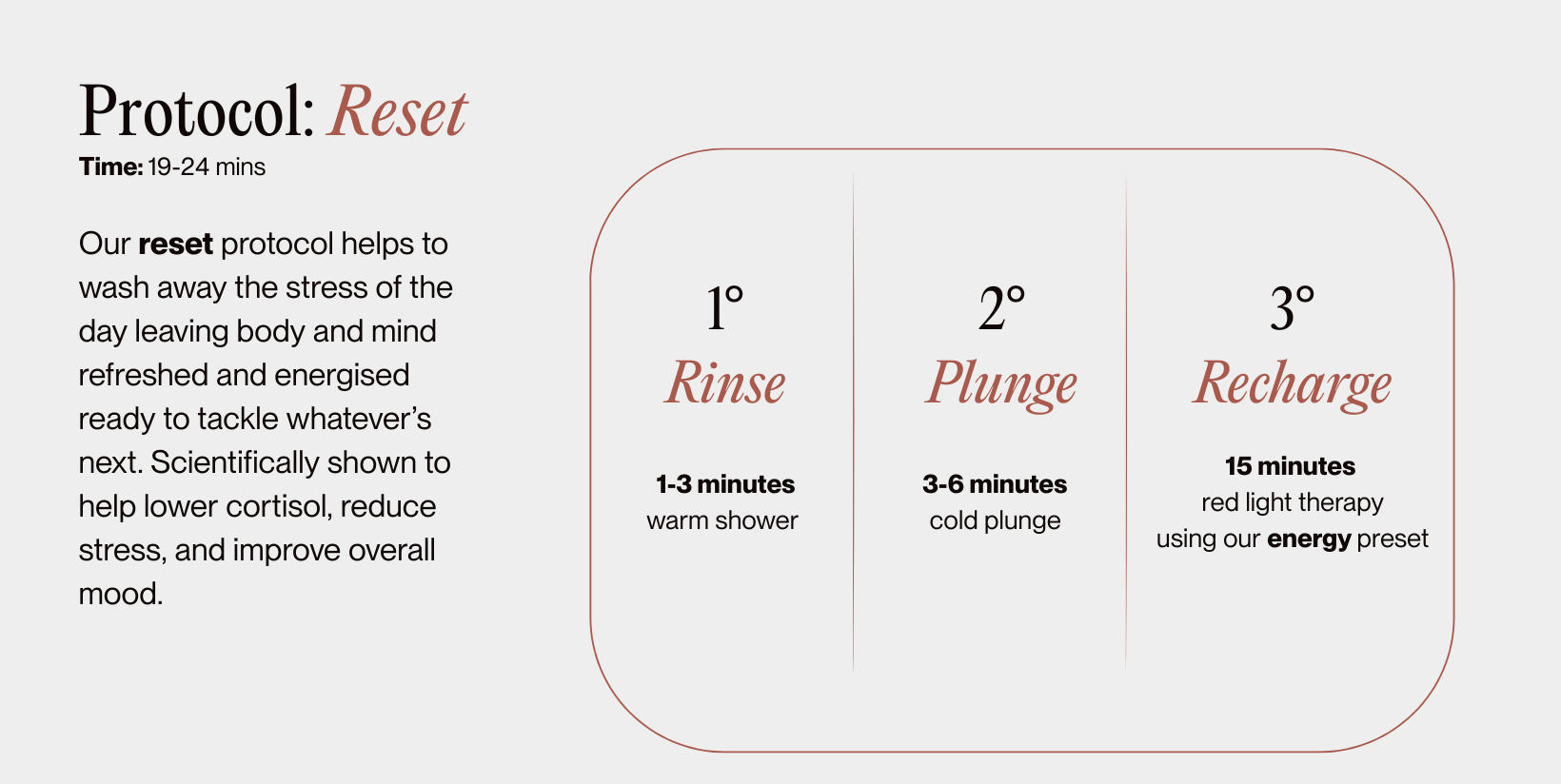
If you’re new to red light therapy and cold exposure, our Reset Protocol is the ideal starting point. This carefully designed 25-minute session demonstrates exactly why the post-plunge timing we’ve discussed is so effective.
What Is The Reset Protocol? This gentle yet powerful protocol helps calm your nervous system, release daily pressure, and sharpen mental focus, leaving you ready to tackle whatever’s next on your to-do list.
The Science-Based Sequence: Step 1: Rinse (1-3 mins) – Prepare your body and mind under a warm shower Step 2: Plunge (3-6 mins) – Cold water immersion to activate your nervous system and create optimal vasoconstriction Step 3: Recharge (15 mins) – Red light therapy while your skin is still cool to maximise penetration and cellular benefits
This protocol perfectly embodies the temperature science we’ve explored: the cold plunge creates the ideal physiological conditions (vasoconstriction and cooled skin) that allow the subsequent red light therapy to penetrate deeper and deliver maximum benefits. You’re not just getting two separate therapies – you’re getting them in the scientifically optimal sequence.
Perfect For:
Busy professionals managing stress
Anyone seeking mental clarity and calm
A first-thing morning or mid-day ‘reset’
Those new to contrast therapy wanting to experience the real benefits
Why You’re Struggling to Build Habits (And What to Do Instead)
5:45 am: I wake up, head downstairs, and reach for a hydrogen tablet with half a litre of water. I empty last night’s dishwasher, sterilise baby bottles, and add 15 drops of methylene blue into another half litre of water.
Then I brave a 3½‑minute cold plunge. While I’m in there, I soak two mugs in hot water. Once out, I spend 8 minutes under red light therapy. After that, I make coffee for me and my wife and take it back upstairs. By 6:25 am, we’re sipping in bed—and by 7:00 am, the kids burst in and our day begins.
When I tell people about my morning routine, the response is almost always something like:
“You do that every day? I wish I could get into the habit of waking up early… or doing ice baths…”
Or: “You drink a litre of water first thing? I keep meaning to drink more water, but I always forget…”
Sound familiar?
When people set out to get fitter, eat better, or feel more in control of their day, they often say things like:
“I just need to get into the habit of exercising…”
“I want to build the habit of eating more protein…”
“If I could just remember to drink more water…”
But here’s the catch: trying to build a habit for something that requires effort, intention, or discomfort often sets you up for disappointment.
The truth is, I haven’t developed a habit of waking up early or doing cold plunges. What I’ve built is a routine – and that’s a big difference.
Habits vs. Routines
We often use the words interchangeably, but there’s a crucial distinction.
A habit is a behaviour done with little or no conciuos thought. A routine is a series of behaviours that are intentional and repeated with effort.
This is backed up by experts like Nir Eyal, author of Indistractable, who warns that many people fail to make lasting change because they try to form habits before building routines.
Routines are what come first – the deliberate, structured behaviours we repeat. Over time, and only sometimes, they might evolve into habits. But not always, and that’s okay.
Trying to shortcut this process leads to frustration. We blame ourselves, thinking we lack discipline, when in fact, all we were doing is following flawed advice.
Why Routines Require Effort
Getting out of bed before sunrise, jumping into a cold plunge, cooking a protein-rich breakfast – these all take conscious thought. Even if they get easier with time, they rarely become truly effortless.
Routines, unlike habits, are often uncomfortable. They all involve a level of discomfort. They go against the grain of what your body wants in the moment – we like being comfortable. They require conscious thought, deliberate effort, and a degree of internal friction.
Compare that to brushing your teeth or making your morning coffee – things that feel strange not to do. Those are habits. But anything that offers delayed gratification – exercise, healthy eating, mindfulness – likely won’t ever feel that automatic.
That’s why chasing the idea of building a habit before building a routine is often setting yourself up to fail.
So How Do You Build a Routine That Sticks?
According to behavioural research and neuroscience, including insights from Harvard Business School, there are three key strategies:
Set Rules, Not Just Intentions We’re often told to “set clear intentions.” But the problem with intentions is they’re vague, flexible, and easy to ignore. They leave too much room for negotiation — both from others and yourself.Instead, set rules.
Rules carry more weight. They feel firmer, more established – and we tend to obey them. While some might argue that rules sound restrictive, the truth is: people respect rules. They don’t respect vague intentions.
For example, don’t just say: “I want to drink more water.”
Say: “I drink 500ml of water as soon as I wake up.”
Likewise, don’t intend to go to the gym three times a week – make it a rule! “I go to the gym three times a week. No matter what.”
Rules create clarity. They eliminate grey areas. They’re easier to follow, harder to argue with, and far more likely to be respected – by yourself and by others.
For example, I’ve walked at least 10,000 steps a day for over 380 days — through birthdays, Christmas, holidays, and even the birth of my son. Why? Because I made it a rule for myself: walk 10,000 steps every day. No excuses.
Be specific about what you’re doing, when you’re doing it, and why.
Reflect on your deeper reason. As Ximena Vengoechea suggests, ask yourself: “Why does this matter to me?” Knowing your why will help you push through inevitable resistance.
Charles Duhigg, author of The Power of Habit, also reminds us: “”There’s no such thing as 21 days to a habit.” Some behaviours might take weeks, others months, some never. Be patient.
Prepare for RoadblocksThink ahead: What typically stops you? Lack of time? Distractions? Mental fatigue?If you’ve failed before, learn from it. Anticipate obstacles and put systems or rules in place. Block out time in your calendar to make it a priority, and reduce decision-making, get accountability from a friend, partner or coach – Accountability is one of the biggest reasons our members keep showing up — and seeing results.
The more friction you remove in advance, the easier it becomes to follow through when energy or motivation is low.
Use Nudges and Microhabits A nudge is a small environmental cue or behaviour that supports the action you want to take.For example:
• Place a full water bottle beside your bed as a reminder to hydrate first thing.
• Lay out your gym clothes the night before.
• Set a daily reminder to book your training session.
You can also try temptation bundling – linking something you want to do with something you should do. Listen to a podcast only while walking. Have a coffee only after a cold plunge.
These small adjustments make routines feel more sustainable, and even enjoyable.
Final Thoughts
If you’re trying to adopt healthier behaviours, don’t wait for them to become automatic. Don’t wait for motivation. And don’t beat yourself up when it doesn’t feel effortless.
Instead, design a routine – one that’s built around clear intentions, realistic expectations, and small supportive nudges.
Because real change comes not from what we do on autopilot, but from the conscious actions we show up for, day in, day out.
That’s where the transformation lives.
Time, Attention, and the Cost of Comfort: How to Reclaim What Matters Most
The Real Reason You’re Always Distracted (And What to Do About It)
I had the pleasure of speaking at the Network & Natter conference at Bloxham Mill this week, where I gave a presentation on one of the most important topics we rarely stop to think about: Time, Attention, and how we can reclaim both to live more intentionally.
You can download the full presentation here. Since the talk, the feedback has been incredible. I’ve been genuinely surprised by just how much it resonated with people.
So, I thought I’d pull together the key points and turn them into an easy-to-digest and actionable blog post. If you couldn’t attend – or you just want to refresh the message – I hope this gives you something to reflect on and put into practice
Attention, Time & Money: Why Discomfort Might Be the Key to Your Happiness
In today’s world, we idolise those who work 60+ hour weeks, live in giant homes, and drive around in £100,000 sportscars. It’s easy to assume that if we simnply work harder and hustle longer, we’ll reach that same level of success – and happiness will follow.
Our education system reinforces this. From a young age, we’re told: work hard, get good grades, earn more money, and everything else will take care of itself.
But there’s one problem: it isn’t true!
The Money-Happiness Illusion
Studies suggest that once your basic needs are met – food, shelter, security – additional income has minimal impact on your happiness. The “sweet spot” for life satisfaction is estimated at around £70,000 per year. Beyond that, more money tends to buy more things, not more joy.
What’s more, we’re trading something finite (our time) for something that we mistakenly treat as infinite (money). But only time can offer the most meaningful rewards: presence, relationships, growth, and purpose.
“All my possessions for one moment of time.”– Queen Elizabeth I
A stark reminder that time, not wealth, is our most precious commodity.
Comfort Creep: How Convenience Is Making Us Weaker
Over the past few decades, we’ve engineered a world that makes almost everything easier. While innovation has improved safety and efficiency, it’s also made our lives too comfortable—and that’s becoming a problem.
From lifts and escalators to Uber and food delivery apps, we’ve removed nearly all physical friction from our day-to-day routines.
The Escalator Study A particularly telling example: in public places, studies show onlyaround 8% of people choose stairs over escalators. That means 92% of us will actively avoid discomfort, even if it’s just walking up a flight of stairs.
It’s the same with prescription weight-loss drugs like Mounjaro, which bypass the discomfort of healthy eating and exercise. Technology has allowed us to escape the natural stressors that once kept us strong—now we’re losing resilience in the process.
We’ve built a life that protects us from the slightest inconvenience, and in doing so, we’ve created a culture of fragility.
Dopamine vs Anandamide: What Really Feels Good?
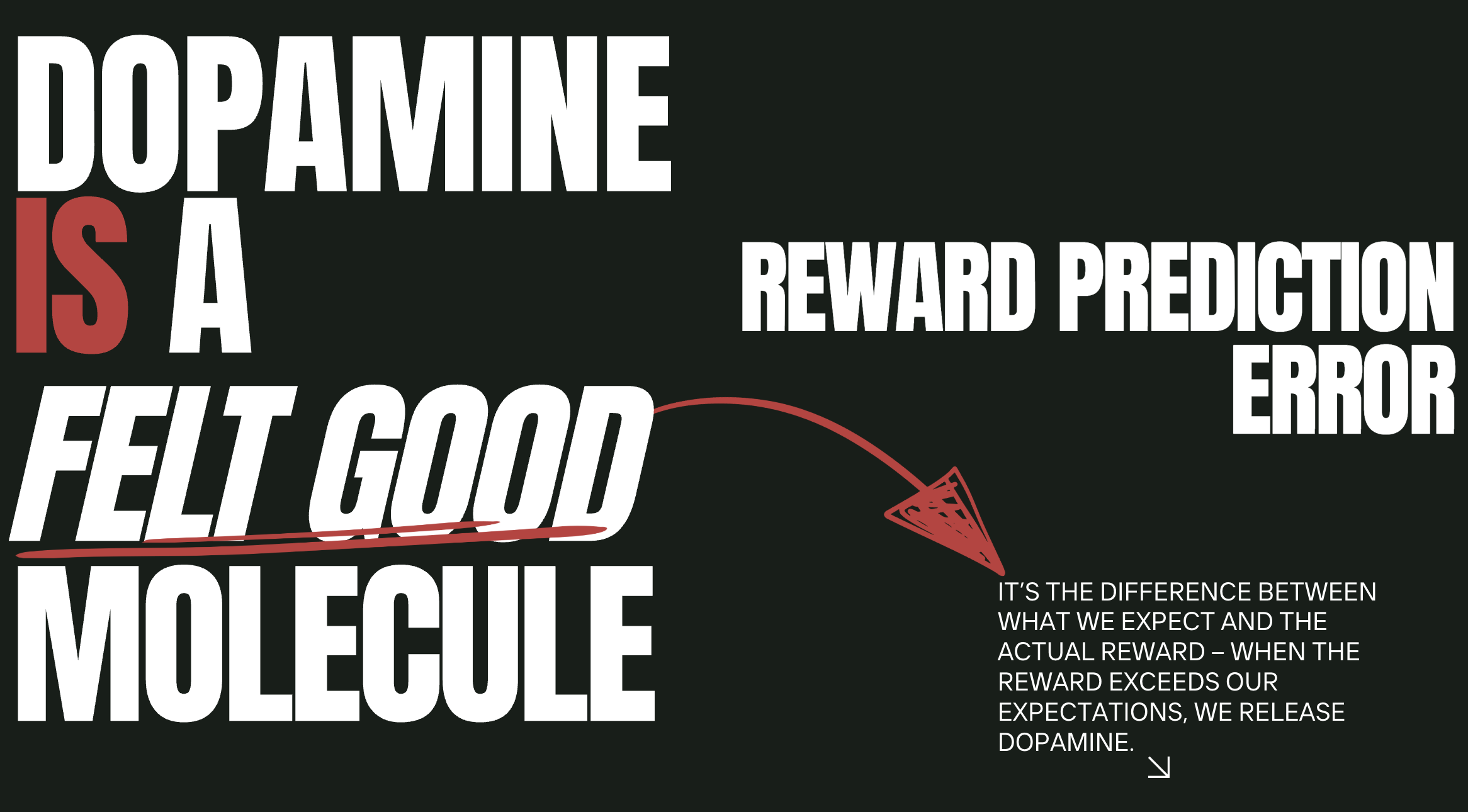
Let’s get something clear: dopamine is not the feel-good chemical. That role belongs to anandamide, a neurotransmitter responsible for true pleasure and bliss (the name itself comes from the Sanskrit word ananda, meaning joy).
The Role of Dopamine Dopamine is the motivation molecule. It spikes when we experience something unexpectedly good—a “reward prediction error.” For example, if you didn’t expect to find a new coffee shop on your way to work, dopamine helps you remember that moment and associates it with pleasure.
But dopamine is fleeting. Despte popular belief dopamine’s role isn’t to make us feel good – it’s to teach us what felt good and drive us to seek it again.
Food, Exercise & Modern Dopamine Traps Modern ultra-processed food is engineered to hijack our dopamine system: high fat, high sugar, salt, crunch, and reward. It overrides natural satiety signals and keeps us craving more. Exercise, on the other hand, triggers a slow release of dopamine and anandamide – especially after exertion – which is part of the famous “runner’s high.”
But when comfort creep and technology make it easier to avoid effort, we stop chasing these natural highs, and start relying on artificial ones – scrolling, snacking, bingeing. And we lose out on the real rewards.
Internal vs External Distractions: Why the Enemy Is Inside
It’s easy to blame our phones for stealing our attention. But surprisingly,only 10% of distractions come from external triggers. A full 90% are internal. They come from within: feelings of boredom, anxiety, restlessness, or dissatisfaction.
When those feelings arise, we grab our phones or check our email—not because we’re truly interested, but because we’re uncomfortable.
Our phones have become our modern “shock machines”In a 2014 study, 67% of men and 25% of women chose to administer electric shocks to themselves rather than sit quietly for 15 minutes. That’s how uncomfortable we’ve become with just being.
Habit Loops and Digital Dependency
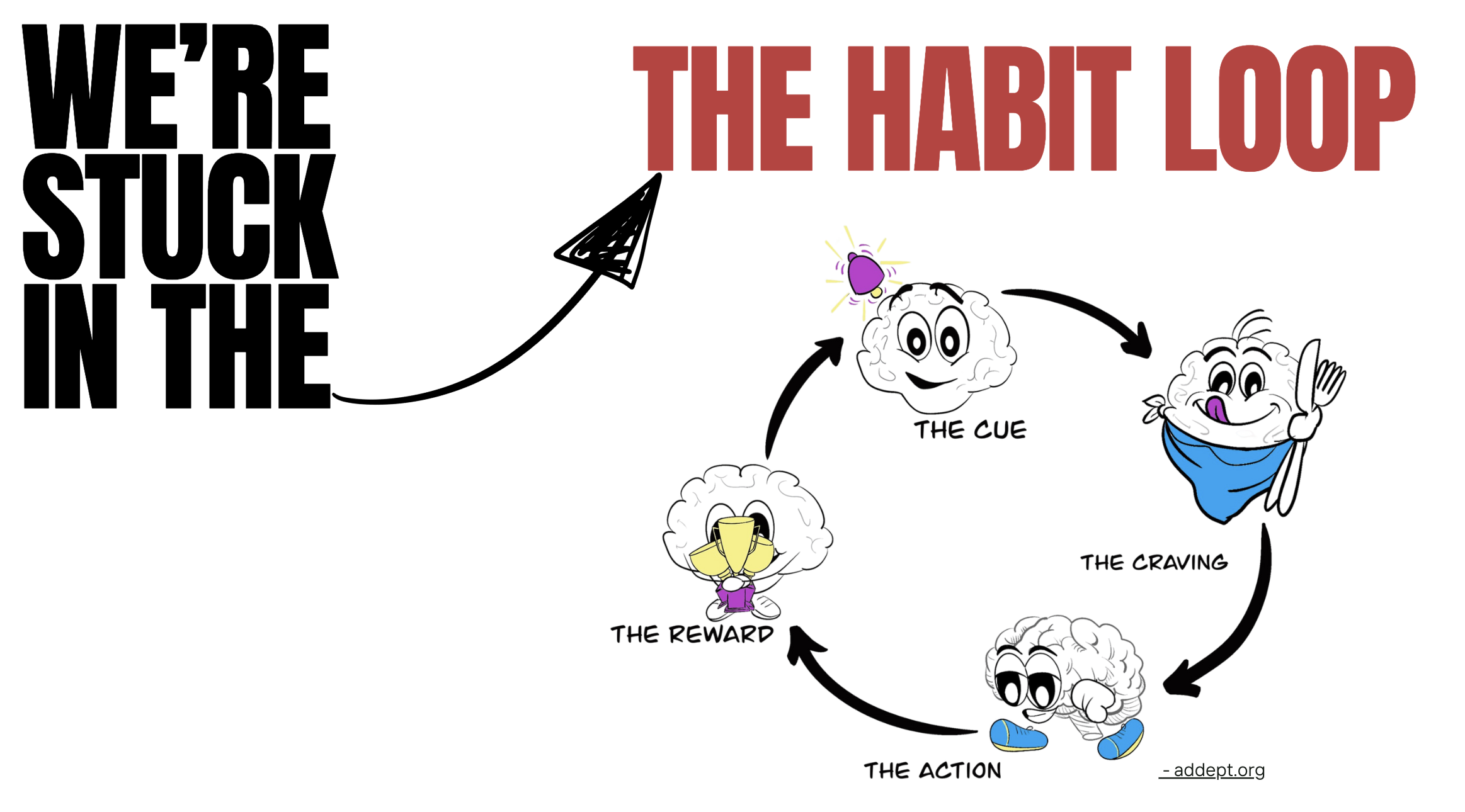
Charles Duhigg’s Habit Loop explains how behaviours form:
Cue: is a trigger, the habit e.g. the sight of your phone. It’s a prompt for your brain to move on to the next step – the craving.
Craving:is that delicious anticipation of the reward. It’s the motivational force behind each habit. We don’t crave the action; we crave the state/the reward that occurs after the action has been done. You don’t crave clicking on social media; you crave the relaxation and entertainment it offers your brain.
Action:is the behaviour itself – working out, drinking your coffee, taking a shower, scrolling on social media – the thing you need to do in order to answer that craving.
Reward:is what doing that action gives you – the dopamine hit! It’s the thing that satisfies the craving and makes you that much more likely to do it again.
This loop wires our brain for fast, repeatable behaviour. Every time you reach for your phone instead of sitting with discomfort, you reinforce the habit.
We’re not addicted to our phones. We’re addicted to relief from discomfort.
Building Resilience Through Hormesis
If comfort is killing our attention, motivation, and vitality—what’s the solution?
The answer lies in hormesis: the process by which small, manageable stressors make us stronger.
These “beneficial stressors” train the body and mind to tolerate discomfort and become more resilient over time.
Here’s how it works:
Cold Exposure (Ice Baths) • Triggers norepinephrine release and dopamine, boosting mood, alertness, and mindfulness. • Regular exposure improves circulation, reduces inflammation, increases fat metabolism, and enhances stress tolerance.
Heat Exposure (Infrared Sauna)
• Increases blood flow and heart rate similar to cardio. • Enhances heat-shock proteins that repair cellular damage. • Reduces cortisol and promotes parasympathetic recovery.
Red Light Therapy • Stimulates mitochondrial function, ATP production, and cellular repair. • Reduces oxidative stress (ROS), improves skin appreance and wound heeling, speeds recovery, and balances hormones. • Shown to positively impact sleep and circadian rhythm.
These aren’t gimmicks. They’re modern applications of ancient wisdom, now supported by clinical research and neuroscience. And they’re at the heart ofAvanto Wellness, our new wellness hub (opening August 2025), designed to help you reclaim your energy, sharpen your mind, and build real-world resilience.
So What Can You Do?
You don’t need to throw away your phone or move to the mountains. But if you want to take back control of your time and attention, start with this:
Let your phone serve you
Keep it out of your workspace. Even its presence lowers memory and focus by up to 10%.
Time block your day Plan your tasks and stick to time-limited windows of work, movement, connection, and rest.
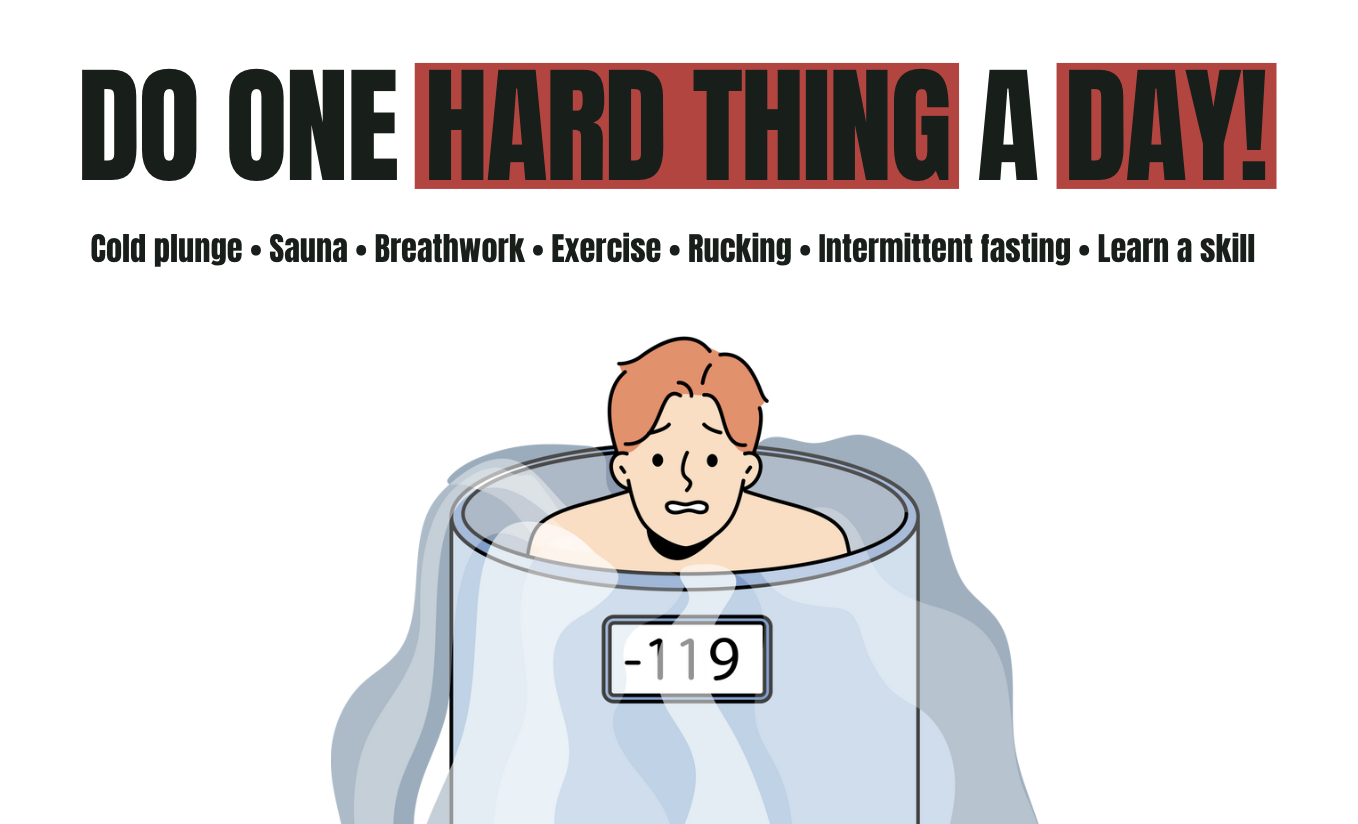
Do one hard thing a day Train your tolerance. Become comfortable around the feeling of discomfort. It could be an ice bath, workout, sauna, or even fasting or learning a new skill.
Get comfortable with discomfort Don’t rush to escape every moment of silence, stillness, or stress. These are opportunities to grow.
Final Thought
Attention is time. Time is life. If we can’t control where our attention goes, we can’t control how our life unfolds.
At Hall Personal Training and through Avanto, we’re here to help you slow down, build resilience, and reclaim the energy and presence you were designed to live with.
Ready to take back control of your time, energy, and focus? Whether you’re looking to improve your resilience, build healthier habits, or simply feel more present in your day-to-day life—we’re here to help.
Discover our new wellness hub, Avanto Wellness – featuring an infrared sauna, cold pluge and red light therapy.
Drop us a message or come visit, we’d love to help you find what works for you.
How to train your heart
What is the most important muscle in the body? Your first answer may be to suggest your legs, abdominals or even your tongue, but however great a well-defined six-pack looks, the most important muscle is in fact the heart! It doesn’t just pump blood around our body, but also has a vital role in shuttling hormones and transporting the nutrients consumed from food to our working tissues and muscles.
Like any muscle, if we want it to grow bigger, stronger and more efficient, we need to exercise it, just as we train our legs, abdominals and arms to be stronger.
So, how we do this?
Well, we apply the same theory as we do to other muscles in the body. Take skeletal muscle for example; the load (weight) and number of reps we use can influence how that muscle develops. If you wanted to focus solely on getting a muscle strong, then you would typically train it across a 1-5 repetition bracket, but people looking for bigger muscles would focus on training between 6-12 reps using a variety of exercises.
Our heart (or rather our cardiovascular system) can also be trained in a similar way to elicit specific training outcomes, such as strength, size or stamina. When it comes to the cardiovascular system, we have three different adaptive abilities or “energy systems”. Let’s take a look at them:
1. The Alactic System – great for supplying us with instant bursts of speed and power 2. The Anaerobic System – great for delivering speed and power for a short period of time 3. The Aerobic System – not a great one for expressing power or speed, but will keep you going for hours on end
Unless you’re an athlete, don’t worry too much about developing the alactic system. For everyday life, your focus should be on building up the anaerobic system and even more importantly, the aerobic system as these are the ones that’ll have the greatest impact on your health and fitness goals.
In the same way we use repetition brackets as a guide for individual training responses (i.e. strength, hypertrophy or muscular endurance), our heart also has its very own set of ‘rep ranges’ called ‘zones,’ and each zone helps to develop one of those three energy systems.
So, how do we know which zone we’re working in?
Let’s think about weight training again. We often estimate the load we should lift based on a percentage of your one rep max for that lift. It works just the same with heart rate training.
Heart rate zones are set as a percentage of maximum heart rate, which can be calculated using the formula 220 – age, or for a more accurate measurement, performing the Cooper Test, a 12-minute maximal running test (which is a bit less fun…)
Once a max heart rate has been established the zones can be set and you can confidently exercise for your desired training outcome:
Zone 1 – 0-65% of Max HR
Helps to improve overall health by driving the recovery process in the body
Zone 2 – 66-75% of Max HR
Works on developing your aerobic fitness
Zone 3 – 76-85% Max HR
Helps to increase the amount of time and power you can work aerobically
Zone 4 – 86-95% Max HR
Helps to develop your anaerobic fitness
Zone 5 – 96-100% Max HR
Helps to develop the power you can express anaerobically and the ability to function at max capacity
These five zones provide the structure required to train cardiovascular fitness to its full capacity. Thanks to modern day fitness apps, we have complete access to what our heart is doing while we’re exercising.
Keep an eye out for my next blog – I’ll explain why it’s important to train your heart, and how you can use technology to train your cardiovascular system to achieve a stronger, healthier and happier future.
The Best Healthy Lunches in Summertown
As personal trainers in North Oxford, we often pop to Summertown to grab a healthy lunch. Our running coach Becky has done a roundup of the best five places to grab a healthy lunch in Summertown, based on whatever your dietary requirements are!
1. M&S Salad and Deli Bar
I started with a firm favourite of mine, the M&S salad bar – a Summertown staple. I am told that this is the only M&S outside of London with a fresh salad bar, and it really is amazing. The particular lunch deal I chose caters more for meat eaters and pescatarians, but wow what a choice us meat eaters have!
For just five pounds you can get ¼ of a chicken and 200g of any salad to go, or you can go large for an extra £2 and get ½ a chicken. This is perfect for anyone on a high protein and low carbohydrate diet. It’d also be a great lunch for any vegetarians out there – just skip the chicken and make sure your salad contains lots of beans and other sources of protein.
There are about ten salad options, all hugely varied and including a wide range of different fruit and vegetables. After much deliberation I opted for the roasted mushroom salad to go alongside my ¼ peri peri chicken.
I was pleasantly satisfied with my choice. The chicken was cooked perfectly and pulled off the bone easily while not being too greasy. I also found the salad tasted fresh and full of flavour so didn’t leave me with that post lunch drowsiness.
I would like to point out that as nutritious as these salads are, they are also quite calorie dense with additional calories coming from full fat dressings such as sour cream and buttermilk. If you’re looking to slim down, I would suggest opting for the chicken breast rather than the leg and removing the skin to save unnecessary calories. You can also choose a salad with fewer dairy and oil-based dressings such as the kale and cranberry salad with orange and ginger dressing.
2. Gail’s
Gail’s needs no introduction in Summertown. Being a London based brand, it isn’t cheap, but you get what you pay for!
Along with the irresistible cakes and bakes, Gail’s also do a rather varied selection of salads such as Quinoa, chopped vegetables and fresh herbs (vegan) and beetroot, lentil and goats’ cheese. They also have a falafel, couscous and ratatouille salad which can be warmed. They’re all packaged and ready to go which is great if you’re in a rush.
I decided to sit in and have a breakfast item off the menu: sautéed mushrooms, goats’ curd, baby spinach and a fried egg on sourdough toast. Despite the cafe being busy it came within 10 minutes and only set me back £7.
If you’re looking for a larger portion or extra protein you can add either smashed avocado (£3), scrambled eggs (£3), streaky bacon (£3.50) or smoked salmon (£4)
This is a great option for vegetarians and vegans, but probably not the best for those sticking to a low carbohydrate diet.
3. LB’s Lebanese Cuisine
While this may not be the quaintest of cafes, it definitely has the widest range of foods you’ll see in Summertown. The counter is filled with Lebanese delights such as Hummus, Moutabal (grilled aubergine in sesame oil), Moussaka, Falafel and many more meze options. They do a vegetarian lunch pack: a selection of six deli favourites served with Lebanese bread for.
I chose the Friday board special, Lamb and tomato inside a baked aubergine with rice and Lebanese bread, for only £5. Before they warm it through, they cover the dish in more juices form the lamb. This was the biggest portion of all the lunch options I’d seen in Summertown and definitely the tastiest. The lamb was so soft and meaty oozing juices into the beautiful soft rice.
Like Gail’s, this is a vegetarian’s paradise with a huge array of meze and salad options, but it’s also a winner if you’re looking for a meatier lunch. This was quite a carb overload so beware of that mid-afternoon drowsiness!
Lebanese food is full of fibre, but it can also be a higher fat and carbohydrate option, so those looking to slim down might like to ask for half the rice before they serve it and skip the bread, making this a meal more energy dense through fats rather than carbohydrates and fats combined. However, if you are looking to build muscle and gain weight this could be the perfect meal for you.
4. Modern Baker
With all the hype in the media regarding gut health, pro-biotics and pre-biotics I was very excited to try Modern Baker. Here the focus is on reduced refined sugar, gluten free and vegetarian/vegan products. These are also probably the most instagrammable of lunches.
There are a variety of gluten and refined sugar free cakes on the counter along with a toast bar for lunch. It doesn’t sound like much, but I found this the most exciting of lunches due to the topping options such as sauerkraut and kimchi; a very different selection in comparison to other places in Summertown! These fermented foods are strong choices for anyone wanting to improve their gut health, as they feed the healthy microbiome (bacteria) in our guts.
I chose the modern baker ‘seedy seedy’ bread topped with hummus, cucumber and kimchi. This also came with a seedy side salad. Now if that is not posh toast, I don’t know what is! It really did hit the spot and I was happy to see the bowl of kimchi was overflowing, definitely a fan. I really do think this is such a simple yet fun idea that North Oxford residents should be taking advantage of!
5. Chozen Noodle
Found inside the co-op this is a less swanky option, however just as comforting in the winter. They have a selection of hot curries, rice dishes and noodles as well as sushi and udon bowls. Prices for sushi range from £4.95 for a regular size katsu box, to £10.25 for a large variety sushi box including Nigiris and Maki rolls. These are perfect, quick and macro-friendly lunch options.
I chose the large chicken udon noodle bowl, costing £5.95, which I had heated up. This really was full of flavour and super filling probably due to a large amount of liquid along with a decent ratio of chicken to vegetables. They definitely don’t skip on the protein! At only 347 calories per bowl this is the perfect lunch for anyone looking to slim down. They also offer seaweed salad and edamame bean sides. Great low-calorie filler options for anyone trying to tackle the afternoon boredom eating.
However, I would add that as warming as the udon bowl is, the cafe is rather chilly as it is in a supermarket, so maybe one to take to a park bench or back to the office.
[INFOGRAPHIC] Unwrapping the health benefits of chocolate
Easter has arrived meaning we only have one thing on the brain, and that’s chocolate, lots of it!
But is chocolate as healthy as the media claims?
We decided to take a look at the science and share with you the actual health benefits chocolate possess.
Let’s take a closer look…
Does garlic protect against vampires?
Does garlic protect against vampires?
With Halloween only a few days away, we haven’t long to prepare ourselves against the creatures that go bump in the night.
Luckily, I’m well prepared and have taken appropriate steps to protect myself against witches, monsters and the creepy-crawlies that may all try to get through my front door in the night.
However, possibly the one I’m most fearful and less prepared against are vampires. Vampires are feared everywhere especially in the Balkan region so I’m weighing up the options to see which protection method would be the most reliable.
I’ve considered many of the popular options:
• A simple stake through the heart – common in Southern Slavic cultures however, the Russians only found this to work when the type of wood was Ash [1] and I certainly don’t have any stake shaped ash lying around.
• Decapitation – this is the preferred method amongst Germans, decapitating their head from their body, which is great in theory but probably not as easy in practice.
• Holy water – we could drench them in Holy water as this is thought to burn their skin [2]. Oh wait, unless you’re a Priest you’re unlikely to have access to that…
• Mirrors – mirrors have been used to ward off vampires when placed, facing outwards, on a door and was used by Bram Stoker in Dracula. However, not all vampires have a reflection and sometimes do not cast a shadow [3] so it’s probably not our best or most reliable option.
Despite these all being great options, I’ve concluded they’re either too difficult to implement or to resource, which leads me to one (last) possible option – garlic! It’s easy to get a hold of and very inexpensive. In fact, Bram Stoker himself suggested the use of garlic to ward off vampires.
Now this seems to work in the movies however, I want to be certain so as luck should have it a group of researchers back in the nineties explored the hypothesis behind garlic’s apotropaic effect against warding off vampires and this is what they found:
Firstly, due to the lack of participating vampires the researchers we forced to use blood-sucking leeches instead – ok, so they’re not as scary, but they still love to drink your blood.
The researchers then allowed the leeches to attach themselves to one of two hands; a garlic-smeared hand and a non-garlic hand. The results
To their surprise, two-thirds of the leeches preferred the garlic-smeared hand over the non-garlic hand. In fact, leeches who took to the garlic-smeared hand took 14.9 seconds to attach themselves compared to 44.9 seconds for the non-garlic hand [4].
As we can see from the results of this study, the traditional belief that garlic has apotropaic properties could likely be wrong, and the reverse may in fact be true, garlic does not protect against vamipres! I suppose this now means that my pot of garlic is futile and we shouldn’t believe everything we see on TV.
I guess the only real option we have is to wait the night out until sunrise; unless of course you get one knocking at your door in which case refusing them entry will keep them away from your home and out of harm’s way [5] – a much easier option if you ask me.
Good luck and Happy Halloween!
References:
1. Alseikaite-Gimbutiene, Marija (1946). Die Bestattung in Litauen in der vorgeschichtlichen Zeit (in German). Tübingen. OCLC 1059867.
2. Burkhardt, “Vampirglaube und Vampirsage”, p. 221.
3. Spence, Lewis (1960). An Encyclopaedia of Occultism. New Hyde Parks: University Books. ISBN 0-486-42613-0. OCLC 3417655.
4. Does Garlic Protect Against Vampires? An experimental study. Tidsskr Nor. N. Laegeforen (Sandvik H, Baerheim A) 1994.
5. Spence, Lewis (1960). An Encyclopaedia of Occultism. New Hyde Parks: University Books. ISBN 0-486-42613-0. OCLC 3417655.