Five things we learned about fitness in June
From eccentric and concentric training, to blood flow restriction and hamstring training, June’s fitness research has covered it all. Our level 4 trainer George has sifted through it all to bring you some gems you can apply to your own training straight away – enjoy!
1. Eccentric training beats concentric training – over a long time period
A recent meta-analysis study – which is the epitome of all studies and one we should definitely listen to – showed that with equal volume, eccentric-only training produced marginally greater increases than concentric-only training. Now, although the increase was relatively small, it would make sense that over time (I’m talking years) we’d likely see an exponential gap form between the two different methods.
As muscles are able to contract against more load during the eccentric, with less energy expenditure for an equal amount of mechanical tension (volume load), the eccentric proves to be of definite importance to any workout – especially hypertrophy and strength programs.
So what should you do with this information? Well, I’m certainly not advising removing concentric contractions. Both eccentric and concentric are essential elements in your training routine. They’re not even different methods, they’re just the two different phases of a rep, so make sure your training covers both. After all, it’s not likely that you’d ever perform just eccentric reps without the concentric – deadlifts would be off the cards!
2. The jury’s out on making bloodflow restriction comfortable
If you’ve ever done blood-flow-restriction (BFR) you’ll be able to recall how uncomfortable it can get! Can we get around this by applying the wraps post exercise, instead of during the set? Typically, wraps would be applied throughout the set to prevent the build-up of metabolites within the muscle from clearing, and then be kept on for an additional 60 seconds post-set.
A recent study tested out completing normal sets, then applying wraps for 5 minutes after the set (instead of while the contractions were taking place), against the same protocol but without post-set wrapping. Results showed that very similar outcomes were found across both groups.
From this study, it was concluded that the accumulation of metabolites isn’t the cause of an increase in muscle cross-sectional area (CSA), but that the BFR causes an increase in motor unit recruitment and that’s why an increased muscle CSA would occur. Taking this, and my previous point into account, seems that an increase in metabolites hasn’t been considered as a potential cause of increased CSA. As the wraps weren’t applied throughout the sets, I’d say that only applying the wrap at the end of the set would likely have allowed much of the metabolic waste to clear. After all, muscles don’t want to be full of metabolic waste, they want to get rid of it as fast as possible and are constantly flushing out that contractile by-product. They won’t be waiting until the last rep has been completed to begin this process.
There we are; as it stands the jury is still out on the exact BFR method to use.
3. Drop sets are best for size, multiple sets are best for strength
I have no idea who came up with the drop set phenomenon but it sure was a great idea, especially as it was likely done out of pure intuition and not backed by science! Numerous studies have shown the benefits of drop sets on muscle size, and here’s the freshest member to the club.
With total load lifted being evenly matched across two different groups, the drop set group increased overall muscle cross-sectional area (CSA) by 10%, beating the 5% in the normal, multiple set group. Although the difference seems minimal, again, added up overtime this could lead to the difference between 15” & 20” pythons!
But what about rep strength instead of size? Even though in this study, drop sets proved to increase muscle CSA by an extra 5% and indicators of fatigue were higher, rep strength didn’t increase. However, in the multiple set group it did. It’s likely that a huge component of this increase would be via metabolic stress (one of the primary mechanisms of hypertrophy) due to increased metabolite build-up within the muscle during the exercise. This decrease causes lower threshold fibres to work and at a higher number of reps, resulting in greater metabolic stress.
Mechanical tension still plays a huge role as another mechanism of hypertrophy and should be varied within your training programme using a phased approach – cycling between mechanical tension, muscle damage and metabolic stress.
Because the multiple set group completed the same total load using higher threshold fibres, greater mechanical tension would have been created therefore a greater increase in strength was observed.
4. The Nail in The Coffin for No Knee Over Toes? Finally!
I’d like to think that this old cliché is dying out and hope that June’s latest study will put it to bed for good. This study pitted ‘knees over the toes’ against its rival ‘knees not-over the toes’ – I guess you’d call it?
I’m not sure whether this study was designed to describe the sheer force created by a knee over the toe approach, but please bear in mind that ‘joint stress’ isn’t a bad thing at all. I’m sure if we exchanged it for ‘joint torque’, some heads would sure turn as it sounds much more conducive to strength and hypertrophy results. Torque is all we’re ever creating around joints when we lift something – from cup of tea to max effort squat – even though the torque values do vary greatly!
All in all, less knee flexion was shown to produce less joint torque (shocker). However, taking the squat for example, you might be able to squat 100kg by flexing to 100o of knee flexion, and 120kg by flexing to only 80o but you added load to the ‘shallower’ squat and would have most definitely still increased joint stress.
Throughout a training program less knee flexion would likely show decreased gains in the quadriceps’ strength and size due to reduced torque, and subsequent muscle stress throughout its entire contractile range.
Anyway, knees over toes is about as arbitrary a measurement I think you could find.
Assuming that the elbow is effectively the knee of the upper body – why haven’t we created an “elbow must not flex further than the hand” movement? Not so crazy, right? I’d like to add that nowhere in this study were exploding patella’s noted during any of the lifts.
5. Curl away for solid hamstrings!
No, unfortunately not bicep curls but Nordic Curls, an old-school hamstring exercise. Along the lines of our founder – Chris’s post in our Facebook Community page – one recent piece of research investigated the effect of eccentric hamstring training on total hamstring strength using two primary exercises, Nordic Curls and the Russian Belt.
Hamstring strain is common in many sports – especially football – and something we want to prevent, hence the need for building rock-solid hamstrings!
Eccentric loading alone of the hamstrings using Nordic Curls and Russian Belt exercises was shown to increase hamstring strength but interestingly, only the Nordic Curl seemed to improve asymmetrical imbalance between legs.
Most Personal Trainers will focus on the hamstrings’ function during hip extension and knee flexion, thinking only about the concentric phase. It’s important to remember their role in the opposite direction, when the hip is flexing and knee extending – acting as stabilizers of those joints. The hamstrings and calves work synergistically to provide stability across the knee, and therefore act like a force decelerator as the foot strikes the floor. Without this you’d have to kiss goodbye to your poor knees!
The biggest takeaway is that both exercises are eccentric loading exercises, therefore a protocol of eccentrically overloaded prone lying leg curls should display the same result. Muscles only response to muscle tension, they’re unaware of the actual exercise performed.
There we have it – curl away for immense hamstrings!
References:
1. Schoenfeld, B. J., Ogborn, D., Vigotsky, A. D., Franchi, M. & Krieger, J. W. (2017). Hypertrophic effects of concentric versus eccentric muscle actions: A systematic review and meta-analysis. The Journal of Strength & Conditioning Research
2. Madarame, H., Nakada, S., Ohta, T., & Ishii, N. (2017). Postexercise blood flow restriction does not enhance muscle hypertrophy induced by multiple‐set high‐load resistance exercise. Clinical Physiology and Functional Imaging.
3. Fink, J., Schoenfeld, B. J., Kikuchi, N., & Nakazato, K. (2017). Effects of drop set resistance training on acute stress indicators and long-term muscle hypertrophy and strength. The Journal of Sports Medicine and Physical Fitness.
4. Kernozek, T. W., Gheidi, N., Zellmer, M., Hove, J., Heinert, B. L., & Torry, M. R. (2017). Effects of Anterior Knee Displacement during Squatting on Patellofemoral Joint Stress. Journal of Sport Rehabilitation.
5. Rey, E., Paz-domínguez, Á., Porcel-almendral, D., Paredes- hernández, V., Barcala-furelos, R., & Abelairas-gómez, C. Effects of a 10-week Nordic Hamstring Exercise and Russian Belt Training on Posterior Lower Limb Muscle Strength in Elite Junior Soccer Players. Journal of Strength and Conditioning Research.
Fitness events in Oxford across July
Not only are we lucky enough to live in one of the most beautiful cities in the country, Oxford also has a host of fitness events going on each month. Here are a few events you can check out in July!
Sunday 9th July, 10:00
Join Cancer Research’s Race for Life at the University Parks in Oxford. Open to ladies only, there’s a 5k and a 10k course, with everyone raising money to beat cancer.
Sunday 9th July, 09:50
Run through and around beautiful Adderbury (near Banbury) on a 5k, 10k or half marathon course, with plenty of off road running!
Wednesday 12th July, 19:30
This is definitely something we can get behind. Open to all levels, this one hour yoga class is accompanied by a bottle of beer. Just book a ticket, bring a yoga mat and you’re away. Tickets are £12.00
Sunday 16th July, 9:00
Burford Bolt 5/10k in Marlow
A challenging 10k course, including both tarmac and woodland in beautiful Marlow. There’s a 5k course too if you’re not feeling too adventurous!
Wednesday 19th July, 7:30
Waddesdon Manor Summer 5k
Fancy giving a 5k a go? Why not do it in the beautiful grounds of Waddesdon Manor with the Vale of Aylesbury Athletic Club??
And of course, there’s the Oxford park run every Saturday at 9am, held in Cutteslowe and Sunnymead Park.
Three hypertrophy mistakes everyone makes, and how to avoid them
In April, I took another trip to Ben Pakulski’s Mi40 Gym in Florida. Mi40 is a world-famous facility specialising in hypertrophy, and I went specifically to increase my knowledge of exercise execution, selection and unsurprisingly push some mental boundaries when it comes to effort in the process.
I want to share a few thoughts about maximising hypertrophy gains that rubbed off on me during my trip, and the top three mistakes people make when it comes to hypertrophy training. Although there are loads of studies and theories about the best way to do this, it’s pretty hard to argue with some of the most mammoth human beings I’ve ever had the pleasure of meeting. Their theories must work, right? There’s always a perfect blend of science and application, and these guys have nailed it.
There are a few main points I want to cover in this blog post. Firstly, all the personal trainers at Mi40 are sticklers for technique. Now, I’m not talking about your typical “bar must touch the chest on bench press” kind of form; it’s a totally different level of technique critique!
Secondly, none of the exercises they use are special in any way; they are simply variations of basic exercises most gym-goers will have in their exercise library. All variation is done intelligently, with a proper thought process, as opposed to variation for variation’s sake, which is something we see far too often from some personal trainers!
Lastly, knowing how to apply focused effort is key to maximising your hypertrophy gains. I say ‘how’ because it seems there isn’t an inherent lack of work being done by most gym-goers, but the focus is often misdirected.
Mistake 1: Putting Periodisation Before Exercise Execution
The importance of exercise execution in training for hypertrophy that has been somewhat neglected by many in the fitness industry lately due to the arrival of the new kid on the block – periodisation.
Bold statement alert. There’s been a lot of discussion in the personal training industry recently about periodisation, and why it is the most important element of hypertrophy training. While there is definitely serious merit to a phased approach to training in everyone’s programme, it shouldn’t be made the determining factor of whether a programme is great or not. Linear, wave or pyramid – I don’t care! Put simply, each and every one of these are methods of altering total workload (volume) across a period of time.
If you ever hear claims of the perfect programme, please turn away from the personal trainer in question, and re-read this blog post. Essentially, you could have the most perfectly periodised training programme known to man, but I can guarantee that if your execution is off, you just might as well throw that plan in the bin!
Before you address periodisation; focusing on executing exercises correctly, and maintaining that perfect execution throughout your entire workout is unbelievably important. If you aim for perfection with each rep, you’ll be open to a greater margin for error within your training, allowing for greater hypertrophy gains.
Mistake 2: Random Exercise Selection
The second element is exercise selection. This is where things get interesting and seemingly unconventional. When it comes to hypertrophy:
- Yes – Free-weight exercises can be great exercises
- Yes – You’ll likely get bigger arms doing barbell skull crushers
- Yes – Chin-ups can build you a bigger back
However, the above exercises may not be your best options for maximum hypertrophy. Stick with me here. By being clever with our exercise selection, we can design more efficient and far superior workouts. Please put aside all prejudices about your favourite exercises and read the following statement carefully.
Essentially, the most effective exercise for a given muscle is one that has the ability to perfectly match the output capability of that muscle throughout its entire range of motion.
And to those who think we’re overcomplicating things here and reply – “But people have been getting big and strong by doing compound basics for years!” – Correct, they have. But, what if we never progressed our thinking? What if we still assumed that pigeon post was the most effective way of getting a message out? I have no idea how many pigeons I’d have to send in order for you all to read this…
There’s an entire plethora of fancy adaptations you can make to achieve a more optimal exercise resistance profile such as employing resistance bands, heavy chains & varying cable angles. Although throwing a resistance band on something may get you more looks in the gym it doesn’t always make the exercise more beneficial, in fact it could be making it worse! They must be used in the right way when it comes to hypertrophy, taking a lottery approach to your exercise selection isn’t likely to get you far. I’ll be doing another blog post on selecting optimal exercises shortly – keep your eyes peeled!
Mistake 3: Misplacing Your Efforts
So, effective execution and the correct exercise selection are crucial to a good hypertrophy programme, or workout. But we’re missing the third key ingredient – good old fashioned hard work.
We need all three elements – execution, selection and effort – present in order to elicit a maximal training response. In fact, we need execution and selection in place first to even qualify to use effort!
You see, most people complete 200% workouts using 50% reps, meaning they go mad for an hour with a tonne of unnecessary sets and flamboyant zero-resistance exercises. I’ll go all in and say that if we focused a little more on selecting more efficient exercises and squeezing the last drop out of every inch of each rep, you could easily cut your training volume and gym time in half. You’d even have more time for changing room selfies!
Look around, judging by the screwed-up faces and endless grunting, it’s not a lack of intensity that’s holding you back. I see 10/10 for effort but a modest 2 for concentrated focus and effort. Actual effort is what counts, it doesn’t matter how much effort it looks like you’re putting in.
The goal isn’t to “win” the workout. The goal is to progress, and enjoy yourself along the way. If you can get that done more effectively & in less time, then it would be foolish not to. Let’s be honest, nobody relishes in the thought of ten sets of Back Squats!
Please come back and tune in soon, when I’m going to lift the veil on ‘the 5 Factors of Optimal Exercise Selection.’
Putting the ‘personal’ into personal training
Hall Training Systems has rebranded to Hall Personal Training, and today unveiled its new logo, tagline and website to support its evolution over the last year.
The underlying ethos of the brand remains the same: we are still committed to providing the very best service to our clients, going above and beyond other personal trainers in Oxford. We are still committed to achieving results through science, but we blend the most up to date health and fitness theory with our years of industry experience, ensuring the best approach for each client as an individual. Finally, we still take a ‘systemised’ approach. Now this doesn’t mean cookie cutter programmes or nutrition – that is completely against what we stand for! For each individual we do everything from scratch, based on your individual goals, exercise history and the time available. But it means we have tools and systems that we know work, and processes we can employ to make sure our results are among the best in the industry, let alone in Oxford.
So, why the rebrand?
Well, when it was founded, Hall Training Systems was the brainchild of our founder, Chris. He loves practical application and science and information, and treating clients as individuals – and the old brand reflected that. But since then, the company has grown, and we now work with an amazing, hand-picked team of personal trainers across Oxford. When we got together to decide what makes us us and sets us apart, our truly personal approach for each individual client shone through. So we wanted to put the personal back into personal training, and back into our brand. We’ve kept the good of the old Hall Training, and made it better.
Now for the strapline…
“Results through science” has been replaced with “Stronger. Healthier. Happier.” Results through science is what we focus on as professionals, but it’s not why our clients come to us. We spoke to our awesome community and asked them to summarise why they wanted a personal trainer in the first place, and most importantly, what we’ve helped them achieve. Being stronger, healthier and happier people was the unanimous feedback we received, and what we, as a team, want our clients to feel when they work with us. From the comments that came back to us, it looks like we’re getting it right!
Finally, you’ll notice we have a shiny new website! We owe our thanks to the fantastic team at Rare Form New Media in Oxford for their help with this. We wanted something that reflected our vision for our clients, our ethos as a team (friendly and approachable, down to earth, but damn good at our jobs), and the fact that we work with people of all ages, abilities and backgrounds. Hopefully you agree that this is what we now have. We hope you enjoy exploring it!
Five things we learned about fitness in March
1. Community can help you improve your fitness results
Now hold on to the edge of your seats, because this study is super interesting.
A research team out in Southwest USA have taken note of the surge in the semi-private fitness training model, and have come out with a really neat study examining its potential benefits over conventional 1-2-1 sessions.
Participating members were split up into groups of 5, and while they did warm up together, they each ran through an individualised programme as part of the session.
Interestingly, the results that fed back through an online survey suggested that self-exercise motivation, exercise efficacy and self-reported health and wellbeing all rose; each of which feed into the core fundamentals of self-determination theory (which is awesome).
The best bit? All study participants came from varying age ranges, had differing physical capabilities and were mismatched in the length they had been training.
So, should you share a personal trainer or seek our a community like our private group? It certainly wouldn’t be a bad idea…Did I hear someone say “Hall Training bootcamp?”
2. Your training should change with your age
Looks like all those bajillion different articles across the internet on ‘training for your age’ may be of some relevance after all.
A recent study examining the impact of a 12-week concurrent high intensity interval strength and endurance programme in healthy older adults, yielding some surprising results. The group that partook in the more rigorous, higher intensity exercise saw greater improvements in body composition, muscle strength, mobility and balance.
But isn’t that expected?
The interesting thing is, this was despite a reduction in overall training volume to the low-moderate group!
Take home note? If you’re worried that your life number may be impacting your ability to train hard, you’re mistaken. Try out some shorter, more intense sessions and your body might just thank you for it!
3. Want a more stable squat? Take a breath.
Looking to maximise your squatting stability? Do your body a favour, and leave the bosu ball alone.
Rather, focus on rhythmic bracing and breathing. Far cheaper, far more effective, far less likely that you’ll lose balance and faceplant the floor. All good things.
A recent study examining the efficiency of Pilates-based breathing and squatting identified increased muscular activity in the rectus, bicep femoris (hamstring) and tibialis anterior (lower leg) when squatting was performed in conjunction with Pilates-based breathing; increasing stability during the movement.
Want to get more stable in your squat? Try Pilates.
4. Oxygenated Water, Fad or Fab?
If you’re anything like me, when oxygenated water hit the shelves, you were sceptical at the very least. I’ve been around the block enough times to roll my eyes when the next super-duper, colourfully marketed, tea detox is thrust my way!
So, Oxygenated water? What even….
Turns out, the guys down at JISSN (journal of the international society of sports nutrition) thought the same when they published a recent study examining the ingestion of oxygenated water in long distance runners.
Incredibly, whilst running performance nor lactate kinetics saw any improvement, lactate clearing was enhanced post-exercising, leading to a reduced recovery period.
More research certainly needs to be looked at in this rather new area, but if you’re a long distance runner, get a little bit sore after training and are looking to optimize your post-training recovery protocol; it might be worth chugging a bottle of the ol’ water air.
5. Fancy foot, everyday foot, barefoot; what shoe should we wear while running?
Running is one of the most popular sports out there. There’s no two ways about it. It has an incredibly low barrier to entry, and at the basic level requires no learnt skill acquisition/training.
It’s no surprise then, that a whole market has emerged around the key instrument in every runner’s arsenal – the foot.
In depth analysis of running gait. Adjustments to over-pronation. Specialist prescribed shoe soles.
The amount of fancy specifications for one singular body part is really quite remarkable. So much so that there’s even been a movement backwards away from hi-tech equipment and back to how mother nature intended it. Barefoot running.
But which is optimal when it comes to running economy?
A recent study down in Tennessee sought to compare the differences in step frequency and running economy between normal shoes, running shoes and no shoes.
Looks like we’ll finally get our answer….
Yet, rather underwhelmingly, the study showed no significant differences in running economy between either of the footwear conditions, although step frequency did increase ever so slightly for the barefoot running group.
So, what type of footwear is best for running?
Unsurprisingly, whichever you feel most comfortable and confident in.
….and whichever look the best, of course!
References:
1. Wayment, Heidi A. Ph.D.; McDonald, Rachel BS. (March 2017). Sharing a Personal Trainer: Personal and Social Benefits of Individualized Small Group Training. Journal of Strength & Conditioning Research.
2. García-Pinillos, Felipe; Laredo-Aguilera, José A; Muñoz-Jiménez, Marcos; Latorre-Román, Pedro A.. (March 2017). Effects of 12-week concurrent high-intensity interval strength and endurance training programme on physical performance in healthy older people. Journal of Strength & Conditioning Research.
3. Barbosa, Alexandre C.; Martins, Fábio M.; Silva, Angélica F.; Coelho, Ana C.; Intelangelo, Leonardo; Vieira, Edgar R.. (March 2017). Activity of Lower Limb Muscles During Squat with and Without Abdominal Drawing-In and Pilates Breathing. Journal of Strength & Conditioning Research.
4. Flemin, N., Vaughan, J., Feeback M.. (March 2017). Ingestion of oxygenated water enhances lactate clearance kinetics in trained runners. Journal of the International Society of Sports Nutrition.
5. Cochrum, Robbie G.; Connors, Ryan T.; Coons, John M.; Fuller, Dana K.; Morgan, Don W.; Caputo, Jennifer L.. (March 2017). Comparison of Running Economy Values While Wearing No Shoes, Minimal Shoes, and Normal Running Shoes. Journal of Strength & Conditioning Research. 31 (3), 595-601.
Alright, so as I’m sure you will have heard, sleep is damn important and most of us don’t get enough of it. At Hall Personal Training, we like to promote a healthy life all round, we’re not just about lifting heavy weights in the gym. So, I would like to give you all a few bits of information on why sleep is so important, and a few tips to try and improve our sleep in the 24-hour world we live in. As a personal trainer, I couldn’t let this opportunity go without looking at how it will impact performance in the gym either!
Why do we need sleep?
We need sleep for a number of different reasons. A key one is the release of hormones and chemicals that maintain homoeostasis (equilibrium of the body). It allows us to rest and recover our body as well as our mind. Our bodies function in patterns known as “circadian rhythms” (behavioural, physiological and biochemical rhythms) and the circadian rhythm for sleep is controlled by the suprachiasmatic nucleus (an area of the brain just behind the optic chasm also known as the “master clock”).
If we don’t get enough sleep, we are at risk of:
- Memory and cognitive impairments
- Decreased performance and alertness
- High Blood Pressure
- Heart attacks
- Heart failure
- Stroke
- Obesity
- Psychiatric problems, including depression and mood disorders
- Attention Deficit Disorder
- Mental impairment
- Fetal and childhood growth retardation
- Poor quality of life
These are just a few of the problems, and issues will vary depending on the type of sleep deprivation, whether it is partial sleep deprivation, long term deprivation or short term deprivation. For example, it has been shown in numerous studies that partial sleep deprivation will have a much greater effect on mood than on cognitive or motor functions.
Will a lack of sleep make me put on weight?
A lack of sleep can also lead to weight gain or difficulty in losing weight. One reason for this is that a lack of sleep can lead to a reduction in Leptin (a hormone that makes us feel full) and an increase in Ghrelin (a hormone that makes us feel hungry) thus leading a person to eat more during the day. As well as this chemical stuff, we should also be aware of the psychological side effects that may lead to weight gain. We know that a lack of sleep can lead to increased stress levels, which can often lead to eating more as a coping mechanism. Also, most of us will be much less likely to drag ourselves to the gym when we’re feeling sleepy.
Can lack of sleep affect me gaining muscle?
Not getting enough sleep can also affect those of us who are looking to put on a bit of muscle mass. This is because sleep is when we get most of our muscle repair and it is also when we increase our production of Growth Hormone (GH). An insufficient amount of sleep will also lead to an increase in cortisol and a reduction in testosterone – all bad things if you’re looking to increase your lean muscle mass!
So how much sleep is enough sleep?
The right amount of sleep will vary from person to person, however, if you can get somewhere between 7-9 hours as an adult you won’t go far wrong.
Any tips on improving sleep?
The best tip for the majority of bad sleepers would be to take a break from electronic screens before bed. These screens produce blue light which our brains interpret in the same way as daylight. This prevents the release of melatonin, a hormone which helps send us to sleep. I’d also suggest that you should try and be in as strict a routine as possible with regards to bedtime and the time you get up. Like I said before, our bodies like rhythms and patterns. You’ll find the newer version of the iphone will have a ‘bedtime’ mode that when enabled will place an orange tint to the screen filtering out blue light.
Something we highly recommend to our clients is the desktop plug-in – f.lux. It’s free to download and will filter out the blue screen light that emits from your laptop or computer; ideal for students and night owls.
References:
“Effects of sleep deprivation on performance: a meta-analysis.” Pilcher JJ, Huffcutt AI. (1996)
“Short Sleep Duration Is Associated with Reduced Leptin, Elevated Ghrelin, and Increased Body Mass Index” Shahrad Taheri, Ling Lin,Diane Austin, Terry Young, and Emmanuel Mignot
“Growth hormone and cortisol secretion in relation to sleep and wakefulness.” J R Davidson, H Moldofsky, and F A Lue
Five things we learned about fitness in February
At Hall Personal training, we ensure we stay on top of the latest research in the health, fitness, strength and conditioning journals. That way we know we are providing the best possible advice to our clients, combining theoretical knowledge with our years of practical experience.
This month, our junior trainer George has scoured the research from February to see what’s new in the fitness industry and to provide us with some top tips you can introduce right away in your training.
1. Should You Use A Weight Vest For Sprinting?
Sprinting is a key component to most team sports so knocking that split second off a 100m sprint time is a key goal for many athletes. Lately, the trend for using weight vests for sprinting (and every other exercise) has skyrocketed. A recent study conducted on improving sprint speed concluded that using a weighted vest during training for added resistance v.s. good old fashioned sprinting produced no noticeable difference in sprint times.
Rather than focusing on adding weight up-top, it would make sense to build stronger and more explosive quads, glutes and hamstrings (prime sprint movers). This would significantly increase sprint times. After all, Force = Mass x Acceleration. Save your money and put in a little more sweat in the gym building immense legs.
2. Increase Performance Using External Cues
Coaching cues are essential for performance and output during training. The two main cues we focus on are external (outside the body) & internal (focusing on the body).
Recent research has indicated a slight advantage in using external cues for increased force output and athletic performance. Even though the advantage is minor, external cues were shown to be better for both force output and performance, therefore we can only conclude that so far, external cues are the title holder! However, both of these were only performed on two exercises so how this would carry over into other exercises is yet to be confirmed.
It would be interesting to try different internal and external cues because not all cues are created equal – some have far better carryover for performance and output than others. Essentially, it all depends how you perform the movement – I could give the best cues in the world but if you’re unable to connect with them, they’re useless!
3. Which Grip Should You Choose For Pullups?
With so many choices in the pull-up library, it can be hard to know which one is the best for strengthening and growing the back. A recent study completed on muscle activation during four pull-up variations showed that the only major ‘pulling’ muscle that demonstrated much difference between variations was the middle trapezius (the meaty bit you put the bar on when you squat) and this was only between a neutral and pronated grip, the latter being superior. Essentially, all other muscles displayed no significant difference between variations in this study.
Now…
As I learnt from my visit to world famous Bodybuilder – Ben Pakulski’s – Mi40 Gym in Florida, understanding that how you think about performing the movement (where you place your focus) goes a long way to determining the outcome of muscle activation. Following on from above, I believe this is why we always get such a variance across numerous studies when looking at EMG results, and no definitive answer. Different cues for the variations would provide different EMG outcomes. I’m not saying that EMG studies are useless by any means, but rather that they should be used as a piece of the puzzle to expand your thought process rather than define it.
4. Increase Reps & Total Workout Volume During Your Rest
Adopting a quick 30-40s antagonistic muscle static stretch during your rest periods may prove to be beneficial to increasing reps performed and subsequent total workout volume. After all, volume is one of the greatest precursors of hypertrophy – this is something you should pay serious attention to! Additionally, during the study, muscle activation was higher during the static stretching workouts compared to the non-stretching and PNF workouts. Win-Win!
The long-term effects of static stretching between sets is still yet to be confirmed.
Luckily, static stretching proved to be better than PNF stretching – somehow partner assisted PNF stretching between sets seems a little difficult to replicate workout-to-workout.
So, instead of scrolling Instagram and Facebook during your rest period, make use of your time and get stretching.
5. Lower The Bar Quicker for Increased Explosiveness
Training with shorter eccentric contractions (when a muscle lengthens under load) seems to provide increased power output as it relates to vertical jump height. Thirty men were divided into three groups that tested varying lengths of eccentric contraction – 2s, 4s & 6s. The group that performed 2s eccentric contractions managed to increase their vertical jump the most – 3cm compared to 1 cm in the other two groups over four weeks of training.
Interestingly, the group that performed the 2s eccentric movements increased their squat 1RM the least – 11kg as opposed to 17kg & 14kg in the 4s & 6s groups respectively.
It would be great to get some further up-to date research on eccentric contraction lengths as it pertains to strength increases across a variety of movements, to see whether 4s is optimal with 6s being too long.
Currently, it looks like shorter eccentrics are better for increased power and explosiveness, possibly taking advantage of the muscle’s natural stretch reflex.
Choosing your tempo will vary considerably between individuals as this will be largely determined by your goals, in this case, power v.s. strength.
References:
1. Effects of Sprint Training With and Without Weighted training with weighted vests and unresisted sprint running training on changes in jumping, sprinting, and Vest on Speed and Repeated Sprint Ability in Male Soccer Players. Rey, E., Padrón-Cabo, A., & Fernández-Penedo, D. (2016). The Journal of Strength & Conditioning Research.
2. The Effects of Either a Mirror, Internal or External Focus Instructions on Single and Multi-Joint Tasks. Halperin, I., Hughes, S., Panchuk, D., Abbiss, C., & Chapman, D. W. (2016). PloS one, 11(11), e0166799.
3. Electromyographic Analysis Of Muscle Activation During Pull-Up Variations. Dickie, J. A., Faulkner, J. A., Barnes, M. J., & Lark, S. D. (2016). Journal of Electromyography and Kinesiology.
4. Strength performance parameters and muscle activation adopting two antagonist stretching methods before and between sets Paz, G., Maia, M.,Whinchester, J., & Miranda, H. (2016). Science & Sports, 31(6), e173-e180
5. The Effects of Eccentric Contraction Duration on Muscle Strength, Power Production, Vertical Jump, and Soreness. Mike JN1, Cole N, Herrera C, VanDusseldorp T, Kravitz L, Kerksick CM.
National pizza day – can pizza fit in a high protein diet?
Just realised it’s National Pizza Day but forgotten to order your protein pizza from Musclefoods.com? All may not be lost. Our junior trainer Rosie has been on the hunt for a high street alternative.
Scouring through the super markets to find a ‘healthy pizza’ or at least a pizza relatively high in protein, low in calories and low in carbs and that would still taste half edible (I know…. Its not a lot to ask for) was more of a challenge than I had anticipated.
Muscle foods.com seemed to be the only place that actually stocked this ‘idealistic pizza’, but I was on the hunt to find a similar pizza from the supermarkets!
With all the hundreds of different types of pizzas available on supermarket shelves, I thought there must be least one that would meet the muscle food pizza nutritional standards. Muscle foods pizza’s nutritional value per 100g is 187 Kcal, 6.7g Fat, 9.2g Carbs and 19g Protein. For a pizza, that’s pretty good!
The plan
- Begin the supermarket pizza prowl
- Buy the 3 highest Protein, lowest calorie pizzas I could find available on the supermarket shelves of Oxford
- Finally cook, eat and assess the sensory attributes and not get too fat with all the pizza eating! (It’s meant to be ‘healthy pizza after all, right?)
I started off looking in M&S ,and I’ve got to say the pizza looked rather yummy and I had high hopes I would be taking a pizza home to eat from here, but unfortunately none of the pizzas came close to what I was looking for nutritionally. I moved on briskly, straight into Tesco, which actually had 3 pizzas that I was torn between; finally my last stop, Sainsbury’s and this was definitely the winner in terms of the most pizza’s meeting the nutritional requirements.
So after a fairly laborious pizza hunt and a hell of a lot of label reading, I had finally found my pizza contenders.
The final 3:
1. Tesco Spicy Meat Feast Pizza
2. By Sainsbury’s Thin and Crispy BBQ Chicken pizza
3. Sainsbury’s Basics Cheese and Tomato Pizza
Firstly, the nutritional comparisons, I looked at the nutritionals per 100g:
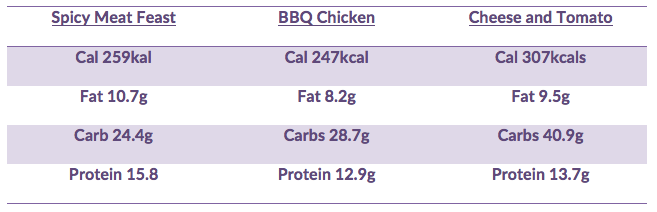
Nutritionally, it was a close chose between the spicy meat feast and BBQ chicken, as both were similar in calories and carbs but meat feast had slightly more protein, and BBQ chicken slightly less fat. I ended up giving them joint first place.
So now to the best part of reviewing pizza… the taste test!
First the spicy meat pizza: I really enjoyed the heat from the jalapenos and the yummy the thick layer of tomato sauce. I also liked the tang from the spicy beef. However if you are not a chili lover, you will not get on too well with this pizza, as it was pretty hot!
Next up, the Cheese and tomato basic pizza, hmm well I wasn’t too excited about eating this one as it looked pretty bland and boring and I can’t say it tasted much better. It was a little bit like a sad cheese and tomato toasty (where the filling has been applied rather sparingly). I actually ended up adding some spinach and chicken to the pizza to make it a little more palatable and to boost up the protein content!
Lastly my favorite of the 3 pizzas, the BBQ chicken, I thought this pizza had a lovely crispy base, a nice even layer of cheese and tomato sauce and slightly smoky taste from the BBQ chicken.
So the final verdict…
After accounting for taste, nutritional value and ultimately the pizza I would be most likely to buy on a regular basis, I have to say the clear winner was the by Sainsbury’s BBQ chicken.
I cant say I’m totally convinced that it is quite up to the standards of the muscle foods high protein pizza, but the BBQ chicken with only 247kcal, 8.2g fat, 12.9g protein and at ½ the cost of the online muscle foods pizza, is a pretty good supermarket winner.
Anyway I hope you enjoy national Pizza day, Eat as much pizza as I have, oh and definitely try the BBQ chicken pizza from Sainsbury’s.
Happy Pizza eating!
Georgey’s 12 week transformation – the training
For the vast majority of people, a body fat transformation will have fat loss as it’s key goal, so Georgey’s transformation was designed to be a combination of reducing energy intake through diet, alongside regular and progressive training; which not only contributed to increasing the energy deficit, but also served to retain essential muscle mass. We began with a workout schedule not too dissimilar to that which Georgey was used to; three full body resistance sessions per week. This allowed her to start to introduce ‘a little’ cardio (in order to assist the energy deficit further) and to adjust to her ‘transformation diet’ (read: less wine and popcorn) without being overwhelmed from the get-go.
As the programme progressed, we gradually increased the amount of work Georgey was doing to make sure we were continually giving her body a reason to adapt. We began this progression by adding an additional resistance training session to each week, spreading the work out over four days instead of three, and making each individual session more manageable. This is essential when you’ve got fewer incoming chocolate buttons to fuel longer workouts. We still trained the full body every session, but to help manage recovery, each day had either a lower body or an upper body emphasis. We then worked up to adding more exercises, sets and reps to each session.
In addition to this, we included ‘easier’ weeks to help manage fatigue, allow for recovery, and to give Georgey time to refocus and get ready for the next few weeks of hard training.
As the journey continued, the training was getting tougher, recovering between sessions was getting tougher, the frequency of ‘my legs hurt’ days had increased and the multiple social engagements of the festive season was making scheduling a little trickier. We needed a little more flexibility. So, we continued with four days of resistance training but moved to training the upper body and lower body separately. This afforded more flexibility to schedule sessions back to back without them interfering with each other. It also meant there were fewer days where Georgey had to face squats and lunges; a good thing for sore legs and a good thing psychologically. As well as maintaining the resistance training sessions, Georgey had been increasing the frequency and intensity of her cardio sessions, getting in up to four hours per week towards the end of the process.
On the subject of squats and lunges, Georgey’s programme was built around compound movements that emphasised full range of motion through multiple joints, like squats, lunges, glute bridges, pushups and rows. These types of movement not only provide the opportunity to apply the most overload to the body to build muscle, as a bonus, they also happen to burn far more calories than isolation exercises. On top of that they’re efficient, hitting more muscle groups at once, making each workout quicker to complete (and that’s no bad thing when your energy levels have taken a hit from eating less food).
Throughout, we kept a close eye on how Georgey was getting on both psychologically and physically. That way we could make adjustments when needed and keep everything moving in the right direction. Aside from taking regular measurements of how her body was changing, we kept a record of all her training sessions so that we could see whether she was at least maintaining, or in her case increasing (go Georgey!), her repetition strength (the number of reps she could do with a certain weight). This was a pretty good indication Georgey was holding onto muscle despite being in an energy deficit.
In conclusion, effective programming and nutrition guidance is they key to a successful body transformation. You need to keep an eye on the intensity and volume of sessions, as well as making sure that no muscle mass is being lost. When planning a transformation like this you need to have a solid overview of what you’ll be doing for the twelve weeks before you start. This helps you keep the end goal in mind, but also know where you’re headed. Georgey found it really helpful to write down all of her workouts for example, and then cross them off one by one so she could see her progress.
I know we would say this, but to achieve the best results, expert guidance is essential. So for one sales plug: hire us, we are all awesome and invaluable, and if you put in the effort, we’ll get you the results.
Five things we learned about fitness in January
At Hall Personal training, we ensure we stay on top of the latest research in the health, fitness, strength and conditioning journals. That way we know we are providing the best possible advice to our clients, combining theoretical knowledge with our years of practical experience.
Our junior trainer Tobi has scoured the research for January to see what’s new in the fitness industry and provide some top tips you can introduce into your training straight away!
1. Heavy loads are better than moderate loads for increasing strength.
A recent study study compared the effects of heavy loads (2-4RM) versus moderate loads (8-12RM). Heavy load training led to an increase of 30% in 1RM back squat and 14.5% in 1RM bench press, whereas 16.7% and 10.5% respectively were noticed in the moderate load group.
Although the study was unable to find the exact mechanism that led to the strength gains in the heavy load group, this is still valuable information and is definitely worth considering if you’re looking to increase your strength.
2. Looking to increase your 100m sprint time? Try Blood Flow Restriction training.
Blood Flow Restriction (BFR) training is when you use lighter loads in the region of 20-30% of 1RM, and restrict blood flow using an item such as a resistance band, a technique commonly used during hypertrophy training.
When performing 6 sets of 100m sprints at 60-70%, sprint times were reduced by 0.38-0.24s. This was compared to a normal programme without the use of BFR. Although times decreased, the difference was less than the difference observed in the BFR group. So next time you decide to increase sprint times, slap on a resistance band, restrict that blood flow and get sprinting.
3. If you’re a footballer and have ever had an ankle injury, then this tip is for you
I’m a footballer and I’ve had many ankle injuries that just kept coming back. I couldn’t quite figure out why, but a study is now suggesting that hip extension strength could be the cause. Over a three-season period they collected data which suggests that low hip extension strength increased the incidence of injury. They concluded that footballers were not able to rely on their hip strength during running, jumping or agility type movements. It’s not known whether increasing hip strength would reduce the incidence of injury but I myself have been working on my glutes the last few months and have noticed that I no longer get any pain in my ankles. Exercises such as glute bridges or hip thrusters should do the trick.
4.Try the 3/7 protocol for building strength
It’s widely known that long rest periods have been used for developing strength and shorter rest periods have been used to develop hypertrophy. The 3/7 approach adopts an incremental approach in the number of repetitions per set (5 sets in total) with 15 seconds of rest between sets. A new study found that the 3/7 protocol led to greater gains in strength (29.8%) compared to a standard set of 4×6, with a rest time of two and a half minutes (21.8%).
5. Males are more likely to suffer from groin pain compared to women
The groin is the inner part of our thighs, which is made up of a group of muscles known as the adductors. The adductor group consist of the adductor longus (most commonly injured muscle), adductor magnus, adductor brevis, gracilis and the tiny pectineus. In females, the rectus abdominals (or abs) inserts onto the pubic bone where as in males it inserts into the gracilis (one of the adductor muscles).
Women have wider hips than men (90 vs. 65 degrees ) that can affect the line of pull of the adductor muscles.
Sports that require a sudden change of direction e.g. football, rugby, tennis and badminton to name a few, tend to see a lot more groin injuries in men. Adductor training can help prevent this from happening and the work ratio of adductor to abductor work should be greater than 80% in favor of the adductors.
Exercises that strengthen your adductors include, Romanian deadlifts, wide stance squats, lateral lunges or the traditional adductor machine.
References:
1.Differential Effects of Heavy Versus Moderate Loads on Measures of Strength and Hypertrophy in Resistance-Trained Men. Schoenfeld, B. J., Contreras, B., Vigotsky, A. D., & Peterson, M. (2016). Journal of Sports Science & Medicine, 15(4), 715.
2. Low Intensity Sprint Training With Blood Flow Restriction Improves 100M Dash, by Behringer, M., Behlau, D., Montag, J., McCourt, M. & Mester, J. (2016). The Journal of Strength & Conditioning Research
3. Hip Strength As An Intrinsic Risk Factor For Lateral Ankle Sprains In Youth Soccer Players: A 3-Season Prospective Study. De Ridder, R., Witvrouw, E., Dolphens, M., Roosen, P., & Van Ginckel, A. (2017). American Journal Of Sports Medicine.
4. Effect Of A Strength Training Method Characterized By An Incremental Number Of Repetitions Across Sets And A Very Short Rest Interval. Laurent, C., Penzer, F., Letroye, B., Carpentier, A., Baudry, S., & Duchateau, J. (2016). Science & Sports.
5. Anatomical and morphological characteristics may explain why groin pain is more common in male than female athletes. Schache, A. G., Woodley, S. J., Schilders, E., Orchard, J. W., & Crossley, K. M. (2016). British Journal of Sports Medicine.