The Benefits of Small Group Personal Training
When we moved to our new private personal training studio in Kidlington last year, we had a few raised eyebrows when we said we’d be offering semi-private and small group personal training. We thought it was time we addressed the question we’ve been asked over the last few months: is 1-on-1 personal training always better? George explains our thoughts…
For someone with an injury or a very sport-specific goal, for sure, 1-on-1 PT will provide the best results in the shortest amount of time. However, when we’re honest with ourselves, 95% of us are looking to improve our general fitness and see the changes that makes to our physique along the way. For us, it’s nearly always better to train with other people. As long as we’re sticking with the fundamentals of training, training with others offers more benefits than 1-on-1 training alone…
It’s very easy for personal trainers to over-complicate things for clients, spending (and often billing!) hours writing incredibly detailed programmes which on the surface may seem like they address your goals, but often leave fundamentals such as mobility or the different energy systems untouched. There aren’t many of us who need to have programmes as complicated as an elite athletes’, despite what we’re told by fitness professionals.
While private 1-on-1 personal training definitely has its place, semi-private and small group training have enormous benefits which shouldn’t be overlooked. Let’s have a look at a few of these benefits now.
1. They allow you to train with a trainer more regularly
As we all know, the frequency and consistency of our training sessions over time will play the biggest part in our success when it comes to achieving a health and fitness goal. Whether you’re working on body shape or simply an improvement in your overall health, frequency and consistency will be king. Through years of coaching clients, we’ve found that those who manage to be active three times per week or more are the most likely to achieve their results, and then maintain them.
If you’re advanced in the gym or a very self-motivated person, then you may well be fine training three times per week on your own. But if you’re new to training, unsure about how to structure a programme for your results, or someone who struggles with motivation then it can be tricky.
If you rely solely on 1-on-1 PT and look at training three times per week or more, your session costs are going to rack up pretty quickly! At Hall Training, our system is specifically designed to give you access to different session types and make regular personal training affordable, while ensuring everything is still tailored towards your specific goals.
2. They make you work harder
Theoretically, training 1-on-1 should mean you’re working as hard as possible in a session. In practice this isn’t always the case. Despite a trainers’ best intentions, it can be easy to spend a good part of a session catching up about a weekend, and sometimes our clients have admitted to chatting as a stalling tactic if things are getting tough! Don’t think we didn’t notice… With 1-on-1 training you need to turn up to every session prepared to push yourself against who you were last session, and it’s not always easy to get into that mindset.
Our semi-private and small group training sessions are where teamwork and camaraderie really come into play. All of our members have told us they work harder when they’re training alongside others. Now this doesn’t mean sessions are competitive, but it means members push themselves to keep up and work hard. As trainers there’s nothing better than seeing your members cheering each other on and providing that extra dose of motivation. There is something really special about training alongside like-minded individuals.
3. They offer interactive learning
One of our mottos is “execution above all else”. As a team, we’re all about performing exercises correctly and we know that watching, understanding and then implementing correct exercise mechanics can be challenging. We’ve found that our members learn so much more quickly when they see those around them, sometimes even in the same session, performing the movements with expert guidance. No more poor form or worrying about doing things badly – you have a whole community of people around you focused on making sure you have the best session ever.
The same applies for asking questions. We aim to give our members the tools they need to truly understand what a healthy lifestyle is. Having different perspectives in one session means different questions get asked and answered on the spot, often questions members may not have thought of themselves.
4. Everything is still bespoke
A common concern we hear is “but everyone is doing something similar, so I won’t get results.” In the politest possible way, that’s nonsense unless you do happen to be an elite athlete or a bodybuilder. Programmes don’t need to be ridiculously complicated to get results, they just need to address all the fundamentals and be properly periodised over time, which ours are. They also need to be tailored to the person, which ours are.
Over ten years of programming for clients, we found that similar methods, philosophies and exercise patterns were yielding the best results for those with the same goals – be that fat loss, hypertrophy, strength or general health. It’s very easy for a personal trainer to write you a “personalised fat loss programme,” but the reality is that programme will have a huge overlap with all of their other fat loss programmes. After all, there are only so many ways to skin a cat.
We took training back to the principles we have found to be the most effective and developed a training method that addresses the whole health and fitness package, while allowing room to pursue individual goals.
What we have is a framework for every session that addresses the entire fitness package – mobility, activation, strength and cardiovascular fitness. Within that framework we’ll have certain movement patterns and muscle groups to target that are the same across clients, however everything is pushed forward or pulled back depending on your ability and goals. You can check out our infographic for more details!
5. Everyone can take part, you’re never alone
When members start our 30-day trial they often worry about training alongside people with different goals or abilities. The benefit of semi-private and small group personal training as opposed to a class or boot camp is that we are still able to tailor everything 100% to you. This is where Hall Personal Training is different to your local small group training or park fitness session – you won’t see four people in a line doing identical things; don’t worry about where you’re starting out from! We have members aged from 16 to 85, looking to do everything from get shredded to a holiday to an ultra-marathon to be better at climbing the stairs.
Our members catch up over coffee before their session if they’ve got time, they congratulate each other or help each other up the stairs after a session if they need to. They arrange 5k runs, or theatre nights, or help us with our charity fundraising and social events. They have all found somebody with a similar goal to work alongside. The biggest benefit of training with others is you’re never alone.
Hopefully this blog post has shed some light on why we’re looking at these different types of training now. Although they may not be the method you’ve been led to believe is the most effective, we can assure you it’ll cover all the bases. If you’re keen to give it a go, or want to challenge us to convince you, why not take out our 30-day trial and put us to the test? As always if you have any questions, you can drop us an email. Reach me on george@hall-training.com.
Our new personal training studio
In June 2017 we wrote a blog post about putting the “personal” back into personal training and how our identity and philosophy as a team had changed since Chris founded the company previously. We shared our new ethos, “stronger, healthier, happier” and outlined the kind of service we wanted to be bringing to our clients – one based entirely around them.
Well, over the last year and a half we have kept our clients at the centre of everything we do, with training and nutrition developed to suit every single individual we work with. While our clients were building healthier and stronger lifestyles, we were proud of them but growing increasingly frustrated with what we could deliver. There was so much more we wanted to do for them – we wanted to increase our sense of a community, we wanted to be able to hold events to boost client education around health and fitness, we wanted to be able to programme without limitations, without worrying about whether kit would be free or whether our training environment would be nice.
So, in January of 2018 we sat down as a team and made the decision to open our own private personal training studio. After years spread out as personal trainers in Summertown, Central Oxford and Botley, we wanted to create a better environment for our clients. One that isn’t intimidating or busy, one where you would never have to fight for kit. One where everyone is supporting everyone else and the entire team is professional. Most importantly, we wanted the freedom to create a cutting-edge personal training programme that delivers results. We wanted our team, our kit and our training principles.
Fast-forward ten months and by some miracle our own studio is open and operational. But what do we want going forward for our members, what does it mean for them?
We want everyone who works with us to be able to come to the studio regularly and to look forward to their sessions. We want to provide somewhere people can work on their long-term goals, ensuring they last into the future. We want a studio where everyone feels welcome, smiles at everyone else and provides that support network. We’ve only been open three weeks, but we think we can see that culture emerging already.
We know that personal training has traditionally been very expensive, while gym memberships often lack the specific guidance needed to ensure results. That’s why we’ve developed a system making personal training three times per week or more affordable, one with built-in time each month to ensure you’re always progressing, and one that ensures constant motivation from those around you. With our mixture of private, semi-private and small group personal training sessions, we believe our members can have the best of it all; more contact time for a reduced cost, with everything still tailored to them.
The last eighteen months have been a huge transition period for us. Who knows what we’ll be reflecting on in eighteen months’ time!? But for now, a huge thank you to everyone who has supported us over the last few months, and everyone who is bringing our new studio to life with their enthusiasm, dedication and hard work. We feel that we’re finally able to offer the kind of service our members should demand of our industry, and we can’t wait to put you and ourselves to the test, getting you the results you deserve with some laughs and coffees along the way.
Spotting the signs of overtraining
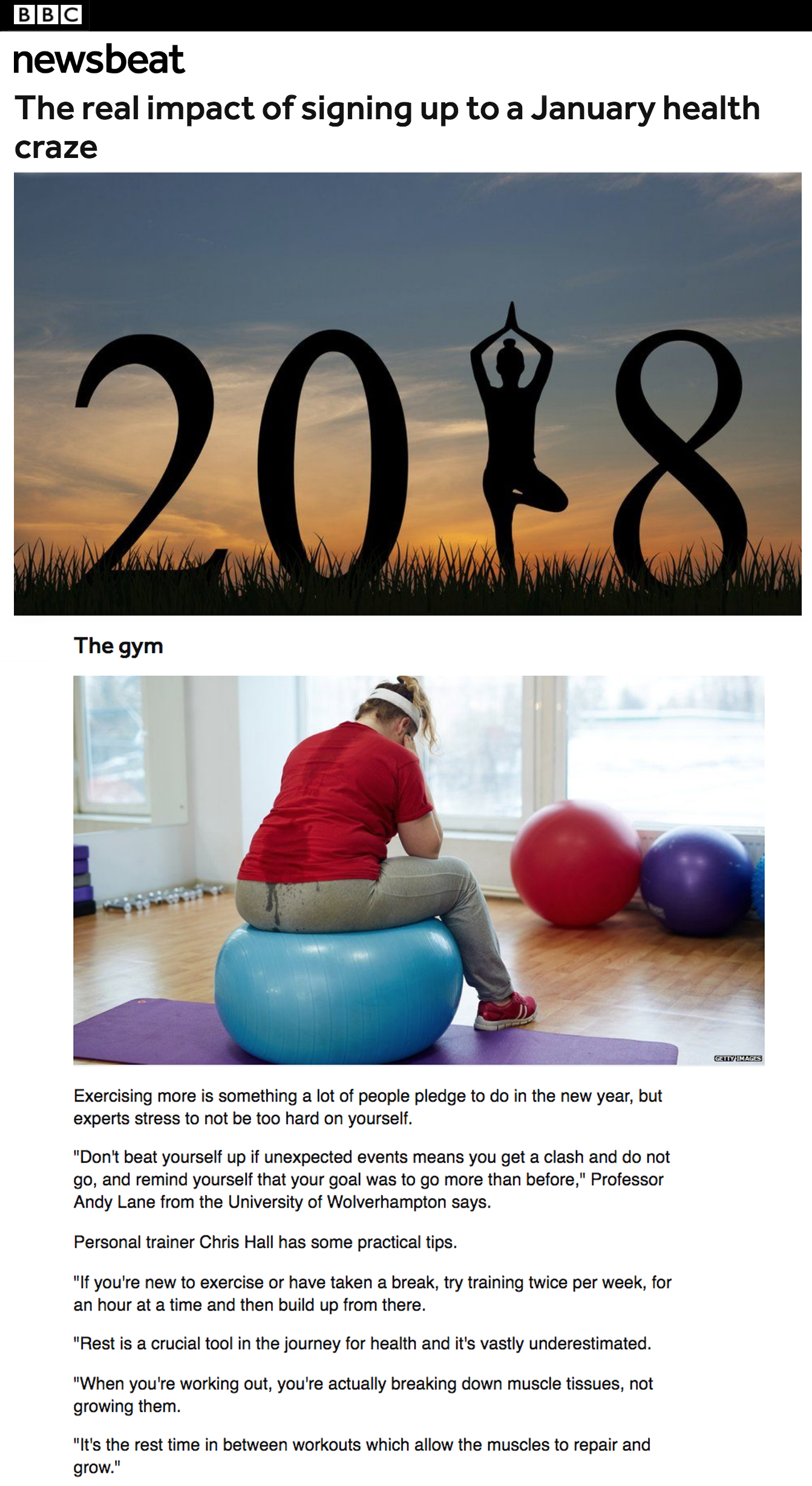
It’s January, and lots of us are thinking about taking up a new exercise regime or increasing the time we spend in the gym. But it’s important not to do too much too soon, despite your best intentions. BBC Newsbeat contacted our executive personal trainer Chris Hall to talk about how much exercise is too much, and how to spot the signs of over-training. You can read his full comments below.
Q1: How much exercise is too much?
The definition of “too much” exercise will vary from person to person. If you’ve not exercised for a few months and set out to run a marathon, it’s very likely that’ll be too much, but for a seasoned marathon veteran, it’d be a normal day’s training.
If you’re new to exercise or have taken a break, try training twice per week, for an hour at a time and then build up from there.
Q2: How do you know if you’re doing too much exercise?
Things to look out for include your ability to fall asleep, and your ability to stay asleep. If you struggle to fall asleep more than normal, it could be a sign that you’re spending too much time training and/or not taking enough rest days. If you’re struggling to stay asleep, it could suggest that you’re training too aggressively and may need to back off slightly from the weights you are lifting.
Another simple thing to measure is your morning heart rate. Most phones and fit-bits now are equipped with heart-rate monitors. Once you’ve established a baseline you’ll be able to see if your morning heart rate is raised. If it is, this could suggest that you’re overtraining. If you’re training too hard, your body will be working overtime to help you recover and to meet the new demands you’re placing on it, causing your heart rate to elevate. Try backing off or resting up until for a day of so until it’s gone back to its baseline.
Another sign to look out for would be overall performance. If you’re suddenly surprised to find yourself having to drop the weights that you would usually lift or, unable to keep your regular pace during those HIIT sessions then this sudden, unexplained drop in performance could be the body’s way of telling you “I’m out of gas and need some rest.”
Q3: What damage can you do by exercising too much?
The most obvious risk of over-training is injury. If you’re overreaching then you’re far more likely to be triggering old injuries to reoccur, or even gathering new ones. You’re also at greater risk of becoming ill if you’ve worked your body into an over-trained state, as your immune system won’t be working as effectively as normal.
There can also be dangers to your mental health. A lack of sleep can lead to depression and mood changes, which can then be aggravated by feelings of failure or low-self esteem if you’re not managing the workouts that were easy for you a couple of weeks ago. Exercise should be a positive experience, so if it’s something you once enjoyed and you’re now dreading it, that’s a good sign you need to take a break. Try taking a full week off, and then slowly increasing your workouts again after that.
Q4: Why is rest important?
When you ask people why they are exercising, it’s usually because they want to be healthier. It’s not uncommon to hear that people are going to go from nothing to hitting the gym or pounding the pavements five-to-seven times per week. However, rest is a crucial tool in the journey for health and its vastly underestimated. Rest is important for recovery and repair. When you’re working out, you’re actually breaking down muscle tissues, not growing them. It’s the rest time in-between workouts which allows the muscles to repair and grow. If you over-train then you hamper the body’s ability to recover, leading to the symptoms listed above.
You can read Chris’s comments and BBC Newsbeat’s full article on January health fads here.
Delayed Onset Muscle Soreness – Take it or leave it, the choice is yours!
Now, you don’t need me to tell you the benefits exercise can have on your health. If you’re reading this, then I’m guessing there’s a high chance you’re already aware of the health benefits we can reap through exercising however, are you aware that these benefits can either be enhanced or dumbed down depending on the way we are exercising?
What if I were to tell you you could structure your training (sets, reps, tempos and load) so it’s more geared towards building muscle or burning body fat; easy right?
But what if we could fine-tune this further, to let’s say designing a workout that would be more bias towards improving cardiovascular health to help lower blood pressure, or to encourage ossification (the formation of new bone) and the release of osteoblasts to help improve bone density and collagen production. Or, you may be training to help prevent cognitive decline and reduce the chances of Alzheimer’s – things now become more complex.
Believe it or not, the body is an amazing, organic piece of machinery that adapts to whatever (give or take) we throw at it, and if you know the right stimulus needed to elicit a response then we can indeed train to produce a truly specific outcome.
Take Delayed Onset Muscle Soreness (DOMS) for example, some people love waking up the following morning feeling sore and aware they trained hard the previous day, while others hate how sore you can get, begrudging having to go into work or be on their feet all day.
But, what if we could choose whether our workouts left us sore or not? If so, we could then specifically design workouts around people’s routines and preferences. After all, if you’re an athlete you don’t want to go into a competition or a game with severe DOMS. Like-wise, if you’re someone whose job it is to be on your feet all day, or spend time running up and down stairs then it’s probably not going to be too comfortable having to do it with DOMS in the legs.
Well guess what, you can adapt your workouts in such a way that the exercises and their execution can bring about varying degrees of muscle soreness to suit your personal ‘pain tolerance’ – a little like choosing how spicy you like you curry, and here’s how:
Sports and Exercise scientist Professor Ken Nosaka, is the leading researcher in the field of muscle damage. He’s conducted numerous studies and found muscle damage to be at its greatest when a muscle is trained eccentrically for repeated bouts of effort and intensity. Prof. Nosaka found DOMS to be at its greatest when a muscle is trained in the last third of its lengthened range and trained to the point where there’s a forty percent drop in intensity (load).
So what does that look like in the real world?
If we take the hamstrings, and compare the seated leg curl to the lying leg curl you’ll find a greater amount of DOMS when using the seated leg curl as compared to the lying leg curl. This is because the seated leg curl works more of the lengthened portion of the range for the hamstrings placing it more into a stretch. The same would also apply when comparing a Romanian deadlift to the lying leg curl. Again, the like a seated leg curl, the Romanian deadlift places the hamstrings into more of a stretch/lengthened position – this is one way to ensure DOMS (Nosaka & Sakamoto, 2001).
The second factor is looking at weight drop off i.e. how hard you push yourself. Let’s say you start off with a weight of 100kgs for your first set and decide to perform five sets. If across those five sets you’ve had to drop the weight by 40 percent (a 40kgs reduction) this reduction in ‘drop-off’ would be enough to cause DOMS (Nosaka K. 2008).
Finally, if the above isn’t enough and you’re left wanting more, then adding an isometric contraction pause at the bottom of the lengthened position of the lift will guarantee to induce some serous muscle damage and with it, DOMS.
Now, this is all well and good if you’re wanting to induce muscle soreness but, what if you’re someone who really doesn’t like being left sore, how can we train to prevent it?
Well, the diagram I’ve put together below gives you a sliding scale ranked from minor to most severe based on the type of training you perform relative to inducing muscle soreness.
Factors Influencing Muscle Damage and Soreness
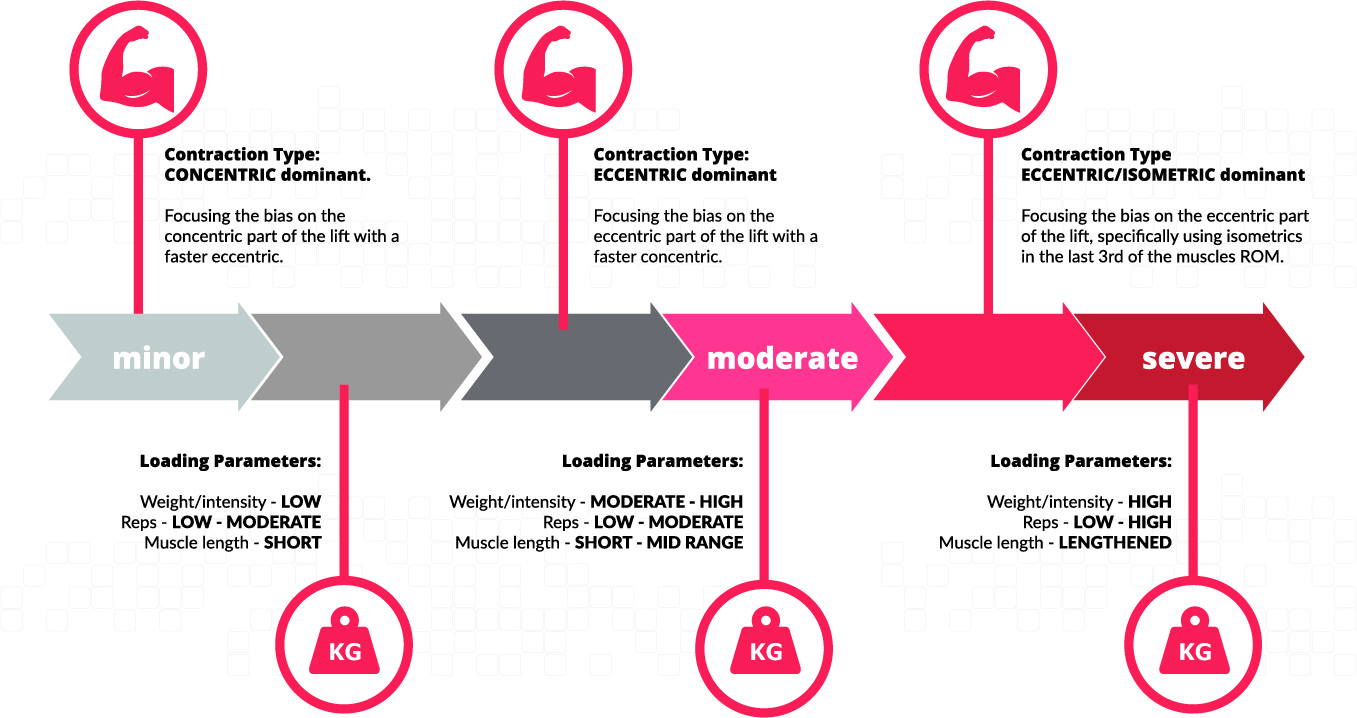
(image based around prof. Nosaka’s research over the last decade)
As you can see, if you’re wanting to limit the amount of DOMS in a muscle then focusing on the concentric part of the lift and keeping the weight relatively low (>60% of 1RM) will limit muscle damage and subsquently muscle soreness. However, age, gender and training experience also have a contrubiting factor towards muscle soreness; with females and younger trainees experiencing lower levels of pain (Lavender AP, Nosaka K, 2006).
Knowing what we now we can truely tailor our workouts around the way we are feeling and wish to feel after the gym. If you’re someone who loves to feel pain for several days after a workout then you can now train towards that however, please don’t go away mistakenly thinking just beascue you’ve induced muscle soreness that it’s a sign of a good workout or for growth – as we already know from one of our previous blogs it’s not always the case.
Does garlic protect against vampires?
Does garlic protect against vampires?
With Halloween only a few days away, we haven’t long to prepare ourselves against the creatures that go bump in the night.
Luckily, I’m well prepared and have taken appropriate steps to protect myself against witches, monsters and the creepy-crawlies that may all try to get through my front door in the night.
However, possibly the one I’m most fearful and less prepared against are vampires. Vampires are feared everywhere especially in the Balkan region so I’m weighing up the options to see which protection method would be the most reliable.
I’ve considered many of the popular options:
• A simple stake through the heart – common in Southern Slavic cultures however, the Russians only found this to work when the type of wood was Ash [1] and I certainly don’t have any stake shaped ash lying around.
• Decapitation – this is the preferred method amongst Germans, decapitating their head from their body, which is great in theory but probably not as easy in practice.
• Holy water – we could drench them in Holy water as this is thought to burn their skin [2]. Oh wait, unless you’re a Priest you’re unlikely to have access to that…
• Mirrors – mirrors have been used to ward off vampires when placed, facing outwards, on a door and was used by Bram Stoker in Dracula. However, not all vampires have a reflection and sometimes do not cast a shadow [3] so it’s probably not our best or most reliable option.
Despite these all being great options, I’ve concluded they’re either too difficult to implement or to resource, which leads me to one (last) possible option – garlic! It’s easy to get a hold of and very inexpensive. In fact, Bram Stoker himself suggested the use of garlic to ward off vampires.
Now this seems to work in the movies however, I want to be certain so as luck should have it a group of researchers back in the nineties explored the hypothesis behind garlic’s apotropaic effect against warding off vampires and this is what they found:
Firstly, due to the lack of participating vampires the researchers we forced to use blood-sucking leeches instead – ok, so they’re not as scary, but they still love to drink your blood.
The researchers then allowed the leeches to attach themselves to one of two hands; a garlic-smeared hand and a non-garlic hand.
The results
To their surprise, two-thirds of the leeches preferred the garlic-smeared hand over the non-garlic hand. In fact, leeches who took to the garlic-smeared hand took 14.9 seconds to attach themselves compared to 44.9 seconds for the non-garlic hand [4].
As we can see from the results of this study, the traditional belief that garlic has apotropaic properties could likely be wrong, and the reverse may in fact be true, garlic does not protect against vamipres! I suppose this now means that my pot of garlic is futile and we shouldn’t believe everything we see on TV.
I guess the only real option we have is to wait the night out until sunrise; unless of course you get one knocking at your door in which case refusing them entry will keep them away from your home and out of harm’s way [5] – a much easier option if you ask me.
Good luck and Happy Halloween!
References:
1. Alseikaite-Gimbutiene, Marija (1946). Die Bestattung in Litauen in der vorgeschichtlichen Zeit (in German). Tübingen. OCLC 1059867.
2. Burkhardt, “Vampirglaube und Vampirsage”, p. 221.
3. Spence, Lewis (1960). An Encyclopaedia of Occultism. New Hyde Parks: University Books. ISBN 0-486-42613-0. OCLC 3417655.
4. Does Garlic Protect Against Vampires? An experimental study. Tidsskr Nor. N. Laegeforen (Sandvik H, Baerheim A) 1994.
5. Spence, Lewis (1960). An Encyclopaedia of Occultism. New Hyde Parks: University Books. ISBN 0-486-42613-0. OCLC 3417655.
Fitness events in Oxford across October
With our HQ in the city, we thought we’d best round up all the fitness events in Oxford that are happening in October. Looking for a new challenge? We’ve found plenty that will test your limits this month!
Saturday 7th October, 10:00am
Fancy yourself in Game of Thrones or Robin Hood? The Oxford Archery Training Centre’s autumn term kicks off on Saturday 7th. The term consists of five structured workshops, and you can attend all of them, or just those you fancy. It’s open to all ages!
Saturday 14th October, 12:00
This one’s a bit further away from our usual Oxford stomping ground, but it sounded so good we just had to include it! Windsor Brewery is hosting a 5k and five mile fun along the River Thames, but best of all its followed by a brewery tour, a beer and a food festival – what’s not to like!
Saturday 21st October, 11:30am
For any of our Oxford University student members, the university Polo Club is running taster sessions on the Saturday and Sunday of this weekend. For £30, you get transport, nibbles and drinks as well as time to practice polo swings. Could this be your next fitness pursuit?
Saturday 21st October, 10:00am
Love Halloween, love being outside? Then you’re in luck. Thames Valley Orienteering Club have arranged a spooky orienteering session at beautiful Waddesdon Manor. There’s no set path to follow, you’ll have to make your own way around the 3k or 5k course, and there will be plenty of spooky surprises!
Friday 28th October, all day
If you fancy something with a bigger thrill, Newbury’s Zombie Run is returning at the end of the month. It’s a 5k inflatable course, complete with zombies. Don’t fancy the run? You can even enter as a zombie to infect the runners!
Various times throughout October
Every Saturday at 9:00am, Oxford’s park run sets of from Cutteslowe Park and Sunnymead Park.
I was in the gym the other day when I overhead a client complaining to her personal trainer that the reason she was unable to lose any weight is because she’s addicted to sugar. She continued to justify her addiction by saying how there’s one study showing sugar to be more addictive than cocaine!
Well, as you can imagine I wanted to share my two cents but decided to stay well out of the conversation. However, it has led me to answer the question about whether eating sugar really does make us gain more weight.
First, let me address the sugar/cocaine study. Yes, there is a study from back in 2007 that concluded sugar was more addictive than cocaine. The basic outline was that rats were given cocaine until they became dependent on it. Then, researchers provided them a choice where they could continue to have the cocaine or they could switch to sugar. Surprise, surprise, they (94%) chose to make the switch over to sugar – from this result the researchers concluded:
“that intense sweetness can surpass cocaine reward, even in drug-sensitized and -addicted individuals.”
And now everyone who’s campaigning against sugar seems to reference this study to back their argument up.
However, let’s just stop to think about this for a second… the rats were fed cocaine until they became dependent on it, which means this was their main source of ‘food.’ The researchers then introduced them to sugar to give them a choice between cocaine and sugar… of course they’re going to choose the sugar over cocaine, they’re rats and their first instinct is to survive!
Gosh, I bet if you gave them a choice between cocaine and blueberries, or cocaine and tuna, they would all turn to the blueberries and tuna, because it’s food! This doesn’t suddenly mean blueberries or tuna are more addictive than cocaine… our survival mechanisms will always make us choose the one that will keep us alive.
So really, this is a hugely flawed and unfair set of results and should be ignored when making an argument against sugar.
Other commonly cited studies among the ‘sugar haters’ are ones from 2004 and 2007, that show correlations between the populations’ rise in obesity and our consumption of sugar from the 1960s to early noughties.
If you were to just look at the data up until 2000, you could be fooled into thinking sugar intake was the cause for our rise in obesity. However, if you then look beyond 2000 and into more recent years, you’ll find this association disappears. In fact, from the early noughties right the way through to 2013, our intake of sugar falls while obesity rates continue to climb. [1]
.jpg)
Sugar isn’t inheritably fattening, but like any food can cause weight gain if you’re overfeeding (Te Morenga 2012). If you’re under eating and in a caloric deficit then it doesn’t matter whether you’re on a low fat, high sugar diet, a low fat, high carb diet, or even a high sugar diet where almost 50% of your calories are coming from sugar – there is no difference in weight loss or fat loss between either diets. (West & De Looy 2001) (Saris, et al. 2000) (Surwitt, et al 1997).
So, if our intake of sugar is declining why is obesity still on the rise? Well the fact of the matter is we’re eating more but moving less. Data shows we’re now eating around 500 calories more than we were in the 1960s, and that the energy we expend through moving around is 142 calories lower from what it once was (Church TS, et al. 2011).
Hence why we’re now recommended to reach 10,000 steps per day, enough to burn around 500 calories, the additional calories we’re now consuming.
The only problem I can see with sugar is how palatable it is – it tastes great and we all love it, hence why it’s used in a lot of foods. Sugar on its own isn’t ‘evil’, but a lot of foods that contain high amounts of sugar also contain high amounts of fat, as the two together make our taste buds dance like crazy! The problem is, these foods don’t seem to fill us up in the same way foods high in protein and fibre do, so we’re always left craving more…
Bonus note: as you’ve just learnt when it comes to adding sugar into your diet you have nothing to fear. However, things do become a little more complicated when looking at how sugar and glucose metabolism works in obese individuals – something I will cover in a future post.
References:
1. wholehealthsource.blogspot.co.uk/2015/11/carbohydrate-sugar-and-obesity-in.html
Understanding the differences between split squats and lunges
Today I bring you a first; a Friday’s fun fact in video format…
This was inspired by our lower body execution day, which we held last weekend.
One of the difficulties we encounter as trainers is in the way split squats, but more so lunges are taught and executed, with a lot of people recruiting too much of their quadricep muscles in a lunge as opposed to their hamstrings and glutes.
Now yes, they may look rather similar but looks can be deceiving as a little like the word ‘ciao’ which means both “Goodbye” in Italy but also “Hello” in Vietnamese, the split squat and the lunge are (technically) total opposites – a lot like the cultural meaning of ‘ciao.’
Trying to favour the hamstrings/glutes over the quadriceps while lunging isn’t always easy work however, if you follow the points I address in this video you’ll soon understand the differences between the two exercises and bd better able to recruit the correct muscles when performing either exercise.
Three reasons why you should take up strongman training
Anyone new to the fitness game will inevitably find the endless choice of exercise equipment overwhelming. Not only is there the choice between cardio or weights, but now with the rise of crossfit-based box gyms and commercial gyms investing more into cardio-based resistance equipment such as prowlers, kegs, tyres and batteling ropes, the average gym goer can now dump the cross-trainer in favour of flipping tyres and pushing a prowler double their own bodyweight down a track, effectively training like a strongman athlete. But how will this impact strength, muscle building and getting lean?
Let’s look at strength first.
Strongman training was put to the test for the first time in a study comparing a strongman programme to a traditional strength programme. The study, carried out over 7 weeks, measured body composition, strength, power, and speed. All performance measures improved up to 7% in both groups, particularly in 1 repetition max strength over the bent over row, squat and deadlift.
However it’s important to note that this could simply be down to the change in stimulus for participants; as we know from Owen’s recent blog post looking at the benefits of programme periodization, training programmes should be revamped regularly to create a new stimuli for our body to adapt to. This change forces new neuron pathways to be created, thus allowing for more strength gains.
So next time the sun’s out, maybe ditch the monotonous cycle of endless squats and deadlifts and allow your body to try something new.
Secondly, is strongman training effective for building muscle?
To build muscle, the muscle in question needs to be under tension for a long period of time. Hypertrophy based programmes usually contain sets lasting up to 30-45 seconds. This is very similar to most strongman events, which usually have the participant training under heavy loads for 30-60 seconds.
The second important factor in building muscle is not in the training itself but in the recovery. A muscle will not grow if it does not recover. Research has found that after a sled drag session completed with 75% body weight, participants saw large elevations in blood lactate and testosterone. This increase in testosterone was still present at the 24-hour recovery mark. Researchers believe this indicates a rebound effect which aids in recovery.
So the answer to our second question is yes; the only downfall of strongman training for hypertrophy would be in the inability to target specific muscles groups.
Will training like a strongman get me lean?
Over the years there has been an increase in High Intensity Interval Training (HITT) among people wishing to lose body fat. These sessions are commonly carried out on a stationary bike or cross trainer. However, teaming HITT training with resistance equipment such as a prowler, sled, keg or tires could further increase your calorie burn. Not only are you burning calories through rapidly raising and lowering your heart rate, but as strongman training helps with hypertrophy, you’ll also be building functional muscle.
Cardio-based resistance exercises (i.e. strongman exercises) produce higher levels of lactate in the blood, releasing a large amount of growth hormone which stimulates fat burning. This was seen in a 400m car push test compared to a maximal treadmill test; blood lactate levels reached 15.06mmol/L. 31% higher during the car push than the max treadmill test. However, this is an exhausting event and would not be recommended for many people at all! A similar stimulus can be created through 5x (2x 20m) sled drags loaded with 75% bodyweight, something our members at Trimnasium and Studio PT will be familiar with!
To conclude, strongman training isn’t the only form of training which will help you reach your fitness goals, but you should definitely consider it, and it should be deemed just as important as traditional forms of training. At Hall Personal Training we recommend keeping your training stimulus changing every 4-8 weeks, and throwing some strongman training into the works could help you with just that!
Are liquid calories ruining your diet?
If you’re struggling to lose weight despite feeling that you eat really healthily, then you may well find this insightful; “liquid calories” could be your stumbling block. If you want to lose weight, then it’s crucial that you become more mindful about what you’re drinking.
However, the difficulty we’re faced with is that liquid calories are also “hidden calories,” meaning that most people are completely unaware how many calories they’re consuming through their drinks. You see, an interesting thing about liquid calories is that they don’t appear to register with the brain in the same way calories from food do (Vartanian LR. 2007). In other words, drinks provide a sneaky way to consume extra energy and to pack on a few extra pounds (DiMeglio DP, Mattes RD. 2000).
I guess this is the reason doctors prescribe high-calorie drinks to both the elderly and those who are suffering from certain eating disorders, to help promote weight gain.
The average adult consumes a little over 500 calories per day from beverages alone, (Drewnowski A. 2013), with drinks being the largest source of added sugars in our diet (Huth PJ, Fulgoni VL, Keast DR et al 2013).
For example, a Starbucks Spiced Pumpkin Latte has recently gone on sale, personally I’m not fan, but I know a lot of you are and they’re all the rage around this time of year however, at whopping 380 calories and 50g sugar it literally takes the place of a small meal… and that’s for a medium cup!
If you stop to think about that for a second… 380 calories; for what’s essentially a fancy coffee, you’ll begin to realise how mad and easy it is to drink away your calories. I actually spoke to the Daily Mail about hidden calories in coffee-shop drinks a couple of years ago.
To put this figure into perspective, doctors, nutritionists and even our personal training team will likely recommend close to a 500-calorie deficit to help kick start weight loss. If you keep an eye on what you’re drinking, losing weight will often be as easy as a walk in the park, and even that’ll help too!
This is just one instance where liquid calories can slip under the radar.
The term liquid calories can umbrella a whole array of foods/beverages that you probably wouldn’t otherwise consider thinking twice about consuming, but all add up:
• cooking oils – average of 120 calories per serving
• fruit juices – average of 100 calories per 200ml
• milk – average of 50 calories per 50ml
• protein shakes – average of 200 calories per shake
• flavoured water – average of 50 calories per 500ml
• fizzy, sugary drinks – average of 150ml per can
• energy drinks – average of 100 calories per can
• pouring cream – average of 70 calories per 15ml – I’ll admit, I used to be a sucker for adding pouring cream to my coffee, but when I actually stopped to check how many calories I was drinking, which was in excess of 220Kcals from cream alone, I quickly stopped and started taking it black, or adding a dash of single cream.
Oh, and let us not forget alcohol. Yes sorry, it too falls under the liquid calorie umbrella, with an average glass of wine providing around 125Kcals – not too bad you say?… Sure, but let’s not kid ourselves as when do we ever have just the one glass…? More like half the bottle, which comes in at around 325 calories!
As you can see, the calories we consume in the form of liquids really can add up, and can begin to limit to your ability to lose weight.
Luckily, liquid calories are as easy to reduce as they are to consume. By being more aware of what you’re drinking and more importantly, how many calories you may just be pouring down your throat, it becomes easier to identify any extra calories you may be consuming.