Orthorexia Nervosa: Has your healthy eating gone too far?
Our social media feeds are full of pictures of healthy food and six packs, encouraging us to live a more active and healthier lifestyle. At first glance this sounds great – being healthy is good. But it is possible to be too healthy. There is a worrying trend emerging, with individuals becoming so obsessed with eating healthily that they are damaging their mental health. The line between healthy eating and an eating disorder becomes blurred.
Orthorexia Nervosa involves an intense compulsion to stick to a concrete set of rules for food consumption, often eating healthy, ‘clean’ foods, with complete avoidance of foods perceived to be unhealthy. Although it is not clinically defined as an eating disorder, it is a growing phenomenon, with increasing numbers of people showing orthorexic tendencies. It is more common among those who regularly exercise.
This obsession with healthy foods could come from a number of sources. Environment is massively important – if those around you are obsessive about the quality and type of food they eat, you are more likely to pick up similar habits. Social trends are becoming more of a problem, particularly with the prevalence of food and fitness bloggers on social media setting excessively high standards. The number of wheat, gluten and lactose free foods available, and the publicity surrounding certain diets is another causal factor. People may hear from a nutritionist or a celebrity that wheat is bad, and then cut it out of their diet for example. Although orthorexics seem to be driven by healthy motivations, underlying reasons such as a desire for control, using their eating habits to create an identity or social standing, and poor body image are more likely to be the driving factor. Orthorexia is also associated with OCD.

In the drive for health, some orthorexics can end up limiting their diet in such a way that it becomes nutritionally unsafe. Cutting out meat and pulses can cause a protein deficiency, while eliminating dairy limits the amount of calcium available to the body. Avoiding gluten often means avoiding wheat-based products, which have a high fibre content, often leads to a low fibre intake, and a lack of B vitamins.
Although these nutritional deficits can be dangerous, it is the mental effects of orthorexia that are often the most debilitating. Thoughts of food type, quality and timings become all consuming, as you would expect with a more common eating disorder, such as anorexia or bulimia. Orthorexia can also wreak havoc on the digestive system, as sufferers eat according to strict ‘healthy’ rules, ignoring signs that they are hungry or full so they eat what they perceive to be the correct diet.
Due to our society’s preoccupation with fitness and a slender physique, orthorexic behaviours can appear socially acceptable when they are really a symptom of an underlying problem.
Signs of Orthorexia
The signs of orthorexia include: avoiding social activity that involves food. Sufferers can find themselves unable to take part in everyday life, due to preoccupation with food. They become increasingly isolated and intolerant of other people’s views about diet and nutrition. Other symptoms include paying increased and unnecessary attention to food source and macronutrient content, and excluding entire food groups from their diet.
Steps to Recovery
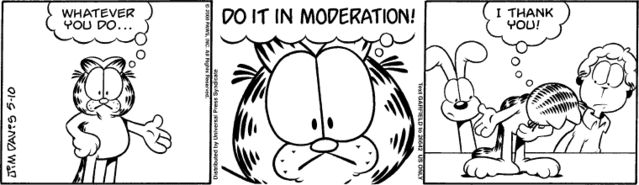
The first step to recovery is noticing and acknowledging that there is a problem. It’s also essential that there is a desire for change. Learning to listen to your body and eat more flexibly is an important first step, as well as gradually reintroducing eliminated or ‘unsafe’ food groups back into the diet. No single food will make you unhealthy or fat as long as it is eaten in moderation, so there’s no reason to cut out an entire food group. Recovering from orthorexia is about learning to eat a diet that is physically healthy, but more importantly, mentally healthy.
For more information, or to seek advice, visit:
http://www.b-eat.co.uk/
http://www.hypnotherapy-directory.org.uk/articles/eatingdisorders.html
About Chris Hall
As the founder of Hall Training Systems, it is my mission to provide you with the very best personal training experience. I set up Hall Training Systems as Oxford’s leading personal training service in nutrition, performance and weight loss, ensuring I can deliver the very best in training techniques.
You can find me on Facebook, Google+ or why not even give us a Tweet @Hall_Training
With the holidays upon us, family commitments and gatherings can make getting to the gym near impossible. Many of my clients tend to travel to see family and friends both abroad and all over the UK. So, to help them stay in shape and give them a level of sanity I sometimes prescribe them the hotel room workout!
A workout that’s designed to be done within 15-20 minutes with no kit and in the smallest of spaces. In this short video I demonstrate an 8 exercise workout that can be done, literally anywhere.
The Circuit
A1 – Split Squat – 2-3x 15 reps
rest 10-30 secs
A2 – Push Ups – 2-3x 15 reps
rest 10-30 secs
A3 – Burpees – 2-3x 20-30 secs
rest 10-30 secs
A4 – Prisoner Squats – 2-3x 20-30 reps
rest 10-30 secs
A5 – Jumping Jacks – 2-3x 30 secs
rest 10-30 secs
A6 – Spot Running w/high knees – 2-3x 30 secs
rest 10-30 secs
A7 – Mountain Climbers – 2-3x 20-30 secs
rest 10-30 secs
A8 – Plank w/alt. leg swipes – 2-3x 10-12 reps per/side
rest 60-90 secs. Repeat 2-3 times
I’m here to tell you how you can instantly make a 7 percent improvement in your strength when it comes to training. All you need is a little more ‘oomph!’
“Get more oomph,” I shout, as I see my client struggling at the bottom of her squat on the last rep of the set.
“Get more oomph!” I repeat again, but loader as she exhales, before releasing a loud grunt and shooting the bar up.
“Well done, very well done. Now rest.”
‘Get more oomph’ is a phrase I use when I want a client to go all out. It’s often at the point when I recognise that they need to use maximal force, aggression and effort in order to make the lift.
I tend to find that a lot of people new to lifting, and even through their first year of training, are failing to express maximal effort and the will to really push themselves.
It’s often females that lack this inner aggression and paranoia of the ‘grunt’ in case it draws any attention to them. They will often keep their mouths shut and admit defeat prior to any real effort being put in to avoid any vocalised embarrassment. Now there’s nothing wrong with this at all. Who’s to say who’s right or who’s wrong, and whether there’s any need to express the occasional kiap at all (kiap is a sharp exhalation of air that can produce a quick, loud, guttural yell)?
However, there is some evidence to suggest grunting may be beneficial to strength and performance. One study published in the Journal of Applied Sports Psychology took 25 novice and 25 experienced martial artists and tested their grip strength using a dynamometer (a device that measures force). They performed the exercise silently and then again using the breathing technique called kiap. The researches found performance for all participants was significantly better with kiap than without, with an average strength increase of 7% [1].
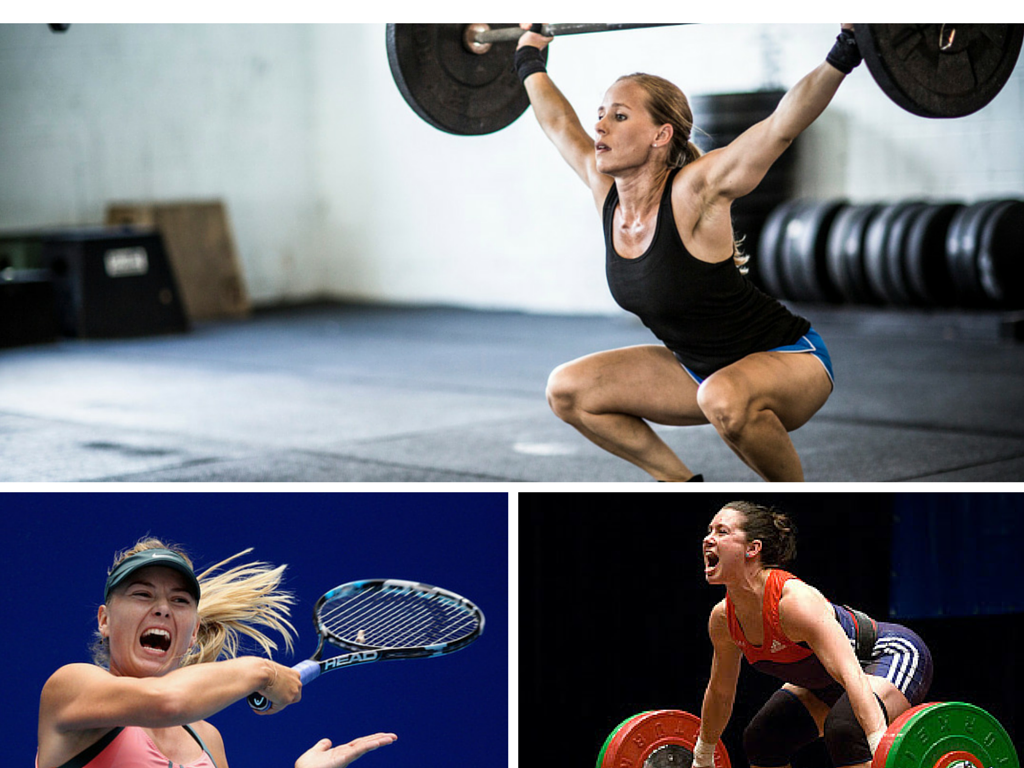
A more recent study looked at what effect grunting had on a tennis player’s ball speed and power of their shots. Researchers at the University of Nebraska got 10 tennis players (five males, five females) to hit balls for five two-minute periods both forehead and backhand, while they measured the speed of the balls. They found on the occasions that the players hit the ball while grunting, the ball speed was significantly greater compared to when they had their months shut [2].
“The results of this study provide an evidence base for using grunting as a means of enhancing sport performance,” write the researchers. “It may be worthwhile for players and coaches in tennis and other sports to experiment with grunting to determine possible improvement in performance.”
Now, I’m not advocating that we should all go to the gym screaming and shouting, as that would make for one noisy and possibly off-putting environment to train in. What I am saying is that if we look at the research, and the anecdotal evidence I’ve seen, it wouldn’t do any harm to let off the occasional grunt, kiap, yell, or whatever you find helps, especially when it could mean you squeeze out extra rep or two, or even a personal best.
So ladies! When you next find yourself battling against a weight don’t be shy to use some occasional oomph! You won’t be judged, I promise!
Sources:
[1] Something to Shout About: A Simple, Quick Performance Enhancement Technique Improved Strength in Both Experts and Novices. Journal of Applied Sport Psychology (Impact Factor: 1.16). 01/2012; DOI: 10.1080/10413200.2012.688787
[2] Callison ER, Berg KE, Slivka DR. Grunting in tennis increases ball velocity but not oxygen cost. J Strength Cond Res. 2014;28(7):1915-9. doi: 10.1519/JSC.0000000000000333.
About Chris Hall
As the founder of Hall Training Systems, it is my mission to provide you with the very best personal training experience. I set up Hall Training Systems as Oxford’s leading personal training service in nutrition, performance and weight loss, ensuring I can deliver the very best in training techniques.
You can find me on Facebook, Google+ or why not even give us a Tweet @Hall_Training