Want to get into running? Start with a 5k
Getting into running, especially joining running events, can be really daunting, but with a little bit of work and determination, everyone is capable of running a 5k.
Why run a 5k?
A 5k is the perfect starter distance. It is a challenging distance to all, not just new runners, but is also very achievable mentally and physically for beginners. Beginner runners should ideally start with shorter distances before moving to the longer, more endurance based events such as a 10k or a half marathon. This will help long term with speed when you progress to the longer distances. For example, running a 10k in under an hour is impossible until you can run a 5k in under 30 minutes. As you progress and look to join group events or races, speed will become key and building up to a 5k will really help you develop this.
What prerequisites should runners have before taking on this plan?
As this is a short distance there is no minimum fitness level required. If you can walk, you will soon run after following the programme below! This is aimed at beginner runners.
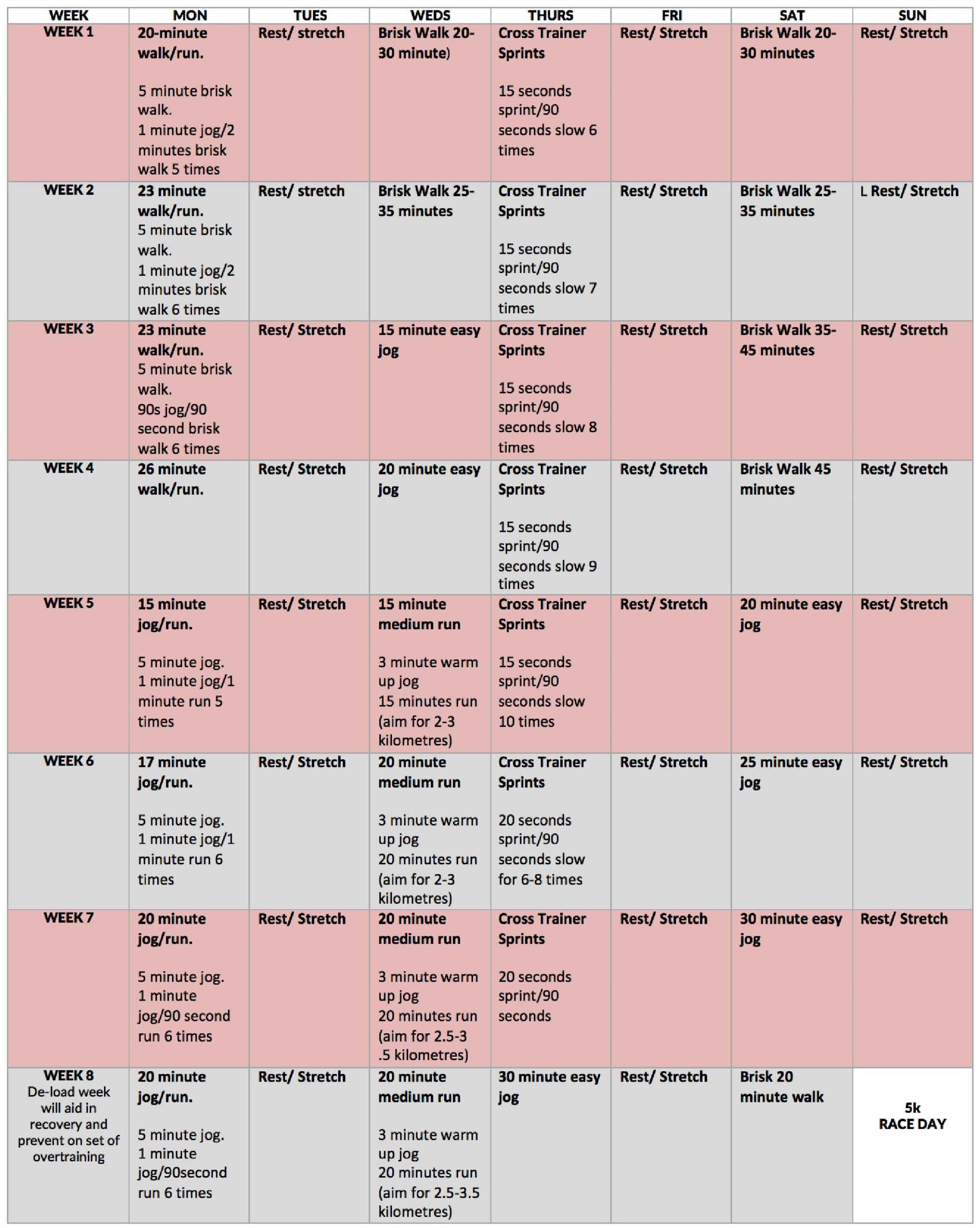
Understanding the programme
Walk/run
Treat the first 5 minutes as your warm up. You will find you have a better rhythm and breathing pattern in the main part of your session after a brisk walk or slow jog. After your warm up, complete 1 minute or 90 seconds jogging followed by 2 a minute brisk walk until the overall time is complete.
Jog/run
Again as above treat the first 5 minutes as a warm up. After your warm up complete 1 minute of slow jogging followed by 1 minute of a faster run. This is not a sprint but should be faster than your 5k pace.
Easy jog
This session is a continuous jog at a steady pace similar to your warm up pace. The aim is to run continuously without stopping. This should not be an overly strenuous session but aimed at building endurance and confidence.
Medium run
This session is aimed at building distance into your continuous run. Aim to maintain the same pace throughout the run while running the furthest you can in the allocated time. This is a harder run than the easy jog.
Cross Trainer sprints
Sprints can be completed on either a cross trainer or bike. Both of which are non-weight bearing which allows your joints to rest. Each 15-20second sprint must be at maximum speed followed by a 90 second slow recovery. The recovery should be approximately 40% of your maximum speed.
Week 8 – deload week
As you can see the volume is lower on week 8. This allows your body to rest in preparation for the 5k race. Keeping the volume high will deplete glycogen/energy levels in the lead up to the race. Taking active recovery the day before the race, such as a 20 minute brisk walk will keep you fresh and hungry for the race.
This programme should be achievable for anyone, no matter your fitness level – so why not give it a go? You’ll be joining your local park run in no time!
If you have any questions or need some further advice, just email me on becky@halltrainingsystems.com. I’d be happy to help!
Common Fears for New Runners
With the sun finally making an appearance, new runners are beginning to take to the streets, fields and hills. I often find that people are nervous before they take up running, but there’s no need to be – running is an excellent way to improve your general fitness and also kick-start any weight loss you may be trying to achieve.
Here are a few of the most common worries I hear, and the reasons why they shouldn’t be anything to fear!
1. Will I cause damage to my joints (specifically knees) from excessive running?
There is no definitive answer to this as it depends on a number of factors such as age, fitness, strength and previous training history. The action of running should not cause damage to a healthy strong joint, especially if you are running correctly and factoring strength and mobility training into your routine. If you are particularly worried I would suggest getting a professional to run you through a movement screen to test whether the main muscles used for running (glutes, hamstrings, hip flexors and quads) are activating correctly and working together efficiently. If they are, then it is unlikely you will damage your joints.
2. What if I’m not the right build for running?
Women seem to struggle with this more than men. With differing body shapes and the constant image of the typical runner on billboards and in magazines this is a common worry. You may not be slight and light weight but that does not mean you cannot or should not run. The lighter you are the easier it may be to cover those long miles but the heavier you are the more power and strength you may have for the sprint finish and speed required while racing (if that added weight comes from muscle). It is no secret that the less body fat you have the easier you will find running but this shouldn’t prevent you from getting started, after all, running could help you lose some of this stubborn body fat. Compression clothing and tight sports bras can help keep those jiggly bits under wraps while covering you up and allowing you to not feel weighed down. Everyone can run, and the more they do, the easier it will become.
3. Am I running far enough?
Most people running for fitness will assume the more miles they cover the better, but this is not always the case. If you are new to running start short. I usually suggest 3k-5k continuous running. If you are a complete newbie to exercise, pick a time and run for that amount of time, for example 10 minutes. Increase this by 2-5 minutes or 0.5-1k once you are stronger at that particular distance or time. There is little benefit in jumping straight into a long run of 8-15k before you are fit as the work effort will plummet. Starting at the longer distance is like trying to lift 100kg with no previous strength training…it ain’t gonna happen. If you can’t run 5k in 25 minutes you will never run 10k in 50 minutes. Work your way up and once you reach the longer distances you will be much faster and stronger than if you had started with them.
4. I don’t know when to increase my distances.
Whether you are running for fitness or running to train for a particular distance you should always vary the distance and route. The body adapts to a stimulus if completed regularly over a short period of time. Once you have run 5k of the same route 5-10 times the body becomes more efficient at that distance. When once you found it almost impossible to maintain 5 minutes per kilometre you now will find it relatively comfortable. To see progress, you must overload the body and change the stimulus regularly. I suggest changing the route every 4-6 weeks and incorporating runs of different distances/speeds every week. Ideally, aim for 2-3 runs a week at varying intensities: for example a 5k fast run, 10k moderate run and one interval/speed session.
5. Should I use a treadmill or run outside? What is the difference?
There is a huge difference between running on a treadmill and taking to the streets or fields. Anyone who uses treadmills and runs outside regularly will most likely agree that you can run for longer without tiring as quickly on a treadmill; this is due to the difference in terrain such as the lack of hills, grass and gravel. The foot strikes the ground at the same angle continuously on a treadmill which can cause injury of a long period of time. The feet and ankles are designed to stabilize when traveling on uneven surfaces. The constant impact at the same angel can upset the joints, tendons and muscles all over the body. There is nothing wrong with using a treadmill occasionally as it may allow you to reach more distance, but I would suggest mixing it up and only using the treadmill when necessary. After all, it’s so much more interesting to run outside! If you plan to complete a race outside my advice would definitely be to train outside, to allow the body time to adapt.
6. I feel exhausted after 60 seconds, I can’t carry on.
I hear this a lot! Running is a weight bearing exercise, meaning you are carrying all your weight continuously unlike activities such as cycling or using the cross trainer. Due to this, larger runners may find it harder, but anyone who is new to running will struggle more in the first 5 minutes than after the first 15 minutes. Your body need time to adapt and start circulating oxygen. Running in the morning or after long periods of sitting can also make you feel breathless as this can cause blood pooling when the valves of veins in your legs do not work effectively, thereby making it difficult for blood to return to the heart. I suggest a 5-minute jog/walk to get the blood circulating and raise the heart rate, along with a 5-minute dynamic mobility session before running.
7. Are all the fancy gadget and monitors necessary?
If you are new to running then I always say you need the bare minimum: a suitable pair of trainers and comfortable lightweight clothes. Many runners get bogged down in timing their runs with GPS watches and measuring their heart rate per kilometre. This can be very helpful if you are a regular runner training for a race or, completing runs requiring a specific pace such as tempo runs and fartlek runs (runs with varying pace). For the average recreational runner, I do not believe these gadgets to be necessary. Just get running, build the distance/time running and increase your fitness. The beauty of running is in its simplicity.
How Will Smoking Affect My Fitness?
Last week saw World No Tobacco Day 2016, with its big push on plain-packaged cigarettes. The initiative is part of a global push to reduce smoking levels. But why are the authorities so concerned about smoking, and should you be too?
Let’s start with the obvious… smoking is bad for you! We all know it, it’s not a secret, yet every day I bet we all see people walking down the street with a cigarette. Unfortunately, for many people smoking is a very social activity and something it’s very difficult to stop.
In the spirit of No Tobacco Day, I want to throw out some information and ideas on the negative effects of tobacco and smoking in general, and also look at how it can impact your exercise – after all I am a personal trainer, and if you weren’t interested in fitness you probably wouldn’t be reading this blog post! I also want to look at what measures you can take to try and stop smoking, as well as what materials are available to help you tackle it.
Enough of the smoke and mirrors
I’ve never been one to “sugar coat” anything so let’s start by quickly highlighting the risk you are taking by choosing to smoke. The World Health Organisation (WHO) estimate that half of the people who use tobacco die as a result of this, which means tobacco could be causing around 5 million deaths each year, or around 10 per cent of world deaths. In addition, there are approximate 600,000 deaths of non-smokers due to second-hand smoke every year. Smoking also increases your risk of all kinds of cancer, including the lungs, mouth, larynx, pancreas, kidney, stomach and bladder, and also affects your fertility (Dechanet et al. 2011). In women, research shows that smoking is harmful to the ovaries, while for men it can cause importance due to the arterial narrowing it causes (Kenderci et al. 2005).
Overall, each cigarette you smoke could take 11 seconds of your life.
Impacts on fitness
Alright, so now you know about all the bad effects that smoking could have on your general health, but how will it affect all of your hard work in the gym . . . Well for one thing, smoking increases carbon dioxide levels in the blood, and reduces oxygen. Your body needs oxygen for your muscles to be able to grow, repair and absorb nutrients. This is a pretty fundamental part of recovery from a good training session. If your muscles can’t grow and repair properly, then you’re cheating yourself out of your hard work. As well as this, shortness of breath, increased phlegm, coughing, and the inability to cope with sudden exertion are all things that will make your journey into health and fitness much more difficult!
Even if you’re young and fit, and train often, it’s unlikely you’ll escape all the negative side effects of smoking. One study looked at the effects of physical fitness among 3,045 Navy personnel and found that smoking was associated with lower exercise levels and lower physical endurance, both cardio and muscular (Conway et. al.1992). Even after differences in the exercise levels of smokers and the non-smokers were taken into account, the smokers fared worse in the tests. If you’re looking to improve your general health and physical fitness, smoking should be one of the first things you drop.
Don’t drag it out
So now you know what you’re doing to yourself, what’s the best way to go about stopping? Going “cold turkey” is the most common choice for people who want to kick the habit. Decide you’ve had enough, throw away all your cigarettes, lighters and ashtrays. Tell your friends and your family as well, everything is easier with a bit of help!
Alternatively, you could look at nicotine replacement by using items such as patches, gum or inhalers. These will help you cope with the cravings. Maybe seek some professional advice to look into the reasons why you smoke. What triggers you to light up a cigarette? What can you do to limit these triggers.
Whatever you think will work for you, why not make a start this “World No Tobacco Day?” Remember that the first few days will be the toughest. Try to distract yourself as much as possible during this time, keep your hands busy and your mind occupied. When you get a craving, just think about delaying acting on it as the feeling will pass and reward yourself with the things you enjoy when you do manage to fight the cravings! It isn’t easy but it does get easier.
For more information on giving up smoking, visit the NHS Smokefree site.
References:
Conway TL, Cronan TA. Smoking, exercise, and physical fitness. Prev Med. 1992;21(6):723-34.
Run your next 10k in an hour!
In preparation for this year’s Town and Gown 10k race I’ve put together an 8 week training plan that’s designed to get men completing the race in under 50 minutes, and most women within the hour. The plan is designed for someone with beginner’s running experience and can be done without needing to sign up to your local gym.
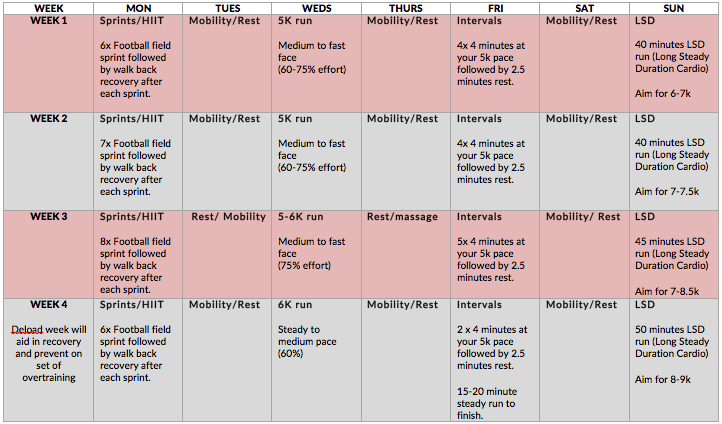
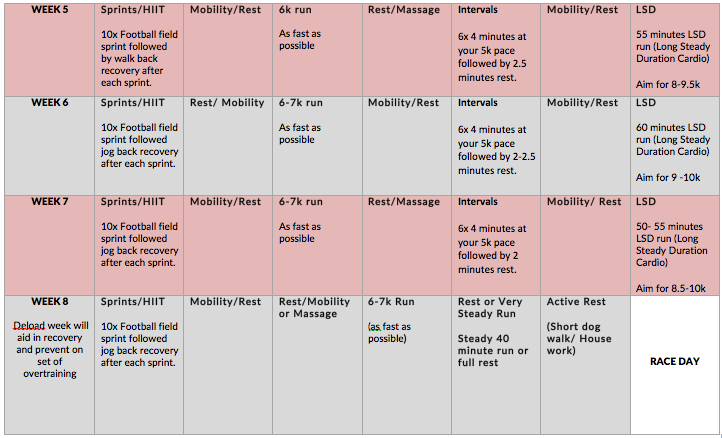
Understanding The Programme
Mobility – Use these sessions to do extra work on your flexibility/mobility. For example, static stretches or foam rolling. I would focus on the muscles used most during running e.g Hip flexors, quadriceps, calves, hamstrings and glutes. It may also be helpful to foam roll/stretch or massage the front of your shins to prevent the on-set of shin splints or to reduce the pain if you are unfortunate enough to suffer from them. Buying a good pair of running shoes tailored to your foot and gait would also be extremely useful and further prevent the risk of injury.
Deload: Weeks 4 & 8 – You may realise you are doing less during these weeks. This time will aid in your recovery and can be seen as ‘active rest’. You will still gain a lot from these weeks fitness wise, but try not to overdo it and add more in. Sometimes less is more and when it comes to 10k-training recovery is key!
Week 8 will be your taper week to allow for optimal recovery and get your body hungry for your 10k race.
Intervals – Intervals teach your body to run fast. This is where you get your speed in. Make sure your hard effort is faster than talking pace but sustainable. On weeks 6 and 7 the recovery gets shorter. This is to challenge your aerobic capacity more in the lead up to the race. Make sure you walk or if possible jog the recovery. This session should ideally be competed on a field so you can stay in the same area. This may also allow you to calculate the distance covered in each sprint bout/set.
Sprints/HITT- HIIT is a great way at working two different energy systems of the body. It’ll help improve and increase your fitness levels and ability to recover. It’s important that you put 100% of your effort into each and every set. Sprint the long length of a football pitch or similar distance, once complete walk back to your start position. Notice this changes in week 6 to a jog back recovery. You could also try this up a hill for approximately 70-100m.
Steady run– Steady runs are an incredibly important part of your active recovery. They help to get the blood flowing through your muscles, pushing out the waste products from the hard sessions. These should be a very steady talking pace. This is the time to really enjoy your running.
About Becky Hodgson
As a successful 800m runner for Oxfordshire Athletics I have a strong postion on evidence based training and application. Strength training is my passion, including passing my knoweldge of lifting on to help other women like myself to see both the physical and practical benefits that strength training has to offer.
You can find me on Facebook, or why not even give us a Tweet @Hall_Training
Weight training for Eating Disorders
With it being Eating Disorders Awareness Week, run by national charity beat, I thought it would be an ideal opportuinty to invite in a guest writter to tell us all about her story and how weight training helped her recover.
With nearly three quarters of a million people in the UK affected by one of these illnesses [1], with around 80 percent of anorexics and 50 percent of bulimics presenting with exercise dependence [2], it’s not uncommon for personal trainers to come across unwell individuals. Three years ago I met a young lady who was struggling to recover from anorexia and bulimia, which she’d suffered from since her early teens, so for about seven years. Here, she shares her story, showing how personal training and correct nutritional guidance helped her overcome her illness and regain her health and happiness.
“In September 2012 I decided that I needed to finally kick my eating disorder – every last bit of it. Although I was just about managing to go about my normal life it still influenced me constantly, every day, and I finally managed to decide that enough was enough. I needed to learn how to nourish by body and how to make is strong, but at the same time know that my weight wouldn’t spiral out of control. It was time to remember to feel alive. I went to the gym and sat down for a consultation with Chris.
In my consultation I explained my situation very honestly. I was told I’d need to eat meat to put on some muscle mass and put butter on my vegetables. I’d been ‘vegetarian’ for four years, purely because of my eating disorder. I left the consultation feeling overwhelmed, and that I couldn’t possibly do what was being asked of me. I decided not to sign up.
Two days later I found myself in my first session with Chris. Somehow my desire to get better had beaten my desperation to cling to my eating habits. I had decided, shakily, to commit 100% to the nutritional advice I was given. No personal trainer aims to make their client fat or unhealthy, so I told myself constantly it was safe. I needed to take a leap of faith to recover, so I threw myself in at the deep end (and had chicken for dinner that night with only a few tears).
Three years later, resistance training has become a huge part of my life. I’m very aware that in some ways this is a way of controlling my body and my food, but it is entirely different to the control exerted by anorexia and bulimia. At first perhaps, there wasn’t too much difference. I used my excessive willpower and applied them to my gym regime, but as exercise has become an established part of my life I’ve relaxed. I try and eat well but am occasionally tempted by some treats, and I’m no longer plagued by guilt if I eat a carbohydrate or, god forbid, some chocolate. I am now in control of my food choices, rather than them controlling me.
It hasn’t always been plain sailing. I still find it difficult to be weighed by somebody else, and a body fat reading that wasn’t what I hoped can make me wobbly for a couple of hours, but that used to be days or weeks. It took a while to get used to a curvier and more muscular appearance, but now you couldn’t pay me to go back. Once, I nearly relapsed when somebody told me my bum was massive, now I’m quite proud of the muscle I’ve managed to put on and the occasional admiration!
Going to the gym gave me a new focus. Rather than trying to drive the number further down the scales, I am trying to push the weight on my lifts up. Rather than spending all day crying over calories, I spend all day living my life. I love the time I spend in the gym but it’s not the be all and end all. I am healthy, happy and strong, and this new life couldn’t be a stronger contrast to my life with an eating disorder.”
If you or anyone you know has been affected by an eating disorder, or if you wish to talk more about Georgey’s story and how we helped her and others like her, please feel free to send us a message confidentially, or visit beat‘s website.
sources:
1. https://www.b-eat.co.uk/about-beat/media-centre/information-and-statistics-about-eating-disorders
2. Davis C, Claridge G. The eating disorders as addiction: a psychobiological perspective. Addict Behav. 1998;23(4):463-75.
Five tips for surviving a marathon – mentally
As a running coach and county competitor I know all too well that having the physical fitness to complete a marathon is one thing, but having the mental fitness to stay motivated for all 26 miles is another feat entirely, and mental fitness is just as important as physical fitness for getting across the finish line.
Here are my top five tips for powering through:
1. My number one top tip, and maybe quite an obvious one would be to have a great playlist. I find this helps me to get lost in my thoughts and not the miles. But make sure your ipod is fully charged, there’s nothing worse than it running out of battery half way through! It may also be helpful to choose songs with a steady beat, at around the pace you want to run at. That way, when you’re struggling you can concentrate on matching your paces to the beat and it will be easier to keep going.
2. Ignore the mile markers. Don’t think about how many you’ve done or you have to go just take each mile 1 at a time. Try and think of it as 26 short sections rather than one long one, that way every mile becomes a fresh challenge and a fresh start.
3. Keep your eyes up front…not on the watch. Watch checking is fine but give yourself target points for when to check. Every five songs can work well as a marker, or perhaps when you’ve been past several mile markers. Continuously checking will make time seem slow, like watching paint dry. Be strict with yourself and you’ll be surprised what great motivation it can be when you look down at your watch and you’re nearer the end or making better time than you thought!
4. Push through the wall. The wall is a purely mental obstacle and it may well require all of your motivation to push yourself through. Make a list in your head of why you are running the marathon and repeat it to yourself. It could be for personal satisfaction, or to raise money for a particular charity. I like to wear something that reminds me of this charity or person, for example a ribbon on my wrist or a bracelet that is connected to my charity. Just looking at it occasionally can increase my motivation.
5. When you reach that half way point and you realise you have to do it all over again, think back to all the miles you have completed during training. This may well be somewhere in the 100s. It may be 13.1 miles more to go, but it’s the last 13.1 miles of all those you have already completed so you can give it everything.
If a full marathon sounds a bit too much like hard work, why not give a half marathon a go? Here’s my half marathon plan, which was featured in Health and Fitness Magazine!
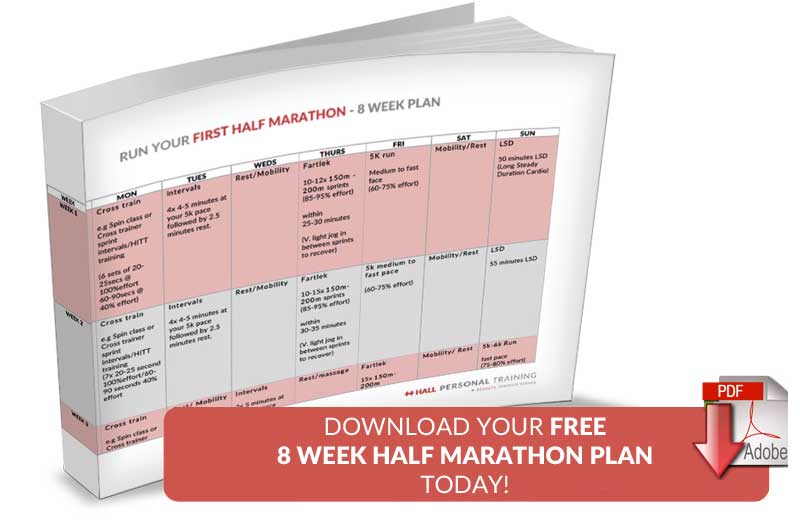
*Image courtesy of Barry Cornelius
About Becky Hodgson
As a successful 800m runner for Oxfordshire Athletics I have a strong postion on evidence based training and application. Strength training is my passion, passing my knoweldge of lifting on to help other women like myself to see both the physical and practical benefits that strength training has to offer.
You can find me on Facebook, or why not even give us a Tweet @Hall_Training
5 reasons why you shouldn’t miss breakfast!
It’s breakfast week, otherwise known as ‘Shake up your wake up’ – and this is a campaign we’re fully behind, as it emphasises the importance of our favourite meal of the day! When faced with the choice between getting up a few minutes early to eat or hitting the snooze button again, spending longer in bed can be really tempting, but it could make it much harder for you to achieve your weight loss goals.
At Hall Training, we always encourage our clients to make time for breakfast, and here are just five of the reasons we think it’s so important:
1. A higher protein breakfast may improve weight loss. A recent 12-week study [1] saw three groups eating either a high-protein breakfast (38g), a low-protein breakfast (13g), or no breakfast at all. The study showed that eating a low-protein breakfast was better than eating no breakfast, and that even those with a low-protein breakfast remained the same body fat. But those on the high-protein breakfast ate less calories per day in total, lost body fat, and stayed fuller for longer.
2. Breakfast could stop you (or your kids) eating so much during the day. A recent study [2] found that students (aged 14) who ate a high-protein breakfast (48g) reported they felt fuller and satisfied for a longer period than students who skipped breakfast or ate traditional, higher-carb breakfasts.They also freely chose to eat 130 fewer calories at lunch than the other two groups. Their hormonal profile indicated better appetite control and regulation of metabolism than the students who ate the regular pancakes as well.
3. Eating more calories in the morning could help you lose weight. A study [3] conducted in 2014 found that eating a higher amount of calories (70 per cent) in the first part of the day could help you lose fat mass and improve your insulin sensitivity, as opposed to eating 55 per cent of your calories at the same time. You can find more information about the study and information on calorie-timing on another of our blog posts: How the timeing of calories may be important for weight loss
4. Eating breakfast could help your concentration. A study [4] conducted on children found that 3 hours after eating a low-GL (Glycemic Load) breakfast, their memory and mood improved. Even the day after eating the low-GL breakfast, the children were still processing information faster and showing improved spatial memory, suggesting that the benefits of a low-GL breakfast are accumulative.
5. Breakfast could help you be more active. An American study [5] looked at the activity levels and number of calories burnt by two groups, one who ate breakfast and the other who didn’t. The results showed that eating breakfast encouraged the participants to engage in more physical activity, and thus burn more calories. The total number of calories burned by those who ate breakfast was 851 per day, compared with just 442 by those who didn’t.
Although the research isn’t always very clear or consistent, it seems to suggest that there are some advantages to having breakfast, and if you are having breakfast then a high-protein looks to be better than a standard breakfast.
So, in celebration of Breakfast Week, here are some of the recipes we use to make sure we get plenty of protein at the start of the day!

Sources:
1. Leidy, Heather J., et al. “A high‐protein breakfast prevents body fat gain, through reductions in daily intake and hunger, in “Breakfast skipping” adolescents.” Obesity (2015).
2. Leidy, J., Reki, E. The Addition of a Protein-Rich Breakfast and its Effects on Acute Control and Food Intake in “Breakfast-Skipping” Adolescents. International Journal of Obesity. (2010).
3. Lombardo M, et al. J Am Coll Nutr. 2014 May 8:1-8. [Epub ahead of print.]
4.Young, Hayley, and David Benton. “The effect of using isomaltulose (Palatinose™) to modulate the glycaemic properties of breakfast on the cognitive performance of children.” European journal of nutrition (2014)
5. Betts JA, Richardson JD, Chowdhury EA, Holman GD, Tsintzas K, Thompson D. The causal role of breakfast in energy balance and health: a randomized controlled trial in lean adults. Am J Clin Nutr. (2014)
About Chris Hall
As the founder of Hall Training Systems, it is my mission to provide you with the very best personal training experience. I set up Hall Training Systems as Oxford’s leading personal training service in nutrition, performance and weight loss, ensuring I can deliver the very best in training techniques.
You can find me on Facebook, Google+ or why not even give us a Tweet @Hall_Training
Pre-Christmas damage control
With Christmas lurking round the corner I often find people ‘freak out’ about what to do when it comes to eating, and worry about bouncing back and regaining the weight that they’re recently lost. I can tell you now, you needn’t be worried, as I say every year:
“It’s not what you eat between Christmas and New Year that makes the difference, but what you eat between New Year and Christmas!”
I wish I could claim this as my own but have been quoting this for several years now when I first heard it at a fitness convention out in the States. Since then it’s one of the few words of wisdom that’s really stuck with me and they are definitely words to live by! You see, the amount of fat a person can gain over a week will be such a small amount that you shouldn’t let the fear of it stop you from fully getting into the festive spirt. It’s funny, as I find people are far too worried about what they’re going to be eating between Christmas and New Year rather than worrying about the other 51 weeks of the year.
Anyway, for those of you who have done well on transforming your body this year and may be worrying that Christmas may undo all the hard work, then here’s a great plan to limit the ‘Santa Bulge.’
We’re almost 10 days away from the big day, leaving just enough time to go strict on a 10-Day carbohydrate depletion phase. This phase is the key and will ensure you get to enjoy all the food and drink (ok, within reason) over the Christmas holidays with minimal fat gain however, it’s not going to be an easy 10 days…
The Day-10 Carbohydrate Plan
Days 1-10 require you to be strict on your carbohydrate consumption. The only carbohydrates you’ll eat will be in the form of green vegetables and nuts. All major and popular carbohydrate sources are to eliminated, these include: bread, pasta, grains (rice, buckwheat, spelt, millet, oats etc.), beans and pulses, cakes, sweet, chocolate, root veg, most condiments and sauces and alcohol! Yes sorry, for the next 10 days it has got to go! Your total daily intake of carbohydrates will be between 30-50g from only green vegetables and nuts. With the elimination of almost a whole food group you now need to fill its gap; protein and fat will do just that.
You need to make sure your consumption of protein is at least 1.8g per kilo of bodyweight or ideally 2.0-2.2g per kg of bodyweight. After you’ve set your protein intake you then need to set dietary fat. This will usually be between 0.7g-1g per kilo of bodyweight and dependent on your total calorie intake.
Over the 10 days you’ll also put yourself into a calorie deficient. I tend to find men do well on around 1600-1800 Kcals and women on slightly less, 1200-1400 Kcals. With this in mind if you take a 60kg female with their protein set at 120g (480 Kcals) and a carbohydrate intake of 30g (120Kcals) the calories from fat would want to be around 600-800 Kcals or between 65 and 90g of dietary fat. Now that you’ve set up some real numbers it’s time to plan your meals.
The majority of meals will consist of the following:
• a protein source – fish, poultry, red meat, eggs and/or full fat greek yogurt.
• green vegetables – spinach, kale, brussel sprouts, broccoli, green beans, peppers, asparagus etc.
• a source of dietary fat – handful of nuts, 1/2 avocado, fish oil, olive oil/oil based salad dressing, oily fish i.e mackerel, salmon, sardines.
The 10 days are designed to help deplete the body of its glycogen stores, so come day 11 and 12 (Christmas day/Boxing day) and throughout the Christmas week you’ll then help to replenish this ‘lost’ glycogen through good eating and drinking. You’ll find you’ll be able to consume all mannerer of foods without it having a detrimental impact on your body fat and composition. Win, win!
What to expect over the next 10-days
During the first few days it’s quite normal to experience the following: headaches, skin breakouts, tiredness and fatigue, irritability, brain fog and weakness (especially in the gym). These should all subside after 5 days of being of going low carb. If after 7 days you’re still suffering then check the following:
1. Protein may be too low – check how much protein you’re ACTUALLY eating against what you NEED to be eating, if it’s too low then take it up
2. Increase salt intake – Proteins needs to digested into their individual amino acids before being absorbed by cells. In order for these amino acids to be absorbed, sodium is needed, so higher protein diets do require a higher sodium intake. If you’re feeling tired then take a look at you salt intake, you may find it’s too low. It’s one reason I recommend the nuts, as salted nuts can really help with this. Also try adding sea salt or himalayan pink salt to foods.
3. Increase fat intake – If you can rule out the two points above and you’re still feeling miserable then take a look at your fat intake. If you’re on the lowest intake (0.7g per/kg/bw) then it may be worth increasing to 0.9-1g per/kg/bw. This will also help give you a few more calories which you may well need.
With regards to results; it’s not uncommon for most people to drop 1-2.5% body fat and 2-4kgs across these 10 days! So, good luck, stay strict over the next 10 days and then you’ll be free to let your hair down and enjoy Christmas for what it’s realy about; sharing good food and drink with close freinds and family.
From everyone here at Hall Training, we wish you a very Merry Christmas!
About Chris Hall
As the founder of Hall Training Systems, it is my mission to provide you with the very best personal training experience. I set up Hall Training Systems as Oxford’s leading personal training service in nutrition, performance and weight loss, ensuring I can deliver the very best in training techniques.
You can find me on Facebook, Google+ or why not even give us a Tweet @Hall_Training
James Bond has been gracing our screens since 1962, and has become a symbol of the British gentleman. The quintessential bad boy, every woman wants him, while every man wants to be him. We are used to seeing Bond in action behind the wheel, out in the field and even in the bedroom, but what does Bond get up to in the gym?
As well as dashing looks and charisma, 007 needs total body strength, explosive power and a fast sprint speed to keep his licence to kill. Here are our top ten exercises you need to get Bond Body Ready:
- The Pull Up
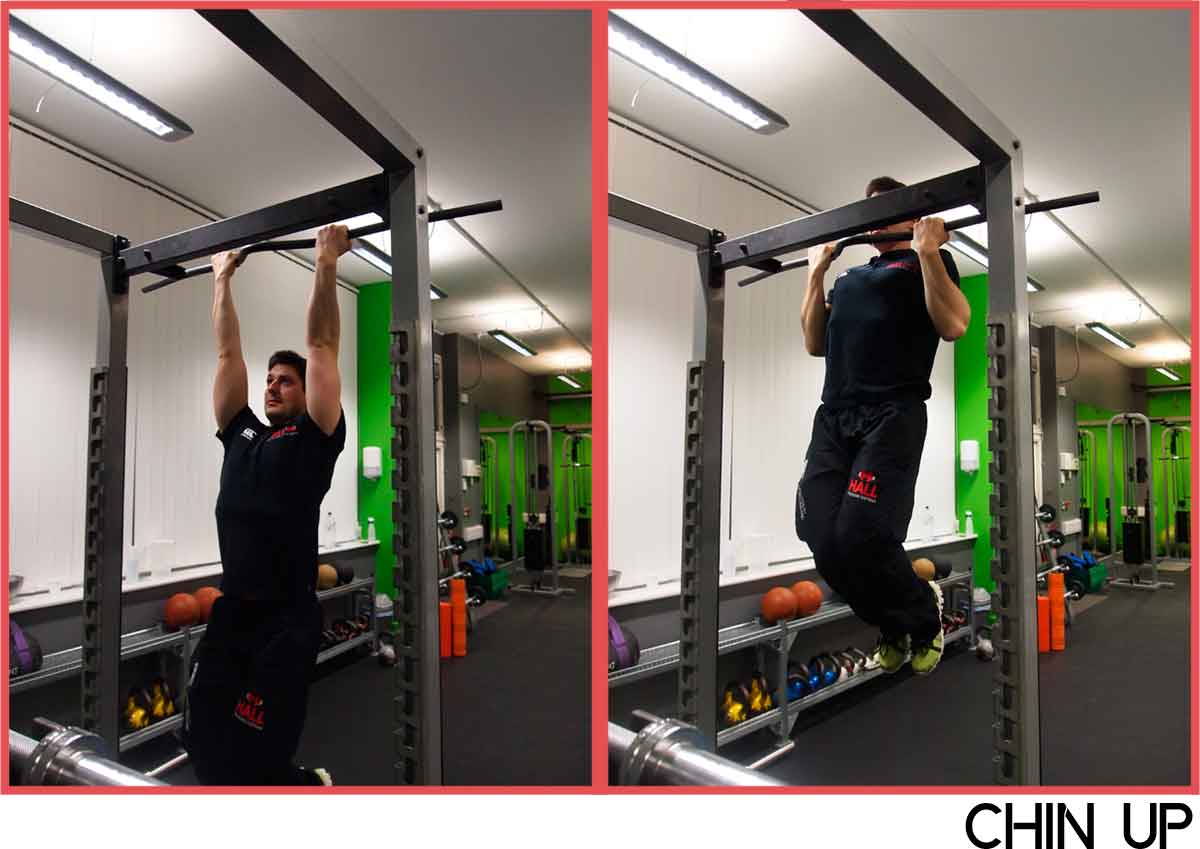
Why: Pull-ups will help develop Bond’s lat (back) and grip strength ready to climb a lift shaft or pull himself onto a helicopter. Another benefit is the range of progressions. If a pull-up (with palms away from you) is difficult to master, start with some chin-ups and build up from there. If they’re easy and you can knock out 20 in a row in true Bond style, put a weight belt on, or lower yourself down more slowly. You’ll be ready to clamber up scaffolding in to time.
- Garhammer Raises/Hanging Knee
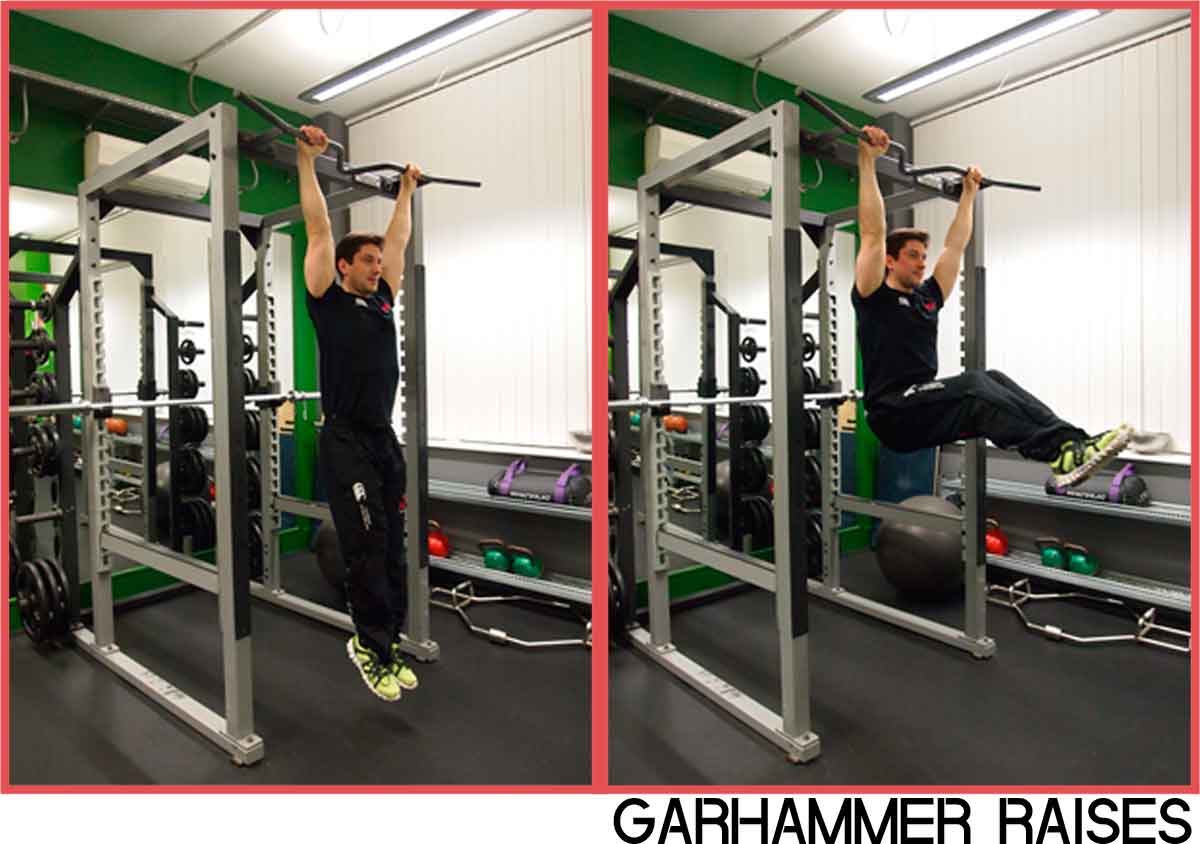
Why: These are very useful for developing the lower abdominals and increasing core strength, and would be essential for escaping when you’re chained hanging to a drain pipe, or creating an explosive kick when hanging from a building. Sit ups are another option for developing impressive abs: striding out of the sea onto a pure white beach is one of Bond’s favourite past times, and if you want the 007-life, you need to look the part! Plus they are a key part of the field agent fitness test, as we saw in Skyfall.
- Box Jumps
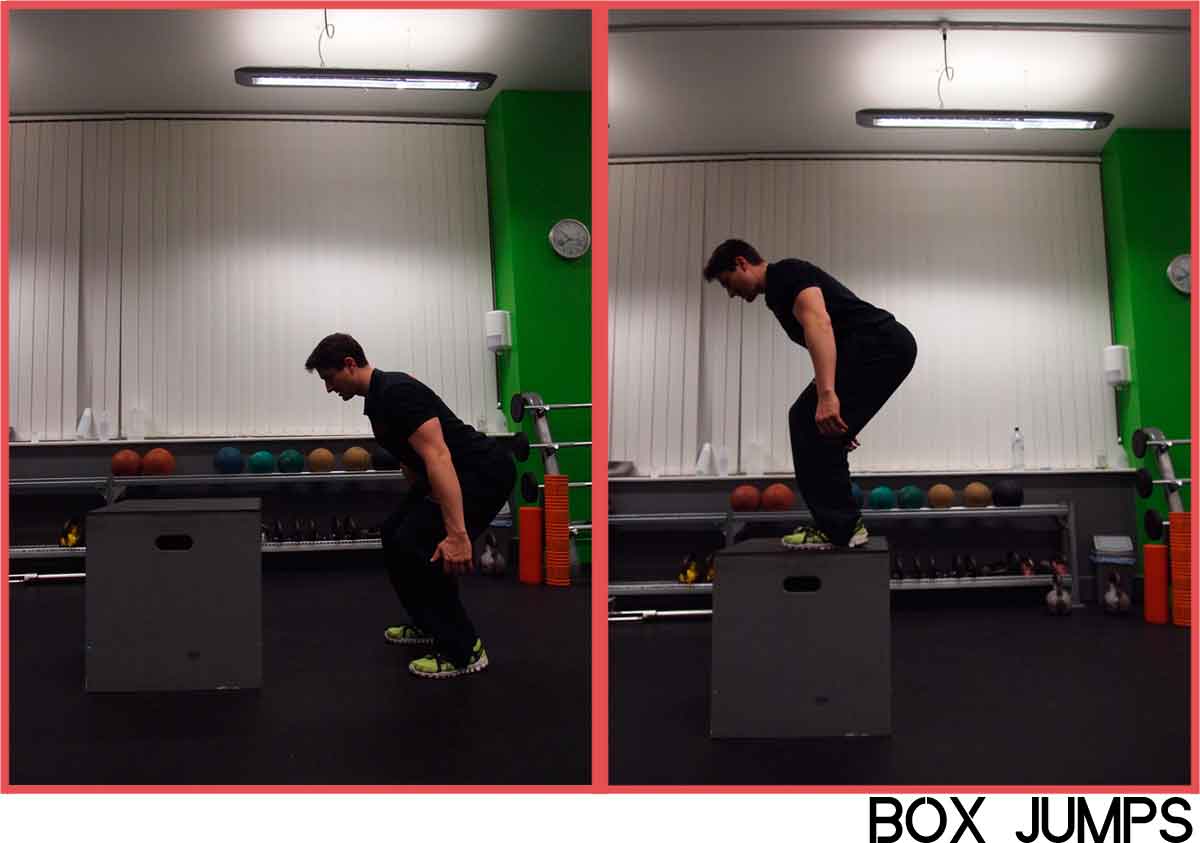
Deskercise: Turning your office desk into a gym!
Due to the demands of modern life, more and more of our clients are in the office between 8am and 6pm, often with a lengthy commute at each end. Although it is still possible to make time for a fitness regime, many people struggle. To help combat this, we’ve started recommending a few desk exercises for our busiest clients. Desk exercise is a great way to combat our sedentary lifestyles, help beat the slouch and fit a bit of exercise into the day.
There are so many different exercises you can do at your desk, including mobility/stretching exercises, strengthening exercises and metabolic exercises to get the heart going. I’ve included a few of my top ones here to give you the ultimate deskercise workout. So, kick off the high heels, remove the tie and unbutton your top buttons, as we’re about to get the blood flowing and warmed up!
Mobility and warm up – the clients who work at a desk often develop slumped over postures and complain of having pain or discomfort in at least one of the following areas: neck, lower back, shoulders and upper back/traps. The exercises in our mobility and warm up circult will help to release these tight muscles that develop as a result of sitting all day. They will help ‘activate’ our postural muscles and develop movement in the spin, neck and shoulder regions. These exercises are key for increasing mobility and keeping muscular-skeleto issues at bay.
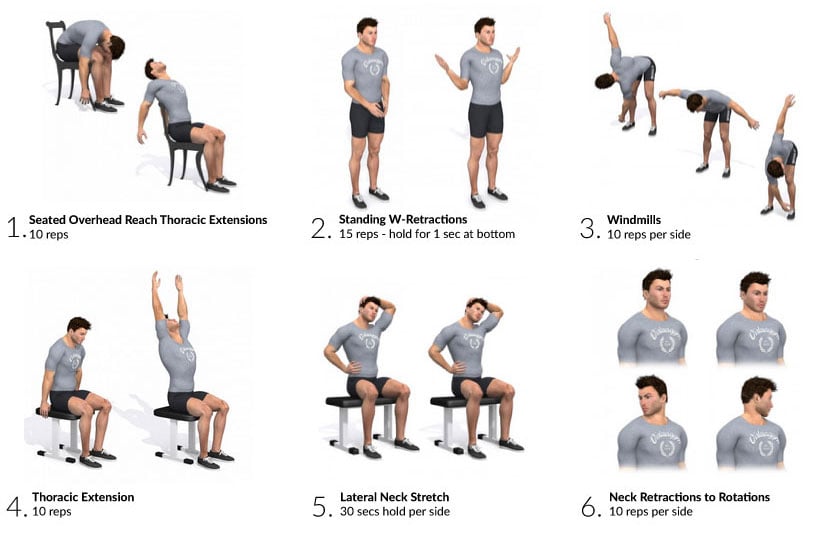
Top Tip: If your focus is on improving mobility and flexibility, then the exercises above should be performed at least once per day. If you do no other exercise try and build up to three times per day. A great time to do them is if you are feeling low on energy or need a break – desk exercises can be a productive way to take a break. Try using cues from other workers too: every time your colleague gets up to make a coffee or pops out for a cigarette, that could be your cue to fit in this quick mobility routine.
Now that we’re feeling looser and all warmed up, let’s move onto the workout itself and begin with our strengthening exercises.
Strengthening exercises – these will help you build up muscle strength and tone while keeping the heart rate high, burning extra calories. This total body workout should be performed in a giant circuit with limited rest, alternating an upper body exercise with a lower body exercise. Perfoming the workout in this way not only allows for a greater amount of work to be done in a short amount of time, but circuit training has been shown to increase caloric expenditure when rest is limited [1] and raise the body’s energy expenditure for up to 38 hours post exercise [2].
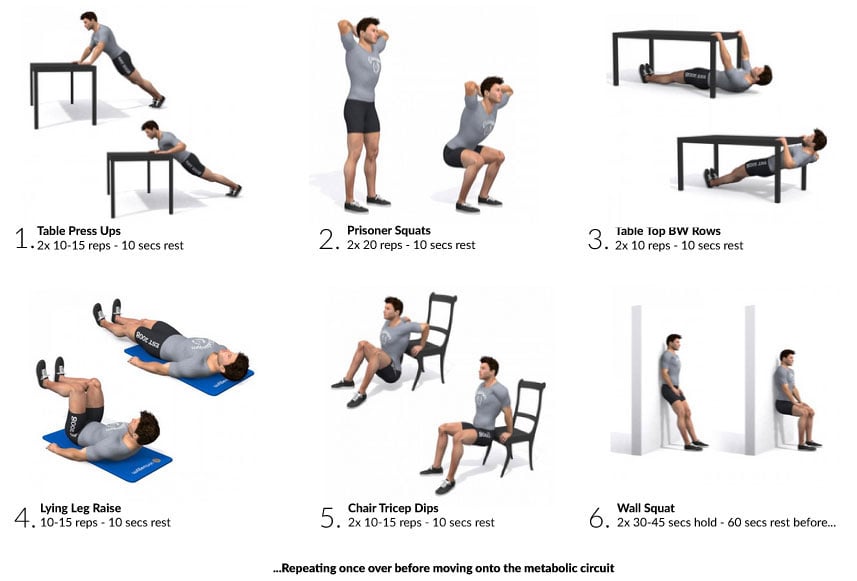
Once you’ve recovered and your legs have stopped shaking, let’s draw this workout to a close by really cranking the intesity up as we finish off with our four-exercise metabolic circuit!
Metabolic exercises – these really get your heart rate elevated, building on cardiovascular fitness as well as helping to mobilse ‘stubborn’ body fat as we move onto our High Intensity Interval Training (HIIT) phase. Similar to the circuit training, these exercises have a high metabolic cost to them allowing for greater energy expenditure and an increase in the body’s metabolism for several hours afterwards! HIIT has also been shown to be a time efficent way of reducing cardiovascualr disease (CVD) risk factors in adolescents [3], a condtion that’s more prevelant in the sedantry population.
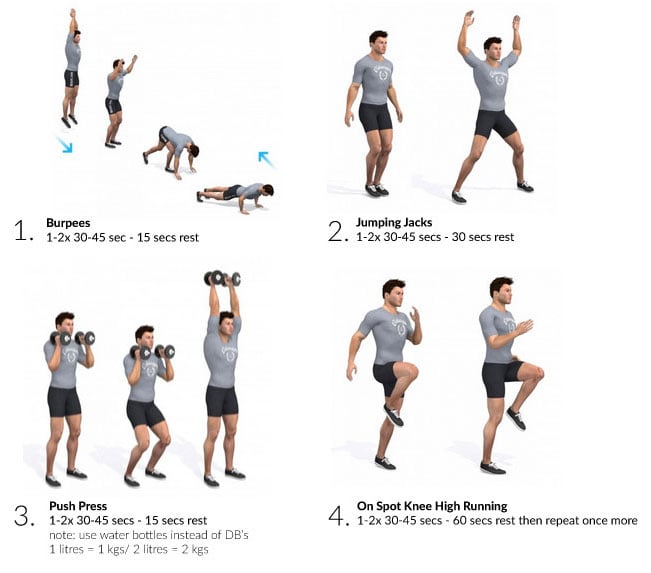
And finally, if there’s time…
Core exercises – if you have both the time and the energy then why not top the workout off by strengthing the core? It’s a region often left underused and weak by people sat down for most of the day. These two simple but effective exercise are a great start to building up a stronger core, which a recent study showed core “assists in the alleviation of chronic low back pain“ [4].
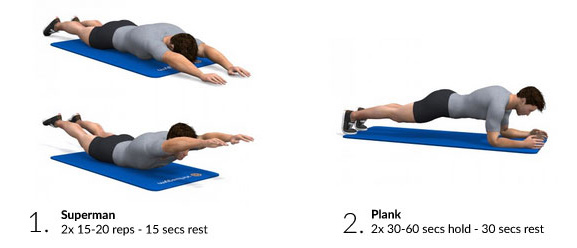
Wrapping up – the workout will take around 15-25 minutes depending on your level of fitness and how many circuits/rounds you complete. For beginners I would advise performing only one circuit of the above with the idea of progressing up to performing it twice or even three times over for more advanced people.
The number of calories you can burn depends entirely on your fitness levels, your weight, the exercises you choose to do and the intensity with which you perform them. Compared to general sitting at a desk which burns around 38Kcals per hour, our deskercise routine could get you burning around 190Kcals in half an hour; 5 times as much! [5]. However, if exercising at your desk isn’t possible then try increasing your general movement, such as tapping your feet, moving your fingers and even maintaining proper posture. Research conducted on a group of twenty women found if the obese women mimicked the activity patterns of the lean women, including a modification of posture allocation, an additional 300 kcal could be expended every day, irrespective of exercise [5].
Note: It’s important to remember that although beneficial, desk exercises are not a proper substitute for a gym workout, or HIIT session. However, they will prevent decline and keep you pain free, mobile and certainly more energised at work; which is certainly a win for you, your health and the boss!
You may also find useful
Our blog post on: Back Pain. Getting to the core of the problem
Sources:
[1] Kelleher AR, Hackney KJ, Fairchild TJ, Keslacy S, Ploutz-Snyder LL. The metabolic costs of reciprocal supersets vs. traditional resistance exercise in young recreationally active adults. J Strength Cond Res. 2010 Apr;24(4):1043-51.
[2] Murphy, Emmett; Schwarzkopf, Robert. Effects of Standard Set and Circuit Weight Training on Excess Post-exercise Oxygen Consumption. Journal of Strength & Conditioning Research. 1992
[3] Buchan DS, Ollis S, Young JD, et al. (2011). “The effects of time and intensity of exercise on novel and established markers of CVD in adolescent youth”. American Journal of Human Biology 23 (4): 517–26. doi:10.1002/ajhb.21166. PMID 21465614.
[4] Chang, Wen-Dien, Hung-Yu Lin, and Ping-Tung Lai. “Core strength training for patients with chronic low back pain.” Journal of Physical Therapy Science 27.3 (2015): 619-622.
[5] http://calorielab.com/burned/
[6] Johannsen DL, Welk GJ, Sharp RL, Flakoll PJ. Differences in daily energy expenditure in lean and obese women: the role of posture allocation. Obesity (Silver Spring). 2008;16(1):34-9. doi: 10.1038/oby.2007.15.
About Chris Hall
As the founder of Hall Training Systems, it is my mission to provide you with the very best personal training experience. I set up Hall Training Systems as Oxford’s leading personal training service in nutrition, performance and weight loss, ensuring I can deliver the very best in training techniques.
You can find me on Facebook, Google+ or why not even give us a Tweet @Hall_Training