How much protein do I need?
Currently the UK government recommends a mere 0.8 grams per kg of bodyweight, that’s a pitiful 56 grams of protein per day for a 70kg male!
Scientists have teamed up to publish large studies looking at health improvements from protein over the course of years but unfortunately, to reap a lot of the benefits associated with protein intake we need to be consuming a lot more than what’s currently being advised, and despite the huge amount of reasearch around protein the government still stands by their recommendation.
Fear not! As my team and I have been reviewing the most recent literature that’s hot off the press, to uncover how much protein is exactly needed if we wish to keep on top of our health, and our training.
We’ve pulled out all of the ‘need-to-know’ stats and figures from the research we’ve reviewed and compiled them into this handy infographic with the specific amounts you should be shooting for.
So, whether you’re an active person who loves to train, someone looking to lose weight or you’re wishing to optimise your performance and recovery, we have a protein intake that’s right for you!
(3)-scaled.jpg)
Spotting the signs of overtraining
It’s January, and lots of us are thinking about taking up a new exercise regime or increasing the time we spend in the gym. But it’s important not to do too much too soon, despite your best intentions. BBC Newsbeat contacted our executive personal trainer Chris Hall to talk about how much exercise is too much, and how to spot the signs of over-training. You can read his full comments below.
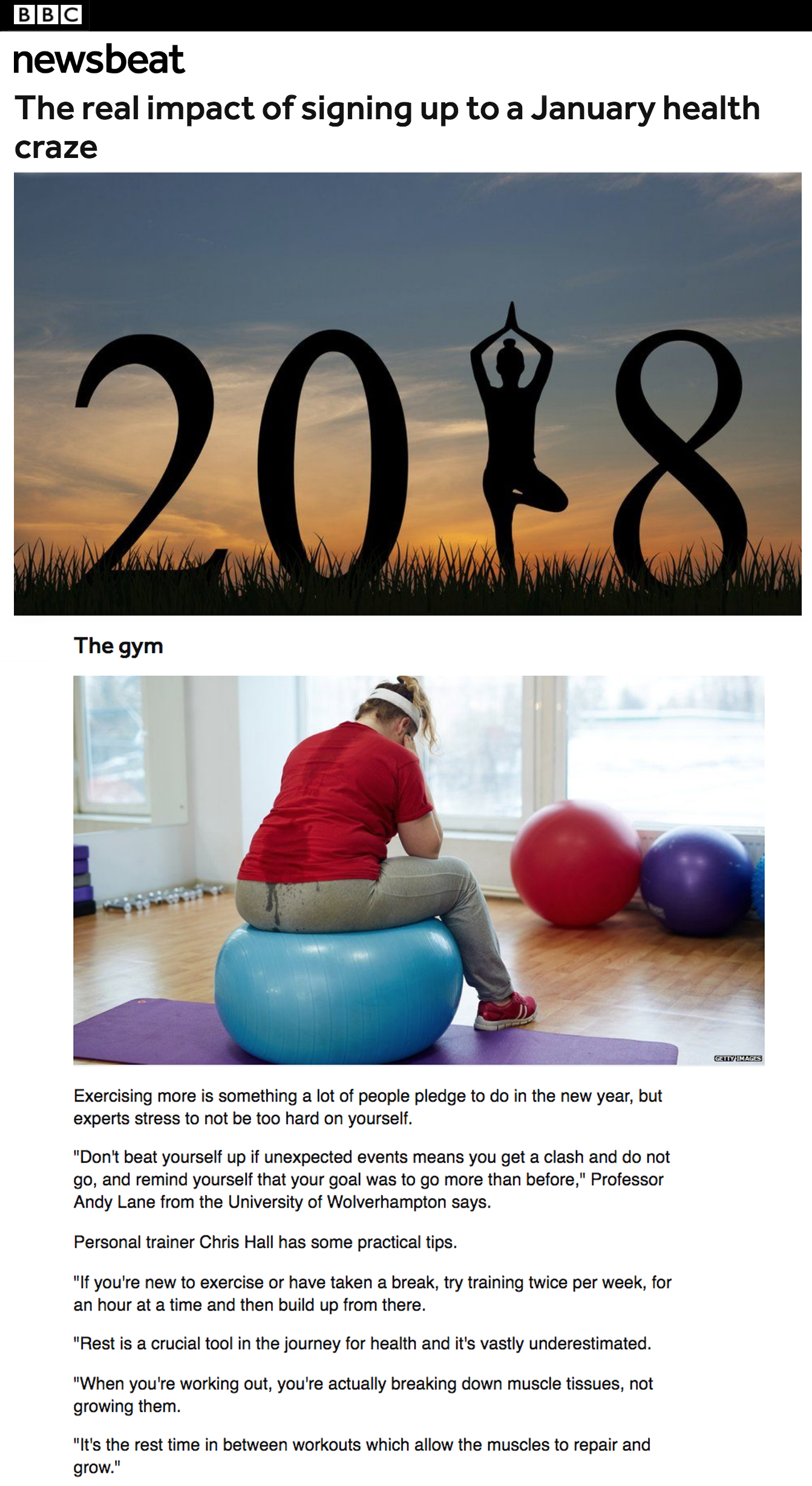
Q1: How much exercise is too much?
The definition of “too much” exercise will vary from person to person. If you’ve not exercised for a few months and set out to run a marathon, it’s very likely that’ll be too much, but for a seasoned marathon veteran, it’d be a normal day’s training.
If you’re new to exercise or have taken a break, try training twice per week, for an hour at a time and then build up from there.
Q2: How do you know if you’re doing too much exercise?
Things to look out for include your ability to fall asleep, and your ability to stay asleep. If you struggle to fall asleep more than normal, it could be a sign that you’re spending too much time training and/or not taking enough rest days. If you’re struggling to stay asleep, it could suggest that you’re training too aggressively and may need to back off slightly from the weights you are lifting.
Another simple thing to measure is your morning heart rate. Most phones and fit-bits now are equipped with heart-rate monitors. Once you’ve established a baseline you’ll be able to see if your morning heart rate is raised. If it is, this could suggest that you’re overtraining. If you’re training too hard, your body will be working overtime to help you recover and to meet the new demands you’re placing on it, causing your heart rate to elevate. Try backing off or resting up until for a day of so until it’s gone back to its baseline.
Another sign to look out for would be overall performance. If you’re suddenly surprised to find yourself having to drop the weights that you would usually lift or, unable to keep your regular pace during those HIIT sessions then this sudden, unexplained drop in performance could be the body’s way of telling you “I’m out of gas and need some rest.”
Q3: What damage can you do by exercising too much?
The most obvious risk of over-training is injury. If you’re overreaching then you’re far more likely to be triggering old injuries to reoccur, or even gathering new ones. You’re also at greater risk of becoming ill if you’ve worked your body into an over-trained state, as your immune system won’t be working as effectively as normal.
There can also be dangers to your mental health. A lack of sleep can lead to depression and mood changes, which can then be aggravated by feelings of failure or low-self esteem if you’re not managing the workouts that were easy for you a couple of weeks ago. Exercise should be a positive experience, so if it’s something you once enjoyed and you’re now dreading it, that’s a good sign you need to take a break. Try taking a full week off, and then slowly increasing your workouts again after that.
Q4: Why is rest important?
When you ask people why they are exercising, it’s usually because they want to be healthier. It’s not uncommon to hear that people are going to go from nothing to hitting the gym or pounding the pavements five-to-seven times per week. However, rest is a crucial tool in the journey for health and its vastly underestimated. Rest is important for recovery and repair. When you’re working out, you’re actually breaking down muscle tissues, not growing them. It’s the rest time in-between workouts which allows the muscles to repair and grow. If you over-train then you hamper the body’s ability to recover, leading to the symptoms listed above.
You can read Chris’s comments and BBC Newsbeat’s full article on January health fads here.
Delayed Onset Muscle Soreness – Take it or leave it, the choice is yours!
Now, you don’t need me to tell you the benefits exercise can have on your health. If you’re reading this, then I’m guessing there’s a high chance you’re already aware of the health benefits we can reap through exercising however, are you aware that these benefits can either be enhanced or dumbed down depending on the way we are exercising?
What if I were to tell you you could structure your training (sets, reps, tempos and load) so it’s more geared towards building muscle or burning body fat; easy right?
But what if we could fine-tune this further, to let’s say designing a workout that would be more bias towards improving cardiovascular health to help lower blood pressure, or to encourage ossification (the formation of new bone) and the release of osteoblasts to help improve bone density and collagen production. Or, you may be training to help prevent cognitive decline and reduce the chances of Alzheimer’s – things now become more complex.
Believe it or not, the body is an amazing, organic piece of machinery that adapts to whatever (give or take) we throw at it, and if you know the right stimulus needed to elicit a response then we can indeed train to produce a truly specific outcome.
Take Delayed Onset Muscle Soreness (DOMS) for example, some people love waking up the following morning feeling sore and aware they trained hard the previous day, while others hate how sore you can get, begrudging having to go into work or be on their feet all day.
But, what if we could choose whether our workouts left us sore or not? If so, we could then specifically design workouts around people’s routines and preferences. After all, if you’re an athlete you don’t want to go into a competition or a game with severe DOMS. Like-wise, if you’re someone whose job it is to be on your feet all day, or spend time running up and down stairs then it’s probably not going to be too comfortable having to do it with DOMS in the legs.
Well guess what, you can adapt your workouts in such a way that the exercises and their execution can bring about varying degrees of muscle soreness to suit your personal ‘pain tolerance’ – a little like choosing how spicy you like you curry, and here’s how:
Sports and Exercise scientist Professor Ken Nosaka, is the leading researcher in the field of muscle damage. He’s conducted numerous studies and found muscle damage to be at its greatest when a muscle is trained eccentrically for repeated bouts of effort and intensity. Prof. Nosaka found DOMS to be at its greatest when a muscle is trained in the last third of its lengthened range and trained to the point where there’s a forty percent drop in intensity (load).
So what does that look like in the real world?
If we take the hamstrings, and compare the seated leg curl to the lying leg curl you’ll find a greater amount of DOMS when using the seated leg curl as compared to the lying leg curl. This is because the seated leg curl works more of the lengthened portion of the range for the hamstrings placing it more into a stretch. The same would also apply when comparing a Romanian deadlift to the lying leg curl. Again, the like a seated leg curl, the Romanian deadlift places the hamstrings into more of a stretch/lengthened position – this is one way to ensure DOMS (Nosaka & Sakamoto, 2001).
The second factor is looking at weight drop off i.e. how hard you push yourself. Let’s say you start off with a weight of 100kgs for your first set and decide to perform five sets. If across those five sets you’ve had to drop the weight by 40 percent (a 40kgs reduction) this reduction in ‘drop-off’ would be enough to cause DOMS (Nosaka K. 2008).
Finally, if the above isn’t enough and you’re left wanting more, then adding an isometric contraction pause at the bottom of the lengthened position of the lift will guarantee to induce some serous muscle damage and with it, DOMS.
Now, this is all well and good if you’re wanting to induce muscle soreness but, what if you’re someone who really doesn’t like being left sore, how can we train to prevent it?
Well, the diagram I’ve put together below gives you a sliding scale ranked from minor to most severe based on the type of training you perform relative to inducing muscle soreness.
Factors Influencing Muscle Damage and Soreness
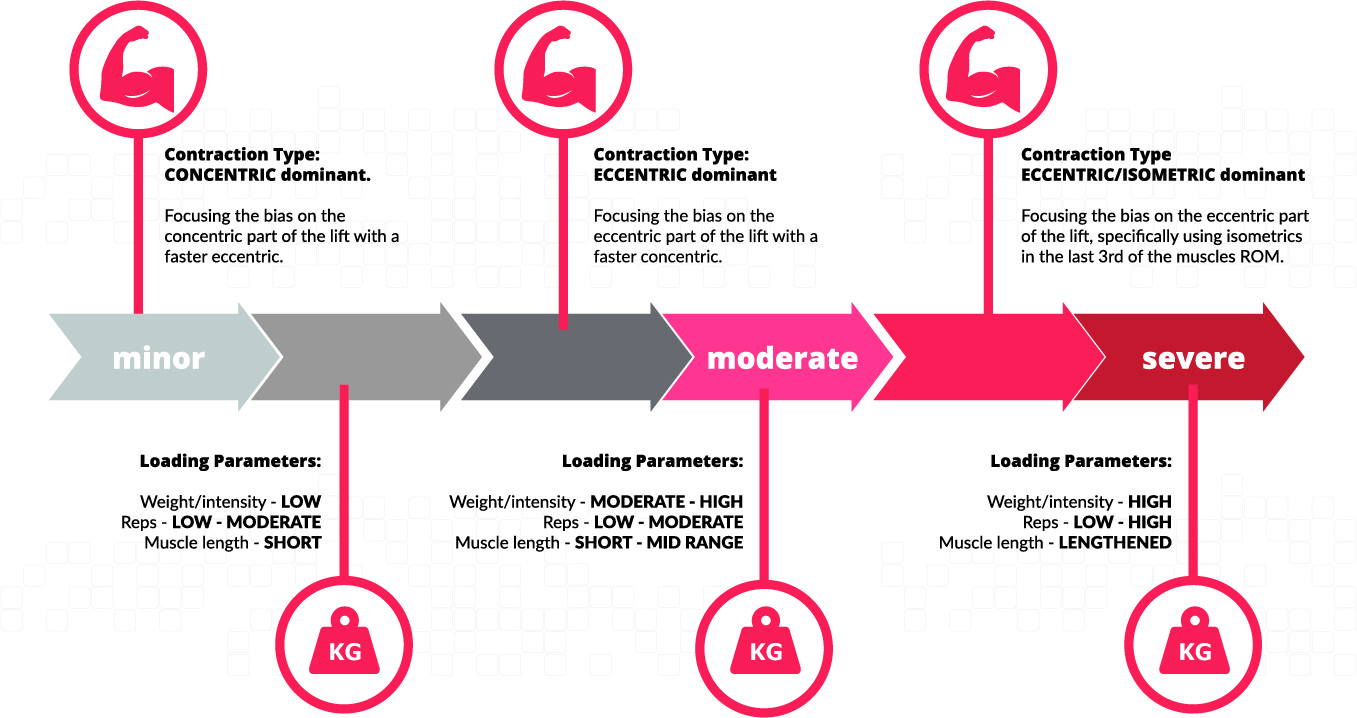
(image based around prof. Nosaka’s research over the last decade)
As you can see, if you’re wanting to limit the amount of DOMS in a muscle then focusing on the concentric part of the lift and keeping the weight relatively low (>60% of 1RM) will limit muscle damage and subsquently muscle soreness. However, age, gender and training experience also have a contrubiting factor towards muscle soreness; with females and younger trainees experiencing lower levels of pain (Lavender AP, Nosaka K, 2006).
Knowing what we now we can truely tailor our workouts around the way we are feeling and wish to feel after the gym. If you’re someone who loves to feel pain for several days after a workout then you can now train towards that however, please don’t go away mistakenly thinking just beascue you’ve induced muscle soreness that it’s a sign of a good workout or for growth – as we already know from one of our previous blogs it’s not always the case.
Five things we learned about fitness in September
As those of you who follow this blog series will know, we learn new things about fitness every month. As personal trainers its crucial we stay up to date with all of this research so we can keep making sure our clients are receiving the best possible support. So what have we learned from the latest research this month? Our fab trainer Elliot, a personal trainer at Trimnasium in Cheltenham, has trawled it all to bring you five gems.
1. Volume isn’t always king
Performing just about every exercise known to man during your session is common practice for many gym-goers, it almost seems like a good idea to exhaust a muscle of everything it has and to be limping out of the gym…
Although even though it seems the norm, is it really more productive to go above and beyond?
If you’re finding yourself particularly sore after training, feeling as if you’re not quite recovering and not able to really push hard, then the amount of work you’re doing in the gym may be doing more harm than good.
A recent study was done to compare the physiological response to a high volume workout to the response to a high intensity workout with lower volume.
What they found may have you re-thinking your next workout… Even after 72 hours, the power output of the athletes who trained with high volume hadn’t returned to their initial baseline, while the athletes who trained at high intensity had returned to that level. Not only that, but markers of muscle damage were significantly elevated following the high volume workout.
So rather that thinking about how much you can fit in during your workout window, strike a good balance between volume and intensity to ensure you’re at your peak whenever you get in the gym.
2. Low carb, high fat or low fat, high carb?
I personally feel as if this question has been asked for as long as I’ve been in the industry and I feel as if it always will be… We are all individuals and will all respond in different ways to different macronutrient ratios, so you’ll hear a lot of ‘this works for me!’ But what does the science really have to say about this…
In a study carried out on a number of overweight individuals, some were assigned to Low Carb, High Fat (LCHF) diets and others were assigned to High Carb, Low Fat (HCLF) diets. Both groups saw significant reductions in both body weight and waist circumference, however the LCHF group saw the greatest changes in both.
Does this give us a definitive answer on which is superior? Maybe, maybe not…
Unfortunately, the subjects were not monitored 24/7 and were not forced to specifically eat certain meals with certain calorie contents. So there are quite a few drawbacks to this study and the LCHF group may have just eaten less and done more activity, unfortunately we’ll never really know.
My opinion: find what suits you the best and stick to it; also understand that science suggests that the LCHF diet may be superior (and science never lies…)
3. Are knee sleeves worth the investment?
If you’ve watched any type of powerlifting competition, strong man event or even if you watch the guy who squats the most in your gym (certainly not me), then you’ll notice that they are probably wearing knee sleeves. What are they for you might be wondering? San they help me squat as much as those guys? And are they really worth the £50-60 pound some of the more reputable brands are selling them at?
The answer… Potentially, but not entirely…
When assessing the powerlifters using knee sleeves, researchers found that knee sleeves seem to improve balance and proprioception, increase knee flexion and reduce knee adduction.
If you’re a keen powerlifter who wants to get as strong as possible in the squat, then they may be worth the investment. Anything that helps increase stability, especially in such a demanding lift, will certainly be of benefit and even more so when handling such heavy loads.
But if you only visit the squat rack on the odd occasion and your main goal isn’t to be the strongest squatter in the gym, then you should be just fine without them.
4. To beet or not to beet?
If you know anything about me, you know I love a good health food fad. I’ll try anything once if it supposedly has a positive effect on your physical or mental wellbeing, my latest venture is apple cider vinegar but that’s another story for another day…
In this study, they tested something that I’ve heard great things about but have never personally tried – ‘beetroot juice.’ They simply wanted to see if it had any benefit over a generic energy drink when it comes to recovery.
The subjects were separated into different groups and consumed different drinks, they all had to participate in a workout specifically designed to produce exercise-induced muscle damage…
What they found was neither the beetroot juice nor the generic energy drink could reduce the loss in strength, however beetroot juice was effective for reducing PWO muscle soreness.
Maybe this will be next on my list!
And last but certainly not least…
5. How long does it take to recover from an intense contest prep diet?
As a physique competitor and someone with a great interest in the endocrine system and the effects it can have on our physical and mental health, it was inevitable that I would delve head first into this study. Most of us may never compete, but if you are dieting or are planning on getting into a very lean state this may also interest you. Considering that for the most part it’s usually anecdotal evidence we hear, it’s nice to see some research done on this topic.
You’ll quite often hear competitors say that the sport is not healthy, but how much does it really impact our hormones?
The study takes a look at a natural male athlete over the course of the 8 months during his competition preparation period. What they found was pretty notable; his testosterone had dropped by almost 70%, his thyroid hormones (T3,T4) were both significantly reduced and his cortisol (A.K.A ‘stress hormone’) was up.
So, as you can see the prep took a huge hit on this athlete, however they continued to monitor the athlete following his competition prep, and after five months of recovery the athlete was able to return to his baseline numbers.
So this is certainly something to bear in mind if you’re in the thick of an intense diet, especially considering not everyone will respond the same way and return to their previous baselines like this athlete did.
References:
1. Bartolomei, S., Sadres, E., Church, D. D., Arroyo, E., Gordon III, J. A., Varanoske, A. N., & Hoffman, J. R. (2017). Comparison of the recovery response from high-intensity and high-volume resistance exercise in trained men. European Journal of Applied Physiology, 1-12.
2. Zinn, C., McPhee, J., Harris, N. K., Williden, M., Prendergast, K., & Schofield, G. (2017). A 12-week low carbohydrate, high fat (LCHF) diet improves metabolic health outcomes over a control diet in a randomised controlled trial with overweight defence force personnel. Applied Physiology, Nutrition, and Metabolism.
3. Sharif, N. A. M., Li, G. S., Usman, J., & Safwani, W. K. Z. W (2017). Biomechanical and functional efficacy of knee sleeves: A literature review. Physical Therapy in Sport.
4. Clifford, T., Howatson, G., West, D. J., & Stevenson, E. J. (2017). Beetroot juice is more beneficial than sodium nitrate for attenuating muscle pain after strenuous eccentric-bias exercise. Applied Physiology, Nutrition, and Metabolism.
5. Pardue, A., Trexler, E. T., & Sprod, L. K. (2017). Case Study: Unfavorable But Transient Physiological Changes During Contest Preparation in a Drug-Free Male Bodybuilder. International Journal of Sport Nutrition and Exercise Metabolism, 1.
Fitness events in Oxford across October
With our HQ in the city, we thought we’d best round up all the fitness events in Oxford that are happening in October. Looking for a new challenge? We’ve found plenty that will test your limits this month!
Saturday 7th October, 10:00am
Fancy yourself in Game of Thrones or Robin Hood? The Oxford Archery Training Centre’s autumn term kicks off on Saturday 7th. The term consists of five structured workshops, and you can attend all of them, or just those you fancy. It’s open to all ages!
Saturday 14th October, 12:00
This one’s a bit further away from our usual Oxford stomping ground, but it sounded so good we just had to include it! Windsor Brewery is hosting a 5k and five mile fun along the River Thames, but best of all its followed by a brewery tour, a beer and a food festival – what’s not to like!
Saturday 21st October, 11:30am
For any of our Oxford University student members, the university Polo Club is running taster sessions on the Saturday and Sunday of this weekend. For £30, you get transport, nibbles and drinks as well as time to practice polo swings. Could this be your next fitness pursuit?
Saturday 21st October, 10:00am
Love Halloween, love being outside? Then you’re in luck. Thames Valley Orienteering Club have arranged a spooky orienteering session at beautiful Waddesdon Manor. There’s no set path to follow, you’ll have to make your own way around the 3k or 5k course, and there will be plenty of spooky surprises!
Friday 28th October, all day
If you fancy something with a bigger thrill, Newbury’s Zombie Run is returning at the end of the month. It’s a 5k inflatable course, complete with zombies. Don’t fancy the run? You can even enter as a zombie to infect the runners!
Various times throughout October
Every Saturday at 9:00am, Oxford’s park run sets of from Cutteslowe Park and Sunnymead Park.
Why do I feel tried after training?
It’s the end of your session, you’ve had a great workout and feeling on top of the world; and then out of nowhere you suddenly feel as though you’re going to drop into a coma as all of your energy is being zapped from your body.
I’m probably guessing you’ve had some experience of this rather strange and unexplained drop in energy a few hours (or even munites) after training, something we refer too as, The Post Workout Slump (PWS).
Why does it occur?
There are many reasons why we can end up feeling tired and mentally fatiuged after training:
• Intensity of the session
• Sleep the night before
• Illness
• Blood sugar levels
• General mood
• Hormonal
These can all contribute to our energy levels during and after exercise however, these are most likely to effect our physical energy, and aren’t the main reason for why we can sometimes suddenly feel whacked mentally.
Tryptophan is probably the main cause for the sudden onset of tiredness as it has been shown to promote fatigue after exercise (Meeusen R. 1996).
Tryptophan is a protein – the precursor for the neurotransmitter called 5-hydroxytryptamine (5-HTP) which is involved in fatigue and sleep.
When we exercise we increase the amount of tryptophan in the bloodstream (Ishikura K. Et al. 2013) increasing it’s availability to the brain within as little as 30 minutes (Blomstrand. E 2005). Once we finish our session the circulating tryptophan is then taken up by the brain and converted to 5-hydroxytryptamine (5-HTP) – minutes later and 5-HTPs effects present themselves as we’re left feeling whacked.
So, is there a way to combat this?
Well I’m glad you asked, as yes there is! Branched Chain Amino Acids (BCAA’s) have been shown to combat tryptophan’s effects and prevent PWS (Blomstrand et al. 2006). They do this by competing with tryptophan in a race to see who can reach and be taken up by the brain first; and guess who wins… the amino acids!
These then force tryptophan to admit defat and reside back in muscle and other tissues. (Blomstrand et al. 1995, 1997).
So, if you’re a person who suffers from the Post Workout Slump after exercise try adding 5-10g of BCAA’s into your water to sip on while training, I guarantee it’ll help you!
You’ll also find sipping on 5-10g of a carbohydrate solution during training also helps to prevent tryptophan to exert it’s fatiguing effects (Davis JM 1995).
BCAA’s have also been show to be particularly beneficial in raising energy in people who are overly stressed or, who suffer from chronic fatigue syndrome (CFS) (Castell LM. et al. 1999).
So there you have it, if we can keep a lid on the amino acid tryptophan from coverting to 5-HTP we can reduce, or even eliminate the need for a nap post exercise. It is worth noting however, that 5-HTP isn’t all bad, and if you’re someone who struggles to curb their carvings for carbohyrdates when dieting then 5-HTP may just become your trusted ally.
Take a look at one of our past fun facts on Tryptophan – The secret to carb cravings!
Understanding the differences between split squats and lunges
Today I bring you a first; a Friday’s fun fact in video format…
This was inspired by our lower body execution day, which we held last weekend.
One of the difficulties we encounter as trainers is in the way split squats, but more so lunges are taught and executed, with a lot of people recruiting too much of their quadricep muscles in a lunge as opposed to their hamstrings and glutes.
Now yes, they may look rather similar but looks can be deceiving as a little like the word ‘ciao’ which means both “Goodbye” in Italy but also “Hello” in Vietnamese, the split squat and the lunge are (technically) total opposites – a lot like the cultural meaning of ‘ciao.’
Trying to favour the hamstrings/glutes over the quadriceps while lunging isn’t always easy work however, if you follow the points I address in this video you’ll soon understand the differences between the two exercises and bd better able to recruit the correct muscles when performing either exercise.
Three reasons why you should take up strongman training
Anyone new to the fitness game will inevitably find the endless choice of exercise equipment overwhelming. Not only is there the choice between cardio or weights, but now with the rise of crossfit-based box gyms and commercial gyms investing more into cardio-based resistance equipment such as prowlers, kegs, tyres and batteling ropes, the average gym goer can now dump the cross-trainer in favour of flipping tyres and pushing a prowler double their own bodyweight down a track, effectively training like a strongman athlete. But how will this impact strength, muscle building and getting lean?
Let’s look at strength first.
Strongman training was put to the test for the first time in a study comparing a strongman programme to a traditional strength programme. The study, carried out over 7 weeks, measured body composition, strength, power, and speed. All performance measures improved up to 7% in both groups, particularly in 1 repetition max strength over the bent over row, squat and deadlift.
However it’s important to note that this could simply be down to the change in stimulus for participants; as we know from Owen’s recent blog post looking at the benefits of programme periodization, training programmes should be revamped regularly to create a new stimuli for our body to adapt to. This change forces new neuron pathways to be created, thus allowing for more strength gains.
So next time the sun’s out, maybe ditch the monotonous cycle of endless squats and deadlifts and allow your body to try something new.
Secondly, is strongman training effective for building muscle?
To build muscle, the muscle in question needs to be under tension for a long period of time. Hypertrophy based programmes usually contain sets lasting up to 30-45 seconds. This is very similar to most strongman events, which usually have the participant training under heavy loads for 30-60 seconds.
The second important factor in building muscle is not in the training itself but in the recovery. A muscle will not grow if it does not recover. Research has found that after a sled drag session completed with 75% body weight, participants saw large elevations in blood lactate and testosterone. This increase in testosterone was still present at the 24-hour recovery mark. Researchers believe this indicates a rebound effect which aids in recovery.
So the answer to our second question is yes; the only downfall of strongman training for hypertrophy would be in the inability to target specific muscles groups.
Will training like a strongman get me lean?
Over the years there has been an increase in High Intensity Interval Training (HITT) among people wishing to lose body fat. These sessions are commonly carried out on a stationary bike or cross trainer. However, teaming HITT training with resistance equipment such as a prowler, sled, keg or tires could further increase your calorie burn. Not only are you burning calories through rapidly raising and lowering your heart rate, but as strongman training helps with hypertrophy, you’ll also be building functional muscle.
Cardio-based resistance exercises (i.e. strongman exercises) produce higher levels of lactate in the blood, releasing a large amount of growth hormone which stimulates fat burning. This was seen in a 400m car push test compared to a maximal treadmill test; blood lactate levels reached 15.06mmol/L. 31% higher during the car push than the max treadmill test. However, this is an exhausting event and would not be recommended for many people at all! A similar stimulus can be created through 5x (2x 20m) sled drags loaded with 75% bodyweight, something our members at Trimnasium and Studio PT will be familiar with!
To conclude, strongman training isn’t the only form of training which will help you reach your fitness goals, but you should definitely consider it, and it should be deemed just as important as traditional forms of training. At Hall Personal Training we recommend keeping your training stimulus changing every 4-8 weeks, and throwing some strongman training into the works could help you with just that!
Five things we learned about fitness in August
From debunking the myth behind BCAA supplementation on muscle growth, to foam rolling and shirt splitting arm science, August’s fitness research has covered it all. Our level 5 trainer Owen has sifted through it all to bring you some gems you can apply to your own training straight away – enjoy!
1. Branched-chain amino acids and muscle protein synthesis in humans: myth or reality?
If you’ve ever had a peek inside a sports nutrition shop, scrolled through a few health websites or simply seen one of the tens of thousand “ADD GENERICFITPROCOMPANY to get your X,Y,Z” on instagram, you’re more than likely familiar with the supplement BCAAs.
If you’re not, congratulations, you’ve probably saved yourself some cash.
Despite commonly held beliefs that these Branched Chain Amino Acids promote anabolism (the growth of tissue) and stave off catabolism (the breakdown of tissue), a recent review by Robert Wolfe (2017) suggests otherwise.
I’ll save you the in depth biochemical details (which are all examined here), and skip to the punch line.
In order to achieve sufficient MPS (muscle protein synthesis) to grow muscle tissue, all EAA (the 9 essential amino acids) are required. This means that the three isolated EAA’s found in BCAAs fall short of the ability to stimulate MPS to the extent of anabolism.
Further to this, the paper theorizes that due to the competition of leucine, iso-leucine and valine for transporters to the cell, MPS may actually be rate-limited by their co-ingestion. This explains why leucine in isolation has been shown to have positive effects on MPS, whilst BCAA’s tend to skew negatively.
Now if you managed to make it through all of those many acronyms, the important take homes are these:
BCAAs do not promote MPS in isolation, all of the amino acids that the body cannot produce are needed. Not only that, but due to the competition of transportation, BCAAs may actually limit MPS, and blunt anabolism.
All in all, this is perhaps the most damning review of BCAAs to date. The kind of stuff that sends a cold chill down the neck of supplement companies everywhere.
My advice?
Whey protein is cheaper, has a full amino acid profile, and has been shown to increase MPS in a peri-workout window.
When total protein is accounted for, there is no coherent reason to be using BCAAs.
Unless of course, you happen to like the taste of particularly expensive flavoured water.
2. The Real Secret to Shirt Splitting Arms (Click Bait Alert)
If you’ve ever meandered into the free weights section of the gym on a Friday night, you’ll be fully aware of the vast quantity of males gathering around the Preacher Curl machine.
Come 6:30pm, not a single EZ Bar nor 10kg dumbbell will be free for use. Not unlike a holy ritual, the clubbers and pubbers of the city amass to pay their respects to the iron.
As far as I’m aware, the practice of training biceps on a Friday evening has been around for as long as the working week has.
Yet when it comes to mastering the art of crafting biceps that render sleeves useless, should we be using heavier loads, or focusing on precise execution?
A recent study, freshly published in the Journal of Strength and Conditioning, sought to provide us with some clarity, comparing two groups using full ROM (range of motion) and partial ROM using 80% 1RM on unilateral elbow flexion on the Scott Bench.
Despite the peak torque, soreness from palpation and arm circumference being statistically similar between conditions, more expressive muscle damage was found in the full ROM (range of motion) group.
As muscle damage is a key pathway towards increasing hypertrophy in a given muscle, we can extrapolate from this study that full ROM exercises are more beneficial than partials for promoting tissue growth, despite the greater absolute load lifted under the partial ROM circumstances.
So if you ever find yourself in that 6:30pm Friday crowd, opt for tighter execution, and eek out as much ROM as you comfortably can.
You’ll be splitting shirts in no time.
Bonus tip:- Pre-shrink your shirt sleeves in the wash. It’s a thing. Unfortunately.
3. Leg Day, Is foam rolling worth our time?
If you’re a regular reader of our blog spot, you may have noticed that our main maestro Chris Hall recently dove into the depths of foam rolling, discussing what it actually does, the benefits and the potential pitfalls.
While I won’t be following Chris down that frightfully deep rabbit hole today, generally speaking the practice of SMR (self-myofascial release) can acutely increase flexibility and aid blood flow to the targeted area, making it a good option before partaking in physical activity.
Not only that, but foam rolling seems to trend towards a ‘cross-over flexibility’ effect, meaning that if you foam roll one area, a corresponding area may actually become more flexible. For instance, rolling out the bottom of the foot with a tennis ball may improve hamstring flexibility.
However, an interesting study published this month by Cavanaugh M.T (2017) found that this isn’t the case in all muscle groups.
The research team found that when SMR was performed on the quadricep muscles, subsequent activation of the bicep femoris (hamstring) decreased significantly. There was no such change in the quadriceps when the hamstrings were rolled.
What does this mean?
Although this is just one study out of many, and no firm conclusions can be drawn yet, it might be an idea to leave the quadriceps out of your next foam rolling routine, particularly if you have a hamstring-biased session.
I also do this because my quads always hurt so much I want to cry.
So much pain, many ouches.
4. The low down on low load training, can you still build muscle?
As personal trainers, I think it’s safe to say that we’re pretty obsessed with adding weight to the bar. In order to disrupt homeostasis and adapt our bodies, increasing levels of stimulus need to be accounted for over a long period of time.
Progressively loading more weight onto a bar continuously allows for appropriate stimulus of which to adapt, building larger, stronger muscles.
Yet while progressive overload is an incredibly (if not the most) important aspect of hypertrophy, is it possible to build muscle using lower relative loads?
There have actually been several studies that have previously shown this could be the case, yet no clear review to pool this data and come up with a conclusive answer.
Enter Schoenfeld B.J. et al. (2017)
This much needed systematic review observed data from 21 of available studies that met the requirement of:
– Using both >60% 1rm and <60%1rm loads.
– All sets in all training protocols reaching momentary muscular failure.
– At least one method of estimated/observing changes in muscle mass and/or dynamic, isometric or isokinetic strength.
– The training protocol lasted a minimum of 6 weeks
– No participants had pre-existing medical conditions that would disrupt potential results.
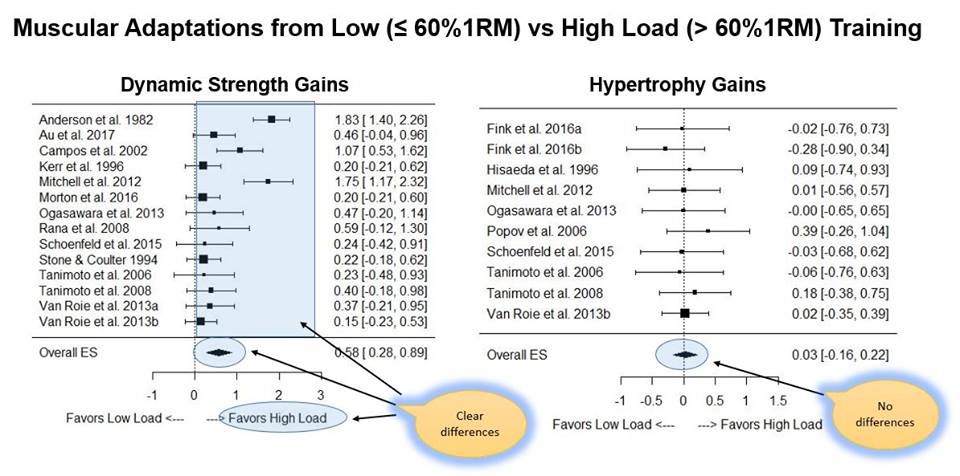
(image: Schoenfeld, B.J et, al. (2017). Strength and hypertrophy adaptations between low- versus high-load resistance training)
Interestingly enough, the data pool suggests that while it’s fundamentally clear that heavier loads are needed in order to increase strength gains, it’s entirely possible to create muscular hypertrophy adaptations in circumstances of low load training.
If we take a look at the above chart, all markers that fall to the right of the centre line, show that heavier loads hold a clear advantage, while everything falling to the left demonstrate low loads being advantageous.
The bottom line?
It’s entirely possible to build muscle whilst using loads lower than 60% of your 1rm. It’s easy to attach the principle of ‘progressive overload’ to simply adding more weight to the bar, while in reality there are many forms of the mechanism.
Decreasing rest times, increased frequency, increased volume, increasing time under tension, greater internal connections to contractions, velocity, loading through different ranges of motion, mechanical drop sets.
The list could go on.
The concept of ‘progressive overload’ in reality, is the ability to bring about increasing levels of stimulus of which to adapt. Do this over a long period of time, and you’ll be putting yourself in a good position to progress, extra load isn’t the only variable we can manipulate.
Oh, and if you want to get stronger, lift heavier.
5. Want to decrease your x-country time? Check this study out.
Coincidentally, prior to writing up this study I stumbled upon all of my old x-country medals/trophies/certificates/other causes of inflammatory hubris.
Turns out, I was quite the little runner in high school, unleashing those pale, peg-like legs and representing South Wales on the odd occasion.
As coincidence (or fate) would have it, an incredibly relevant study was accepted and published by the Journal of Strength & Conditioning research this August, examining high school x-country runners.
Naturally, my curiosity prevailed and I had to take a peek at the findings. After all, this new information might have been the missing link in my progression!
It’s theorised that a key reason for a decrease in running efficiency and therefore running economy is due to the fatigue of the muscles that stabilise the movement.
This study examined whether a protocol in pelvic and core stability strength training had any beneficial relevance to high school x-country runners across a six-week period.
Race times were measured at three and six week intervals, and interestingly enough, both the control group and the pelvic protocol group saw decreases in their race times.
What does this tell us?
Core stability work might help, or it might not. I know, great stuff.
We can however, further ascertain that the primary method to get better at running, is to run more. Time on your running feet is the primary mechanism to build greater running efficiency and economy, thereby decreasing your race time.
Run more, get better.
Looks like I was never destined for greatness, and didn’t miss a trick in my running days after all.
I’m not sure if that’s a comfort or not.
Anyhow, if your preparing for a marathon and still have some thrist left for knowledge, then you gather a few more helpful tips from a blog we contributed to for Ashbounre Health, check it out here.
References
1. Robert R. Wolfe. (2017). Branched-chain amino acids and muscle protein synthesis in humans: myth or reality?. Journal of the International Society of Sports Nutrition
2. Baroni, Bruno et al. (2017). Full Range of Motion Induces Greater Muscle Damage Than Partial Range of Motion in Elbow Flexion Exercise With Free Weights. Journal of Strength & Conditioning Research:. 31, 2223-2230.
3. Cavanaugh, Mark T et al. (2017). Foam Rolling of Quadriceps Decreases Biceps Femoris Activation. Journal of Strength & Conditioning Research:. 31 (.), 2238-2245.
4. Schoenfeld, Brad & Grgic, Jozo & Ogborn, Daniel & Krieger, James. (2017). Strength and hypertrophy adaptations between low- versus high-load resistance training: A systematic review and meta-analysis. Journal of strength and conditioning research. 10.1519/JSC.0000000000002200.
5 .Clark, Anne W et al. (2017). Effects of Pelvic and Core Strength Training on High School Cross-Country Race Times. Journal of Strength & Conditioning Research. 31 (.), 2289-2295
Is muscle soreness a reliable indicator of a good workout?
If you’ve ever picked up a weight and swung it around a few times you’ll inevitably wake up the following day thinking, “Oh my God, I can hardly move…”
This is known as Delayed Onset Muscle Soreness (DOMS). Presenting itself 24 to 72 hours after exercise, it’s most commonly seen in people who are new to training or those who have been inactive for long periods of time (MacIntyre, DL. et al. 1995).
For individuals new to training, waking up in pain often has negative connotations and can be worrying, especially if you aren’t made aware of it and if you don’t understand the mechanics behind it.
Nevertheless, for those of us who are regular gym-goers we relish the pain and look forward to the prospect of waking up sore, as for us it’s a psychological indictor of a good session and hard work.
Now it may be an indicator for us psychologically, but what about physiologically? Can we use muscle soreness (DOMS) as a gauge to reliably indicate how successful our workout was?
Well to answer this we should first need to define what DOMS is and why it occurs.
Originally, DOMS was thought to be caused by a build-up of lactic acid and metabolic waste that comes from training, but this has now largely been refuted. Although the exact mechanism still isn’t well understood, we do know DOMS is brought about through unaccustomed eccentric muscle action, causing a disruption of connective and/or contractile tissue (Cheung, K. 2003).
It is not a singular mechanism but rather a result of several mechanisms beginning with micro-trauma, and followed by an inflammatory response in the muscle (Lewis, PB. 2012).
In short, DOMS is an inflammatory response to tiny tears (micro-trauma) in the connective tissue caused by training.
It’s worth noting exercises that emphasise the eccentric contraction of a lift will have the greatest influence on DOMS, more so than concentric or isometric contractions (Faulkner, JA. 1993).
Why DOMS manifests itself as pain remains somewhat unclear, it may be attributed to some form of self-protection mechanism to prevent further damage, as DOMS has been shown to impair force output for up to 24 hours following exercise, as well as altering walking and running biomechanics (Paschalis, C. et al. 2007) (Vila-Chã, C. et al. 2012).
This is one of the reasons we tend to discourage people from training the same muscle group two days in a row, and rather have a rest day or perform a split-body routine.
So, knowing that DOMS is a response caused by trauma and damage to a muscle, can we be right in thinking that DOMS leads to more muscle growth and a sign of a great workout?
Well no, as I’m afraid it’s not quite that simple.
Yes, there’s a strong correlation between DOMS and exercise-induced muscle damage. However, when we’re looking to build muscle (hypertrophy) there are three key mechanisms we need to factor in: mechanical tension, metabolic stress muscle damage.
Muscle damage does lead to hypertrophy but it’s only part of the puzzle, as hypertrophy can still occur without it, via mechanisms one and two – mechanical tension and metabolic stress. (Schoenfeld B. 2010).
A recent paper published in the Journal of Strength and Conditioning stated:
“Although DOMS may provide a general indication that some degree of damage to muscle tissue has occurred, it cannot be used as a definitive measure of the phenomenon,”
and then went on to conclude:
“It remains debatable as to whether DOMS is an accurate gauge of muscle damage.” (Schoenfeld B, Contreras B. 2013).
So, although DOMS may provide some indication of muscle damage, it’s definitely not a reliable indicator and it won’t always reflect the magnitude of the damage, or occur at all.
If you’re using your ‘soreness’ as way to measure whether you’ve had a productive session then you need to think again, as studies have shown that even after a single bout of exercise DOMS can be significantly reduce in subsequent sessions (Nosaka, K. 2001), and these effects persist for at least several weeks (Clarkson, PM. 1992).
This would explain why soreness is common at the beginning of a new programme or to someone who’s new to exercise, but eases as time goes by.
My take home message:
DOMS is a result of training and is something we should neither be worried about nor obsess over.
As handy as it would be to use DOMS as a way of measuring your workout’s productiveness, it’s both unreliable and terribly inaccurate.
It’s also worth mentioning that certain techniques such as foam rolling (as I discussed last week) can reduce DOMS, along with adequate sleep, nutritional intake and supplementation – protein post workout has proven to be effective in reducing DOMS post-exercise (Shimomura Y. 2010) along with the consumption of caffeine prior to training, another win for coffee lovers! (Hurley CF. 2013).