I was in the gym the other day when I overhead a client complaining to her personal trainer that the reason she was unable to lose any weight is because she’s addicted to sugar. She continued to justify her addiction by saying how there’s one study showing sugar to be more addictive than cocaine!
Well, as you can imagine I wanted to share my two cents but decided to stay well out of the conversation. However, it has led me to answer the question about whether eating sugar really does make us gain more weight.
First, let me address the sugar/cocaine study. Yes, there is a study from back in 2007 that concluded sugar was more addictive than cocaine. The basic outline was that rats were given cocaine until they became dependent on it. Then, researchers provided them a choice where they could continue to have the cocaine or they could switch to sugar. Surprise, surprise, they (94%) chose to make the switch over to sugar – from this result the researchers concluded:
“that intense sweetness can surpass cocaine reward, even in drug-sensitized and -addicted individuals.”
And now everyone who’s campaigning against sugar seems to reference this study to back their argument up.
However, let’s just stop to think about this for a second… the rats were fed cocaine until they became dependent on it, which means this was their main source of ‘food.’ The researchers then introduced them to sugar to give them a choice between cocaine and sugar… of course they’re going to choose the sugar over cocaine, they’re rats and their first instinct is to survive!
Gosh, I bet if you gave them a choice between cocaine and blueberries, or cocaine and tuna, they would all turn to the blueberries and tuna, because it’s food! This doesn’t suddenly mean blueberries or tuna are more addictive than cocaine… our survival mechanisms will always make us choose the one that will keep us alive.
So really, this is a hugely flawed and unfair set of results and should be ignored when making an argument against sugar.
Other commonly cited studies among the ‘sugar haters’ are ones from 2004 and 2007, that show correlations between the populations’ rise in obesity and our consumption of sugar from the 1960s to early noughties.
If you were to just look at the data up until 2000, you could be fooled into thinking sugar intake was the cause for our rise in obesity. However, if you then look beyond 2000 and into more recent years, you’ll find this association disappears. In fact, from the early noughties right the way through to 2013, our intake of sugar falls while obesity rates continue to climb. [1]
.jpg)
Sugar isn’t inheritably fattening, but like any food can cause weight gain if you’re overfeeding (Te Morenga 2012). If you’re under eating and in a caloric deficit then it doesn’t matter whether you’re on a low fat, high sugar diet, a low fat, high carb diet, or even a high sugar diet where almost 50% of your calories are coming from sugar – there is no difference in weight loss or fat loss between either diets. (West & De Looy 2001) (Saris, et al. 2000) (Surwitt, et al 1997).
So, if our intake of sugar is declining why is obesity still on the rise? Well the fact of the matter is we’re eating more but moving less. Data shows we’re now eating around 500 calories more than we were in the 1960s, and that the energy we expend through moving around is 142 calories lower from what it once was (Church TS, et al. 2011).
Hence why we’re now recommended to reach 10,000 steps per day, enough to burn around 500 calories, the additional calories we’re now consuming.
The only problem I can see with sugar is how palatable it is – it tastes great and we all love it, hence why it’s used in a lot of foods. Sugar on its own isn’t ‘evil’, but a lot of foods that contain high amounts of sugar also contain high amounts of fat, as the two together make our taste buds dance like crazy! The problem is, these foods don’t seem to fill us up in the same way foods high in protein and fibre do, so we’re always left craving more…
Bonus note: as you’ve just learnt when it comes to adding sugar into your diet you have nothing to fear. However, things do become a little more complicated when looking at how sugar and glucose metabolism works in obese individuals – something I will cover in a future post.
References:
1. wholehealthsource.blogspot.co.uk/2015/11/carbohydrate-sugar-and-obesity-in.html
Understanding the differences between split squats and lunges
Today I bring you a first; a Friday’s fun fact in video format…
This was inspired by our lower body execution day, which we held last weekend.
One of the difficulties we encounter as trainers is in the way split squats, but more so lunges are taught and executed, with a lot of people recruiting too much of their quadricep muscles in a lunge as opposed to their hamstrings and glutes.
Now yes, they may look rather similar but looks can be deceiving as a little like the word ‘ciao’ which means both “Goodbye” in Italy but also “Hello” in Vietnamese, the split squat and the lunge are (technically) total opposites – a lot like the cultural meaning of ‘ciao.’
Trying to favour the hamstrings/glutes over the quadriceps while lunging isn’t always easy work however, if you follow the points I address in this video you’ll soon understand the differences between the two exercises and bd better able to recruit the correct muscles when performing either exercise.
Three reasons why you should take up strongman training
Anyone new to the fitness game will inevitably find the endless choice of exercise equipment overwhelming. Not only is there the choice between cardio or weights, but now with the rise of crossfit-based box gyms and commercial gyms investing more into cardio-based resistance equipment such as prowlers, kegs, tyres and batteling ropes, the average gym goer can now dump the cross-trainer in favour of flipping tyres and pushing a prowler double their own bodyweight down a track, effectively training like a strongman athlete. But how will this impact strength, muscle building and getting lean?
Let’s look at strength first.
Strongman training was put to the test for the first time in a study comparing a strongman programme to a traditional strength programme. The study, carried out over 7 weeks, measured body composition, strength, power, and speed. All performance measures improved up to 7% in both groups, particularly in 1 repetition max strength over the bent over row, squat and deadlift.
However it’s important to note that this could simply be down to the change in stimulus for participants; as we know from Owen’s recent blog post looking at the benefits of programme periodization, training programmes should be revamped regularly to create a new stimuli for our body to adapt to. This change forces new neuron pathways to be created, thus allowing for more strength gains.
So next time the sun’s out, maybe ditch the monotonous cycle of endless squats and deadlifts and allow your body to try something new.
Secondly, is strongman training effective for building muscle?
To build muscle, the muscle in question needs to be under tension for a long period of time. Hypertrophy based programmes usually contain sets lasting up to 30-45 seconds. This is very similar to most strongman events, which usually have the participant training under heavy loads for 30-60 seconds.
The second important factor in building muscle is not in the training itself but in the recovery. A muscle will not grow if it does not recover. Research has found that after a sled drag session completed with 75% body weight, participants saw large elevations in blood lactate and testosterone. This increase in testosterone was still present at the 24-hour recovery mark. Researchers believe this indicates a rebound effect which aids in recovery.
So the answer to our second question is yes; the only downfall of strongman training for hypertrophy would be in the inability to target specific muscles groups.
Will training like a strongman get me lean?
Over the years there has been an increase in High Intensity Interval Training (HITT) among people wishing to lose body fat. These sessions are commonly carried out on a stationary bike or cross trainer. However, teaming HITT training with resistance equipment such as a prowler, sled, keg or tires could further increase your calorie burn. Not only are you burning calories through rapidly raising and lowering your heart rate, but as strongman training helps with hypertrophy, you’ll also be building functional muscle.
Cardio-based resistance exercises (i.e. strongman exercises) produce higher levels of lactate in the blood, releasing a large amount of growth hormone which stimulates fat burning. This was seen in a 400m car push test compared to a maximal treadmill test; blood lactate levels reached 15.06mmol/L. 31% higher during the car push than the max treadmill test. However, this is an exhausting event and would not be recommended for many people at all! A similar stimulus can be created through 5x (2x 20m) sled drags loaded with 75% bodyweight, something our members at Trimnasium and Studio PT will be familiar with!
To conclude, strongman training isn’t the only form of training which will help you reach your fitness goals, but you should definitely consider it, and it should be deemed just as important as traditional forms of training. At Hall Personal Training we recommend keeping your training stimulus changing every 4-8 weeks, and throwing some strongman training into the works could help you with just that!
Are liquid calories ruining your diet?
If you’re struggling to lose weight despite feeling that you eat really healthily, then you may well find this insightful; “liquid calories” could be your stumbling block. If you want to lose weight, then it’s crucial that you become more mindful about what you’re drinking.
However, the difficulty we’re faced with is that liquid calories are also “hidden calories,” meaning that most people are completely unaware how many calories they’re consuming through their drinks. You see, an interesting thing about liquid calories is that they don’t appear to register with the brain in the same way calories from food do (Vartanian LR. 2007). In other words, drinks provide a sneaky way to consume extra energy and to pack on a few extra pounds (DiMeglio DP, Mattes RD. 2000).
I guess this is the reason doctors prescribe high-calorie drinks to both the elderly and those who are suffering from certain eating disorders, to help promote weight gain.
The average adult consumes a little over 500 calories per day from beverages alone, (Drewnowski A. 2013), with drinks being the largest source of added sugars in our diet (Huth PJ, Fulgoni VL, Keast DR et al 2013).
For example, a Starbucks Spiced Pumpkin Latte has recently gone on sale, personally I’m not fan, but I know a lot of you are and they’re all the rage around this time of year however, at whopping 380 calories and 50g sugar it literally takes the place of a small meal… and that’s for a medium cup!
If you stop to think about that for a second… 380 calories; for what’s essentially a fancy coffee, you’ll begin to realise how mad and easy it is to drink away your calories. I actually spoke to the Daily Mail about hidden calories in coffee-shop drinks a couple of years ago.
To put this figure into perspective, doctors, nutritionists and even our personal training team will likely recommend close to a 500-calorie deficit to help kick start weight loss. If you keep an eye on what you’re drinking, losing weight will often be as easy as a walk in the park, and even that’ll help too!
This is just one instance where liquid calories can slip under the radar.
The term liquid calories can umbrella a whole array of foods/beverages that you probably wouldn’t otherwise consider thinking twice about consuming, but all add up:
• cooking oils – average of 120 calories per serving
• fruit juices – average of 100 calories per 200ml
• milk – average of 50 calories per 50ml
• protein shakes – average of 200 calories per shake
• flavoured water – average of 50 calories per 500ml
• fizzy, sugary drinks – average of 150ml per can
• energy drinks – average of 100 calories per can
• pouring cream – average of 70 calories per 15ml – I’ll admit, I used to be a sucker for adding pouring cream to my coffee, but when I actually stopped to check how many calories I was drinking, which was in excess of 220Kcals from cream alone, I quickly stopped and started taking it black, or adding a dash of single cream.
Oh, and let us not forget alcohol. Yes sorry, it too falls under the liquid calorie umbrella, with an average glass of wine providing around 125Kcals – not too bad you say?… Sure, but let’s not kid ourselves as when do we ever have just the one glass…? More like half the bottle, which comes in at around 325 calories!
As you can see, the calories we consume in the form of liquids really can add up, and can begin to limit to your ability to lose weight.
Luckily, liquid calories are as easy to reduce as they are to consume. By being more aware of what you’re drinking and more importantly, how many calories you may just be pouring down your throat, it becomes easier to identify any extra calories you may be consuming.
Five things we learned about fitness in August
From debunking the myth behind BCAA supplementation on muscle growth, to foam rolling and shirt splitting arm science, August’s fitness research has covered it all. Our level 5 trainer Owen has sifted through it all to bring you some gems you can apply to your own training straight away – enjoy!
1. Branched-chain amino acids and muscle protein synthesis in humans: myth or reality?
If you’ve ever had a peek inside a sports nutrition shop, scrolled through a few health websites or simply seen one of the tens of thousand “ADD GENERICFITPROCOMPANY to get your X,Y,Z” on instagram, you’re more than likely familiar with the supplement BCAAs.
If you’re not, congratulations, you’ve probably saved yourself some cash.
Despite commonly held beliefs that these Branched Chain Amino Acids promote anabolism (the growth of tissue) and stave off catabolism (the breakdown of tissue), a recent review by Robert Wolfe (2017) suggests otherwise.
I’ll save you the in depth biochemical details (which are all examined here), and skip to the punch line.
In order to achieve sufficient MPS (muscle protein synthesis) to grow muscle tissue, all EAA (the 9 essential amino acids) are required. This means that the three isolated EAA’s found in BCAAs fall short of the ability to stimulate MPS to the extent of anabolism.
Further to this, the paper theorizes that due to the competition of leucine, iso-leucine and valine for transporters to the cell, MPS may actually be rate-limited by their co-ingestion. This explains why leucine in isolation has been shown to have positive effects on MPS, whilst BCAA’s tend to skew negatively.
Now if you managed to make it through all of those many acronyms, the important take homes are these:
BCAAs do not promote MPS in isolation, all of the amino acids that the body cannot produce are needed. Not only that, but due to the competition of transportation, BCAAs may actually limit MPS, and blunt anabolism.
All in all, this is perhaps the most damning review of BCAAs to date. The kind of stuff that sends a cold chill down the neck of supplement companies everywhere.
My advice?
Whey protein is cheaper, has a full amino acid profile, and has been shown to increase MPS in a peri-workout window.
When total protein is accounted for, there is no coherent reason to be using BCAAs.
Unless of course, you happen to like the taste of particularly expensive flavoured water.
2. The Real Secret to Shirt Splitting Arms (Click Bait Alert)
If you’ve ever meandered into the free weights section of the gym on a Friday night, you’ll be fully aware of the vast quantity of males gathering around the Preacher Curl machine.
Come 6:30pm, not a single EZ Bar nor 10kg dumbbell will be free for use. Not unlike a holy ritual, the clubbers and pubbers of the city amass to pay their respects to the iron.
As far as I’m aware, the practice of training biceps on a Friday evening has been around for as long as the working week has.
Yet when it comes to mastering the art of crafting biceps that render sleeves useless, should we be using heavier loads, or focusing on precise execution?
A recent study, freshly published in the Journal of Strength and Conditioning, sought to provide us with some clarity, comparing two groups using full ROM (range of motion) and partial ROM using 80% 1RM on unilateral elbow flexion on the Scott Bench.
Despite the peak torque, soreness from palpation and arm circumference being statistically similar between conditions, more expressive muscle damage was found in the full ROM (range of motion) group.
As muscle damage is a key pathway towards increasing hypertrophy in a given muscle, we can extrapolate from this study that full ROM exercises are more beneficial than partials for promoting tissue growth, despite the greater absolute load lifted under the partial ROM circumstances.
So if you ever find yourself in that 6:30pm Friday crowd, opt for tighter execution, and eek out as much ROM as you comfortably can.
You’ll be splitting shirts in no time.
Bonus tip:- Pre-shrink your shirt sleeves in the wash. It’s a thing. Unfortunately.
3. Leg Day, Is foam rolling worth our time?
If you’re a regular reader of our blog spot, you may have noticed that our main maestro Chris Hall recently dove into the depths of foam rolling, discussing what it actually does, the benefits and the potential pitfalls.
While I won’t be following Chris down that frightfully deep rabbit hole today, generally speaking the practice of SMR (self-myofascial release) can acutely increase flexibility and aid blood flow to the targeted area, making it a good option before partaking in physical activity.
Not only that, but foam rolling seems to trend towards a ‘cross-over flexibility’ effect, meaning that if you foam roll one area, a corresponding area may actually become more flexible. For instance, rolling out the bottom of the foot with a tennis ball may improve hamstring flexibility.
However, an interesting study published this month by Cavanaugh M.T (2017) found that this isn’t the case in all muscle groups.
The research team found that when SMR was performed on the quadricep muscles, subsequent activation of the bicep femoris (hamstring) decreased significantly. There was no such change in the quadriceps when the hamstrings were rolled.
What does this mean?
Although this is just one study out of many, and no firm conclusions can be drawn yet, it might be an idea to leave the quadriceps out of your next foam rolling routine, particularly if you have a hamstring-biased session.
I also do this because my quads always hurt so much I want to cry.
So much pain, many ouches.
4. The low down on low load training, can you still build muscle?
As personal trainers, I think it’s safe to say that we’re pretty obsessed with adding weight to the bar. In order to disrupt homeostasis and adapt our bodies, increasing levels of stimulus need to be accounted for over a long period of time.
Progressively loading more weight onto a bar continuously allows for appropriate stimulus of which to adapt, building larger, stronger muscles.
Yet while progressive overload is an incredibly (if not the most) important aspect of hypertrophy, is it possible to build muscle using lower relative loads?
There have actually been several studies that have previously shown this could be the case, yet no clear review to pool this data and come up with a conclusive answer.
Enter Schoenfeld B.J. et al. (2017)
This much needed systematic review observed data from 21 of available studies that met the requirement of:
– Using both >60% 1rm and <60%1rm loads.
– All sets in all training protocols reaching momentary muscular failure.
– At least one method of estimated/observing changes in muscle mass and/or dynamic, isometric or isokinetic strength.
– The training protocol lasted a minimum of 6 weeks
– No participants had pre-existing medical conditions that would disrupt potential results.
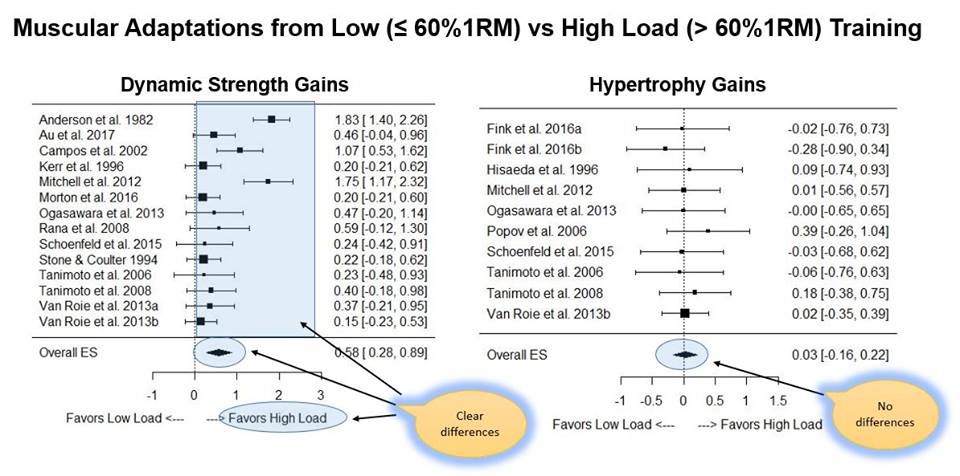
(image: Schoenfeld, B.J et, al. (2017). Strength and hypertrophy adaptations between low- versus high-load resistance training)
Interestingly enough, the data pool suggests that while it’s fundamentally clear that heavier loads are needed in order to increase strength gains, it’s entirely possible to create muscular hypertrophy adaptations in circumstances of low load training.
If we take a look at the above chart, all markers that fall to the right of the centre line, show that heavier loads hold a clear advantage, while everything falling to the left demonstrate low loads being advantageous.
The bottom line?
It’s entirely possible to build muscle whilst using loads lower than 60% of your 1rm. It’s easy to attach the principle of ‘progressive overload’ to simply adding more weight to the bar, while in reality there are many forms of the mechanism.
Decreasing rest times, increased frequency, increased volume, increasing time under tension, greater internal connections to contractions, velocity, loading through different ranges of motion, mechanical drop sets.
The list could go on.
The concept of ‘progressive overload’ in reality, is the ability to bring about increasing levels of stimulus of which to adapt. Do this over a long period of time, and you’ll be putting yourself in a good position to progress, extra load isn’t the only variable we can manipulate.
Oh, and if you want to get stronger, lift heavier.
5. Want to decrease your x-country time? Check this study out.
Coincidentally, prior to writing up this study I stumbled upon all of my old x-country medals/trophies/certificates/other causes of inflammatory hubris.
Turns out, I was quite the little runner in high school, unleashing those pale, peg-like legs and representing South Wales on the odd occasion.
As coincidence (or fate) would have it, an incredibly relevant study was accepted and published by the Journal of Strength & Conditioning research this August, examining high school x-country runners.
Naturally, my curiosity prevailed and I had to take a peek at the findings. After all, this new information might have been the missing link in my progression!
It’s theorised that a key reason for a decrease in running efficiency and therefore running economy is due to the fatigue of the muscles that stabilise the movement.
This study examined whether a protocol in pelvic and core stability strength training had any beneficial relevance to high school x-country runners across a six-week period.
Race times were measured at three and six week intervals, and interestingly enough, both the control group and the pelvic protocol group saw decreases in their race times.
What does this tell us?
Core stability work might help, or it might not. I know, great stuff.
We can however, further ascertain that the primary method to get better at running, is to run more. Time on your running feet is the primary mechanism to build greater running efficiency and economy, thereby decreasing your race time.
Run more, get better.
Looks like I was never destined for greatness, and didn’t miss a trick in my running days after all.
I’m not sure if that’s a comfort or not.
Anyhow, if your preparing for a marathon and still have some thrist left for knowledge, then you gather a few more helpful tips from a blog we contributed to for Ashbounre Health, check it out here.
References
1. Robert R. Wolfe. (2017). Branched-chain amino acids and muscle protein synthesis in humans: myth or reality?. Journal of the International Society of Sports Nutrition
2. Baroni, Bruno et al. (2017). Full Range of Motion Induces Greater Muscle Damage Than Partial Range of Motion in Elbow Flexion Exercise With Free Weights. Journal of Strength & Conditioning Research:. 31, 2223-2230.
3. Cavanaugh, Mark T et al. (2017). Foam Rolling of Quadriceps Decreases Biceps Femoris Activation. Journal of Strength & Conditioning Research:. 31 (.), 2238-2245.
4. Schoenfeld, Brad & Grgic, Jozo & Ogborn, Daniel & Krieger, James. (2017). Strength and hypertrophy adaptations between low- versus high-load resistance training: A systematic review and meta-analysis. Journal of strength and conditioning research. 10.1519/JSC.0000000000002200.
5 .Clark, Anne W et al. (2017). Effects of Pelvic and Core Strength Training on High School Cross-Country Race Times. Journal of Strength & Conditioning Research. 31 (.), 2289-2295
Caffeine addict or chronically stressed? You need Adaptogens.
So today’s Friday’s Fun Fact is a little different as in all honestly this week has been crazy, with no real time to come up for air.
Stress this week has certainly been my accompanying partner, after launching Cheltenham, the arrival of two new trainers and being asked to speak at a Virgin Sport event – we’ve not spread out the workload too well! The greatest stress is knowing things aren’t going to slow down, and I’ve been relying on caffeine and coffee to keep me going.
But is that a good idea? Probably not… if you’re a caffeine addict too, read on.
Let’s be clear about one thing, I like caffeine and I absolutely love coffee, I’m not arguing with that, but relying on caffeine or other stimulants as an energy boost for a long-term solution is a little like relying on petrol to start a campfire.
Your ability to produce energy is like a campfire. You look for good-sized logs that will burn for a long time, providing a consistent amount of heat. You can use the campfire for warmth, to cook and even for protection. The wood you gathered burns steadily and you have a good supply of additional wood to add to the fire when necessary.
Throwing petrol on your campfire may cause the fire to burn brighter and hotter (for a moment), but it’s not safe or well-controlled. It quickly burns up the logs used to make it, leaving you with a pile of burnt-out ashes before you even had time to gather up more fire wood – no amount of petrol is going to relight those ashes and fix the problem.
So, if we’re heading into stressful times we need to ditch the petrol canister and go out to find our supply of fuel, otherwise we’re likely to ‘burn-out the fire.’
But is there anything that can help to tackle the stress? Well, Adaptogens could be the answer.
What are adaptogens?
Adaptogens are plant or fungus compounds that can both support the body against the effect of stress, and also strengthen and rejuvenate the body after prolonged exposure to stress. Whether you’re in a state of high stress or low stress, adaptogens can help to restore balance. (Panossian A & Wikman G. 2010).
Western-style research into the compounds didn’t begin until 1947, when the Soviets were looking for compounds to strengthen and protect their soldiers (Brekhman, I.I Dardymov, I.V 1969).
They found that these compounds helped regardless of the source of the stress (chemicals, environment, stress from physical activity, psychological stress etc.). When adaptogens were used, they saw a decrease in illness, faster recovery from physical exertion, and an improved level of homeostasis and wellbeing.
As well as the above, adaptogens have also been shown to:
• increase mental performance and physical work capacity in sleep deprived people (Shevtsov VA. et al. 2003)
• reduce symptoms of both anxiety and depression (Andrade et al. 2000) with Ashwaganda showing up to a 56% reduction in symptoms in people with anxiety (Cooley K et al. 2009)
• help improve life and work-related stress (Edwards D, et al. 2012)
• Rhodiola Rosea has been shown to help people to improve performance on work-related tasks by about 20% (Darbinyan V, et al. 2000)
• What’s more is that adaptogens have been shown to take effect within as little as 30 minutes, with the benefits continuing for at least 4-6 hours (Panossian A. 2005)
If, like me, you’re reading this thinking they’re exactly the type of firewood I need to light my fire and they sound awesome, then here’s a list of your most popular adaptogens:
Asian ginseng*
Holy Basil
Ashwagandha*
Cordyceps
Schisandra
Siberian ginseng
Reishi
Shiitake
Rhodiola Rosea*
*most extensively studied adaptogens in the scientific literature.
Now, the next time you’re having to deal with choric periods of stress stop throwing the petrol over the fire by spending your time at the coffee machine, but rather gather up some fire wood and start taking one of these adaptogens.
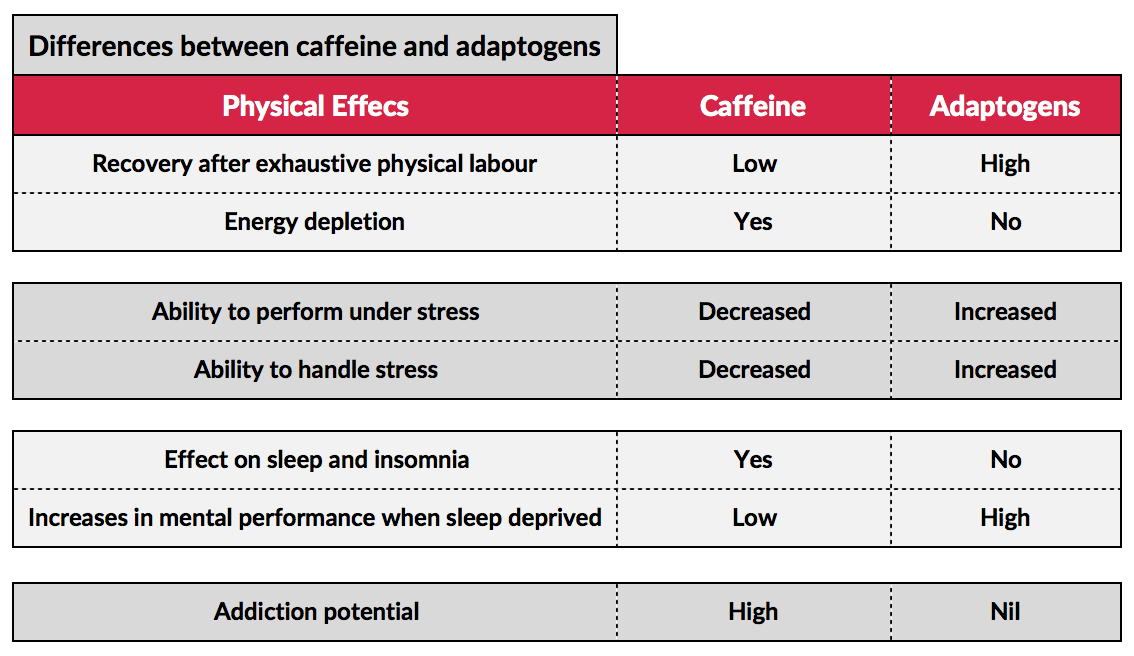
Here’s a brief list I’ve pieced together comparing the differences between caffiene and adaptogens based on the scientific evidence and work Alexander Panossian’s done over the years on adaptogens:
Is muscle soreness a reliable indicator of a good workout?
If you’ve ever picked up a weight and swung it around a few times you’ll inevitably wake up the following day thinking, “Oh my God, I can hardly move…”
This is known as Delayed Onset Muscle Soreness (DOMS). Presenting itself 24 to 72 hours after exercise, it’s most commonly seen in people who are new to training or those who have been inactive for long periods of time (MacIntyre, DL. et al. 1995).
For individuals new to training, waking up in pain often has negative connotations and can be worrying, especially if you aren’t made aware of it and if you don’t understand the mechanics behind it.
Nevertheless, for those of us who are regular gym-goers we relish the pain and look forward to the prospect of waking up sore, as for us it’s a psychological indictor of a good session and hard work.
Now it may be an indicator for us psychologically, but what about physiologically? Can we use muscle soreness (DOMS) as a gauge to reliably indicate how successful our workout was?
Well to answer this we should first need to define what DOMS is and why it occurs.
Originally, DOMS was thought to be caused by a build-up of lactic acid and metabolic waste that comes from training, but this has now largely been refuted. Although the exact mechanism still isn’t well understood, we do know DOMS is brought about through unaccustomed eccentric muscle action, causing a disruption of connective and/or contractile tissue (Cheung, K. 2003).
It is not a singular mechanism but rather a result of several mechanisms beginning with micro-trauma, and followed by an inflammatory response in the muscle (Lewis, PB. 2012).
In short, DOMS is an inflammatory response to tiny tears (micro-trauma) in the connective tissue caused by training.
It’s worth noting exercises that emphasise the eccentric contraction of a lift will have the greatest influence on DOMS, more so than concentric or isometric contractions (Faulkner, JA. 1993).
Why DOMS manifests itself as pain remains somewhat unclear, it may be attributed to some form of self-protection mechanism to prevent further damage, as DOMS has been shown to impair force output for up to 24 hours following exercise, as well as altering walking and running biomechanics (Paschalis, C. et al. 2007) (Vila-Chã, C. et al. 2012).
This is one of the reasons we tend to discourage people from training the same muscle group two days in a row, and rather have a rest day or perform a split-body routine.
So, knowing that DOMS is a response caused by trauma and damage to a muscle, can we be right in thinking that DOMS leads to more muscle growth and a sign of a great workout?
Well no, as I’m afraid it’s not quite that simple.
Yes, there’s a strong correlation between DOMS and exercise-induced muscle damage. However, when we’re looking to build muscle (hypertrophy) there are three key mechanisms we need to factor in: mechanical tension, metabolic stress muscle damage.
Muscle damage does lead to hypertrophy but it’s only part of the puzzle, as hypertrophy can still occur without it, via mechanisms one and two – mechanical tension and metabolic stress. (Schoenfeld B. 2010).
A recent paper published in the Journal of Strength and Conditioning stated:
“Although DOMS may provide a general indication that some degree of damage to muscle tissue has occurred, it cannot be used as a definitive measure of the phenomenon,”
and then went on to conclude:
“It remains debatable as to whether DOMS is an accurate gauge of muscle damage.” (Schoenfeld B, Contreras B. 2013).
So, although DOMS may provide some indication of muscle damage, it’s definitely not a reliable indicator and it won’t always reflect the magnitude of the damage, or occur at all.
If you’re using your ‘soreness’ as way to measure whether you’ve had a productive session then you need to think again, as studies have shown that even after a single bout of exercise DOMS can be significantly reduce in subsequent sessions (Nosaka, K. 2001), and these effects persist for at least several weeks (Clarkson, PM. 1992).
This would explain why soreness is common at the beginning of a new programme or to someone who’s new to exercise, but eases as time goes by.
My take home message:
DOMS is a result of training and is something we should neither be worried about nor obsess over.
As handy as it would be to use DOMS as a way of measuring your workout’s productiveness, it’s both unreliable and terribly inaccurate.
It’s also worth mentioning that certain techniques such as foam rolling (as I discussed last week) can reduce DOMS, along with adequate sleep, nutritional intake and supplementation – protein post workout has proven to be effective in reducing DOMS post-exercise (Shimomura Y. 2010) along with the consumption of caffeine prior to training, another win for coffee lovers! (Hurley CF. 2013).
Foam rolling – is it a waste of time?
It seems whatever gym or health club you walk in to, you’re bound to see people rolling around with a look of pain on their faces as they incur the torture of the foam roller.
Ten years ago, when I first started out in the fitness industry, it was difficult to find any gym that had foam rollers… now, I can guarantee you’ll struggle to find a gym that doesn’t have them.
So why the sudden boom, and what attracts us to want to roll around on the floor using something which quite frankly, causes me to grit my teeth in an expression of pain?
Well the answer lies in releasing myofascial – a fancy way of saying: improving the flexibility of the fascia tissue that surrounds our muscles.
Foam rolling, or Self-Myofascial Release (SMFR) as it’s more commonly referred to in the fitness industry is the term given to a specific form of manual therapy that is intended to release the fascia tissue, allowing for an improvement in range of motion and flexibility. Many trainers and therapists will recommend foam rolling as a way to improve flexibility, reduce muscle soreness and ‘break down the fascia tissue.’
I’ll be the first to admit, ten years ago when I use to recommend to clients they ‘rolled out’ I used to say:
“it was like using a rolling pin to roll out dough,” and told them that:
“a foam roller essentially helps to roll out clumped up and knotted fascia tissue to help reduce adhesions and make it more elastic.”
Oh how wrong I was, as now we now know that’s not the case! Advances in science have shown us we cannot simply ‘release’ fascia. Not unless you apply 2000lbs of force per square inch (Lawrence A. 2016), something I’m pretty sure a foam roller cannot deliver… I know it hurts but that pain would be something else entirely.
So, if we’re unable to release this fascia manually, why do we see noticeable changes in flexibility and the way our muscles feel when we roll? As let’s be honest, several minutes on a foam roller and we feel great.
Well, the mechanism by which self-myofascial release works is unclear. Currently, the best evidence supporting it points towards a neurophysiological mechanism involving muscle activity for acute changes, in other words, maybe it’s all in our heads. Rolling on a roller sends signals to our brain, which in turn tells the central nervous (CNS) to relax the muscle.
Physically, you do increase blood flow to the rolled-out area, which will help to turn over any metabolic waste and help push through new oxygenated blood, having a positive effect.
Now if foam rolling works through a neurophysiological mechanism, does this mean the results people observe are a placebo, let’s take a look shall we?
• Improvements in range of motion and flexibility
It seems there is evidence to show foam rolling does lead to greater improvements in range of motion and flexibility, however these improvements are short lived.
When I say short lived, I mean the benefits in ROM after having foam rolled only seem to last for up to 10 minutes (Škarabot J et al. 2015). Nevertheless, if you intermittently foam roll after static stretching then these improvements in flexibility can last significantly longer (Behm, D. 2017).
There’s also evidence to show that there’s a cross-over flexibility effect. This means if you were to work on rolling out one area of the body, you would see improvements in another area (to a lesser extent than rolling the specific area).
Grieve et al. (2015) assessed the effects of using a tennis ball to roll out the bottom surface of the foot and subsequently reported improvements in hamstring flexibility.
Kelly & Beardsley (2016) found increases in the opposite ankle after the leg was foam rolled, suggesting a cross-over effect.
• Improvements in muscle soreness
Here at Hall Training we recommend you spend a couple of minutes after your session rolling out the muscles you’ve just worked to help reduce what’s known as “Delayed Onset Muscle Soreness” or DOMS. Research has found that spending time rolling out after exercise does lead to a dramatic drop in pain caused by DOMS (Vaughan and McLaughlin. 2014) (Pearcey GE. 2015).
– the only caveat here is the time needed to significantly see a reduction in pain associated with DOMS is anywhere between 3-20 minutes.
• Improvements in performance
Historically, many strength coaches would prescribe static stretching prior to resistance training to help athletes increase their ROM and improve joint mobility. However, improvements in ROM are only really observed when stretching for 45 seconds or more, which also the time when static stretching can produce undesirable short-term reductions in athletic performance – decreased strength and increased risk of injury (Kallerud and Gleeson, 2013).
One of the reasons foam rolling has taken off is its ability to increase flexibility without having detrimental effects on performance (Sullivan, K.M et al. 2013) (Behm, D. 2017).
• Possible improvements in cardiovascular system
I have emphasised the word ‘possible’ here as it’s the only study of its kind and with a small sample size but, scientists in Japan found the use of foam rolling led to improvements in arterial stiffness of the lower leg and improvements in Peripheral Artery Disease (PAD), a disease in which the arteries in your legs or arms are narrowed or blocked, which leads to poor circulation and risk of stroke of heart disease (Okamuto. 2013).
So there you have it, the real reasons why foam rolling has an effect on our flexibility, and a few other bonuses that are associated with it. All-in-all, it’s not so much of a waste of time.
My important and easy take home points:
1. For improvements in acute flexibility and ROM
As little as 5-10 secs of rolling is needed – easy (Sullivan, K.M et al. 2013).
I you require greater increases in flexibility that last longer (more than 10 minutes) then:
• 30-60 secs of rolling is required to which you can combine with 30-45secs of static stretching (Škarabot J et al. 2015) (Behm, D 2017).
2. For reduced muscle DOMs
Foam rolling for at least 3 minutes and up to 20 minutes after training seems to be required (Vaughan and McLaughlin. 2014) (Pearcey GE. 2015).
3. Improvements in flexibility without a detriment to performance
Foam rolling prior to training 30-60 seconds. Can combine with static stretching for further increases in ROM but keep to under 1 minute (Sullivan, K.M 2013) (Behm, D 2017).
4. Improvements to cardiovascular health
Although there is evidence to suggest foam rolling can lead to improvements in circulation and CV health, it does require you to roll 30 minutes at a time, something I feel is a little long and rather dull – your best bet would be to go out for 20-30 minute stroll, as the effects will be similar (Okamuto. 2013).
5. In a hurry…?
Then take advantage of cross-over effect – roll out the bottom of your feet to help release the hamstrings (Grieve et al. 2015) or, if you roll out one leg you’ll see improvements in the other leg too (Kelly & Beardsley 2016).
Attention: if you’re still someone who’s spending time rolling out their IT Bands then stop! As you really need to look at this before you continue wasting your time.
If you’ve come across something known as the IT band, then you will probably have heard a number of different and conflicting terms used to define both what it is and its purpose.
If you’ve never heard of it then great, as the below is all you need know!
Firstly, let me tell you what it isn’t!
The IT band isn’t:
• anything to do with IT, and provides no use whatsoever for computing or electronics
• the latest pop or rock band to hit the UK charts
• nor is it a type of radio frequency
So what do people think it is?
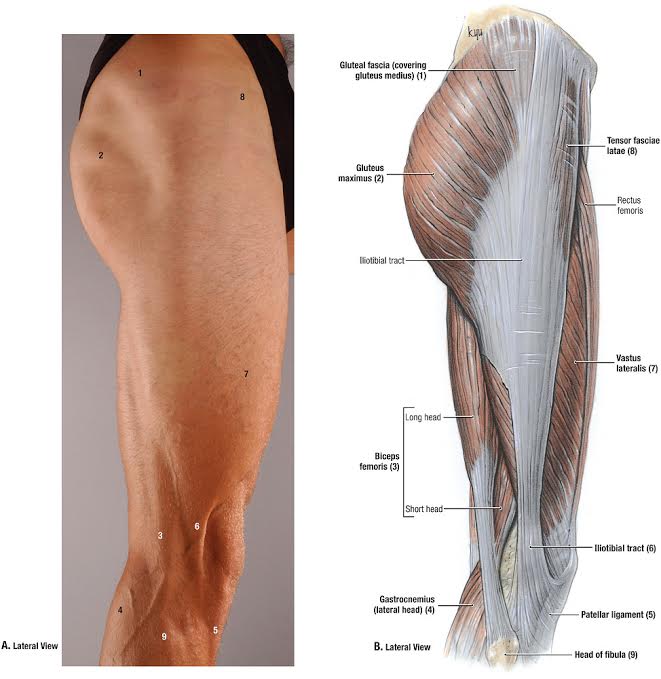
Well, the IT band, or “ITB”, refers to the Iliotibial Band. Now most people in the fitness industry will tell you the ITB is “a ligament that runs down the outside of the thigh, from the hip to the shin.” You may also hear trainers refer to it as “a muscle”, however, both statements are false.
For starters, ligaments are used to connect bone to bone, and if you know anything about the IT band and where it originates, you’ll know it doesn’t attach itself directly onto a bone.
It’s also important to note the IT band isn’t a muscle, but based on the way personal trainers talk about stretching it and rolling it, you could be forgiven for thinking it is. Whether other personal trainers realise it or not, the IT band is neither a ligament nor a muscle.
But what is it really?
The IT band is made up of fascia tissue, and multiple muscles insert onto IT (see what I did there). The two major muscles that make up the IT band are the gluteus maximus and the tensor fascia latae (TFL), which make up both the anterior and posterior portion of the band at the hip.
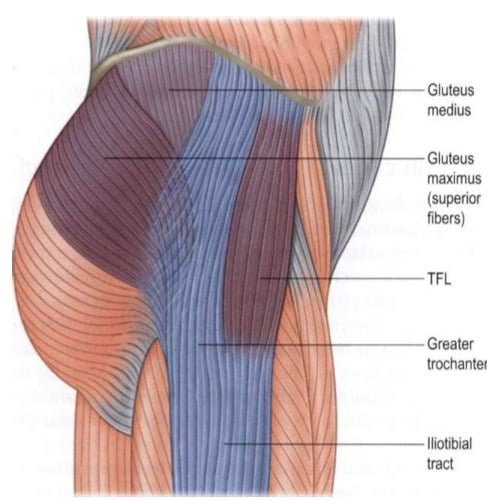
(image from Anatomy Trains by Tom Myers)
The IT band then runs the length of your thigh and inserts onto the lateral aspect of your tibia – a fancy way of saying to connects to the outer part of your shin bone. Down here, the anterior portion of the IT band connects onto the tibialis anterior, while the posterior portion connects onto the peroneus longus.
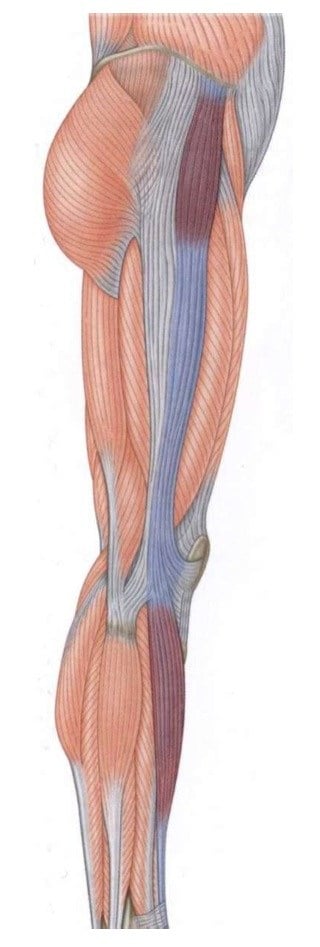
(image from Anatomy Trains by Tom Myers)
Its function is therefore to make a connection between these muscles, the TFL and the tibialis anterior, and another connection between the gluteus maximus and peroneus longus. This connection helps to transport force from the lower extremity to the upper extremity – i.e. the knee to the hip and vice versa, as well as providing stability at both the hip and the knee.
As you can now see, the TFL, gluteus maximus, tibialis anterior and peroneus longus insert into this band creating one long fascial tendon, which has the same contractile force of steal.
Complaints of having a ‘tight IT band’ are often confused with having tightness in the surrounding muscles. Due to the structure of the IT band, we now know it cannot become ‘tight’.
Due to the makeup and density of the IT band, methods such as foam rolling, stretching and even massage used to help release it are worthless, and will only bring about extreme pain with little to no success.
Instead, focus should be given to the muscles that insert onto the band such as the TFL, which can become extremely tight and overworked if there’s an imbalance between the TFL and tibialis anterior (remember these two muscles are connected on the anterior portion of the IT band).
You’ll find runners tend to have the biggest problems with IT band pain; as Whitey Lowe explains:
“the IT band is under its greatest tension during the first third of the stance phase in running or walking. There is increased tension on the ITB when decelerating the body’s momentum, such as walking or running downhill.”
If a runner over-strides, with the foot striking well in front of the hip, then the heel and leg must act as a braking mechanism before then accelerating off. Over-striding can place unnecessary force through the IT band, and if the glutes are weak or underactive then the TFL will absorb a lot of this force at the hip.
The other muscle to look out for is the vastus lateralis (the outer muscle of your thigh). This muscle lies underneath your IT band and if tight, can place pressure against the IT band, causing discomfort. Resistance training specialist, Michael Goulden, from Integra Training has found that releasing or foam rolling the vastus lateralis helps to relieve many cases of a ‘tight’ IT band.
(image from http://web.duke.edu/)
So, there you have it! You now know the IT band isn’t a ligament, a muscle or a poorly named 80s pop band.
Instead, it’s a band of fascia tissue made up of a number of muscles all inserting into it. We also know that if pain arises in the IT band that it’s not the band itself, but an imbalance between the muscles surrounding the band, namely the TFL and vastus lateralis being too tight, and the glutes max (more than likely) being too weak.
Next week, I’ll be delivering a video on how you can stretch the ‘IT band’ or rather the muscles that make it up to help effectively reduce the symptoms of typical ‘ITB Syndrome’.
How many calories do we burn when weight training?
Today’s Friday Fun Fact is a question I’ve wanted to find an answer to for a while: just how many calories do we burn when weight training?
Heart rate monitors and fitness trackers can provide us with some basic numbers, and are great at determining how many calories we’re burning during some light to moderate cardio work, but when we do any strength training or perform high intensity interval work, they’re pretty useless!
You see, heart rate monitors estimate our energy expenditure through the linear relationship between power output (how much work you’re doing per unit of time) and the amount of oxygen consumed (which is equivalent to energy expenditure during aerobic exercise). Because the relationship between heart rate and oxygen consumption is linear, you can use your heart rate to estimate total energy expenditure.
However, this linear relationship crumbles under very high intensities, like when you’re sprinting or doing some resistance training, which is why they’re not reliable.
When it comes to measuring these kinds of activity, fitness trackers aren’t much better. Although they may sense movement, they have no way of determining how much load (weight) you’re lifting. For example, a Fitbit worn on the wrist will likely show the same number of calories burnt whether you perform a squat with ten kilos or a hundred kilos – not very rewarding for you.
So how can we estimate energy expenditure during resistance training?
Before answering the question it’s important we highlight the word “estimate,” or rather, replace it with the word “guesstimate.”
When it comes to weight training, variables such as gender, age, weight, loading parameters, programme design (traditional sets vs. supersets) load on the bar, range of motion etc. will all have an impact on the amount of energy used during a session. So, when we look at this we can only really guesstimate the number of calories based on the evidence that’s been documented in the literature.
When we look at the literature the number of repetitions performed is our best predictor at guesstimating energy expenditure in each session.
• A study by Kelleher et al, comparing supersets to traditional sets, found the total energy expenditure ranged from 260 to 279 calories across 240 reps – that’s about 1.1 calories per rep.
• A study published in the Journal of Strength and Conditioning Research looking at eight single set exercises found energy expenditure to range between 70 – 135 calories across 120 reps – that’s about 0.6 calories per rep.
• Hunter et al, took subjects through 8-10 exercises for two sets each (total of 160 reps), and found their average energy expenditure to be 113 calories – that’s 0.7 calories for each rep.
• Lastly, a study that looked at the relationship between rest intervals and total number of calories burnt on a leg press over five sets of 10 reps (50 reps) found an approximate energy expenditure of 90 calories – 1.8 calories per rep. However, when the same subjects then performed dumbbell chest flys for the same number of sets and reps, only 50 calories were burned – 1 calorie per rep (Farinatti, 2011).
As you can see there’s quite a range, with majority of the literature suggesting you burn between 0.5 and 1 calories per rep.
How do you know whether it’s really 0.5 or 1 calorie per rep?
To guesstimate the total number of calories you’ve used during a session I would hazard a guess using the following guidelines:
1 rep = 1 calorie when:
• Favouring super sets over tradition single sets
• As part of a circuit
• Compound exercises in favour of isolation exercises
• Larger muscles over smaller muscles
• Sufficient load is used i.e. nearing repetition maximums
• Rest intervals are incomplete
• Using stimulants pre-workout, such as caffeine before training
1 rep = 0.5 calories when:
• Single sets are performed
• Rest intervals are longer (+1 min)
• Smaller muscle groups are utilised
• Lighter loads are used
• The majority of your session is built around isolation work
The next time you’ve finished a workout and slumped over in a corner of the gym waiting to catch your breath, take a moment to tally up your reps, and match them against the points above to see how many calories you’ve burnt – it may just motivate you crank out a bonus 5 sets of 20 reps on the leg press as a finisher – after all, that’ll be 100 extra calories you’ve just used!