Georgey’s 12 week transformation – week 5
This week I am much more cheerful! Getting back to normal at the gym after taking it easy last week has actually been a relief, much to my surprise! It is so much easier to stay motivated and stick to my diet plan when I am training harder. I have always been a very ‘all or nothing’ type of person, and I think this is starting to come out across in my 12-week challenge. I have certainly learned some good lessons to take into my next deload period in three weeks’ time, namely don’t take your eye off the prize, pausing doesn’t mean you can stop.
My training has definitely upped in intensity this week and boy can I feel it. Today is the first day since Tuesday that I actually feel like I can walk again. My hamstrings have been so sore, and I also gave myself shin splints thanks to relying on the cross trainer a bit too much for my cardio. I’ve been forced to use the static bike to try and ease the work on my legs. Another lesson for this week: nothing is more boring than steady state cardio, but you can get through it if you’ve downloaded yourself a great playlist or audio book.
I had some good news on Monday: my body fat dropped another percent this week – I’m on a roll! Thankfully that meant that my calories have stayed consistent and didn’t need to drop, and that I have also maintained the same amount of cardio. So the only thing that’s changed this week is the one extra weights session. Considering how much I’ve been going to the gym, one extra hour doesn’t feel too bad. Bar the aches and DOMS I’ve hardly noticed it!
It hasn’t all been plain sailing. The dark, cold, early mornings are getting harder, and my mood has dropped on a few days. My caffeine consumption is definitely going up and funnily enough, other people’s positive reactions are also starting to dwindle. Where they started off with full support, some friends are now starting to get annoyed with my fussiness around meal times and obsessive planning in advance. I totally understand, and luckily the vast majority still think I’m doing a great thing, but it does hammer home just how self-obsessed and shallow you have to become to complete this process. Getting annoyed when other people eat a takeaway or making other people worry about what they eat in front of you is not sustainable, and I am starting to become more aware that the support I am relying on from other people is costing them as well. It’s an important consideration, but I’ve gone too far to worry too much – I’m just going to keep doing what I need to do to get to where I want to be!
My motivation is sky high at the moment and I genuinely think it comes from seeing consistent progress and having such great support. Towards the end of this week I’ve noticed my top two abs start to make an appearance – an incredibly shy appearance, but I hope they will be here before too long! I have ordered myself some new trainers, and I’m going to let myself wear them when I get to 15% body fat. New trainers for me are about as exciting as birthdays, so I am hoping that this promise to myself will keep me on track! They are currently in the back of my car and I’ve not even opened the box; I’m being good as gold.
Hopefully over the next week my motivation stays, my abs become more obvious (i.e. I get leaner still) and my strength doesn’t drop off. By the time I write my next blog post I will be half way through, so it’s getting exciting, but the pressure is on!
Fingers crossed…

Georgey’s 12 week transformation – week 4
In two days from now I will be a third of the way through the challenge, which is a worrying thought! This will be a short blog from me, as I haven’t got much to report – it’s finally deload week.
Deloadingmeans cutting back on the volume of work done in training sessions. This allows my body to properly rest and recover from the previous weeks ready to go into a new set of programmes from next week.
My programme is split into three four-week chunks, with a deload week at the end of each section. It has been absolutely lovely this week to take a step back from training and I can tell that my body was ready for it, because even my deload lifting days have been quite tough, even though they have significantly less volume than I was lifting last week!
I have taken this as an opportunity to try and stick in a bit more cardio, but despite my new, harsher diet and my extra cardio, my scale weight has still stayed the same. This is the third week in a row that it’s not budged. This isn’t an exaggeration, I haven’t even lost 100g! But my last body fat reading revealed that I have lost an extra 0.5kg of fat, and an extra 0.8% overall of body fat, so the trend is going in the right direction. Perhaps this is just how much I weigh? Who knows… but as long as my body fat keeps going down then that’s the main thing. So far it’s down 5% in 3 measurements – woohoo!

I haven’t noticed the drop in calories to be honest, but I have started to notice social situations becoming a bit trickier and a bit more tempting. Still going strong though!
Over all, so far I am starting to feel a bit more confident in my body and a bit more like myself again, which is really great, and definitely a nice feeling! But if I am honest, my attitude to training and nutrition has become a kind of sad acceptance… I know what I have to do and I just do it without questioning it. I find writing it all out on a post it note and then crossing it off really helps to keep me accountable, and having the post it staring at me on my desk gets me off my bum at lunch time to do my cardio!
Next week we step up another gear with my training, adding in an extra weights session and even some dreaded drop sets. I am looking forward to getting back into it, because although the rest has been lovely this week, compared to the previous intensity I am feeling really lazy!
I’ll let you know how I get on…
Georgey’s 12 week transformation – week 3
I’m going to be honest. Week three has not been fun, and saying that after the week in which I had a chronic ear infection is saying something! This is the first week I have found sticking to the diet plan to be hard work and mentally draining. There haven’t been any points when I’ve nearly cracked, but I have been craving loads of different foods, and becoming generally really food obsessed. When I realise I can’t have the foods I am craving I feel a resigned acceptance. I know in the long run it’s for the best, but it won’t stop me staring at the chocolate trolley when it trundles past on the train. Or wanting to inhale the whole lot.
I have also learned an important lesson about preparation this week. I’ve been all over the place with long train stints and relying on clients to provide lunches (pre-ordered chicken salads). This has meant long periods of hunger, not being quite sure what to track, and struggling to pick appropriate snacks at the endless train stations. I had thought that throughout this process I would be able to take quite a strict approach to what I eat, a relaxed approach to planning my eating, but as time goes on, it’s becoming clearer that everything needs to be planned down to the final detail when I’m not somewhere I can access food easily. Sunday afternoons will now have the extra fun job of planning meals as well as food prep!
In the last two weeks I have lost 4.1% body fat, which I am absolutely blown away by and really pleased with as a start. However, since my 1kg drop in the first week, my scale weight has stayed resolutely put. Now, there are many potential reasons for this: my body has been ill and therefore stressed, I could be holding onto excess water weight. But on a 12 week plan we don’t have time for any bad weeks, and if my scale weight stays the same over the weekend, there’s every chance my body fat won’t have dropped again on Monday, which is a delay I just can’t afford! To reach my target I need to lose an average of 1% every week until the end of the plan, which is a tall order.
This means that next week it’s more cardio, and less food. The thought of this isn’t doing my mood much good at the moment, but as long as I can fit a Grenade bar in my macros most days (these are manna from heaven and Jamie Alderton is a demi-God for inventing them/having those abs) then I think I will cope.
Saying this, my training has been great. I have managed to fit in a lunchtime cardio session (just 30 minutes) on one of the only days I’ve been in the office, and I’ve really enjoyed all my sessions. I’m training harder than ever, and this morning managed to get my hip thrusters up to 100kg (for 12 reps, after 3 sets of 8). So there are positives! I have one more weight training session to do this weekend, and am aiming to get 1 hr 30 of cardio in on top, plus a potential wintery walk somewhere!
I think it being Halloween this week is very apt for my doomy and gloomy blog post, but when I started this I knew it wasn’t going to be plain sailing. For now, I am just happy that my body fat has continued to drop, that my training is going really well, and that I am managing to resist temptation (even if it makes me sad inside).
Next week I am looking forwards to trying to hit the cardio a bit harder, hoping to get a slide on my scale weight and easing back on the weight training slightly to let my body recover! Fingers crossed it’ll be a good one!
Until then…
Five things we learned about fitness in October
The clocks have gone back and the evenings are darker, but the pace of fresh new research into health and fitness hasn’t slowed down at all. Here are five things we learned last month that may well be useful for your own training! Especially if you suffer from DOMS or a stitch…
1. Certain people experience higher levels of Delayed Onset Muscle Soreness (DOMS) than others – bad luck!
Delayed onset muscle soreness is expected after a heavy weights session or a tough interval session, not only in untrained people but also in experienced athletes. This is due to the damage inflicted on the muscle during the workout. The level of soreness may depend on how hard the person trained or how new the person is to that particular programme or exercise. However, a new study has emerged suggesting it might not all be in the training, but in a person genes. So, if your training partner experiences more DOMS than you it may not be that they’re training harder, but caused by their genotypes.
At Hall Training we write personalised programmes for each client to prevent them from training the same muscle two days in a row. Our advice would be to follow the same programme for 5-6 weeks to allow the body to adapt, and to allow approximately 48 hours before training the same muscle again.
2. Struggling with energy lows? Oat bran could be the answer
On your feet all day with little time to eat? Want to reduce those energy highs and lows? It would seem it’s as simple as pre-loading on oat bran. Eating oat bran before a high carbohydrate meal helps to lower post meal glucose absorption by 25%. The most effective dose was 25g, with every 1g seeing a reduction of 4.35% reduction in glucose absorption.
The mechanism is not yet fully understood but scientists believe the gastric emptying of the stomach is delayed by the increase of viscosity/thickness of the stomach contents. The mixing of foods with the digestive enzymes is then reduced, thus slowing glucose absorption. A handy trick if you’ve got a long active day ahead would be to try adding a tablespoon of oat bran to your porridge or morning smoothie. It may also prove useful for stablising blood sugar in those people who have elevated blood glucose levels.
3. Feeling SAD? Brave the cold!
As the nights turn darker and the days get shorter your bright happy mood may start to diminish. According to the mental health association 1 in 15 people in the UK suffer from Seasonal Affective Disorder (SAD). This is a form of mild depression that comes into effect as the seasons change, usually from summer to winter. It can range from a mild form of the winter blues to being so disabling you cannot function between the months of November to February. SAD is usually caused by lack of daylight and is rare in people living within 30 degrees of the equator, where daylight hours are longer.
Your mind may be telling you to wrap up warm, hunker down and hide from the world but recently, psychologists are telling us to brave the cold through water therapy. This could be a cold shower or if you’re feeling particularly low, a long cold dip in your local lake might do the trick.
The simultaneous firing of all skin-based cold receptors—thought to be three to ten times denser than warm receptors—from jumping into the cold may result in a positive therapeutic effect.
4. You might be breathing wrong
Obviously you’d be dead if you weren’t breathing, but surprisingly we all pick up bad breathing habits due to the way we sit and move. Now, we all know the importance of a good warm up before exercise; ideally improving the mobility at each joint through stretching and foam rolling. But how many people reap the benefits long term through these techniques? As a personal trainer I can tell you minor benefits will be seen immediately after the warm up, but clients seem to revert back to their old selves by the next session. They then begin to rush the mobility/warm up routines as the months go on due to lack of long term change.
This month, the Hall Training team had its own ‘Eureka’ moment during a visit from local physiotherapist and ciropractor – Austin Lawrence, who taught us the benefits of proper diaphragmatic breathing on posture and movement quality.
It can be as simple as lying on the floor for several minutes and focusing on breathing deeply into your stomach, letting it expand like a balloon. Spending a couple of minutes doing this each day could be the answer to looser calf and hip muscles, meaning deeper squats and deadlifts and a far more efficient body. Not only this but breathing correctly can also improve muscle activation in the glutes by loosening the sacrum. We suggest fixing your breathing before spending hours with that painful foam roller. Over time breathing through your diaphragm will become second nature.
5. What exactly is a stich? Who knows?
A stitch is an all too familiar feeling, not only with fitness newbies but with seasoned athletes. But what is it? What causes it? And how can we make it go away?
It turns out that the stitch was quite the mystery until a series of studies were conducted over the past decade. An Australian researcher called Darren Morton ruled out popular theories. He induced a stitch by feeding volunteers carbonated drinks followed by running on a treadmill. Then, using electrodes to monitor abdominal muscle and monitored breathing and found no change during the stitch, ruling out abdominal spasms and respiratory muscle spasms.
So, what’s the answer? Well, there still is no definite answer.
Stitches seem to arise often in people with brain lesions or compressed nerves in the thoracic spine (upper back). A 2010 study found a link between the degree of curvature in the spine and susceptibility to stitches. They found the pain can come from extra pressure from the abdominal cavity when the stomach is full and there is excess curvature of the spine. This causes friction on the outer layer of abdominal muscle causing the stitch.
If you find you are particularly susceptible to stitches, we suggest working on your posture daily through mobility exercises and steering clear of food 1-2 hours prior to exercise.
Reference:
1. http://www.innerself.com/content/living/health/healing-disciplines/9542-a-cold-splash-water-therapy-for-depression-chronic-fatigue.html
2. https://www.mentalhealth.org.uk/a-to-z/s/seasonal-affective-disorder-sad
Baumert P; Lake MJ; Stewart CE; Drust B, Genetic variation and exercise-induced muscle damage: implications for athletic performance, injury and ageing. Eur J Appl Physiol. 2016 Sep
3. Steinert, R.E.; Raederstorff, D.; Wolever, T.M.S.Effect of Consuming Oat Bran Mixed in Water before a Meal on Glycemic Responses in Healthy Humans—A Pilot Study. Nutrients 2016, 8, 524.
4. Lawrence, Austin at Hall Training day, 2016
5. Alex Hutchinson’s ‘Which comes first, cardio or weights?‘
As winter arrives and the cold weather sets in there’s only one type of food that helps to warm our bellies – carbohydrates. Today I want to talk about a group of carbohydrates known as ‘grains’.
Grains are any food made from wheat, rice, oats, cornmeal, barley or another cereal. Bread, pasta, oatmeal, breakfast cereals, tortillas, and grits are all examples of grain products.
Grains can be divided into 2 groups:
- Whole Grains – Whole grains are untouched and contain the entire grain kernel ― the bran, germ, and endosperm. Examples include wholewheat flour, bulgar wheat, oats and brown rice.
- Refined Grains – Refined grains are grains that have been milled, a process that removes the bran and germ. This is done to give grains a finer texture and improve their shelf life, removing a lot of the dietary fiber, iron, and some B vitamins. Examples are white flour, white bread, and white rice.
Most grains have been given a bad rap over the last few years with some ‘experts’ claiming that consuming them causes weight gain, abdominal bloating, cardiovascular disease and even cancer. Eating any foods in excess will inevitably cause weight gain and sometimes bloating, but to say grains are a danger to one’s health is completely absurd and certainly not true! If anything, I can only see grains being beneficial to health as they’re useful sources of minerals, antioxidants and fibre, which should all feature as part of a healthy diet, alongside lean proteins and healthy fats. So, to reap the benefits, I’ve made a guide to some great grains:
Amaranth
Amaranth is usually rich in magnesium, which is required for muscle relaxation and helping the body to manage stress; calcium, which helps to maintain bone density; iron which carries oxygen round the body, and lysine (some evidence suggests it helps counter the effects of cold sores but more importantly it helps to reduce calcium loss and therefore good for bone health).
Tip: It is in the same family as quinoa and beetroot and contains no gluten. In fact it’s technically not a grain at all but cooks like rice or can be used as a substitute to popcorn.
Barley
Georgey’s 12 week transformation – week 2
Week two got off to a flying start. We did my body fat on Monday, and I had dropped far more than I had expected to in two weeks, let alone one! But then on Tuesday I woke up with a really painful ear infection. I managed to push through my training session and that day of work, but ever since then I have been laid up with visits back and forth to the doctor, and I missed my training session this morning. At the moment there’s still some hope for the week – If I can get a decent night’s sleep tonight, then can try and fit in my remaining two training sessions over the weekend.
Food wise, I have managed to stick to the diet plan on the whole. I have eaten precisely 18 chocolate buttons (they had smiley faces, I hoped they may cheer me up) and a small serving of plain homemade popcorn last night to accompany The Fall, but those are the only two things that have been off-plan. That being said, I’ve been tracking but not making sure that I’ve been hitting my protein targets, so I have probably been quite under this week. Still, 12 weeks is a long time and although my goal is going to be really hard to achieve, I think it’s important to be realistic and cut myself some slack when I’m ill, as long as I get straight back on it as soon as I can. Not everything can go perfectly, and I can’t beat myself up about it all the time – better to learn that now than have a breakdown about it in week nine.
On last week’s blog I had a couple of questions about what plan I’m following, and as I don’t have much to report this week, I thought I’d share now!
I have started off relatively easy: three one-hour weight training sessions per week. They are all total body, but one of them has a greater emphasis on upper body, and another on lower, the final one is evenly split. I will follow this plan for four weeks in total (so two to go after this week, one of which is a de-load week) before the training ramps up a gear. As soon as my body fat or weight stops dropping, I will introduce a cardio session, but for nowI am trying to keep as many cards up my sleeve as possible. For those of you who’d like to see exactly what I’m doing, I’ll be sharing pictures of my programmes on my Instagram over the next few weeks: @georgey_r
My macros have been plotted carefully for me based on my weight, food preferences and exercise schedule, but I am currently aiming for 40 per cent of my diet to come from protein, with the remaining 60 per cent split evenly between carbs and fats. So far, this seems to be working a treat, but we will find out on Monday whether I’ve managed to lose any more body fat this week (if not I blame the chocolate buttons). Here are the drops I made from starting:

I am not expecting the same amount of progress on Monday, but a little bit would be nice!
Until next week…
Georgey’s 12 week transformation – week 1
Working behind the scenes at a personal training company means I am constantly surrounded by a team of incredibly fit, determined people. It also means that I hear the struggles their clients are going through to achieve their dream results, and the expectations of people who come to Hall Training looking for support.
I had hoped that being surrounded by this uber-fit team would mean some of their dedication would rub off on me, that all clients would find it super easy to achieve their dream bodies, and that people turning to the team for help would realise how hard ‘being super fit’ actually is. Unfortunately, this hasn’t been the case!
At Hall Training our focus is nearly always on health over aesthetics, and on sustainability over sudden, drastic changes, unless of course a client comes to us with a tight deadline such as a holiday or wedding. On other personal training websites, it’s common to see pictures of incredible transformations, from overweight to six pack in just 12 weeks. But how realistic is this, how much do you sacrifice, is it worth it? Well, I’ve decided to find out.
For the next 12 weeks (well, 11 and a half now you’re reading this!) I am going to try really hard to stick to the workout and nutrition plan that the team have set up for me. That means no weekend wine (huge sacrifice), no snacking on the yummy food in the office (more for my colleagues!) and a lot of early starts.
I am going to write a short blog every week so you can see how I get on. I promise now not to sugar coat anything – the highs and lows will be here for everyone to see!
So far, it’s day 4 of 84 and things are going well. Other than underestimating how many grams of carbs were in the sushi I grabbed on the go on Tuesday, I’ve managed to stick to my nutrition plan perfectly. It’s actually quite tough to get the calories in when you’re in diet mind set! I’ve only done one workout so far this week, the other three are all scheduled over the next few days. My hamstrings still hurt from that one, so we’ll have to see how the next three go…
We hope that this blog will make it clear exactly how much hard work a client and their trainer have to put in to make a big difference in a small space of time, but also show what can be achieved if you really put your mind to it. On a personal level, I’m just really hoping that I can stick to it and also that I end up feeling a bit more like ‘me’ again at the end. I can make all the excuses in the world – a new job, two house moves, stress at work – but I am hoping to find that the truth is, if you plan and make time, it is possible to achieve your health and fitness goals and have a life, even through Christmas party season! If everything goes to plan, my last day will be the 8th January, and fingers crossed I will be a better version of myself by then!
Until next week…
Keeping fit for students – our top tips
Balancing lectures, essays and socialising with your health and fitness is tough – there’s no two ways about it. But despite the copious alcohol on offer, and resulting late night trips to the kebab van, it is possible to stay in shape while you’re at university. Our trainer Pete has provided his top tips for busy students:
1. Buy a gym membership
This may sound obvious but it will give you some accountability. When I was a student money wasn’t exactly free flowing so, hopefully, if you are paying for a gym membership it will make you want to make the most of it and will keep you going. Luckily in Oxford there are cheap membership deals on offer. Whether you’re living in central Oxford, or based in Cowley, Pure Gym memberships often come in at under £20 per month, and lots of the Oxford colleges have their own offers or facilities you can take advantage of.
2. Schedule your gym trips
Although every thinks that when you are a student you have unlimited free time to spend watching Jeremy Kyle, this is not always the case. Workloads can be heavy and the stress can make you think you need to spend every waking minute in the library. YOU DON’T. Set yourself a time to go to the gym. I used to like going in the morning as it was a more exciting prospect to wake up to than going to sit at a computer all day. Making the gym part of your routine will also make the habit stick. Try to go to the gym at the same time, on the same days each week. Half way through term you won’t even notice that you’re making time for it anymore – it’ll be natural.
3. Plan a decent programme
The gym can be stressful if you don’t have plan. There is nothing worse than getting in, looking around and not knowing what you are going to do. Often, this leads to people doing the same thing every time, because they can’t think of what they should be doing. This can lead to you losing the enjoyment of going to the gym and it will also stop you making the progress you could be making. So try and plan what you are going to do, no matter how basic. If you struggle to do this or just don’t know how to then maybe go to some classes at the gym or think about getting a personal trainer.
4. Get a gym buddy
Going to the gym with a friend can help on a number of different levels. Firstly, making the gym more of a social event will continue to keep it more interesting, thus keeping you going. Secondly, it means that if you are having an off day and can’t be bothered to train, then hopefully your friend won’t be feeling the same and will encourage/force you to go to the gym and I guarantee you’ll thank them for it afterwards. Finally, if you are a super competitive person it will make you push harder when you work out.
5. Set a goal
You may have heard us bang on about goal setting before, that’s because its damn important! You wouldn’t do all your uni work if you didn’t know you were going to get a degree at the end of it, or if you didn’t want a degree. So why would you put in loads of work at the gym if you don’t know what you want the end result to be? Whatever it is, make sure you know what you want from your efforts and keep that in mind.
6. Do things you enjoy
Obviously, it’s nice to optimize what you do at the gym but if for some reason you can’t do that, don’t get disheartened and just remember that something is always better than nothing. You have still made the effort to go, you have still burned calories and stimulated your muscles, you will still get that self-righteous feeling and can brag about going to the gym. Finally, doing things you don’t like will nearly always lead to you stopping doing it. So do things you enjoy when you go the gym whether it’s a Zumba class or lifting ridiculously heavy weights.
So next time work feels overwhelming, take a break, plan your gym trips, and refocus on your health and fitness. By the end of term, you should definitely be seeing some results!
If you need a helping hand, check out our student training page to see how our tailored sessions could point you in the right direction, at a fraction of the cost of regular personal training sessions!
Poor posture? It could be Upper Cross Syndrome
For those of you who don’t already know, as well as being a personal trainer I am also a qualified sports therapist. A sports therapist works with musculoskeletal injuries such as muscle strains, ligament sprains and fractures, to name just a few. In my role as a sports therapist, I also analyse posture and any postural imbalances that a person may have. One of the most common types of posture issue I see is Upper Cross Syndrome (UCS).
Upper Cross Syndrome is a muscle imbalance which affects the upper body and to be more specific, the head and shoulder area. It is characterised by a rounding of the shoulders and an extended neck. If somebody is suffering from UCS, you will notice forward neck translation (forward told of the head), a hunched back, rounded shoulders, and pain and tightness in the upper back and neck.
Why does it happen?
Our bodies are fantastic at adapting to muscle imbalances, which sounds great but really it’s not. Adjusting for imbalances puts a lot more stress on other joints, which shouldn’t be loaded with the extra work. Due to the adaptation seen in UCS, muscles that tend to be relaxed when their buddies should be doing the work get loaded with extra responsibilities.
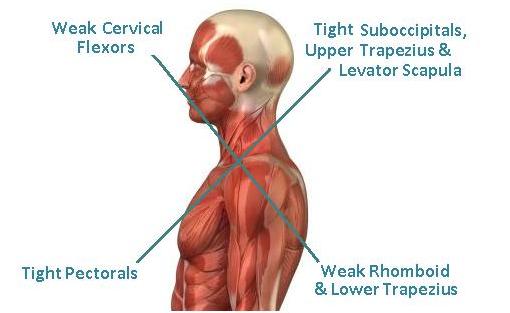
The main muscles which are affected by UCS are the pectorals, upper trapezius and levator scapulae, also weak rhomboids, lower trapezius and neck flexors. The image below describes which muscles are weak and which are tight in the condition.
 What are the causes?
A sedentary lifestyle is the main contributor to UCS. This can range from sitting on the sofa watching TV to being sat at a desk while working. Training patterns can also be a contributing factor, especially in men. When I walk around the gym, I see a lot of men in the free weights area with UCS. I ask them what they’re training and the normal response is chest. They don’t give any attention to their backs and this is why this posture is visibly noticeable. The pecs become tight and when back training is neglected, the lower traps, rhomboids and serratus anterior become weak, which causes the shoulders to round.
Using your smartphone or tablet can also cause the muscles at the back of your neck to become tight and the muscles at the front of your neck to become weak. A lot of us keep our phones at a distance, and its because of this that we over-extend our heads, causing that long neck look that you may see.
How can I fix it?
The first issue to address is strengthening the muscles that have become weak. Any exercise that strengthens the upper back will help, however I would strongly recommend the High Cable Lateral Extension and Seated Rows.
High Cable Lateral Extensions
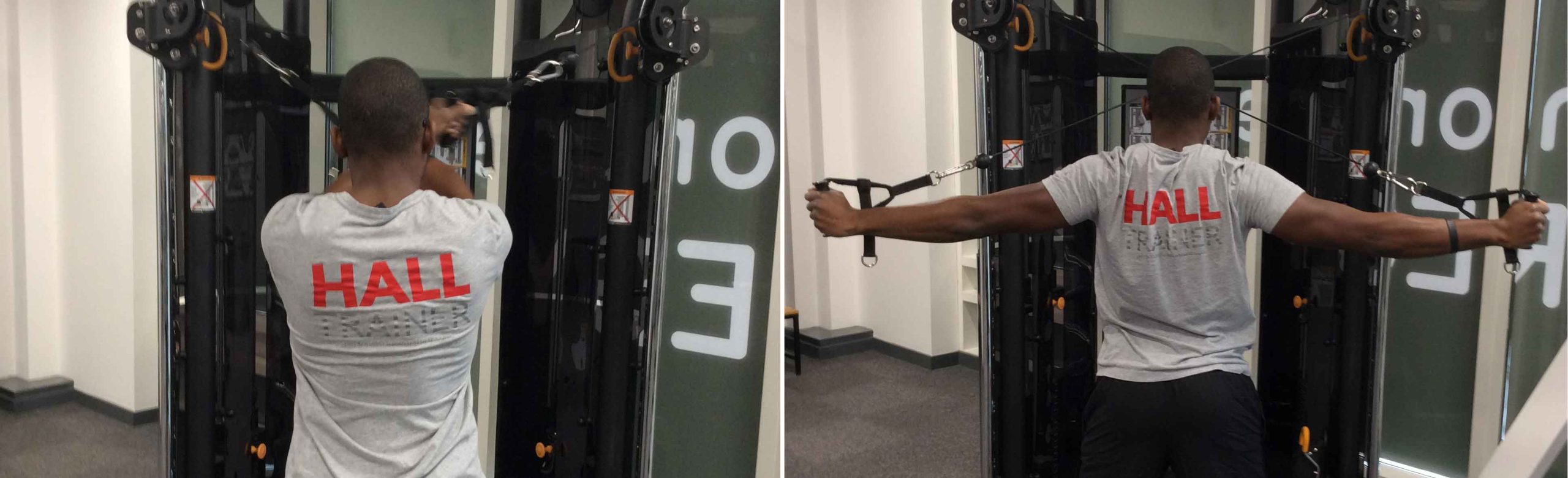
Stand facing the cable machine and hold the left cable with the right arm and the right cable with the left arm as shown in the picture on the left. Next create the letter T with your arms as shown in the picture on the right. As you make the letter T, squeeze the shoulder blades together (a good cue for this is try to get your shoulder blades into your back pocket). Return back to the starting position. It’s best to work with light weights focusing on high repetitions. Three sets of 15 reps will do the trick.
Seated Rows (Machine or Cable)
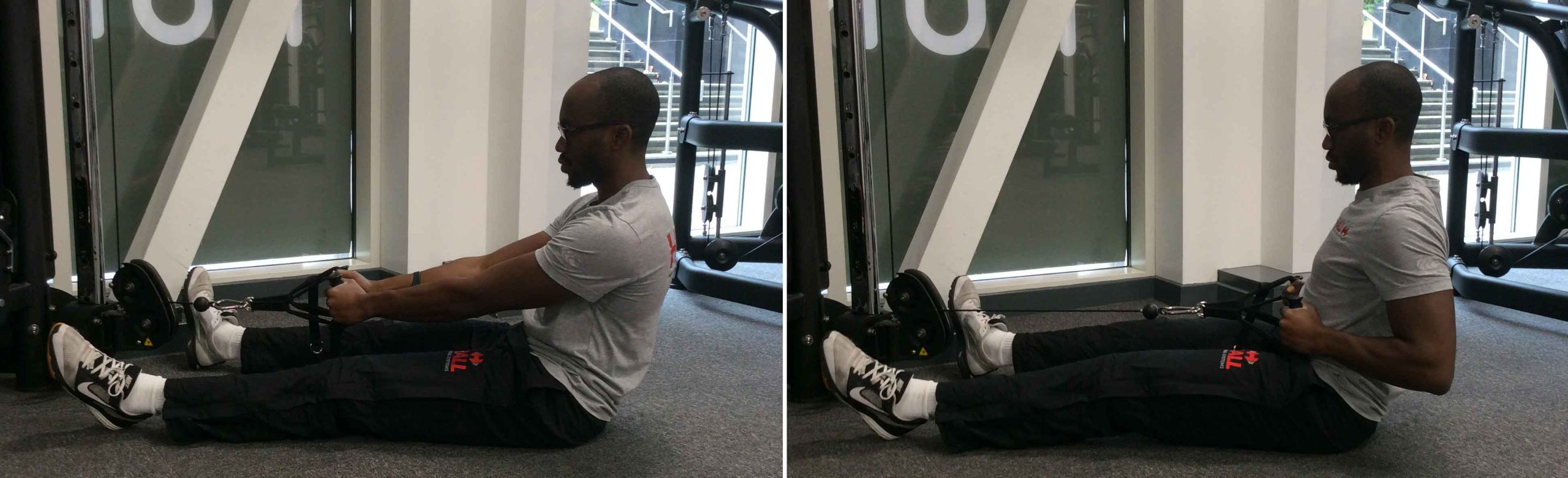
You can use either a cables machine or a fixed machine. What you want to do is pull either the cables/handles towards your chest and focus on squeezing the shoulder blades together. Again use the cue I mentioned above to help squeeze the shoulder blades together.
Upper Cross Syndrome is a relatively common condition, but by being more aware of your posture on a daily basis and working to strengthen your upper back, you can really make some ground in reducing the symptoms and improving your posture.
If you have any further questions or need more advice, drop me a line.
Want to get into running? Start with a 5k
Getting into running, especially joining running events, can be really daunting, but with a little bit of work and determination, everyone is capable of running a 5k.
Why run a 5k?
A 5k is the perfect starter distance. It is a challenging distance to all, not just new runners, but is also very achievable mentally and physically for beginners. Beginner runners should ideally start with shorter distances before moving to the longer, more endurance based events such as a 10k or a half marathon. This will help long term with speed when you progress to the longer distances. For example, running a 10k in under an hour is impossible until you can run a 5k in under 30 minutes. As you progress and look to join group events or races, speed will become key and building up to a 5k will really help you develop this.
What prerequisites should runners have before taking on this plan?
As this is a short distance there is no minimum fitness level required. If you can walk, you will soon run after following the programme below! This is aimed at beginner runners.
Understanding the programme
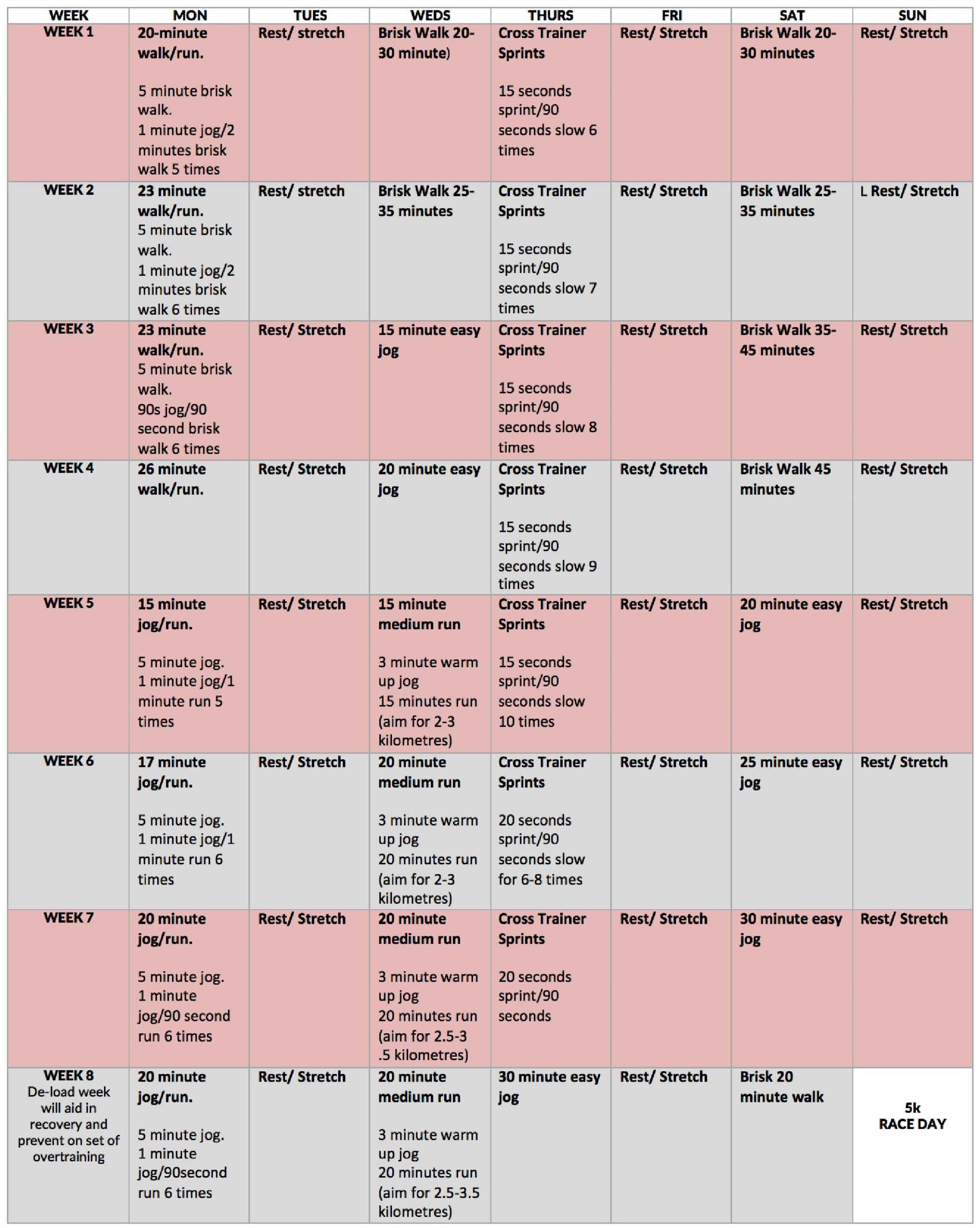
Walk/run
Treat the first 5 minutes as your warm up. You will find you have a better rhythm and breathing pattern in the main part of your session after a brisk walk or slow jog. After your warm up, complete 1 minute or 90 seconds jogging followed by 2 a minute brisk walk until the overall time is complete.
Jog/run
Again as above treat the first 5 minutes as a warm up. After your warm up complete 1 minute of slow jogging followed by 1 minute of a faster run. This is not a sprint but should be faster than your 5k pace.
Easy jog
This session is a continuous jog at a steady pace similar to your warm up pace. The aim is to run continuously without stopping. This should not be an overly strenuous session but aimed at building endurance and confidence.
Medium run
This session is aimed at building distance into your continuous run. Aim to maintain the same pace throughout the run while running the furthest you can in the allocated time. This is a harder run than the easy jog.
Cross Trainer sprints
Sprints can be completed on either a cross trainer or bike. Both of which are non-weight bearing which allows your joints to rest. Each 15-20second sprint must be at maximum speed followed by a 90 second slow recovery. The recovery should be approximately 40% of your maximum speed.
Week 8 – deload week
As you can see the volume is lower on week 8. This allows your body to rest in preparation for the 5k race. Keeping the volume high will deplete glycogen/energy levels in the lead up to the race. Taking active recovery the day before the race, such as a 20 minute brisk walk will keep you fresh and hungry for the race.
This programme should be achievable for anyone, no matter your fitness level – so why not give it a go? You’ll be joining your local park run in no time!
If you have any questions or need some further advice, just email me on becky@halltrainingsystems.com. I’d be happy to help!